
What is Bipolar Disorder? A Guide for Los Angeles Families
What if the volatile mood swings your young adult is experiencing aren't just a difficult phase, but the early signs of a manageable neurobiological condition? For many Los Angeles families, the search for clarity begins with a single, heavy question: what is bipolar disorder? It's natural to feel a deep sense of anxiety when faced with the stigma of a diagnosis or the confusion of seeing a loved one struggle with delusional thinking. With the median age of onset around 20 years old, these challenges often arrive just as a young person is stepping into adulthood.
You deserve a steady hand to guide you through this uncertainty. We believe that with specialized care, recovery is the expectation rather than the exception. This guide will help you understand the complexities of bipolar types and the critical connection to psychosis. We'll also preview the specialized recovery pathways available in Southern California, such as the California OnTrack program, which helps 85% of participants return to school or work within six months. There's a clear roadmap to a functional, successful life, and it begins with clinical insight and profound empathy.
Key Takeaways
- Gain a clear understanding of what is bipolar disorder by viewing it as a manageable neurobiological condition rather than a temporary phase of mood swings.
- Recognize the specific warning signs of mania, depression, and psychosis to ensure early and effective intervention for your loved one.
- Learn why a thorough psychiatric evaluation's the essential first step in distinguishing bipolar symptoms from other complex conditions like ADHD.
- Discover how the Coordinated Specialty Care model provides a structured, team-based path toward psychological stability and social reintegration.
- Identify specialized recovery pathways in Los Angeles that combine clinical expertise with a focus on functional, independent living.
Defining Bipolar Disorder: More Than Just Mood Swings
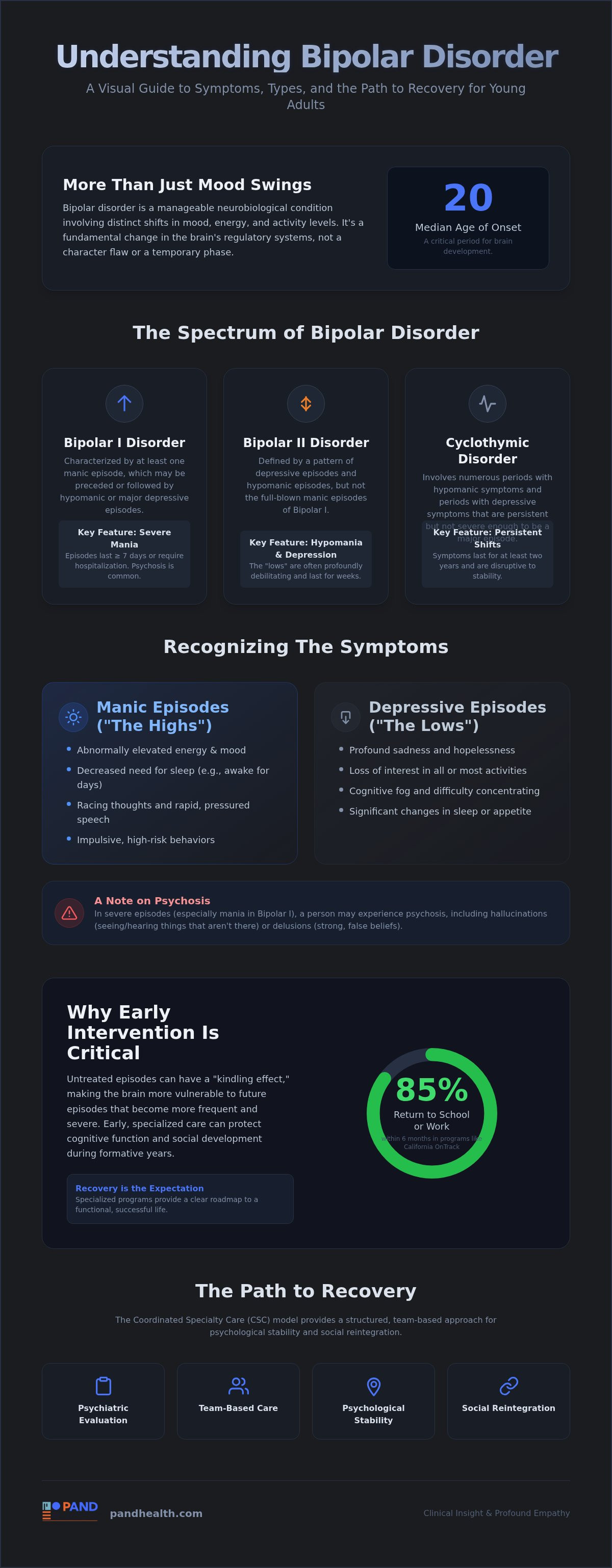
Families often struggle to separate personality from pathology when a loved one begins acting out of character. When asking what is bipolar disorder, it's vital to recognize it as a chronic neurobiological condition rather than a temporary phase or a character flaw. It involves distinct shifts in mood, energy, and activity levels that significantly impair daily functioning. Unlike everyday moodiness, which typically responds to external circumstances, bipolar episodes represent a fundamental change in the brain's regulatory systems that requires professional intervention.
We approach this diagnosis with a commitment to recovery-oriented care. This means we don't just focus on symptom suppression; we focus on the restoration of a full, meaningful life. Research indicates that these mood cycles are linked to complex changes in brain chemistry and structure, meaning they require more than just willpower to manage. Understanding the biological roots of these shifts helps remove the burden of guilt from both the individual and their family. Recovery is the expectation, and it starts with this biological clarity.
The Three Main Types: Bipolar I, II, and Cyclothymic
Bipolar disorder isn't a singular experience; it exists on a spectrum with specific clinical classifications that determine the course of treatment.
- Bipolar I: This is characterized by manic episodes that last at least seven days or are severe enough to require immediate hospital care. Psychotic features, such as hallucinations or delusions, often accompany these "highs."
- Bipolar II: This type involves a pattern of depressive episodes and hypomanic episodes. Hypomania is less severe than full mania, but the depressive "lows" can be profoundly debilitating and last for weeks.
- Cyclothymic Disorder: This involves periods of hypomanic symptoms and depressive symptoms lasting for at least two years. While the shifts are less extreme than the other types, they are persistent and disruptive to a person's stability.
Why Early Intervention Matters for Young Adults
The "critical period" for symptom onset usually occurs between the ages of 13 and 40, a time when the brain is still undergoing significant development. When we address what is bipolar disorder in young adults, we must emphasize the "kindling effect." This theory suggests that each untreated episode makes the brain more vulnerable to future ones, causing them to become more frequent and severe over time. Untreated mania can literally "re-wire" the brain's stress response.
Early intervention stops this cycle before it becomes a lifelong pattern. By providing specialized support during these formative years, we can protect cognitive function and social development. In Los Angeles, resources like the California OnTrack program offer a specialized pathway for young people to stabilize and thrive. Recovery isn't just about managing a diagnosis; it's about ensuring that a young person's future remains bright and uninterrupted.
The Spectrum of Symptoms: Recognizing Mania, Depression, and Psychosis
Understanding the nuances of symptoms is the first step toward stability. When exploring what is bipolar disorder, we must look beyond the surface level "mood swings" often portrayed in media. A manic episode is a period of abnormally elevated energy that lasts for at least a week. During these "highs," an individual might experience a decreased need for sleep, often staying awake for days without feeling tired. Their speech may become rapid and difficult to interrupt as they navigate racing thoughts and impulsive behaviors that carry high potential for painful consequences.
Conversely, the "lows" of depression bring a heavy, profound sadness. This isn't just a bad day; it's a loss of interest in all activities and a cognitive fog that makes simple decisions feel impossible. According to the National Institute of Mental Health, these episodes represent a significant departure from an individual’s usual behavior. In some complex cases, a person may experience "Mixed Features," where the agitation of mania and the hopelessness of depression occur simultaneously. Psychotic features are defined as hallucinations or delusions that occur specifically during a mood episode.
When Bipolar Meets Psychosis: Bipolar I with Psychotic Features
For those with Bipolar I, psychosis isn't a rare complication but often a hallmark of severe episodes. When families ask what is bipolar disorder with psychotic features, they are often seeing delusions of grandeur, such as a belief in having special powers or a secret connection to famous figures. These are "mood-congruent" because they match the elevated state. However, "mood-incongruent" features can also appear, where the hallucinations or delusions don't align with the current mood, adding another layer of clinical complexity that requires a steady, expert hand to navigate.
The Role of Social Cognition
Bipolar symptoms often interfere with social cognition, which is the brain's ability to process and act on social information. When a young adult can't accurately read social cues or manage emotional responses, their relationships and career goals often suffer. When we lose the ability to interpret a friend's tone or a colleague's body language, isolation quickly follows. We prioritize Social Skills Training as a vital component of reintegration. Maintaining vocational and educational goals is essential for long-term wellness. If you're concerned about a loved one's behavior, reaching out for a professional evaluation is the most compassionate step you can take toward their recovery.
Diagnosis and Common Misconceptions: Getting Clarity
Arriving at an accurate clinical diagnosis is a meticulous process that goes far beyond a simple checklist of moods. While many online tools offer a surface-level glance at symptoms, truly understanding what is bipolar disorder requires a deep dive into an individual's psychiatric history and current functioning. A comprehensive evaluation is the only way to ensure that symptoms aren't being mimicked by other conditions. We view a diagnosis not as a life sentence, but as a roadmap that provides the necessary directions for a successful, stable future.
The clinical landscape is often complicated by "differential diagnosis." This involves distinguishing bipolar disorder from conditions with overlapping symptoms, such as ADHD, autism, or schizoaffective disorder. For instance, the high energy of a manic episode can sometimes be mistaken for the hyperactivity of ADHD, yet the treatment pathways are vastly different. In Los Angeles, we also carefully evaluate for cannabis-induced psychosis, as heavy substance use can trigger episodes that look nearly identical to Bipolar I. Getting this right is essential for long-term wellness.
Myth vs. Reality: Debunking Bipolar Stigma
Stigma often prevents families from seeking the care they need. By reviewing the symptoms and causes of bipolar disorder, we can replace fear with clinical facts. Here are the most common misconceptions we encounter:
- Myth: People with bipolar disorder are dangerous or unpredictable. Reality: With evidence-based treatment, individuals lead stable, highly productive lives as active members of their community.
- Myth: Medication is the only way to manage the condition. Reality: While medication provides a biological foundation, psychosocial interventions like cognitive training are critical for long-term success.
The Importance of Family Involvement
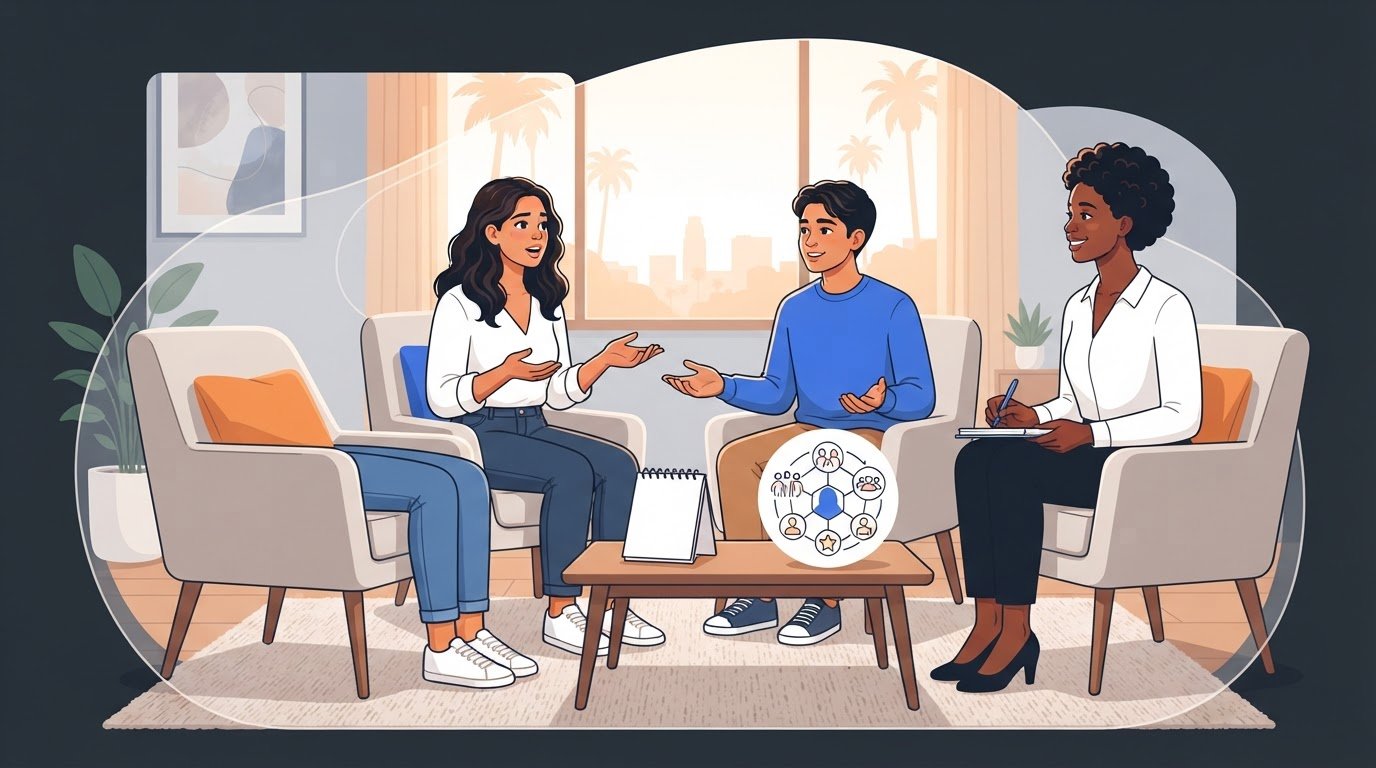
Recovery doesn't happen in a vacuum. We believe that family members shouldn't be passive observers but active "recovery partners." Our approach incorporates Behavioral Family Therapy to strengthen communication and problem-solving within the home. Research consistently shows that utilizing Family Psychoeducation significantly reduces relapse rates and improves the overall quality of life for everyone involved. When a family is informed and supportive, the path to stability becomes much clearer and more sustainable.
The Path to Recovery: Coordinated Specialty Care (CSC)
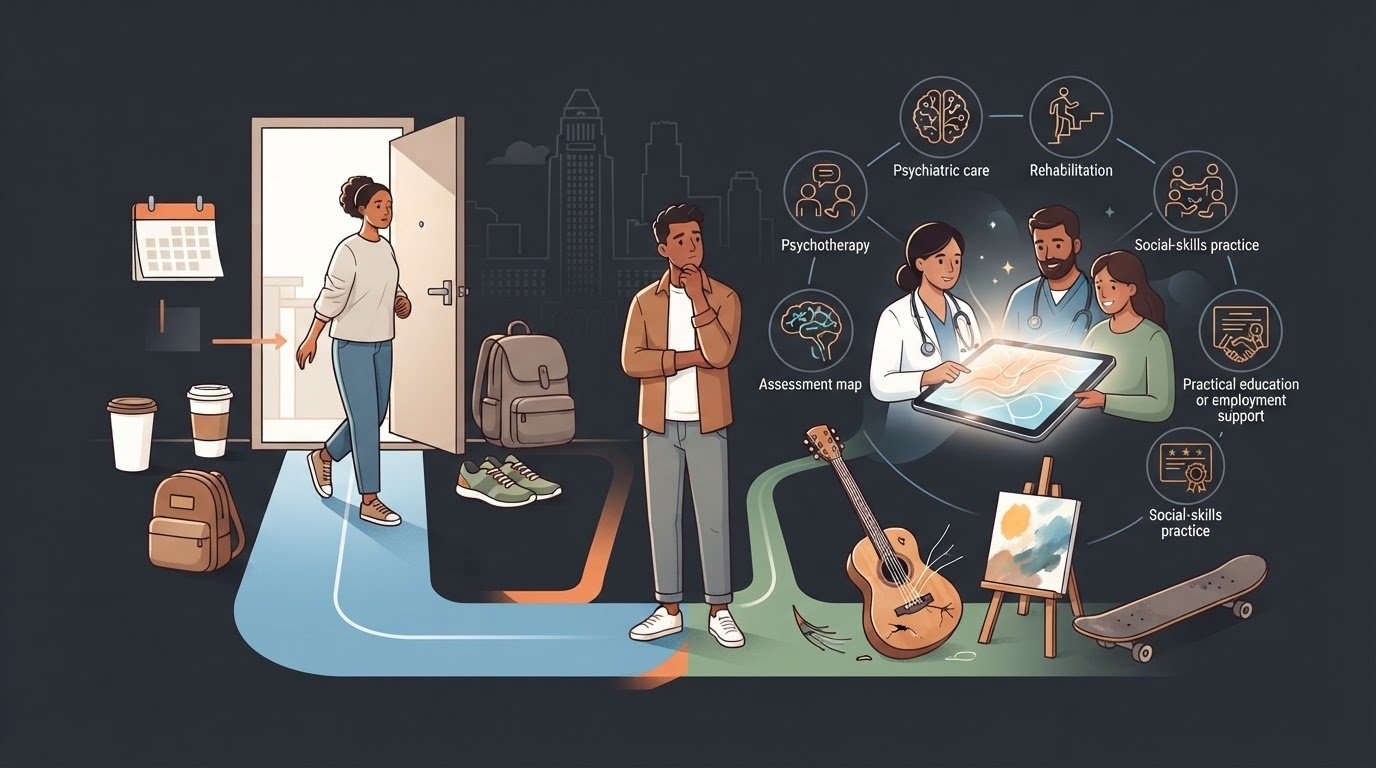
While medication and standard therapy provide a foundation, a complex diagnosis often requires a more intensive, team-based approach. We utilize the NAVIGATE framework, an evidence-based model that brings together a multidisciplinary team to support every aspect of a young person's life. This isn't just about managing symptoms; it's about redefining what is bipolar disorder treatment through the lens of functional success. Our "Augmented CSC" model extends standard care by integrating high-intensity fitness and specialized cognitive training to accelerate the healing process.
The effectiveness of this approach is demonstrated by our outcomes. Within the California OnTrack model, we've achieved an 85% success rate in employment or education participation after just six months of treatment. We also maintain a rehospitalization rate of only 6%, which is significantly lower than the 10% industry average. By focusing on rapid reintegration, we help young adults reclaim their independence before the disorder can derail their long-term goals.
Cognitive Remediation and Metacognitive Training (MCT)
Recovery involves more than just emotional stability; it requires strengthening the brain's underlying processing power. We utilize Metacognitive Training (MCT), a specialized intervention that helps individuals "think about their thinking." This process is essential for correcting the delusional patterns and cognitive biases that often occur during severe mood episodes. As the only outpatient CSC in Southern California with certified MCT instructors, we provide niche expertise that targets the root of thought disorders. Our program pairs daily computer-assisted brain training with high-intensity fitness, creating a powerful synergy that promotes neuroplasticity and cognitive clarity.
Supported Education and Employment (SEE)
A successful life is built on meaningful activity and community connection. When families ask what is bipolar disorder recovery, they're looking for a return to the milestones of young adulthood. Our Supported Education and Employment (SEE) services ensure that a diagnosis doesn't mean the end of a career or education. Through our Work-Study Program, case managers act as dedicated advocates in Los Angeles schools and workplaces. They help secure necessary accommodations and provide the scaffolding for clients to earn degrees or maintain professional roles. We've found that functional outcomes are directly linked to long-term clinical stability. If you're ready to start this specialized journey, we invite you to contact our Los Angeles team to discuss a tailored recovery plan.
Specialized Bipolar Care in Los Angeles: Why Pand Health?
While many clinics offer general mental health services, navigating a complex diagnosis requires a level of specialization that generic providers often overlook. Pand Health stands as the premier Southern California institution for early intervention, located at 11500 W. Olympic Blvd., Suite 399, Los Angeles, CA 90064. When families in Southern California first ask what is bipolar disorder, they are often in the midst of a crisis that requires more than just a general practitioner's advice. We provide a lifeline through the only coordinated specialty care model in the region focused specifically on early psychosis and bipolar-I with psychotic features.
Our approach is grounded in the belief that every individual has the potential for a successful, independent life. We don't settle for mere symptom management. Instead, we implement rigorous, data-driven protocols that prioritize functional outcomes like returning to school or maintaining a career. A deep, clinical understanding of what is bipolar disorder helps families replace anxiety with a structured plan of action. At Pand Health, recovery is the expectation, not the exception!
What to Expect at Pand Health
Our intensive outpatient treatment model provides between 24 and 32 hours of direct care per client. This high-standard intervention ensures that no aspect of the recovery journey is left to chance. We seamlessly integrate psychiatric medication management with psychosocial rehabilitation, creating a holistic framework for wellness. Clients participate in social skills training and psychological rehabilitation designed to restore normalcy and confidence. For families seeking ongoing guidance, the Mind Exposed Podcast serves as a vital local resource. It offers clinical expertise and supportive narratives that help demystify the challenges of mental health recovery within the Los Angeles community.
Taking the Next Step
Beginning the journey toward stability starts with a comprehensive psychiatric evaluation. We encourage families who are seeing early warning signs to take immediate action, as early intervention is the most effective way to protect long-term brain health. To prepare for the first appointment, it's helpful to gather a history of symptoms and any previous medical records. This information allows our team to build a precise, individualized roadmap from day one. You can start this process by contacting Pand Health to schedule an initial consultation. We're here to provide the steady hand and expert guidance your family needs to move forward. A full, vibrant life is within reach, and we're dedicated to helping your loved one achieve it.
Reclaiming the Future Through Specialized Care
Understanding what is bipolar disorder is the first step toward transforming a family's uncertainty into a focused plan for wellness. We've explored how this neurobiological condition requires more than just willpower; it demands a team-based approach that prioritizes early intervention. By recognizing the spectrum of symptoms and debunking common myths, you can move past the stigma and focus on the practical pathways to stability. The roadmap to a functional, successful life is built on clinical insight and profound empathy.
At Pand Health, we offer the only augmented Coordinated Specialty Care model in Southern California. Our specialized team includes certified instructors in Metacognitive Training, contributing to our 85% success rate in employment and education participation after just six months. You don't have to navigate this storm alone. Start your recovery journey with a comprehensive evaluation at Pand Health in Los Angeles. Your loved one's potential remains intact, and we're here to ensure that recovery is the expectation, not the exception.
Frequently Asked Questions
Can bipolar disorder be cured, or is it a lifelong condition?
Bipolar disorder is a lifelong neurobiological condition, but it's entirely manageable with the right intervention. We don't use the word "cure" because the goal is sustainable, recovery-oriented living. At our Los Angeles center, we focus on helping young adults achieve clinical stability through integrated care. This allows them to lead full, productive lives where the diagnosis no longer dictates their daily potential or future opportunities for success.
What is the difference between Bipolar I and Bipolar II?
The primary distinction lies in the severity of the "highs." Bipolar I involves at least one manic episode that lasts a week or requires immediate care, often featuring psychotic symptoms like delusions. Bipolar II is characterized by a pattern of depressive episodes and hypomanic episodes, which are less intense than full mania. Understanding what is bipolar disorder in its various forms ensures that treatment is precisely tailored to the specific mood patterns an individual experiences.
How do I know if my teenager's mood swings are actually bipolar disorder?
Distinguishing between typical adolescent development and a clinical condition requires professional expertise. If you're trying to determine what is bipolar disorder versus normal teenage behavior, look for shifts that are significantly out of character. These might include a sudden decreased need for sleep or profound hopelessness that lasts for weeks. If these changes interfere with school or social life, a psychiatric evaluation at our Los Angeles clinic is the most appropriate next step.
What are the early warning signs of a manic episode?
Early indicators often include a noticeable surge in energy and a decreased need for sleep without feeling fatigued. You might observe rapid, pressured speech, racing thoughts, and a sudden increase in impulsive or risky behaviors. Some individuals also experience heightened irritability or an inflated sense of self-importance. Recognizing these red flags early allows for prompt clinical intervention, which can stabilize the mood before it leads to a significant disruption in daily functioning.
Is hospitalization always necessary for bipolar disorder with psychosis?
Hospitalization isn't the only option for managing severe symptoms. While safety is the priority, our intensive outpatient model in Los Angeles provides a robust alternative. We offer 24 to 32 hours of weekly treatment, which includes psychiatric management and cognitive training. Our rehospitalization rate is only 6%, significantly lower than the 10% industry average. This allows young adults to receive high-level care while remaining connected to their families and their local community.
Can someone with bipolar disorder hold a regular job or finish college?
Absolutely. With the right support, professional and academic success is a realistic expectation. Our California OnTrack program specifically targets these functional goals through a dedicated Work-Study curriculum. Data from our recent cohort shows that 85% of participants are actively engaged in employment or education after just six months of treatment. We provide workplace and school advocacy to ensure that a diagnosis doesn't prevent a young person from achieving their long-term ambitions.
How does Pand Health's California OnTrack program differ from standard therapy?
Standard therapy often involves a single weekly session, which may not be enough for complex conditions. Our California OnTrack program is an augmented Coordinated Specialty Care model. It integrates psychiatric care with daily computer-assisted brain training, high-intensity fitness, and social skills training. We use certified Metacognitive Training instructors to address delusional patterns directly. This intensive, multidisciplinary approach is designed to produce measurable improvements in cognitive performance and social reintegration that traditional therapy cannot match.
What should I do if a loved one refuses treatment for bipolar symptoms?
Navigating treatment resistance requires a blend of profound empathy and clear boundaries. Start by focusing on the functional challenges they face, such as sleep issues or stress, rather than the diagnosis itself. Sharing resources like the Mind Exposed Podcast can help normalize the experience without being confrontational. If the situation is urgent, consulting with a Los Angeles specialist can provide you with a strategy for intervention. We help families become recovery partners.
Disclaimer
This article is for information and educational purposes only, and can NEVER replace a proper medical evaluation. If you or a loved one may be suffering from psychosis or the prodomal symptoms of psychosis, get evaluated by a professional as soon as possible. Early diagnosis and treatment can be life-saving.