


Treatment for Avolition and Anhedonia: Understanding Your Options
What if difficulty getting started and losing pleasure aren’t signs of laziness or a lack of care, but symptoms that deserve thoughtful support? Avolition can make initiating everyday activities feel unusually hard, while anhedonia reduces the interest or enjoyment those activities once brought. They can occur together, but they’re not the same, and the right treatment for avolition and anhedonia depends in part on what’s contributing to them.
If even important routines feel out of reach, or relationships, work, school, and self-care have become less rewarding, it’s understandable to want clear answers. These symptoms may be linked to depression, psychosis, medication effects, or other factors. Careful clinical assessment helps guide next steps rather than assuming one explanation fits everyone.
This article explains how avolition and anhedonia differ, why identifying possible causes matters, and what evidence-informed support may involve. For people experiencing psychosis, care can bring together psychiatric treatment, psychotherapy, family support, rehabilitation, and practical help with education or employment. Progress may take time, but a considered plan can connect treatment with the person’s daily needs and goals.
Key Takeaways
- Avolition affects starting or sustaining activities, while anhedonia diminishes interest or pleasure; distinguishing them can clarify what support may help.
- Assessment considers symptom history, daily functioning, mood, health, sleep, and possible medication effects before treatment choices are made.
- Treatment for avolition and anhedonia should match the underlying cause and a person’s needs, rather than follow a single approach for everyone.
- Small, meaningful activities made manageable can support daily routines without pressure or blame while clinical care develops.
- For eligible teens and adults with psychosis-related needs, California OnTrack combines psychiatric oversight and psychotherapy with rehabilitation supports such as cognitive remediation and social skills training.
What Do Avolition and Anhedonia Feel Like, and How Are They Different?
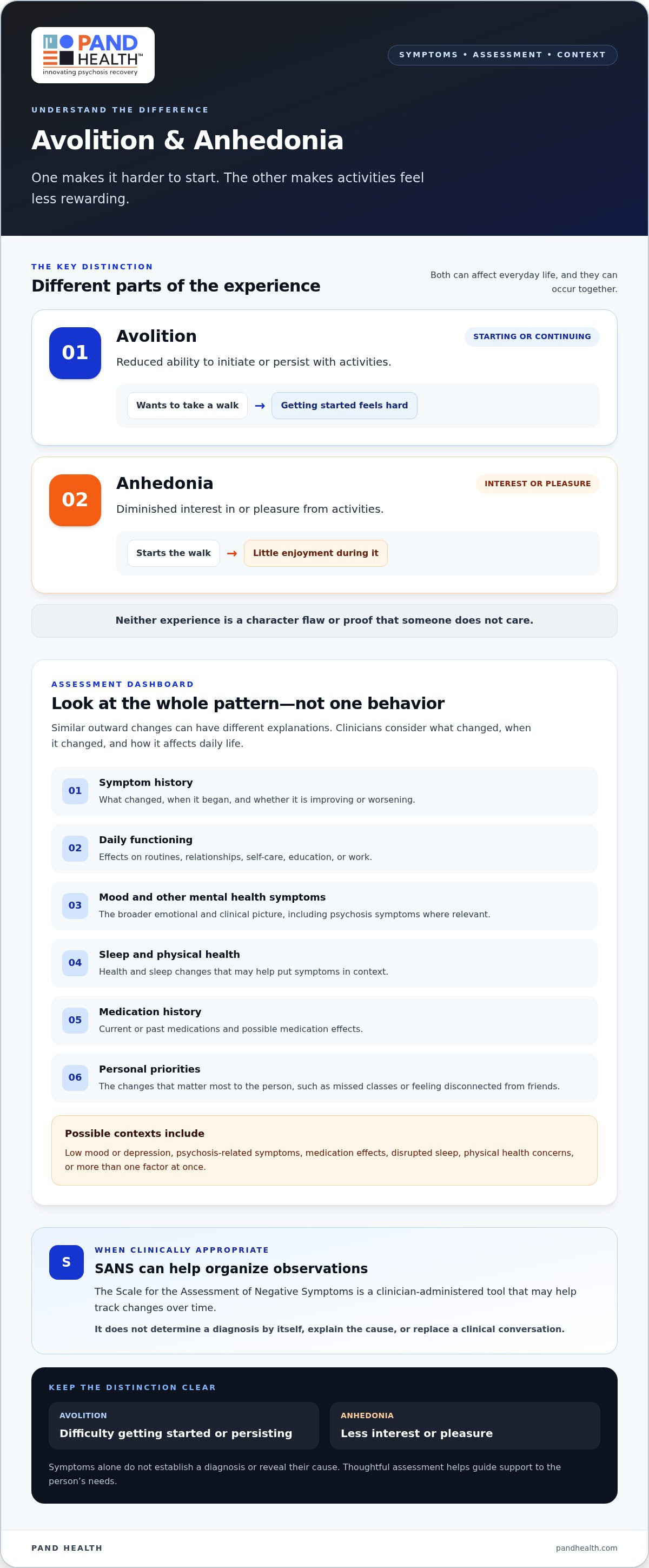
Avolition and anhedonia can both make everyday life feel harder, but they describe different experiences. Avolition is reduced ability to initiate or persist with activities. Anhedonia is diminished interest in or pleasure from them. A person experiencing avolition may struggle to get out for a walk, even if they expect it could help. With anhedonia, they may start the walk but find it brings little enjoyment. Both can occur together, and neither is a character flaw or proof that someone doesn’t care.
These experiences can affect daily functioning, but a symptom by itself doesn’t establish a diagnosis or explain its cause. Clinicians look at the broader pattern, including changes over time and their impact on a person’s life. Understanding Avolition can provide further background on the term, but individual symptoms need to be considered in their clinical context.
Avolition: when starting or sustaining activities becomes difficult
With avolition, the challenge is often generating the momentum to begin or continue an activity, rather than deciding that it matters. A person might intend to shower but not get started, leave messages unanswered despite wanting to stay connected, or have difficulty beginning schoolwork or a work task. These changes can be misunderstood as unwillingness. A more helpful question is whether initiating activity has become noticeably harder than it was for that person.
Clinicians consider whether the change persists, how it compares with someone’s usual patterns, and whether it affects routines, relationships, education, or work. Everyone has days when energy or motivation dips. A broader, sustained change, especially one that disrupts functioning, calls for more context than a quick judgment about effort.
Anhedonia: when interest or pleasure feels diminished
Anhedonia can involve less pleasure in the moment, less anticipation beforehand, or both. Someone may no longer look forward to a favorite meal, music, or time with friends. They might still attend a gathering, yet feel little enjoyment while there. Familiar activities can feel less rewarding, but that experience alone doesn’t point to one specific cause.
The effects may show up in social, recreational, and everyday moments: declining invitations, losing interest in hobbies, or finding ordinary routines emotionally flat. Some people describe a broad reduction in enjoyment; others notice it only in particular activities. That distinction, along with when the change began and what else is happening, can help a clinician understand the experience.
Because avolition concerns getting started and anhedonia concerns interest or pleasure, it’s useful to describe each separately during an assessment. Clear examples can help clinicians understand what has changed and consider appropriate next steps for treatment for avolition and anhedonia, rather than treating either experience as a personal failing.
Why Assessment Matters Before Choosing Treatment for Avolition and Anhedonia
Similar outward changes can have different explanations. Someone may withdraw from activities because of low mood, difficulty experiencing reward, psychosis-related negative symptoms, medication effects, disrupted sleep, or more than one factor at once. The right treatment for avolition and anhedonia therefore depends on understanding the pattern behind the symptoms, not simply naming what a person seems to be doing less often.
Symptoms can guide an assessment, but they cannot diagnose a condition or reveal its cause on their own. Clinicians consider how long the change has lasted, whether it is getting better or worse, and how it affects daily life. They also look at mood, other mental health symptoms, physical health, sleep, and medication history. This helps distinguish a change that may fit a depressive episode from one occurring in a psychosis-spectrum context or alongside another concern.
What a clinician may explore during an assessment
An assessment often begins with the person’s account of what changed and when. A clinician may ask about routines, relationships, school or work, mood, sleep, health, and current or past medications. They may also discuss psychosis symptoms where relevant. The person’s priorities matter: missing classes, feeling disconnected from friends, or struggling with self-care may call for different functional goals even when symptoms overlap.
These questions aren’t a test of character. They help place reduced activity or pleasure in context, including whether the change is persistent and meaningfully different from the person’s usual experience. A clinician considers the whole picture rather than interpreting one behavior in isolation.
Why tracking symptoms can support clearer clinical decisions
When clinically appropriate, a professional may use a consistent measure such as the Scale for the Assessment of Negative Symptoms (SANS), a clinician-administered tool used to assess negative symptoms. It can help organize observations and track changes over time. It doesn’t determine a diagnosis by itself, explain why symptoms are present, or replace a clinical conversation.
Specific descriptions can make that conversation more useful. Rather than concluding that someone “isn’t trying,” note what is observable: an activity takes longer to begin, a previously regular routine has stopped, or enjoyment feels reduced. A simple record of changes in sleep, mood, medication, and functioning may help the clinician see patterns, without turning self-monitoring into a demand for constant performance.
Assessment also helps keep treatment decisions proportionate. A change in medication, for example, should be discussed with the prescribing clinician rather than made independently. If symptoms are affecting daily life, a qualified mental health professional can consider the history, explore possible explanations, and discuss suitable next steps. For psychosis-related concerns in Los Angeles, information about mental health support can help families explore a clinical conversation.
Comparing Treatment Approaches: Match Care to the Underlying Cause
There isn’t one treatment that fits every experience of reduced motivation or pleasure. Care is chosen according to what assessment suggests may be contributing, the person’s goals, and how symptoms affect daily life. When depression is part of the picture, clinicians may focus on treating that condition. When avolition occurs alongside psychosis-related negative symptoms, a plan may combine psychiatric oversight with therapies and rehabilitation. These approaches aren’t a universal ranking, and they may be used in combination.
Medication decisions require a prescribing clinician who can consider the person’s symptoms, health context, current medications, and possible benefits and risks. Psychotherapy and behavioral approaches may also be considered, but no option guarantees a particular response or timeline. The goal is a thoughtful plan that can be reviewed and adjusted as needs become clearer.
When care focuses on depression or another identified condition
If an assessment points to depression or another condition, clinicians may address that condition as part of care. Psychotherapy and medication can be individualized options, discussed in light of the person’s preferences, health, and circumstances. This approach doesn’t assume that reduced pleasure or drive has one cause, or that treating an underlying condition will produce the same result for everyone.
When avolition appears among psychosis-related negative symptoms
In a psychosis-related context, care may bring psychiatric oversight together with psychotherapy and psychosocial support. Symptom-focused care and rehabilitation have related but distinct aims: one addresses clinical needs, while the other can support everyday functioning, social participation, or education and work goals. Metacognitive training for psychosis is another therapy clinicians may consider within an appropriate care plan.
| Approach | Potential purpose | Clinician discussion points |
|---|---|---|
| Psychotherapy | Support coping, emotional wellbeing, or recovery goals in context. | Which concerns and goals should sessions focus on? |
| Medication management | Address an identified clinical condition or symptoms as appropriate. | What benefits, risks, side effects, and follow-up are relevant? |
| Coordinated psychosis care | Combine psychiatric oversight with psychosocial interventions. | How can clinical care and the person’s functional goals work together? |
| Rehabilitation supports | Build practical skills or support participation in daily life. | Which routines or social, school, or work goals matter most? |
The comparison is a starting point, not a prescription. A clinician can explain why an approach fits the assessed context, what it is intended to address, and how progress will be reviewed. For people exploring psychosis-focused care in Los Angeles, contact Pand Health to discuss clinical support and recovery goals. A careful, individualized plan for treatment for avolition and anhedonia can make room for both symptom care and meaningful daily-life priorities.
Practical Ways to Support Daily Function While Treatment Develops
Clinical care can take time to understand and address what’s affecting someone’s daily life. In the meantime, practical support may make an activity feel more approachable and give the person and clinician useful information about what helps. These strategies complement professional care; they don’t replace assessment or prove that someone can overcome symptoms by trying harder.
A simple sequence can keep the focus on learning, not performance:
- Choose one meaningful activity. Let the person identify something they want to do, such as preparing breakfast, attending one class, or sending a message to a friend.
- Make the first step manageable. Define a small starting action, such as putting out breakfast items or opening the school assignment. Agree on a flexible reminder or routine if it would help.
- Review what happened without judgment. Notice whether the activity started, how much effort it took, and whether it felt enjoyable. If it didn’t happen, explore possible barriers and adjust the plan together.
Keep these observations separate. A person might complete an activity but find it unrewarding, or enjoy it once underway but need substantial help getting started. Tracking activity, effort, and enjoyment independently can give a clinician a clearer picture than a general judgment such as “better” or “worse.” A few brief notes are enough; tracking should not become another demanding task.
Set manageable activity goals without turning them into a test
Choose a first step that feels relevant to the person, not simply convenient for others. A flexible routine can offer a helpful cue, while a reminder is a tool, not a measure of commitment. If the plan proves too difficult, that information can guide a smaller step or reveal a barrier. Completing the activity isn’t the only useful result; noticing what made it easier or harder also matters.
Support participation at home, school, work, and socially
Ask what kind of support the person wants before stepping in. They may prefer help breaking a task into steps, company while getting started, or space to try independently. For school, work, or social participation, plan collaboratively and build toward goals at a pace that feels workable. If social connection is a priority, social skills training may be one option to discuss as part of broader care.
Family members and other supporters can encourage participation without blame. Offer choices, recognize effort, and stay curious about obstacles rather than interpreting difficulty as a lack of care. The purpose of structure is to reduce friction and support a person’s own goals, not to impose a schedule or demand immediate change.
If reduced motivation or enjoyment is affecting everyday functioning, discuss the changes with a qualified mental health professional. A clinician can help connect daily observations with an individualized plan for treatment for avolition and anhedonia. To explore psychosis-focused support and recovery goals in Los Angeles, contact Pand Health.
How Pand Health Connects Psychosis Care With Recovery Goals in Los Angeles
For people experiencing psychosis-related symptoms, care can address more than clinical concerns alone. Pand Health’s California OnTrack is an augmented Coordinated Specialty Care (CSC) model based on the NIMH NAVIGATE framework. It brings psychiatric oversight and psychotherapy together with rehabilitation supports, so care can consider both mental health needs and the person’s goals for everyday life.
Relevant components include psychiatric medication management, psychotherapy, cognitive remediation, and social skills training. These supports have different purposes. Psychiatric care addresses clinical needs; cognitive remediation works on cognitive skills, while social skills training supports interpersonal abilities. A coordinated approach can help connect these areas to goals chosen by the individual, without assuming every service is right for everyone.
A coordinated outpatient model for eligible teens and adults
California OnTrack serves teens and adults ages 13-40 with first-episode psychosis, schizophrenia-spectrum disorders, or clinically high risk for psychosis. The program’s intensive outpatient treatment is described as 24-32 hours per client. It combines clinical care with psychological and social rehabilitation; it is outpatient treatment, not residential care or an emergency response service.
Functional goals can make care more concrete. Depending on the person’s priorities, supported education and employment may help connect treatment with participation in school or work. These supports aren’t a promise that symptoms will change, nor do they directly treat every person’s symptoms. They are ways to include meaningful roles and practical aspirations in a recovery-oriented plan.
Program outcomes offer context, not a prediction for any individual. In a 2022-2024 cohort of 41 patients, Scale for the Assessment of Negative Symptoms (SANS) scores decreased 40% after nine months. In the same cohort, participation in employment or education increased from 6% at enrollment to 85% after six months. These figures describe that cohort’s experience; individual progress can differ.
Discussing whether specialized care may fit your situation
A conversation about care can begin with what has changed, how it affects daily functioning, and which goals matter most. A person or family might raise concerns about getting started with routines, social connection, school, or work. Sharing these details can help the team understand the needs being discussed and consider whether psychosis-focused outpatient care is relevant.
For families in Los Angeles, California OnTrack offers a coordinated framework that links psychiatric treatment with rehabilitation and practical recovery goals. Discuss care options with Pand Health by sharing the concerns and priorities you’d like the team to understand. Treatment for avolition and anhedonia can require careful assessment, and support should be guided by the person’s clinical context and individual goals.
Take the Next Step at Your Own Pace
You don’t need to have every answer before seeking support. A useful next step can be to note what has changed, what feels hardest in daily life, and what you hope could become more manageable. These observations can help guide a conversation about treatment for avolition and anhedonia, including which concerns need attention first.
Care is a process of understanding and adjustment, not a test of willpower or a promise of instant change. If psychosis-related symptoms are affecting you or someone close to you, Pand Health can discuss how clinical care and recovery goals may fit together. Discuss care options with Pand Health.
With thoughtful assessment and support shaped around individual needs, a workable path forward can begin one step at a time.
Frequently Asked Questions
Are avolition and anhedonia diagnoses or symptoms?
They describe symptoms or experiences, not specific diagnoses. For example, difficulty initiating a task may be one concern to discuss, but it cannot identify a disorder by itself. A clinician considers how long the change has been present, whether it affects responsibilities or relationships, and what else is happening emotionally and physically. Sharing when you first noticed a change can help make an appointment more focused and informative.
Can avolition and anhedonia happen at the same time?
Yes. A person might find it hard to begin meeting a friend and then feel little enjoyment once they’re together. The two experiences can overlap, but one doesn’t automatically mean the other is present. If both seem to be affecting life, describing them separately can help: explain what feels difficult before an activity and what the experience is like during it. That detail may help a clinician understand the impact.
Do avolition and anhedonia always mean depression or schizophrenia?
No. These experiences alone don’t establish depression, schizophrenia, or another condition. A clinician may consider changes in mood, psychosis-related experiences, sleep, health, and medication history, along with how daily life has shifted. An online checklist or one behavior can’t replace that broader evaluation. If you’re preparing for an appointment, note a few specific changes and questions rather than trying to decide on a diagnosis in advance.
Can medication contribute to low motivation or reduced pleasure?
Medication effects are one possibility a prescriber may assess, but they aren’t the only explanation. If a change appears after a medication is started or adjusted, write down roughly when it began and what else changed around that time. Share those observations with the prescribing clinician. Don’t stop, reduce, or change a prescribed dose on your own; the prescriber can discuss potential benefits, risks, and alternatives based on your situation.
How long does treatment for avolition or anhedonia take to help?
There isn’t a set timeline that applies to everyone. The pace of change can depend on what’s contributing, the person’s circumstances, and the care plan. A clinician may review concrete goals over time, such as returning to a regular responsibility or noticing a change in participation, and adjust support as appropriate. Be cautious of promises of immediate or guaranteed improvement. Ask the treating professional how progress will be discussed and reassessed.
How can families support someone experiencing avolition without adding pressure?
Ask the person what kind of help they’d welcome, rather than taking over or setting expectations without their input. They may prefer a reminder, help preparing for an activity, or simply company. If a plan doesn’t work, respond with curiosity about what got in the way instead of criticism. Family members can also share concerns with the person’s care team, while respecting the individual’s preferences and the team’s guidance.
Should someone stop medication if motivation or pleasure gets worse?
No. Don’t stop or change prescribed medication without speaking with the prescriber, even if symptoms seem connected to a recent change. Keep a brief note of when the concern began, any dose changes, and other symptoms, then raise it with the clinician. If there’s immediate danger or a serious safety concern, seek urgent local help. Medication questions deserve prompt, direct discussion with the professional responsible for prescribing it.
Disclaimer
This article is for information and educational purposes only, and can NEVER replace a proper medical evaluation. If you or a loved one may be suffering from psychosis or the prodomal symptoms of psychosis, get evaluated by a professional as soon as possible. Early diagnosis and treatment can be life-saving.