

OnTrack LA: Coordinated Specialty Care for Young Adults
What if psychosis care could help a young adult work toward stability without putting education, employment, and independence to one side? When symptoms disrupt daily life, it’s understandable to wonder whether intensive treatment will take over, or whether general therapy can provide enough support. For families searching “OnTrack for young adults Los Angeles,” the key question is what kind of care fits the person’s needs and goals.
California OnTrack at Pand Health is coordinated outpatient care for people experiencing first-episode psychosis, schizophrenia-spectrum disorders, or who are clinically high-risk for psychosis. Built on the NAVIGATE framework, the program brings together psychiatric care, psychosocial support, family involvement, and supported education and employment. These elements connect treatment with a young adult’s life beyond appointments.
This article explains who California OnTrack is designed to support, what its coordinated care model involves, and how it differs from general therapy or emergency services. You’ll also learn how treatment can relate to school, work, and everyday functioning, plus what information about symptoms, treatment history, and personal goals can help families discuss care.
Key Takeaways
- California OnTrack brings psychiatric and psychosocial support together in an intensive outpatient model, rather than focusing on a single therapy.
- Learn how coordinated care, individual therapy, and emergency services differ in purpose and scope, helping clarify what kind of support may fit.
- For a conversation about OnTrack for young adults Los Angeles, prepare notes on current concerns, goals, existing supports, and questions for the care team.
- Supported education and employment connect care with everyday goals, while family involvement and cognitive support can address needs beyond symptoms.
- Explore the reported outcomes for Pand Health’s 2022 to 2024 cohort of 41 patients, including how education and employment participation changed over time. These figures don’t predict individual results.
What Is OnTrack for Young Adults in Los Angeles?
California OnTrack is Pand Health’s coordinated specialty care program for people experiencing early psychosis. For families comparing OnTrack for young adults Los Angeles options, the key distinction is that it brings clinical and psychosocial support together in an intensive outpatient model. Care is organized around the person’s needs and recovery goals, rather than treating one concern in isolation.
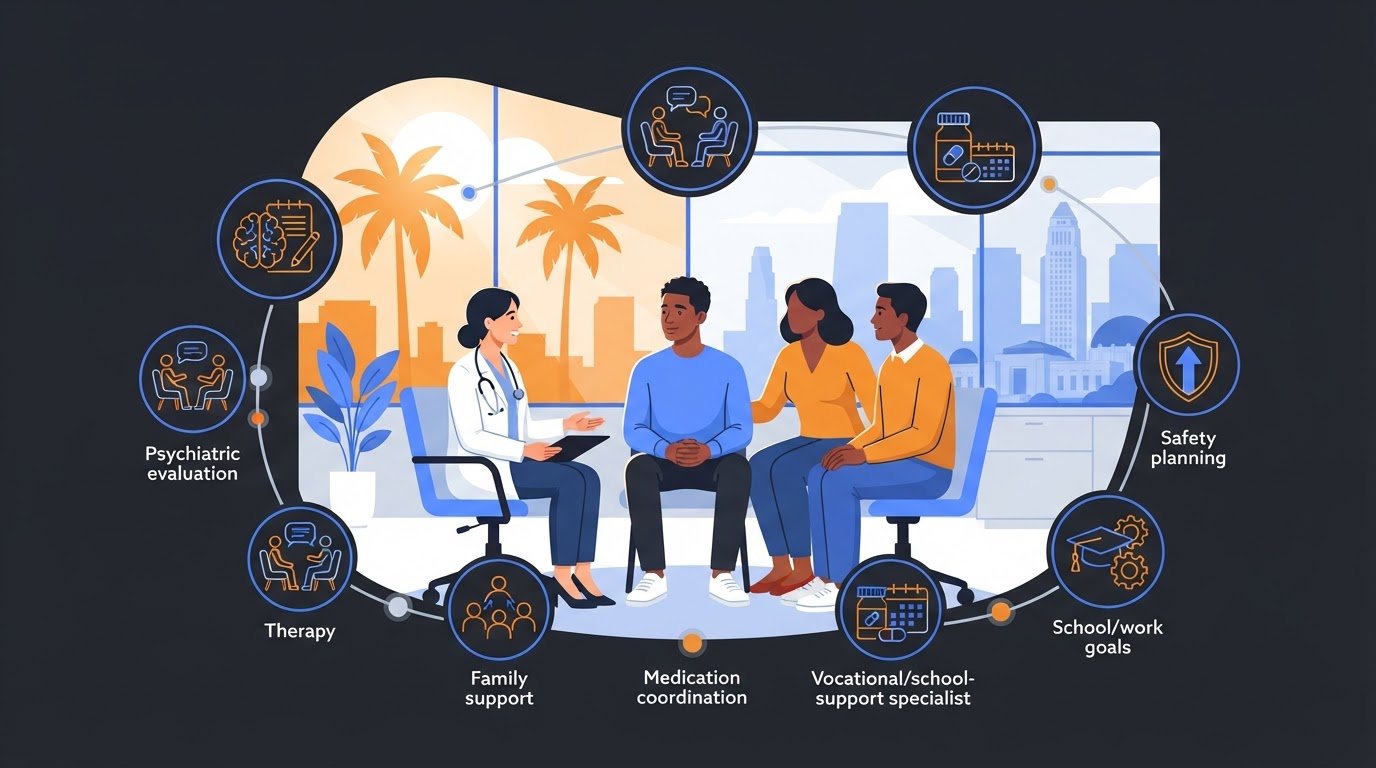
Outpatient care takes place while a person remains in the community, rather than living at a treatment facility. OnTrack combines psychiatric care with evidence-based psychosocial interventions, cognitive remediation, family support, and help with education or employment. The model recognizes that recovery involves more than symptom management. Reconnecting with community, returning to school, exploring work, and building daily routines may also matter.
Who may explore California OnTrack?
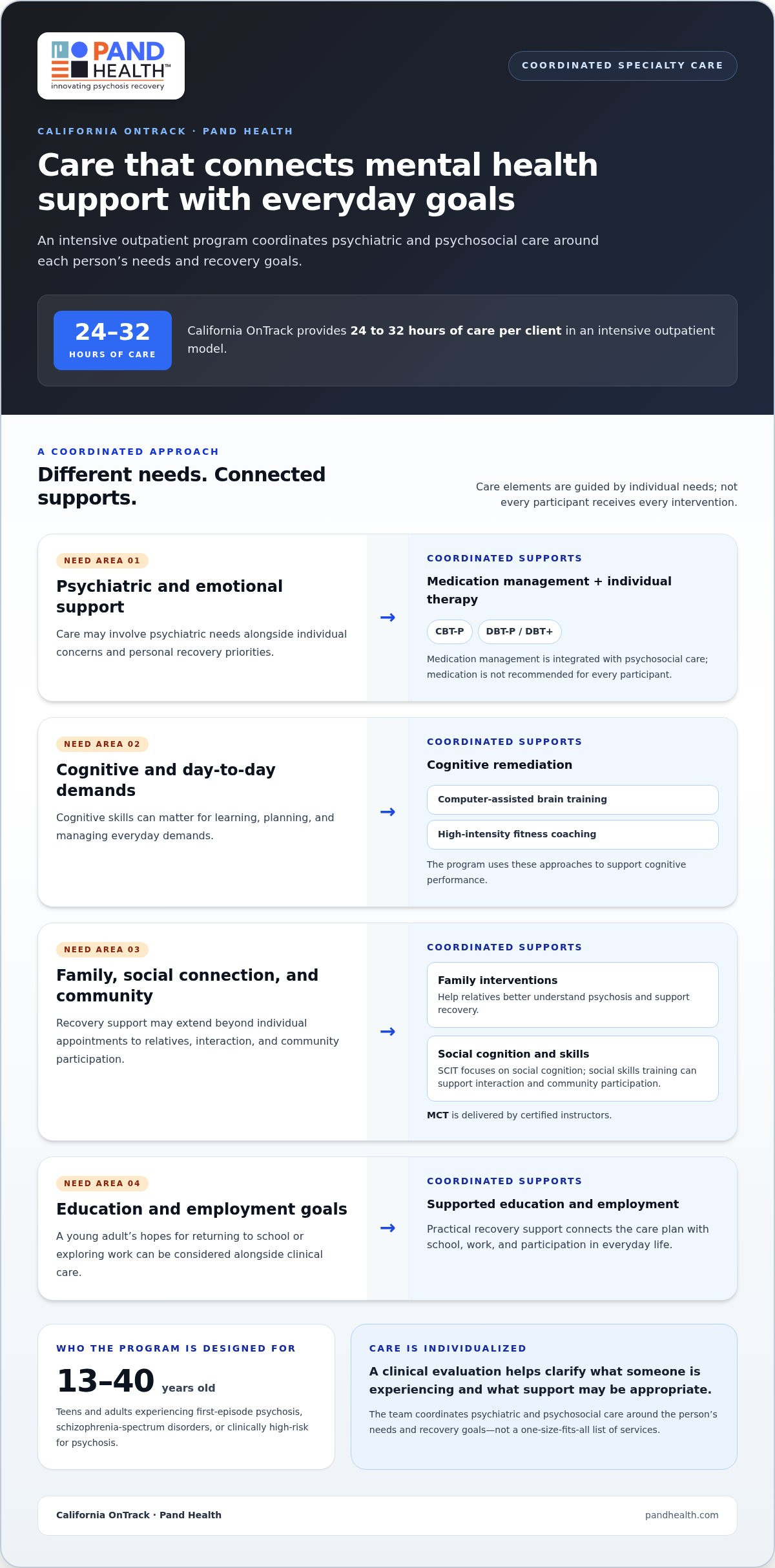
California OnTrack is designed for teens and adults ages 13 to 40 who are experiencing first-episode psychosis, schizophrenia-spectrum disorders, or are clinically high-risk for psychosis. These are clinical descriptions, not conclusions a young adult or family should draw from a single experience. Unusual thoughts, changes in perception, or difficulty functioning can have different explanations, and one symptom alone doesn’t establish a diagnosis or determine program fit.
A clinical evaluation helps clarify what someone is experiencing and what support may be appropriate. If concerns are affecting relationships, school, work, or day-to-day life, families can note what has changed and share that context with the care team. The purpose is to understand the whole picture, not to label someone based on one sign.
What does coordinated specialty care mean?
Coordinated specialty care is a team-based approach that brings mental health treatment and practical recovery support into one plan shaped around the person’s needs and goals. Rather than depending on one standalone intervention, the team coordinates psychiatric and psychosocial care so different forms of support can work together. For example, clinical care can be considered alongside family needs or a young adult’s hopes for returning to school or exploring employment.
This integrated approach is the foundation of Coordinated Specialty Care (CSC), a model developed for early psychosis care. Pand Health’s California OnTrack program builds on the NAVIGATE framework with a broader set of psychosocial supports. Coordination connects conversations about symptoms and wellbeing with practical supports for participation in everyday life. It doesn’t mean every person receives the same services or follows an identical path; care is guided by individual needs and recovery goals.
For a young adult, that broader focus can be important. Treatment can account for the life a person wants to build, including relationships, community involvement, education, or work, while addressing mental health needs. California OnTrack’s intensive outpatient structure brings these priorities into a coordinated care setting, offering an alternative to relying on general therapy alone when needs extend across several areas of life.
What Young Adults Can Expect From OnTrack's Integrated Care
For young adults considering OnTrack for young adults Los Angeles, integrated care means psychiatric and psychosocial supports are coordinated rather than treated as unrelated appointments. The plan can bring together medication management, therapy, family support, cognitive interventions, and help with education or employment. Which elements are relevant depends on the individual’s needs; inclusion in the program does not mean every participant receives every intervention.
Medication management is integrated with psychosocial care. It isn’t a recommendation that every participant take medication. The care team considers psychiatric needs alongside the person’s daily functioning and recovery priorities, while psychosocial interventions address other areas of life. California OnTrack is an intensive outpatient program providing 24 to 32 hours of care per client.
Therapies and cognitive supports within the care plan
Therapeutic interventions may include cognitive behavioral therapy for psychosis (CBT-P) and dialectical behavior therapy for psychosis (DBT-P or DBT+). Social Cognition and Interaction Training (SCIT) focuses on social cognition, while Metacognitive Training (MCT) is delivered by certified instructors. These interventions offer different forms of support within a broader plan, rather than serving as interchangeable treatments.
Cognitive remediation is another component. The program uses computer-assisted brain training alongside high-intensity fitness coaching to support cognitive performance. Cognitive skills can matter for tasks such as learning, planning, and managing day-to-day demands. Family interventions can help relatives better understand psychosis and support recovery, while individual therapy provides space to work on concerns and personal goals. Social skills training can also support interaction and community participation.
Connecting treatment with education and employment
Clinical care connects with practical goals through the Supported Education and Employment curriculum and Work-Study Program. Case-managed school and job support may include counseling, motivational interviewing, resume building, social skills training, and advocacy. The focus is on helping a young adult work toward education or employment goals with support coordinated with care, rather than treating school or work as separate from recovery.
For example, someone hoping to return to classes may need to identify a manageable next step and support for navigating school demands. A person exploring work may benefit from resume-building help and advocacy. The plan can account for individual priorities without assuming that everyone is ready for the same pace or path. The California OnTrack care team can help connect these goals with the person’s coordinated care plan.
How to Assess Whether OnTrack Fits a Young Adult's Needs
Choosing a level of support can feel difficult when one young adult’s needs touch several parts of life. A useful starting point is to compare what different services are designed to do, then consider whether concerns call for coordinated clinical and practical support. This can help families considering OnTrack for young adults Los Angeles prepare for an individualized discussion, rather than trying to determine eligibility or make a diagnosis on their own.
| Type of support | Purpose | Scope |
|---|---|---|
| Coordinated specialty care | Address early psychosis through an integrated, recovery-oriented plan. | May coordinate psychiatric and psychosocial care with cognitive, family, and education or employment supports, based on individual needs. |
| Single therapy | Focus on a defined therapeutic approach or concern. | Provides a particular form of support, but isn’t the same as a team coordinating multiple areas of care. |
| Emergency services | Respond to an immediate safety or urgent medical concern. | Addresses urgent needs, not ongoing outpatient coordination of treatment and life goals. |
Questions that clarify care priorities
Before discussing program fit, write down what has changed, what matters most to the young adult, and which supports are already involved. Specific observations are often more useful than a label. Consider whether concerns affect daily routines, relationships, concentration, or participation in school or work.
- What are the most pressing concerns, and how are they affecting day-to-day functioning?
- What goals feel meaningful now, such as returning to education, exploring employment, or strengthening social connection?
- Would family communication or family support be helpful, and what supports are already in place?
- Are cognitive challenges affecting tasks such as organizing, learning, or following through?
These prompts help make the conversation concrete. They don’t establish a diagnosis or mean that every OnTrack participant receives every intervention in the same way. A clinical discussion considers the whole person, their needs, and their priorities.
Understanding outpatient care versus other levels of support
California OnTrack is intensive outpatient care. That means it coordinates substantial clinical and psychosocial support while the person remains in the community; it is not residential or hospital care. The program provides 24 to 32 hours of care per client. Families can discuss how the model’s intensity may relate to daily responsibilities and goals.
Outpatient coordination and emergency response serve different purposes. If there’s an immediate safety concern or urgent medical need, seek appropriate emergency services or urgent assessment. OnTrack isn’t a crisis center or a substitute for emergency evaluation.
Ultimately, fit can’t be determined by matching a symptom to a program description or predicting an individual outcome. A clinical conversation can clarify concerns, existing supports, and goals, and help determine whether coordinated outpatient care is an appropriate direction. Preparing those details can make the discussion more focused and reassuring.
Starting an OnTrack Conversation in Los Angeles
Beginning a conversation about OnTrack for young adults Los Angeles doesn’t require having every answer in advance. A few notes can help the young adult and family describe what’s happening, what they hope will change, and what support is already involved. The goal is to give the care team a clearer picture, not to arrive with a self-diagnosis or a decision already made.
What to prepare before discussing program fit
Keep preparation practical. Gather relevant clinical history and a current medication list if available. A short timeline of changes can also help: note when concerns began, what has shifted in daily functioning, and what has helped or felt difficult so far.
It may be useful to write down questions and priorities before speaking with the team. For example:
- What concerns are most important to discuss, and how are they affecting daily life?
- What goals matter to the young adult, such as returning to school, exploring work, or strengthening social connections?
- Which clinicians, supports, or services are currently involved?
- What questions remain about the care model, participation, or insurance arrangements?
Insurance coverage and payment arrangements depend on plan and benefit details. Have the insurance information available when discussing coverage for California OnTrack. Preparing this question alongside clinical and personal goals can make the conversation more useful without turning it into a checklist for eligibility.
Planning for family and practical support
Family therapy and family psychoeducation are among California OnTrack’s services. Their role can be discussed in relation to the young adult’s preferences and the family’s needs. The young adult should have room to express what involvement feels helpful, whether that means shared conversations, learning how to offer support, or a more limited family role.
Before a meeting, families may want to consider what they hope to understand and what the young adult wants to keep private. Discuss how communication and participation can be approached respectfully, including consent boundaries. This helps keep the conversation centered on the young adult’s goals while recognizing that family members may also need guidance.
Pand Health’s Los Angeles location is at 11500 W. Olympic Blvd., Suite 399, Los Angeles, CA 90064. Knowing the location can help families plan travel and consider how participation may fit with school, work, or other responsibilities.
Once you’ve gathered the concerns, goals, current supports, and questions that matter most, you can take the next step at a comfortable pace. Discuss California OnTrack with the team to begin a conversation about the program and the young adult’s needs.
Pand Health's California OnTrack: Recovery Goals and Next Steps
Pand Health’s California OnTrack builds on Coordinated Specialty Care with an augmented, recovery-oriented approach. Its purpose extends beyond symptom management: care can also support goals such as participating in the community, pursuing education, and exploring employment. Those goals are personal, and progress can look different for each young adult. The program’s reported outcomes offer a view of what happened for one group of participants, not a forecast for someone considering care.
What the reported cohort outcomes show
In a cohort of 41 patients treated from 2022 to 2024, education or employment participation was 6% at enrollment, 40% after three months, and 85% after six months. The same cohort had a reported rehospitalization rate of 6% after enrollment. These figures describe observed participants and should not be read as typical results or a promise about any individual’s experience.
Among 41 patients in Pand Health’s 2022 to 2024 cohort, education or employment participation rose from 6% at enrollment to 40% after three months and 85% after six months; these observed cohort results don’t predict an individual’s outcome.
The sequence gives useful context: participation was measured at enrollment and at later points, rather than reported as a single before-and-after figure. It can help readers understand the kind of functional goal tracked in the cohort, but it can’t show what will happen for a particular young adult. Individual circumstances, needs, and progress differ.
The 6% rehospitalization rate is also a cohort finding, not an assurance of reduced hospital use for future participants. Read it with its specific group and timeframe in mind, and avoid treating it as a guarantee or a direct comparison with another program. Outcomes can inform questions about care, but they don’t replace a discussion of personal fit.
A recovery-oriented next step
Education, employment, and community participation can be meaningful parts of recovery alongside clinical wellbeing. California OnTrack connects those aims with coordinated outpatient care, rather than treating life goals as separate from mental health support. This gives a young adult and family a way to discuss what matters to them and how progress might be understood in the context of their own priorities.
Structured monthly interviews and assessments continue after discharge as part of Pand Health’s follow-up. This ongoing monitoring provides a way to track how a person is doing beyond the active phase of care; it doesn’t imply a particular duration or outcome.
For families exploring OnTrack for young adults Los Angeles, the cohort data can serve as a starting point for questions, not a measure of what one person should expect. A conversation can focus on current concerns, individual goals, and whether coordinated specialty care may be a suitable direction. Learn more about OnTrack in Los Angeles to review the program details.
Take the Next Step at Your Own Pace
Exploring care doesn’t require a family to have every decision settled. A useful next step is to talk together about what the young adult wants life to look like, what feels difficult right now, and what kind of support would feel respectful and manageable. Those priorities can guide a more personal discussion about whether coordinated care is worth exploring.
For anyone considering OnTrack for young adults Los Angeles, program data can offer context, but it can’t predict one person’s path. Individual needs, preferences, and goals deserve attention in their own right. It’s reasonable to bring questions, take time to consider the answers, and include the young adult’s voice in the process.
A conversation with Pand Health can help clarify what to discuss next and how California OnTrack may relate to the young adult’s goals. Discuss California OnTrack with Pand Health when you’re ready to take that step. Hope can begin with a thoughtful conversation and a plan shaped around the person, not just the diagnosis.
Frequently Asked Questions
Who may be eligible for California OnTrack as a young adult?
California OnTrack is designed for teens and adults ages 13 to 40 who are experiencing first-episode psychosis, schizophrenia-spectrum disorders, or are clinically high-risk for psychosis. For families exploring OnTrack for young adults Los Angeles, a clinical discussion can help clarify individual needs and program fit. These descriptions don’t diagnose someone or guarantee acceptance.
Does California OnTrack accept insurance?
Insurance coverage depends on an individual’s plan and benefits. Have the insurer’s name and plan details ready when discussing coverage for California OnTrack with Pand Health. Don’t assume a service is covered based on plan name alone.
How soon can a young adult begin California OnTrack in Los Angeles?
Pand Health offers same- or next-day psychosis evaluation services. An evaluation helps assess psychosis-related concerns and discuss appropriate care. If the young adult’s immediate safety is at risk, use emergency support rather than waiting for a program appointment.
Does a young adult need a referral to discuss OnTrack?
To start a focused discussion about California OnTrack, prepare a brief description of the young adult’s concerns, relevant care history, and current goals. Contact details for current clinicians can also help provide context when applicable. A clinical evaluation can help clarify the situation and identify appropriate next steps.
Can family members be involved in a young adult's OnTrack care?
Yes. California OnTrack includes family therapy and psychoeducation, which can help relatives build understanding and discuss ways to support the young adult. Family involvement should be considered as part of an individual care plan, not assumed to look the same for everyone. The young adult can share what kind of participation feels useful, and the care team can discuss consent, privacy, and appropriate boundaries for family communication.
What should families do if a young adult may be in immediate danger?
California OnTrack is outpatient care, not an emergency response service. If someone faces imminent danger or needs urgent medical attention, call 911. For crisis support, call or text 988. Share the immediate safety concern clearly with the responder and follow their guidance. Don’t wait for a routine program discussion or intake process to address an urgent situation; those steps serve a different purpose from emergency assessment.
Disclaimer
This article is for information and educational purposes only, and can NEVER replace a proper medical evaluation. If you or a loved one may be suffering from psychosis or the prodomal symptoms of psychosis, get evaluated by a professional as soon as possible. Early diagnosis and treatment can be life-saving.