
Psych 101: Learning about psychosis & thought disorders
Understanding starts here, the questions you have and a path to the clinical detail you need.
The basics
Our conception of the human "mind" is a manifestation of brain function. In turn, the brain is composed of numerous autonomous, but highly coordinated functional units.
If one information-processing unit malfunctions or slows down, the effect cascades, compromising the functioning of connected regions that rely on it. Some have analogized this to an airplane factory with multiple coordinated assembly lines. Smaller problems in one line may go unnoticed, yet manufacturing defects introduced eventually lead to a critical component failing, ultimately compromising the whole aircraft.
It is poorly understood what causes the mental disintegration we term psychosis, but it appears to be evenly attributable to genetic predisposition and environmental triggers, the Stress-Vulnerability Model. That stress plays such an important role in the development of psychosis is why two of the best-described risk factors are physical trauma and psychological trauma.
When the mind begins to shatter, it does so incompletely and insidiously, without detection. What people often term a "psychotic break" is not a sudden event like a heart attack, but rather the end stage of progressively deteriorating brain function. The period leading up to florid psychosis, when schizophrenia can be diagnosed, is termed the "psychotic prodrome" and can last years. Because symptoms onset gradually, patients, families and close friends will often unconsciously overlook or rationalize them. This compartmentalization of insanity is the norm early in the illness, allowing delusional beliefs or misperceptions to remain hidden. Simple, everyday conversations will not uncover growing psychosis until very late in the illness.
"I have seen mad people, and I have known some who were quite intelligent, lucid, even clear-sighted in every concern of life, except on one point. They could speak clearly, readily, profoundly on everything; till their thoughts were caught in the breakers of their delusions and went to pieces there, were dispersed and swamped in that furious and terrible sea of fogs and squalls which is called MADNESS.", Guy de Maupassant
The literary quote above captures some aspects of a thought disorder or psychosis, but a practical understanding of what you or a loved on eis experieincing requires a much deeper understanding.
Psychosis is a symptom, not a label
Psychosis (positive symptoms) describes a loss of contact with shared reality, hearing, seeing, or believing things others don't. It can appear in many conditions, and on its own it is not a diagnosis.
Thought disorder is about how thinking flows
Formal thought disorder shows up in speech: ideas that slide off track, connect loosely, or thin out. Clinicians listen for it because it is observable, not just reported.
Schizophrenia is a diagnosis made over time
A diagnosis requires a pattern that persists, psychosis, disorganization, and negative symptoms together with functional decline over months, not days.
Contrasting Symptoms of Psychosis
Psychosis manifests through three distinct categories of symptoms. Understanding the difference between what is added, what is confused, and what is lost is crucial for recognition and treatment.
Positive
The "Added" StateBehaviors, thoughts, or sensory experiences that are added to a person's normal baseline. These are typically the most noticeable symptoms to outside observers.
Hallucinations
Experiencing sensations that are not real (e.g., hearing voices, seeing visions, feeling tactile sensations).
Delusions
Strong, fixed beliefs not based in reality (e.g., severe paranoia, grandiosity, believing the TV is sending secret messages).
Disorganized
The "Confused" StateReflects confusion or disruption in how a person processes information. This manifests in how they communicate or physically behave.
Disorganized Speech
Derailment (jumping unrelated topics), tangential answers, or "word salad" (words strung together without logical meaning).
Abnormal Behavior
Unpredictable agitation, bizarre posturing, dressing highly inappropriately for the weather, or catatonia.
Negative
The "Lost" StateA loss or reduction in normal functioning, emotions, or behaviors. Often mistaken for depression and typically the most debilitating long-term.
Flat Affect & Avolition
Severe reduction in emotional expression (blank face, monotone voice) and a profound lack of drive to complete everyday tasks.
Alogia & Asociality
Speaking very little (poverty of speech) and a severe lack of interest in forming or maintaining social relationships.
Important Context
Experiencing psychosis is a medical condition, not a personal failing. It is often a symptom of underlying conditions such as schizophrenia, bipolar disorder, or severe depression. If someone is exhibiting these symptoms, evaluation from a medical professional is critical. Early intervention leads to better outcomes.
The Schizophrenia Spectrum & Disorders with psychosis
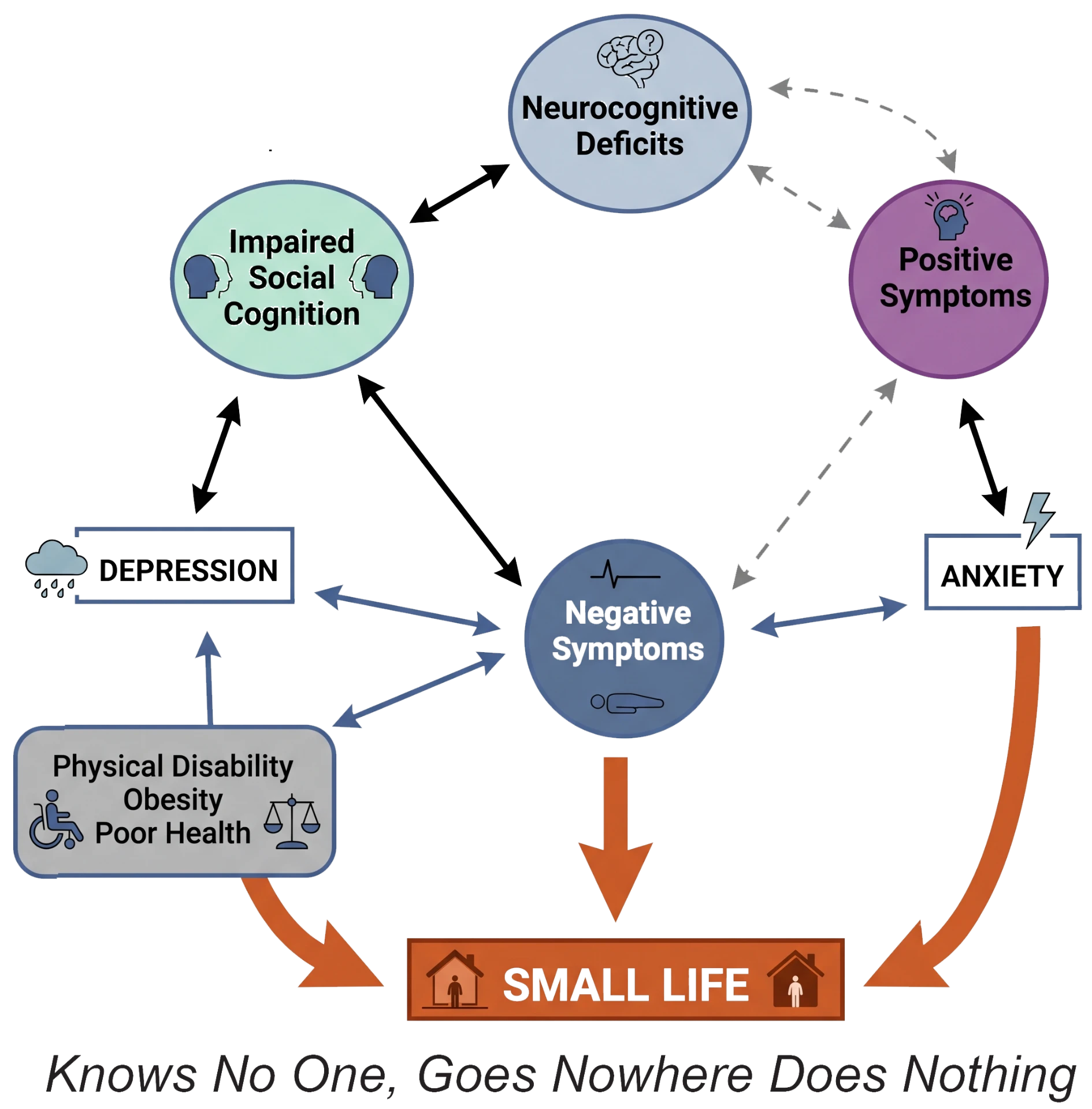
The different domains of psychosis synergize with each other, and mood disorders to produce poorer physical health (see cardiometabolic health here) and much smaller lives, diminished of purpose and meaning. To learn more about the symptoms of psychosis or how they develop see our clinical reports What is psychosis?, Decoding Schizophrenia or Early psychosis: a critical window.
Where to go next
Not sure where you fit? Talk with our team a short conversation is often faster than more reading.
Keep reading
All understanding psychosis pages →- Understanding psychosisWhat is psychosis?Psychosis, thought disorder, and schizophrenia explained from the ground up.For families
- Understanding psychosisRecognizing psychosisEarly signs, what to look for, and how to tell them apart from ordinary teenage change.For families
- Understanding psychosisAnosognosia & treatment impactWhy insight is often the hardest part, and what delay in treatment costs.For everyone
- Research & libraryLibraryOur full collection of articles, guides, and downloadable material.For everyone
- Understanding psychosisWhat to look forThe FACTS early-warning framework with concrete examples of each domain.For families