Neurodivergent Care
Building resiliency, training in social skills, interpersonal communication, executive function coaching, and remediation of social cognition deficits, built around real school, work, and family life.

Pand... Health: Social4Life
Being neurodivergent means that your brain functions, learns, and behaves differently from what is considered standard or "neurotypical." Neurodivergent teens and young adults must navigate challenges like social communication difficulties, sensory differences, anxiety, executive-function gaps, or rigid thinking patterns. Many high functioning members of the neurodivergent community carry the clinical diagnosis of Autism Spectrum Disorder (ASD), but not all. To learn more about these differences see What is Autism. Since neurodivergence occurs early in brain development it is not surprising that ASD is often accompanied by anxiety, OCD, mood, ADHD, or executive-function differences, however, the symptoms can also be mistaken for multiple other psychiatric conditions. Neurodiversity carries strengths along with the challenges. Each individual needs to choose their own place in the world, and how they want to interact with those around them. Our program balances teaching functional strategies for navigating a neurotypical world with affirming the individual's authentic identity and preventing harmful suppression (e.g. masking burnout). For those who want to partake more in the richness and rewards of a larger society, we can help you develop the skills to do so. For you we have created the Social-4-Life program. ***A minority of ASD individuals go on to develop psychosis later in life, the full CSC++ specialized support makes a meaningful difference. Our flagship programs, California OnTrack, BackOnTrack, and the Work-Study Program, are designed to meet young people where they are and keep them moving forward. To learn more, see distinguishing autism from psychosis.
Summary of available services
Specialty interventions designed for neurodivergent teens and young adults, delivered on a schedule that works for real life.
Social-4-Life: Organization
Pillar 1: Social Cognitive Remediation
Addressing the cognitive underpinnings of social interaction through structured remediation, using SCIT-A (Social Cognition and Interaction Training for Autism) to build foundational social processing.
SCIT-A Methodology
- 1Emotion Identification: Recognizing facial cues and micro-expressions.
- 2Attribution Bias: Reducing 'jumping to conclusions' in social scenarios.
- 3Theory of Mind: Practice in cognitive perspective-taking.
Pillar 2: Social Communication
Utilizing proven social skills training methodology, we shift focus from compliance to ecologically valid competence. This Pillar targets real-world friendship and professional networking.
Caregivers learn the curriculum simultaneously to support real-world generalization.
Goal Alignment Comparison
Increase eye contact to appear 'normal' in conversation.
Stop 'stimming' behaviors during social interactions.
Learn standard neurotypical idioms and scripts.
Pillar 3: Neurodiversity-Affirming Psychotherapy
Dialectical Behavior Therapy adapted for neurodivergent individuals focuses on emotional regulation without suppressing autistic traits. The "Middle Path" balances self-acceptance with functional change.
Neuro-Mindfulness
Instead of traditional breath-work which can cause interoceptive distress, we use sensory focus. Exercises involve naming 5 textures in the room or identifying specific sounds in a recording.
Skill: S.T.O.P. (Stop, Take a sensory check, Observe surroundings, Proceed with awareness).
Pillar 4: Supporting Education, Employment & Environment "The Transition Ecosystem"
Creating independent lives while achieving academic success and competitive employment
Apartment Skills
Menu planning, laundry, home maintenance.
Executive Function
Organizing syllabi, scheduling, accommodations.
Soft Skills
Professional emails, hierarchy, feedback.
Self-Advocacy
Disclosure and workplace adaptations.
Pillar 5: Minimizing Complications
Addressing the co-occurring conditions like ADHD, OCD, Tics/Tourette's, ARFID or GI disorders, motor coordination, e
ADHD
Executive function coaching, medication collaboration, and environmental scaffolding.
OCD
Exposure-based support adapted for autistic cognition and sensory sensitivities.
Tics / Tourette's
Habit-reversal informed strategies and stress reduction to reduce tic impact.
ARFID & GI Disorders
Gradual, sensory-informed approaches to nutrition and gastrointestinal comfort.
Motor Coordination
Practical supports for dyspraxia, coordination, and physical confidence through onsite physical conditioning.
Integrated Care
One coordinated team tracking how conditions interact and compound over time.
"For the first time our son had a team that spoke his language, and taught him the skills he needed to actually use what he already knew."
, Pand Health parent
Skills-first
Concrete skills, not open-ended talk.
Neurodivergent clients often already understand themselves well. What they need is deliberate practice in the specific skills that unlock school, work, and relationships, and a team that knows how to teach them.
Built around real life
Sessions and groups scheduled around classes, work, and family, not the other way around.
Infinitely personalized
Each plan flexes to individual goals, strengths, and sensory needs. No two schedules look the same.
Skills that generalize
We practice in-session, then coach clients to use the same skills at school, at work, and at home.
A team, not a building
Psychiatry, therapy, skills groups, and coaching move with you, in person and via secure telehealth.
What we work on
Reading social cues, initiating and sustaining conversation, planning and follow-through, emotion regulation, and navigating conflict at school, work, and home.
Not an identity to fix
Neurodivergence isn't a problem to eliminate. It's a way of experiencing the world. Our job is to add skills and supports, not to make anyone mask who they are.
Co-occurring is common
Anxiety, depression, OCD, and psychosis-spectrum symptoms often accompany neurodivergence. Expert evaluation makes the path forward much clearer.
Frequently Asked Questions
Who is this program for?
Neurodivergent teens and young adults, including those on the autism spectrum, with ADHD, or with related social-cognitive differences, who benefit from targeted training in social skills, communication, and executive function.
How is this different from traditional therapy?
We focus on concrete, practicable skills: initiating and maintaining conversation, reading social cues, planning and follow-through, and navigating school, work, and relationships, not open-ended talk therapy alone.
Do you address co-occurring conditions?
Yes. Anxiety, depression, OCD, and psychosis-spectrum symptoms frequently co-occur with neurodivergence. Our team treats the whole picture rather than a single label.
How long does the program take?
Plans are individualized. Most clients engage for several months to a year of active skills work, with lighter maintenance touchpoints after that.
Do you coordinate with schools and families?
Yes. School coordination, IEP/504 support, and family training are built into the program so gains generalize outside our sessions.
LISTEN TO OUR PODCAST
Neurodivergence and thought disorders, in our clinicians' own words.
Short clips from The Mind Exposed, the same clinicians work with your family.
Early warning signs
What families notice first
From the featured episode
Clinical context families can use
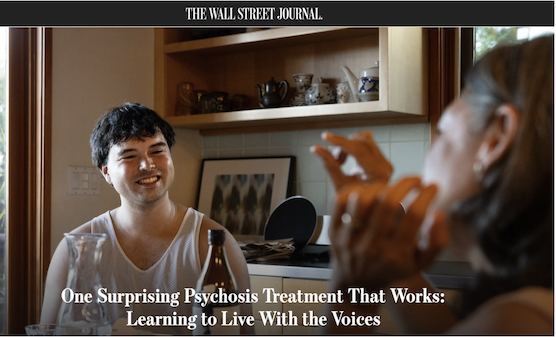
Read about us in The Wall Street Journal.
WSJ covered our successful outcomes in a lengthy front-page feature story.
Read the article →Keep reading
All autism++ pages →- Autism++Autism-only careSupport for autistic young people who are not on a psychosis pathway.For families
- Autism++ASD vs. schizophrenia (clinical)The full clinical differential, including pitfalls, mimics, and catatonia.For clinicians
- Autism++Co-occurring autism & thought disordersWhen both are present: assessment and treatment sequencing.For clinicians
- Autism++Adapted CBT for autismHow we adapt cognitive behavioral therapy for autistic clients.For everyone
- Autism++Autism workplace accommodationsPractical accommodations that keep autistic adults in work and school.For families