
How to Improve Executive Function in Schizophrenia: Practical Steps
What if making a task easier to start matters more than trying harder to finish it? In schizophrenia, difficulty planning, organizing, shifting attention, or solving problems can disrupt everyday routines and feel discouraging. If you’re wondering how to improve executive function in schizophrenia, begin by identifying which part of a specific task is getting in the way, then choose a support that fits the person’s needs and goals.
Small, structured steps can make daily tasks more manageable, but they aren’t a substitute for individualized clinical care. This guide explains what executive function includes and offers practical approaches, such as breaking tasks into steps, using reminders, and building consistent routines. It also explains how cognitive remediation can connect practice with meaningful goals in daily life, education, or work. With guidance from a clinical team, these strategies can become part of a broader psychosis care plan and be adjusted over time.
Key Takeaways
- Executive function includes the thinking skills behind planning, organizing, shifting attention, and following through on goals.
- To explore how to improve executive function in schizophrenia, start with one meaningful task and identify the specific point where it becomes difficult.
- Assessment can clarify which skills need support, while tools such as the WCST measure selected abilities rather than treating them.
- Cognitive remediation and practical supports can complement each other by connecting skill practice with everyday routines and personal goals.
- Coordinated psychosis care can integrate cognitive goals with rehabilitation and other supports. California OnTrack serves teens and adults ages 13-40.
What executive function means in schizophrenia, and how it can affect daily life
Planning a morning, keeping track of what needs doing, and following through can take more effort when executive-function skills are under strain. A routine may involve several small decisions, and losing track of one step can make the whole task feel difficult. These challenges aren’t a measure of intelligence, motivation, or character. They describe specific thinking skills that may need support.
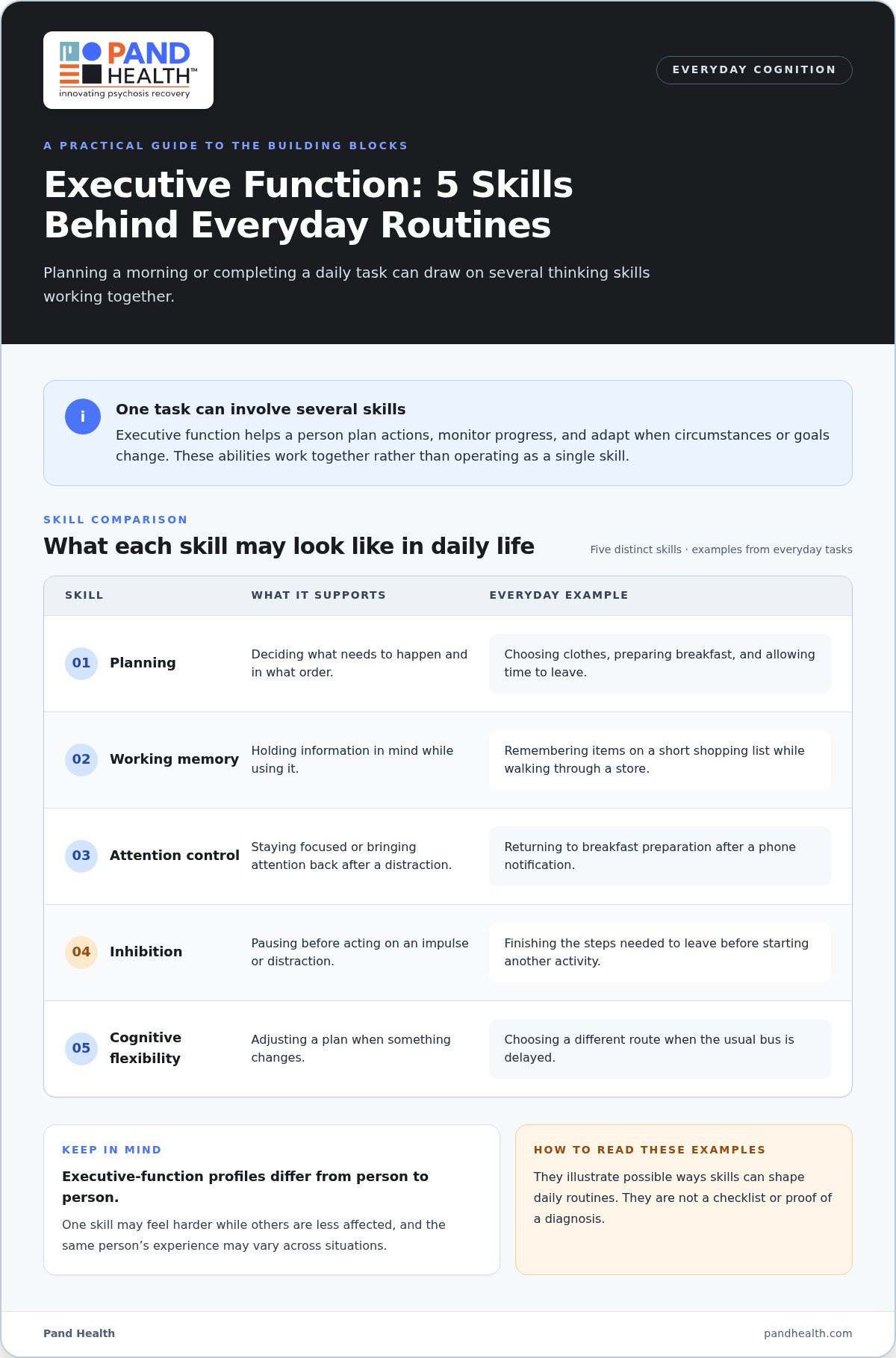
Executive function is the group of thinking skills that helps a person plan actions, monitor progress, and adapt when circumstances or goals change. It supports goal-directed behavior, from getting ready for an appointment to completing a work assignment. These abilities work together rather than operating as a single skill. The overview of executive dysfunction in schizophrenia describes processes such as attention, working memory, planning, and cognitive flexibility.
Which executive-function skills can be affected?
Executive-function profiles differ from person to person. One skill may feel harder while others are less affected, and the same person’s experience may vary across situations. Consider how these abilities might shape a morning routine:
- Planning: Deciding what needs to happen and in what order, such as choosing clothes, preparing breakfast, and allowing time to leave.
- Working memory: Holding information in mind while using it, such as remembering the items on a short shopping list while walking through a store.
- Attention control: Staying focused on a task or bringing attention back after a distraction, such as returning to breakfast preparation after a phone notification.
- Inhibition: Pausing before acting on an impulse or distraction, such as finishing the steps needed to leave before starting another activity.
- Cognitive flexibility: Adjusting a plan when something changes, such as choosing a different route when the usual bus is delayed.
How can these challenges show up in everyday life?
Difficulty organizing steps may contribute to missed appointments or unfinished household tasks. Trouble holding details in mind can make it harder to follow a conversation, remember instructions, or keep track of school or work responsibilities. Shifting between activities may also take extra time, particularly when a routine changes unexpectedly. These are possible experiences, not a checklist or proof of a diagnosis.
Executive-function difficulties can have more than one contributing factor. Stress, sleep, medication effects, symptoms, and the demands of a particular environment may all be relevant, and experiences vary. If these concerns persist or interfere with daily goals, discuss them with a qualified mental-health professional. It can help to bring a specific example, such as which step of a routine is difficult and when the problem tends to occur. Identifying the sticking point is a useful first step when considering how to improve executive function in schizophrenia.
Why schizophrenia can affect planning, attention, and flexible thinking
Executive function relies on several cognitive processes working together. Planning may depend on holding information in mind, focusing on the next step, and adjusting when something changes. If one part of that chain is harder to use, a task can take more effort even when the goal is clear. Research identifies differences in attention, working memory, and executive functioning among some people with schizophrenia, but these findings describe patterns across groups, not a diagnosis of any one person. The National Institute of Mental Health’s overview of cognitive symptoms also discusses challenges with attention, working memory, and executive functioning.
Executive-function experiences vary from person to person, and a diagnosis alone cannot predict which skills will feel difficult or what support will help. Concentration can also be affected by stress, poor sleep, medication effects, other health concerns, or changes in daily circumstances. These factors can overlap. If focus or follow-through changes, discuss the pattern with a qualified mental-health professional rather than assuming a single cause or changing medication without clinical guidance.
What does the prefrontal cortex have to do with executive function?
The prefrontal cortex is part of broader brain networks involved in planning, attention, and controlling actions. It contributes to executive function, but it doesn’t work alone, and no single brain area explains every cognitive difficulty associated with schizophrenia. As an analogy, think of a team coordinating a project: one person may help set priorities, while others handle details and communicate updates. This is only a simplified way to picture connected processes, not a complete model of the brain.
Why cognitive strengths and challenges can differ between people
People have different cognitive strengths, health histories, symptoms, routines, and demands at school, work, or home. Even for one person, performance can shift with fatigue, stress, or changes in the environment. A person who struggles to begin paperwork may still be attentive and capable in a conversation or a familiar activity. Difficulty completing a task doesn’t automatically mean a lack of interest, care, or effort. The task itself may involve several steps, distractions, or demands on memory and attention.
Individualized assessment can help clarify which skills are creating barriers and whether other factors may be contributing. It’s useful to raise concerns when a change disrupts appointments, self-care, relationships, education, or work. A clinician can consider the person’s experience in context and discuss appropriate next steps. This provides a more grounded starting point for considering how to improve executive function in schizophrenia, rather than relying on assumptions based on diagnosis alone.
For people in Los Angeles exploring coordinated psychosis care, Pand Health’s care options can be part of a conversation about support and individual goals.
Which approaches may help: cognitive remediation, practical supports, and assessment
Assessment, cognitive remediation, and everyday supports serve different purposes. An assessment can describe areas of difficulty; remediation provides structured practice; practical strategies make specific tasks easier to manage. These approaches can complement one another, but no single approach is right for everyone. A clinician can help match support to the person’s goals and broader care plan.
| Approach | What it does | What to keep in mind |
|---|---|---|
| Assessment | Examines selected cognitive skills and identifies patterns that may affect functioning. | Tests such as the Wisconsin Card Sorting Test (WCST) measure selected skills. A test can inform care, but it isn’t a treatment by itself. |
| Cognitive remediation | Uses structured activities to practice cognitive skills, often with guidance and feedback. | Practice is not an instant fix or a guaranteed cure. Applying a skill to daily life may take additional support. |
| Compensatory strategies | Uses tools and routines to reduce the demands of everyday tasks. | Supports should fit the person and be adjusted when needs or circumstances change. |
What cognitive remediation is, and what it is not
Cognitive remediation is structured support that gives a person opportunities to practice cognitive skills, such as attention, memory, or problem-solving. It may use guided exercises, including computer-assisted activities, within appropriate clinical care. It isn’t a guaranteed cure, and improvement on a practice activity doesn’t automatically mean the same skill will transfer to a busy kitchen, classroom, or workplace.
Applying a practiced skill in everyday life is a separate step. A person might practice holding information in mind during an exercise, then work with a care team to use a written prompt while preparing for an appointment. Pand Health includes computer-assisted cognitive remediation within broader psychosis care, alongside rehabilitation and other supports.
How compensatory strategies can support everyday tasks
Practical tools can reduce the number of steps someone needs to remember or organize at once. They aren’t evidence of failure; they’re ways to make a task more manageable. Try one support for a specific routine:
- Written checklists: Keep a short list of items needed before leaving home.
- Reminders: Use a calendar alert for an appointment or a planned task.
- Smaller steps: Break a household task into actions, such as gathering supplies, starting, and putting items away.
- Consistent routines: Place frequently used items in the same location or follow a familiar sequence.
Social-cognitive skills, such as interpreting social cues, are related to but distinct from executive function. For some people, social skills training may complement cognitive supports. A practical approach to how to improve executive function in schizophrenia is to consider assessment, skill practice, and real-life supports together, then adapt them with clinical guidance to the person’s needs.
How to build a realistic executive-function practice plan
A useful plan starts with a task that matters to the person, not an idealized schedule with too many demands. Notice where the task gets stuck, then test one practical support. Small goals make practice more manageable by focusing on one clear next step at a time. A treating clinician or care team can help shape the plan, especially if cognitive difficulties are changing or affecting daily functioning.
- Choose one meaningful task. Pick something specific, such as preparing for an appointment, completing one study activity, or sorting a few important papers.
- Identify the sticking point. Is it hard to begin, remember the steps, stay focused, or finish? Naming the difficult part helps avoid treating the whole task as one problem.
- Select one support. Try a brief checklist, a calendar reminder, or placing needed materials where the task will happen. Start with the tool that feels easiest to use.
- Choose a predictable practice time. Connect the task to a familiar part of the day, if that suits the person’s routine. Keep the starting step small and clear.
- Record what happened without judgment. Note whether the task was attempted, which step felt difficult, and whether the support helped. Use this information to adjust the plan, not to rate personal effort.
Turn one everyday goal into smaller actions
For an appointment, a visible sequence might be: find the appointment details, gather what needs to go along, set a reminder, and leave with enough time for the trip. The finish point could be arriving or checking in. A paper checklist may fit one person’s routine; another may prefer a reminder alongside an existing calendar habit. Keep only the steps that make the goal easier to start and follow.
For a study goal, define one bounded action, such as opening the assigned material and completing a short portion. If starting is the barrier, place the materials in view beforehand. If losing track is harder, mark the stopping point on the page. Adjust the size gradually, and consider changes with input from the treating team rather than adding several new demands at once.
Review what helps and when to ask for support
After practicing, make a brief note: what was attempted, where progress paused, and which support was useful. A missed task can still offer information. Perhaps the reminder came at the wrong time, the first step was too broad, or the routine changed. Modify one element and observe what happens. If new or worsening cognitive difficulties interfere with everyday life, discuss them with a qualified clinician.
For goals involving education or employment, connect the practice task to the person’s broader plans. Pand Health’s California OnTrack Work-Study Program supports education and employment goals within psychosis care. Information about the program is available through Pand Health.
How coordinated psychosis care can support cognitive goals in Los Angeles
Executive-function support can be more useful when it connects with the rest of a person’s care and the goals they value. A coordinated approach may bring together psychotherapy, medication management, rehabilitation, and practical support for daily life, education, or employment. The aim is to make cognitive work relevant to the person’s own priorities, not to impose a single measure of progress.
What coordinated specialty care can bring together
Coordinated Specialty Care (CSC) combines clinical and psychosocial supports so care can address more than symptoms alone. Within Pand Health’s California OnTrack, computer-assisted cognitive remediation is provided twice daily alongside high-intensity fitness coaching. These are components of a broader program, not stand-alone solutions. A useful care plan connects practice with individual goals, such as following a daily routine, returning to school, or preparing for work.
Pand Health’s California OnTrack is an augmented CSC program in Los Angeles for teens and adults ages 13-40. In a 2022-2024 cohort of 41 patients, cognitive performance was reported at the 33rd percentile at baseline, the 40th percentile after three months, and the 50th percentile after 12 months. In that same cohort, participation in employment or education was 6% at enrollment, 40% after three months, and 85% after six months. These figures describe the cohort; they don’t establish that the program caused the changes, predict an individual’s outcome, or represent everyone who receives care.
How to explore support for cognitive and everyday goals
Patients and families can bring concrete examples to conversations with the treating team: which daily tasks feel difficult, what matters most to the person, and what support has been useful so far. Goals might involve managing appointments, building a steadier routine, continuing education, or exploring employment. Naming a goal helps the team consider how cognitive practice and rehabilitation could fit into the wider care plan.
For someone working toward school or employment, cognitive support can be considered alongside supported education and employment, rather than treated as an isolated exercise. The question of how to improve executive function in schizophrenia is personal: needs, pace, and meaningful goals differ from one person to another. California OnTrack brings cognitive remediation into a broader model of psychosis care in Los Angeles.
Make the next step personal and manageable
Progress can begin with a conversation about what matters most in daily life. A goal might be feeling more prepared for school, building a steadier routine, or taking a first step toward work. Bring that goal, along with a specific difficulty getting in the way, to a treating professional. Together, you can consider what support fits and how to adjust it as needs change.
Pand Health’s California OnTrack is an augmented Coordinated Specialty Care model. Its 2022-2024 cohort of 41 patients offers a program-specific snapshot of cognitive performance and education or employment participation over time. These cohort findings provide context, not a prediction or guarantee of any individual’s experience.
If you’re exploring care that connects cognitive support with personally meaningful goals, contact Pand Health to learn about California OnTrack in Los Angeles. A thoughtful plan can start with one goal and grow through collaborative clinical guidance.
Frequently Asked Questions
Can executive function improve in schizophrenia?
Executive-function skills may change with appropriate support, but the course and pace differ for each person. If you’re considering how to improve executive function in schizophrenia, set a goal that matters in daily life and review progress with the treating team. For example, someone might work toward managing one recurring responsibility more independently. A clinician can help distinguish skill challenges from other factors and adjust supports without treating setbacks as personal failure.
What exercises help executive function in schizophrenia?
Structured activities that engage attention, planning, or problem-solving may be useful when they match a person’s needs and care plan. For instance, practice following a short set of written instructions, then note which step was easiest to lose track of. A clinician can help select or adapt cognitive exercises and consider how they relate to everyday goals. These activities can support practice, but they shouldn’t replace clinical care or be treated as a guaranteed way to improve functioning.
How does cognitive remediation work for schizophrenia?
Cognitive remediation uses planned activities to practice skills such as attention, memory, and reasoning, often with repetition and feedback. A clinician may help identify which skills to target, review how the person responds, and connect practice with situations outside the exercise. For example, a task that involves remembering information can be paired with strategies for using instructions in a real setting. The approach is one part of a wider care plan, not a quick fix.
Can schizophrenia medication affect executive function?
Medication can affect people differently, and changes in alertness, concentration, or energy may influence how easy it feels to plan and complete tasks. These experiences can also relate to symptoms, sleep, stress, or other health factors, so it’s important not to assume the cause. If cognitive concerns begin or worsen after a medication change, record what you notice and discuss it with the prescribing clinician. Don’t stop or adjust medication without their guidance.
How can family members support executive functioning?
Family members can offer practical support while preserving the person’s choice and independence. Ask what kind of help would be useful before stepping in, and agree on a specific role, such as accompanying someone to an appointment or helping review instructions afterward. Keep communication calm and concrete, and allow time for a response. If everyone is unsure how to help, family psychoeducation or family therapy can offer a setting to discuss supportive approaches together.
Is the Wisconsin Card Sorting Test a treatment for executive-function problems?
No. The Wisconsin Card Sorting Test (WCST) is an assessment tool that examines selected abilities, including aspects of flexible thinking and problem-solving. It may provide information for a clinician’s overall understanding, but taking the test doesn’t itself teach strategies or treat cognitive difficulties. Results need to be interpreted in context and alongside the person’s daily experience. A care team can use assessment findings, when appropriate, to inform a broader discussion of support and goals.
Disclaimer
This article is for information and educational purposes only, and can NEVER replace a proper medical evaluation. If you or a loved one may be suffering from psychosis or the prodomal symptoms of psychosis, get evaluated by a professional as soon as possible. Early diagnosis and treatment can be life-saving.