
LA Work-Study Guide for Mental Health Recovery
What if the greatest risk to your long-term recovery isn't returning to work, but staying away from it for too long? For many young adults in Southern California, the prospect of re-entering a high-pressure environment after a mental health crisis feels like standing at the edge of a cliff. You might worry about resume gaps from hospitalization or fear that the stress of a deadline will trigger a relapse. These concerns are valid, yet professional identity is often the missing piece in the puzzle of lasting wellness.
Finding a specialized work-study program for mental health recovery LA that balances clinical care with vocational goals is essential for a successful transition. We understand that you need more than just a job; you need a supportive environment where your growth is protected. This guide will show you how specialized programs bridge the gap between clinical intervention and professional achievement. You'll discover how the California OnTrack curriculum uses the NIMH NAVIGATE framework to help participants reach an 85% employment or education rate within six months. We will also explore how to gain transferable skills and professional advocacy without compromising your psychological stability or your future career path.
Key Takeaways
- Understand why traditional employment models often fail during early recovery and how to avoid the "all-or-nothing" trap that leads to relapse.
- Learn how a specialized work-study program for mental health recovery LA integrates clinical care with professional coaching to bridge the gap between treatment and career.
- Discover the critical differences between standard financial aid work-study and supported employment models that prioritize long-term functional recovery.
- Identify the essential steps for a safe return to the workforce, beginning with clinical stabilization and objective cognitive assessments.
- Explore the outcomes of the California OnTrack program, which uses the NIMH NAVIGATE framework to help 85% of participants reach their vocational goals.
The Vocational Gap in Mental Health Recovery
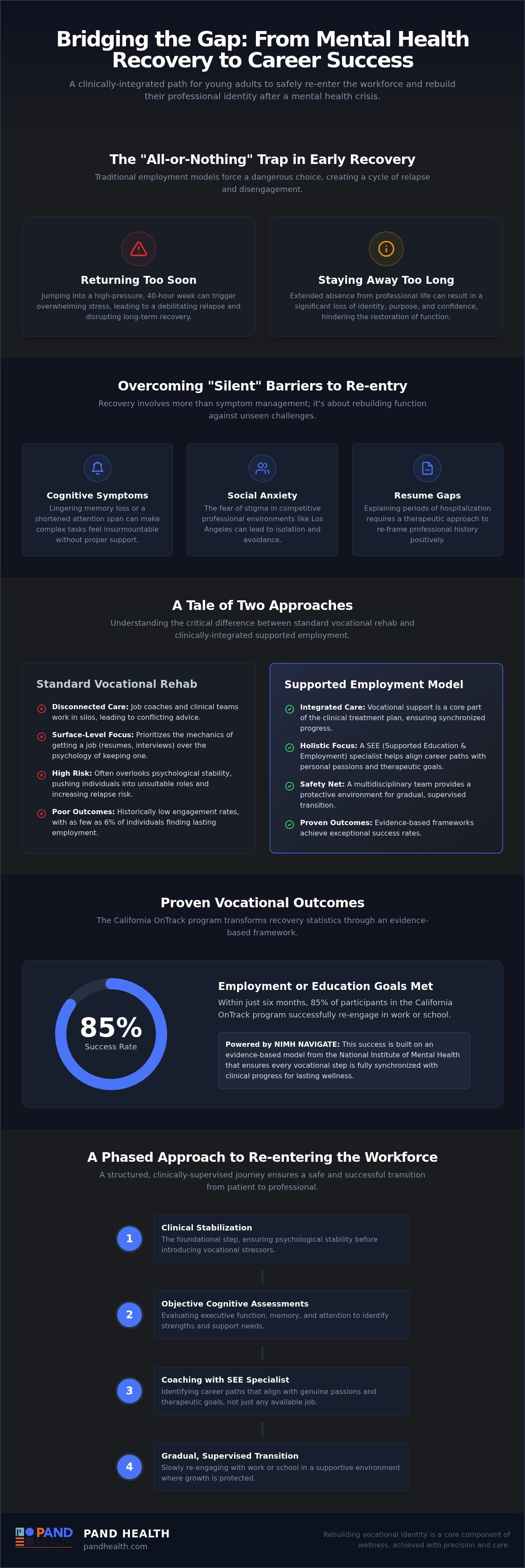
For young adults in Los Angeles, the path back to the workforce after a mental health crisis is often paved with good intentions but lacks a solid foundation. Traditional employment models usually demand an immediate return to high performance, which creates an "all-or-nothing" trap. If you jump back into a forty-hour week too soon, the overwhelming stress can trigger a relapse. Yet, staying away from professional life for too long can lead to a loss of identity and purpose. This is where the need for a specialized work-study program for mental health recovery LA becomes clear. It acts as a necessary bridge, allowing for a gradual, clinically-supervised transition that respects the pace of your healing.
The Los Angeles job market presents unique stressors that can be difficult to navigate during early recovery. The city's fast-paced environment, high cost of living, and the social pressure to "hustle" can be debilitating for someone managing the aftermath of a psychotic episode. Without a steady hand to guide the process, the transition from patient to professional often feels like being thrown into the deep end without a life vest. We believe that vocational identity is a core component of wellness, but it must be rebuilt with precision and care.
Barriers to School and Career Re-entry
Recovery isn't just about the absence of symptoms; it's about the restoration of function. Many individuals face "silent" barriers that aren't always visible to an employer. These include:
- Cognitive Symptoms: Lingering memory loss or a shortened attention span can make complex tasks feel insurmountable.
- Social Anxiety: The fear of stigma in the competitive LA professional scene can lead to isolation.
- Resume Gaps: Explaining a period of hospitalization or intensive treatment requires a therapeutic approach to re-framing professional history.
These challenges don't mean you aren't capable of success. They simply mean your environment needs to adapt to your current needs while you rebuild your executive function.
Why Standard Vocational Rehab Isn't Enough
Most vocational rehabilitation services focus on the mechanics of getting a job, such as resumes and interviews, rather than the psychology of keeping one. There's often a profound disconnect between a generic job coach and your clinical team. Without this coordination, a coach might push for a role that contradicts your psychiatrist's recommendations for stress management. Standard models also frequently overlook the importance of an evidence-based approach to supported employment, which integrates vocational support directly into the clinical treatment plan. This integrated care ensures that professional progress never comes at the cost of your psychological stability. If you're ready to explore a more coordinated path to your career goals, you can reach out to our team at contact us to learn about our specific intake process.
What is a Recovery-Oriented Work-Study Program?
Unlike traditional financial aid packages that focus solely on tuition assistance, a work-study program for mental health recovery LA is a clinically integrated intervention. It combines vocational or educational support with intensive mental health treatment. This model recognizes that professional success is a therapeutic milestone, not just a financial necessity. Historically, individuals in early recovery have faced dismal engagement rates in the workforce, often as low as 6%. By utilizing a structured, recovery-oriented framework, we've seen those numbers transform to an 85% success rate within six months.
The cornerstone of this approach is the NIMH NAVIGATE framework. This evidence-based model ensures that every step toward a career is synchronized with your clinical progress. Instead of working in a vacuum, your vocational goals are supported by a multidisciplinary team. This structure provides a safety net that traditional job boards or campus career centers simply cannot offer. It is a lifeline designed to guide you through the transition from clinical care back to the community.
The Supported Education & Employment (SEE) Model
The SEE specialist serves as your primary advocate and guide. Through motivational interviewing, they help you identify career paths that align with your genuine passions rather than just taking any available job. This is crucial for maintaining long-term engagement and preventing the "all-or-nothing" trap mentioned previously. Your specialist also provides direct workplace advocacy. They help you navigate the complex decision of when and how to disclose a diagnosis to an employer or professor. For students returning to competitive institutions like UCLA or USC, academic counseling ensures your course load remains manageable while you continue your clinical work.
Clinical Integration: The California OnTrack Approach
In our California OnTrack program, therapists and job coaches function as a single, cohesive unit. This synergy allows for real-time adjustments that protect your progress. If symptom management becomes a challenge, your work hours or academic deadlines can be modified immediately to prevent burnout. We also integrate social skills training directly into your professional interactions. This helps you build confidence in networking and workplace communication, turning every shift or class into a rehabilitative experience. If you're looking for a path that respects your health while pursuing your ambitions, you can learn more about our integrated vocational services.
Standard Work-Study vs. Supported Employment in Los Angeles
While many students are familiar with standard university work-study, these programs are designed for financial assistance rather than psychological rehabilitation. A traditional work-study position at a Los Angeles campus is an administrative arrangement; it helps you pay for tuition by providing a part-time job. In contrast, a work-study program for mental health recovery LA focuses on functional recovery. The primary goal isn't just a paycheck, but the restoration of your ability to navigate professional and social environments successfully. This distinction is critical because, for someone in early recovery, the wrong environment can be a significant setback.
Eligibility for these programs also differs fundamentally. Standard work-study relies on FAFSA requirements and financial need. Supported employment, however, is based on a clinical diagnosis and a demonstrated need for vocational intervention. Instead of being supervised by a campus office manager who may not understand your history, you're guided by a therapeutic team. This shift from administrative oversight to therapeutic case management ensures that your work life supports your wellness rather than competing with it. We measure success not just by hours worked, but by your long-term career stability and the absence of symptom exacerbation.
Why Financial Aid Work-Study May Not Fit Recovery Needs
The high-pressure atmosphere of a busy LA college campus can be overwhelming for those recovering from a mental health crisis. Standard work-study positions often have rigid hour requirements that don't allow for essential therapy appointments or the fluctuating energy levels associated with medication adjustments. Most campus supervisors lack specialized training in mental health. They may misinterpret cognitive symptoms, like a lack of focus or slow processing speed, as a lack of effort. This misunderstanding creates a cycle of stress and perceived failure that can jeopardize your progress. Without a clinical safety net, a simple part-time job can quickly become a source of profound anxiety.
The Benefits of a Clinically-Managed Program
A clinically-managed work-study program for mental health recovery LA provides the flexibility you need to heal. Scheduling is tailored to your clinical needs, ensuring you never have to choose between a shift and a psychiatric consultation. These programs emphasize the development of "soft skills," such as metacognition and social interaction, which are often impaired after a psychotic episode. By focusing on these underlying executive functions, you build a more resilient professional foundation. Long-term monitoring is a core component of this model. It allows our specialists to identify early signs of burnout or stress, making proactive adjustments to prevent a relapse or rehospitalization. This steady hand provides the security needed to pursue your ambitions with confidence.
Steps to Re-entering the LA Workforce After a Crisis
Re-entering the professional world is a journey that requires a methodical, step-by-step approach to ensure long-term success. It isn't a race to the finish line; it's a careful reconstruction of your professional identity. For many, a work-study program for mental health recovery LA provides the necessary framework to move through these stages without the risk of burnout. By following a structured path, you can transform a period of crisis into a foundation for resilience and career growth.
The process begins with Clinical Stabilization. Your health is the primary priority, and symptom management must be consistent before vocational goals are introduced. Once stabilized, we move to Cognitive Assessment. This stage identifies your unique strengths and any lingering gaps in executive function, such as memory or focus. Next is Goal Mapping, where you decide whether returning to school or entering the workforce is the right immediate fit. From there, we focus on Resume and Interview Prep. This involves reframing your recovery period as a time of personal development and resilience building. Finally, Gradual Re-entry allows you to start in low-stress, high-support roles that respect your current capacity while you build stamina.
Preparing for the Transition
Success in the workplace often depends on the cognitive "engine" that powers your daily tasks. Utilizing cognitive remediation therapy is an effective way to sharpen your focus and improve processing speed before you clock in for your first shift. Beyond cognitive work, participating in social skills groups allows you to practice professional communication in a safe, non-judgmental space. It's also vital to set realistic expectations with your family support system. Having everyone on the same page about your pace and goals reduces external pressure, allowing you to focus on your progress. If you're ready to begin this structured journey, you can reach out to Pand Health to discuss your specific needs.
Navigating the Los Angeles Market
The Southern California job market is vast, but not every environment is conducive to early recovery. Our specialists help you identify recovery-friendly employers and industries that value diversity and employee wellness. Understanding your rights under the Americans with Disabilities Act (ADA) is also a crucial part of this transition. You have the right to reasonable accommodations that help you perform your job effectively. By using specialized vocational rehabilitation services, you can find job matches that align with both your career ambitions and your clinical requirements. This targeted approach ensures that your first step back into the LA workforce is a stable one.
The Pand Health Advantage: Proven Vocational Outcomes
Our approach at Pand Health is built on the belief that recovery is the expectation, not the exception. In our California OnTrack program, we see this belief manifest in tangible, life-changing results. While traditional vocational models often struggle to keep participants engaged, our specialized work-study program for mental health recovery LA achieves an 85% success rate within just six months. This outcome isn't a matter of luck. It's the result of a rigorous, integrated curriculum that treats the whole person rather than just a set of symptoms. We provide the structure you need to move from a state of crisis to a state of professional achievement.
We've observed a profound shift in the clinical trajectory of our participants. Historically, individuals facing early psychosis might experience inpatient stays averaging 40 days. Through our intensive outpatient model, we've seen those averages reduced to just 7 days. This dramatic reduction is possible because we provide the high-level support usually found in a hospital within a community-based, professional setting. The synergy between daily physical fitness, APA-recommended cognitive remediation, and dedicated job coaching creates a resilient foundation for long-term health. By addressing physical wellness and cognitive clarity alongside vocational goals, we ensure that you're prepared for the demands of the modern workplace.
Beyond Job Placement: Sustaining Long-Term Success
Securing a position is only the first step. To ensure you thrive in your new role, we conduct monthly post-discharge interviews that track your professional growth and identify any emerging stressors. We also provide ongoing educational support for students to help you navigate the complexities of university life in Southern California. A key differentiator in our program is the use of Metacognitive Training (MCT). This specialized training sharpens your workplace decision-making by helping you recognize and correct cognitive biases that can lead to stress or interpersonal conflict. It's about giving you the mental tools to maintain your stability independently.
Join the California OnTrack Community
Recovery flourishes in the context of community. Our program utilizes the Clubhouse model, a supportive environment where you can find purpose and connection among peers who understand your journey. This social integration is just as important as your vocational training; it reminds you that you aren't alone in this process. If you're ready to take the next step, the journey begins with a comprehensive psychiatric evaluation to ensure we tailor our support to your specific needs. We invite you to Contact Pand Health today to discuss your vocational goals and learn how our steady hand can guide you back to professional success.
Reclaiming Your Professional Identity
The transition from clinical recovery to a thriving career is a journey that requires a steady hand and specialized expertise. You don't have to navigate the high-pressure Los Angeles job market alone or settle for a role that risks your stability. By choosing a specialized work-study program for mental health recovery LA, you're investing in a future where professional success and psychological wellness exist in harmony. Our methodology is grounded in clinical excellence, featuring the only program in Southern California to offer APA-recommended Social Cognition and Interaction Training (SCIT) and Metacognitive Training (MCT).
These evidence-based interventions lead to transformative results, including a significant 19-point improvement on PANSS symptom scales. This clinical progress powers our 85% employment and education rate after just six months, proving that recovery isn't just a possibility; it's our standard. If you're ready to bridge the gap between treatment and your career goals, we're here to guide you. We invite you to schedule a vocational recovery consultation at our Los Angeles office. Your potential is still there, and we're dedicated to helping you reach it with confidence and security.
Frequently Asked Questions
What is the difference between federal work-study and a mental health work-study program?
Federal work-study is primarily a financial aid tool designed to help students pay for tuition through part-time campus employment. A work-study program for mental health recovery LA is a clinical intervention that prioritizes functional stability and career longevity. While federal programs focus on administrative placement, our model integrates psychiatric care and job coaching to ensure that your professional responsibilities support your long-term wellness rather than causing burnout.
Who is eligible for the California OnTrack work-study program in Los Angeles?
Eligibility for the California OnTrack program is based on clinical need rather than financial status. We specifically serve teens and young adults who are navigating the challenges of early psychosis or first-episode symptoms. To participate, individuals must undergo a comprehensive psychiatric evaluation at our Los Angeles office. This ensures the program is the right fit for your clinical profile and vocational aspirations, providing a steady hand during your transition.
Can I participate in a work-study program if I am still taking medication for psychosis?
Yes, you can absolutely participate while continuing your medication regimen. In fact, medication management is an integrated component of our clinical framework. Our specialists work closely with your psychiatric team to monitor side effects and adjust your schedule accordingly. This coordination ensures that your work or school hours respect your energy levels and cognitive capacity, preventing the stress that often leads to a relapse.
How much does a vocational recovery program cost in LA?
The cost of a vocational recovery program depends on the specific level of clinical care required and your insurance coverage. Because we provide highly specialized, intensive outpatient services, we work with various providers to make care accessible. We don't provide a flat fee because every treatment plan is individualized. We recommend contacting our intake team for a detailed verification of benefits and a discussion of available funding options.
What kind of jobs are available through mental health supported employment?
Supported employment focuses on competitive jobs in the open market that align with your genuine career interests. We don't limit you to sheltered positions; instead, we help you find roles in diverse LA industries, from creative arts to technology. The goal is to find an environment that matches your current cognitive strengths while providing a path for professional growth. Every placement is supported by ongoing advocacy and workplace training.
How does job coaching for adults with autism differ from psychosis recovery?
While both involve specialized support, job coaching for psychosis focuses heavily on cognitive remediation and managing executive function gaps that follow an episode. For adults with autism, the focus often shifts toward navigating social nuances and sensory environments. In psychosis recovery, we utilize Metacognitive Training (MCT) to help you recognize and correct cognitive biases in the workplace. This ensures you have the mental tools to maintain professional stability.
Will my employer know I am in a mental health recovery program?
Your participation is confidential, and your employer will not know you are in a recovery program unless you choose to disclose that information. We provide expert guidance on your rights under the Americans with Disabilities Act (ADA) and help you decide if disclosure is beneficial for securing reasonable accommodations. Our specialists act as your advocate, helping you navigate these complex professional decisions while protecting both your privacy and your career.
Can I go back to college while in the OnTrack program?
Returning to college is a primary goal for many of our participants, and we provide robust academic support to make it possible. The work-study program for mental health recovery LA includes academic counseling to help you manage course loads at Los Angeles institutions. We assist with securing classroom accommodations and provide the cognitive training necessary to handle the rigors of higher education. This ensures you can pursue your degree safely.
Disclaimer
This article is for information and educational purposes only, and can NEVER replace a proper medical evaluation. If you or a loved one may be suffering from psychosis or the prodomal symptoms of psychosis, get evaluated by a professional as soon as possible. Early diagnosis and treatment can be life-saving.