


Alternatives to Psychiatric Hospitalization in Los Angeles: Compare Costs
When an acute crisis requires 24-hour supervision to reduce immediate risks and support stabilization, hospitalization may be necessary. When that level of supervision isn’t needed, alternatives to psychiatric hospitalization in Los Angeles may include residential care or a partial hospitalization program (PHP), where participants receive structured treatment and return home in the evening.
It’s understandable to weigh cost alongside safety, support, and continuity of care. This guide compares hospitalization, residential treatment, and PHP, including what each involves, how costs may differ, and what to consider in Los Angeles. You’ll also learn how therapy, skills training, psychiatric care, and family involvement can fit into a treatment plan, helping you understand the available options and the support each may provide.
Key Takeaways
- Understand when a crisis may call for hospital-level supervision and when structured care outside a hospital may be appropriate.
- Compare residential treatment, PHP, and IOP by the intensity and schedule of support each provides.
- Weigh costs alongside the level of care, daily structure, and support needed rather than comparing price alone.
- See how therapy, skills training, psychiatric care, and family involvement can contribute to a treatment plan.
- Learn how Pand Health’s psychiatric evaluations and related services can help clarify care needs and support recovery.
When is Psychiatric Hospitalization Necessary?
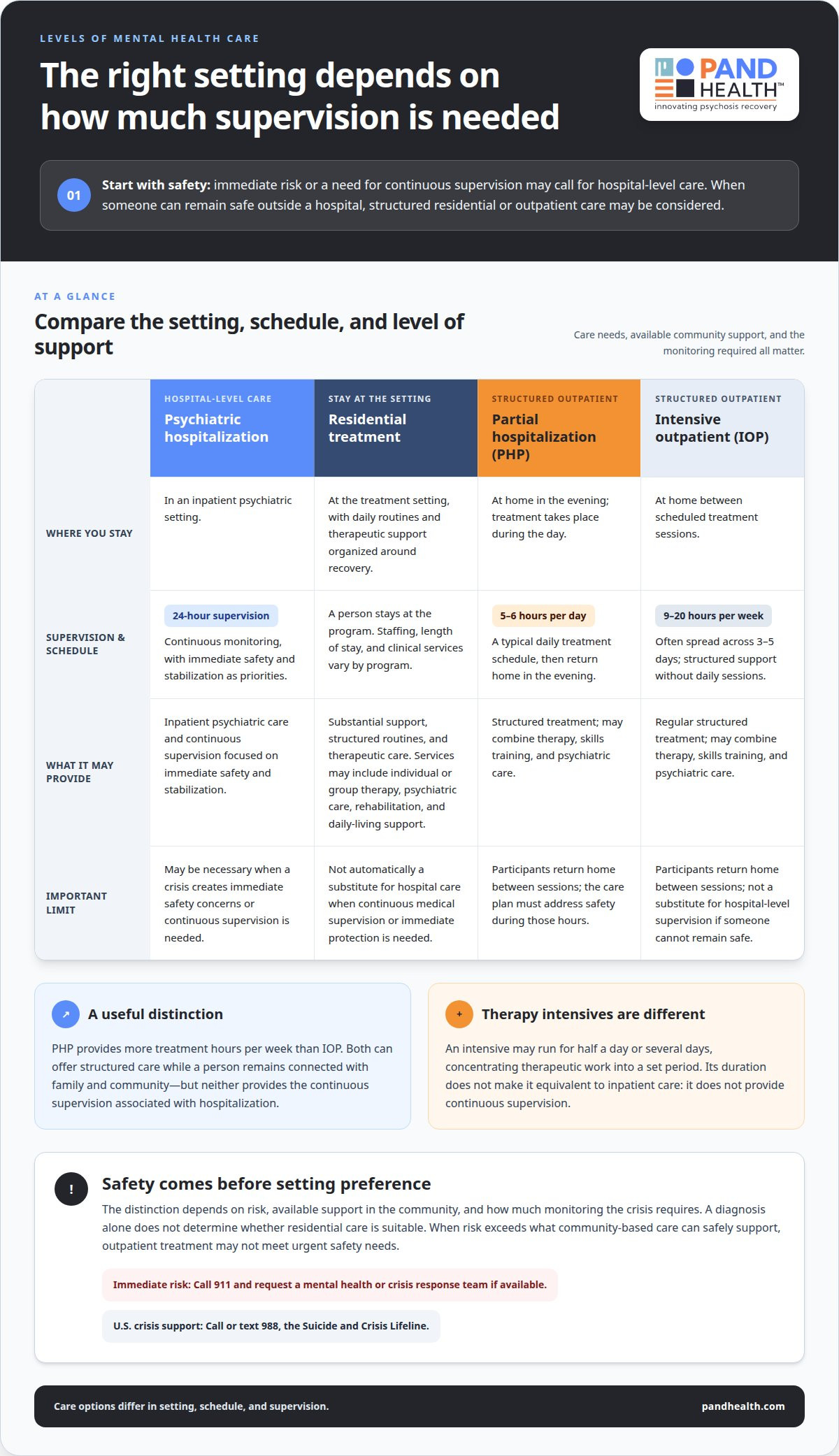
Hospitalization may be necessary when an acute mental health crisis creates immediate safety concerns or a person needs continuous supervision. Inpatient psychiatric care provides 24-hour supervision, with immediate safety and stabilization as central priorities. A less restrictive treatment program may be appropriate when a person can remain safe outside a hospital and attend scheduled care. The distinction depends on risk, support available in the community, and how much monitoring the crisis requires.
If someone is at immediate risk of suicide or harming another person, call 911 and request a mental health or crisis response team if available. For crisis support in the United States, call or text 988, the Suicide and Crisis Lifeline.
Partial hospitalization programs (PHPs) and intensive outpatient programs (IOPs) offer structured treatment while participants remain at home. A PHP typically involves five to six hours of treatment per day, with clients returning home in the evening. IOPs generally provide 9-20 hours of care per week, often spread across 3-5 days. These options can combine therapy, skills training, and psychiatric care while allowing continued connection with family and community.
Intensity matters. A PHP provides more treatment hours per week than an IOP, while an IOP may suit someone who needs regular, structured support without daily sessions. Both can include individual and group therapy alongside psychiatric care. Neither is a substitute for hospital-level supervision when someone cannot remain safe outside an inpatient setting.
Therapy intensives are another format to consider. They may run for half a day or several days, concentrating therapeutic work into a set period. Their duration alone doesn’t make them equivalent to inpatient care: they don’t provide the continuous supervision associated with hospitalization. The level of support needed during and between sessions remains central.
To find same-day outpatient psychiatry, PHP, or IOP in Los Angeles, use your health plan’s behavioral health directory to identify programs, then request a same-day intake. Explain the immediate concern and ask what level of care the program provides. This helps distinguish an outpatient assessment from a program that can provide intensive treatment.
Avoiding hospitalization during a serious crisis can leave urgent safety needs unmet if outpatient contact is limited or delayed. People in IOP or PHP return home between sessions, so the care plan must address safety during those hours. A person may refuse a recommendation for voluntary hospitalization, but cannot refuse involuntary hospitalization. When risk exceeds what community-based care can safely support, the limits of outpatient treatment matter more than convenience.
Residential treatment as an alternative to psychiatric hospitalization
Short-term residential treatment can offer a structured setting for people who need substantial support without prolonged hospitalization. It may help with stabilization and provide a transition to outpatient care. Unlike outpatient treatment, residential care involves staying at the treatment setting, where daily routines and therapeutic support can be organized around recovery. It is not automatically a substitute for hospital care when someone needs continuous medical supervision or immediate protection.
Programs differ in staffing, clinical services, length of stay, and medication coordination. Treatment may include individual or group therapy, psychiatric care, rehabilitation, and support with daily living. Medication decisions belong within a person’s clinical plan and should take the setting’s available medical support into account. California Psychiatric Health Facilities are a distinct inpatient setting. Services can include psychiatry, clinical psychology, psychiatric nursing, social work, rehabilitation, drug administration, and appropriate food services.
The phrase “residential mental health treatment in Los Angeles” can refer to different levels of support. Before considering a program, understand whether it provides short-term stabilization, ongoing residential treatment, or a transition plan to outpatient care. These distinctions matter for someone experiencing anxiety, a thought disorder, or another mental health concern: the setting must match the person’s needs and safety requirements. A diagnosis alone doesn’t determine which setting is suitable.
Residential treatment is generally voluntary when someone chooses to enter and participate. That choice can support engagement, but it doesn’t remove the need to address urgent safety concerns. If a person may harm themselves or someone else, crisis support takes priority over arranging a routine residential referral. For crisis support in the United States, call or text 988, according to the Substance Abuse and Mental Health Services Administration (SAMHSA). The Los Angeles County 24/7 Mental Health Access Line is a county route for mental health support and service navigation; use it for urgent guidance when there’s no immediate danger.
Los Angeles County mental health crisis teams and mobile crisis services respond to crisis situations in the community, assess immediate needs, and help connect people with appropriate support. Their role is different from a residential program, which provides a place to stay and planned treatment. If danger is immediate, call 911 rather than relying on a residential referral or outpatient appointment.
Eligibility for crisis residential or short-term mental health programs depends on a person’s assessed needs, safety, and the program’s level of care. A referral may come through a treating clinician, mental health crisis service, or access line; an assessment can clarify whether residential care or outpatient support fits. Ask about current symptoms, medication needs, and a transition plan. These details help distinguish a residential option from hospital-level care.
Partial hospitalization programs (PHP)
A partial hospitalization program (PHP) provides structured mental health treatment during the day, without an overnight stay. In Los Angeles, PHP programming is typically scheduled five days per week. Participants attend daily sessions and return home in the evening, keeping treatment connected to everyday routines. This structure may suit someone who needs more frequent support than standard outpatient therapy but can safely stay outside a hospital between sessions.
A PHP typically involves five to six hours of treatment per day and over 20 hours per week. Programming may include individual therapy, group therapy, and psychiatric care. These components serve different purposes: individual sessions focus on personal concerns, group work offers structured therapeutic interaction, and psychiatric care supports clinical assessment and treatment. The mix can be tailored to a person’s specific challenges rather than treating every participant’s needs as identical.
The schedule helps explain this level of care. Daily attendance creates regular opportunities to work on emotional and practical concerns, while evenings at home maintain contact with family and community. For example, someone working on a specific challenge can apply insights from a therapy session at home, then return to the program for continued support. A PHP does not provide continuous overnight supervision.
Compared with an intensive outpatient program (IOP), a PHP generally involves more weekly treatment hours and daily sessions. An IOP usually provides 9-20 hours of care per week, often across several days. The distinction is not simply about choosing the more intensive option. It is about matching the level of care to the person’s support needs, safety outside sessions, and ability to attend a structured schedule.
PHPs can help participants maintain family and community connections during treatment. This continuity may matter when recovery involves practicing skills in everyday settings, not only discussing them during sessions. Individual therapy, group therapy, and psychiatric care can be coordinated within the program schedule, while the person returns home each evening. The balance between treatment hours and time at home is central to how PHP differs from residential care.
When comparing programs in Los Angeles, consider the schedule, types of therapy, psychiatric support, and whether daily travel and attendance fit the person’s circumstances. Also consider what support is available outside program hours. PHP is an alternative to hospitalization only when the person’s needs can be met without hospital-level supervision. If safety concerns require continuous monitoring, a daytime program cannot provide that level of care.
Therapy, skills training, and medical support
A treatment plan can combine psychotherapy, practical skills training, and medical support. Each addresses a different part of recovery. For example, someone managing distressing symptoms may explore concerns in therapy, practice a coping skill, and discuss medication needs during clinical care. Inpatient, residential, and outpatient settings can differ in how these supports are scheduled and coordinated.
Psychotherapy gives someone space to work through emotional experiences, identify patterns, and set treatment goals. Individual sessions focus on personal concerns, while group therapy offers structured practice with other participants. Standard outpatient care may involve sessions once or twice a week. More intensive programs can include therapy several days a week, depending on the program and level of care.
Skills training turns treatment goals into practice. A session might focus on communication, coping with stress, or managing daily routines. Practicing these skills can help someone use therapeutic strategies outside appointments, such as during a difficult family conversation. The right focus depends on the person’s challenges, symptoms, and recovery goals, rather than a one-size-fits-all curriculum.
A medication evaluation considers symptoms, current medications, treatment history, and concerns about possible effects. A clinician can use that discussion to inform the treatment plan and determine whether medication support should be part of care. Medication management may include reviewing how someone is responding and communicating relevant changes or concerns to the treating clinician. Medication decisions should be integrated with the broader plan, not separated from therapy and daily functioning.
For example, changes in sleep and concentration may need to be considered alongside emotional distress and daily responsibilities. A coordinated plan can connect psychotherapy goals with medical support, so different parts of treatment address the same priorities. Family involvement may also help clarify changes relatives have observed, while respecting the person’s role in their own care.
Substance use can also affect treatment planning. When mental health symptoms and substance use concerns occur together, clinicians need to understand both rather than considering either in isolation. The relationship between symptoms, substances, medication, and daily functioning can shape the supports included in a treatment program. Clear communication about these factors helps make the plan more relevant to the person’s circumstances.
When comparing care options, consider therapy frequency, access to psychiatric care, skills practice, and support between sessions. An outpatient plan may be less intensive than residential or inpatient care, but its value depends on whether it addresses the person’s current needs. Asking how therapy and medical support work together can help show whether a program offers a coherent path through treatment and recovery.
Cost comparisons with psychiatric hospitalization
Cost comparisons should start with the level of care required, not the lowest daily figure. That figure describes hospitalization, not every person’s total bill or the cost of other treatment. Length of stay, services received, and insurance coverage affect what someone ultimately pays.
Inpatient psychiatric care provides continuous supervision and crisis stabilization in a hospital. Residential treatment involves staying in a treatment setting, while PHP and IOP provide scheduled services without an overnight hospital stay. These programs differ in staffing, intensity, and time spent in treatment. Total cost depends on the program’s structure and how long someone participates.
A lower daily cost doesn’t automatically mean lower total spending. For example, someone may attend outpatient treatment for a longer period, while inpatient care may involve a shorter stay. Comparing one day of inpatient care with one outpatient session misses the broader financial picture. Consider the full treatment period, included services, and additional costs such as travel or missed work.
Insurance coverage can also affect out-of-pocket expenses. Before choosing a behavioral health program, review your plan’s mental health benefits, network rules, deductibles, and copayments. Ask how inpatient psychiatric care, residential treatment, PHP, and IOP are classified under the policy. Compare the options using the same assumptions, including expected treatment frequency and duration.
Peer respite houses provide free short-term stays for people experiencing mental distress. This option is distinct from inpatient facilities and clinical treatment programs. A free stay doesn’t establish that someone’s clinical needs can be safely met there. The central question is whether the setting provides the support required during the crisis.
For a practical comparison, write down the level of care, expected schedule, included services, and coverage for each option. Then compare likely out-of-pocket expenses over the same period. Include the transition plan, since moving from inpatient stabilization to outpatient support may involve several types of care. A plan connecting each stage can make costs easier to understand and prevent comparisons based only on a single day or session.
Cost should inform the decision, but safety and clinical need set its limits. If a crisis requires hospital-level supervision, choosing a less intensive setting solely to reduce expenses may leave urgent needs unmet. For a non-emergency evaluation of treatment needs, discuss care options and the questions shaping your comparison.
Pand Health: Psychiatric evaluation
Pand Health provides psychiatric evaluations to help clarify symptoms, treatment needs, and appropriate next steps. An evaluation may be useful when changes in thinking or behavior raise questions about a thought disorder, autism, or psychosis. It can also help determine whether ongoing outpatient support may fit the person’s needs.
Depending on the person’s needs, care may include social skills training or psychological and social rehabilitation. These supports can address practical and social challenges as part of a broader recovery plan. If psychosis is a concern, an evaluation can guide a conversation about suitable care. Immediate danger calls for emergency support, not a routine appointment.
For a thoughtful discussion of evaluation and support options, contact Pand Health.
Choose a Next Step That Fits the Need
For families considering alternatives to psychiatric hospitalization in Los Angeles, the next step is to clarify what support is needed now and what may help sustain progress. A focused evaluation can bring symptoms, daily challenges, and treatment priorities into one conversation. From there, care planning can consider the person’s goals and the support available around them.
Pand Health offers psychiatric evaluations, evaluations for thought disorders and autism, social skills training, and psychological and social rehabilitation. These services can help address questions about symptoms, social functioning, and ongoing support needs. Families can also participate in psychoeducation to better understand how to support a loved one’s care.
If you’re ready to discuss evaluation or support options, contact Pand Health to discuss care. A clear next step can make a difficult decision feel more manageable, and progress can begin with one thoughtful conversation.
Frequently Asked Questions
Can I refuse hospitalization if a provider recommends it?
You may refuse a recommendation for voluntary hospitalization, but involuntary hospitalization cannot be refused. If you disagree with a voluntary recommendation, ask the provider to explain the safety concerns and discuss other levels of care. Share what support is available at home and any changes in symptoms. If immediate danger is present, call 911; a preference for outpatient care does not replace urgent safety support.
How do I know if I need PHP or IOP?
A PHP generally suits people who need more frequent treatment than an IOP provides, while an IOP offers a less intensive weekly schedule. Consider whether daily attendance is manageable, support is available between sessions, and the person can remain safe outside program hours. For example, difficulty attending daily sessions may affect whether PHP is practical, but safety and clinical needs remain central to the choice.
How is crisis stabilization different from inpatient hospitalization?
Crisis stabilization focuses on an immediate crisis and may last from a few hours to several days. Inpatient psychiatric hospitalization provides continuous supervision and may last from several days to weeks. Stabilization may lead to outpatient care when hospital-level support is no longer needed. The setting and duration depend on the person’s safety needs and the intensity of care required.
What alternatives to psychiatric hospitalization are available in Los Angeles?
Options in Los Angeles include crisis stabilization, short-term residential treatment, PHP, IOP, and standard outpatient therapy. These settings differ in whether someone stays overnight, how often treatment occurs, and how much clinical support is provided. The right option depends on the person’s safety needs and ability to participate. If someone faces immediate danger, call 911 rather than relying on a scheduled outpatient appointment.
What are the differences between psychiatric inpatient care, crisis residential programs, and psychiatric urgent care in Los Angeles?
Psychiatric inpatient care provides 24-hour supervised treatment in a hospital. Crisis residential programs offer a short-term place to stay and support stabilization outside a hospital setting. Psychiatric urgent care refers to urgent assessment or crisis support, not necessarily an overnight stay. These labels can describe different services, so the key distinction is the level of supervision and whether the setting can address immediate safety needs.
How much do crisis residential, outpatient, and other psychiatric alternatives cost in Los Angeles, and does Medi-Cal cover them?
Costs for other options depend on the program, treatment schedule, and coverage. Medi-Cal coverage depends on eligibility and the specific service; don’t assume every residential or outpatient option is covered. Review the applicable benefits and any authorization requirements before comparing expected out-of-pocket costs.
What are California’s rules for involuntary psychiatric holds, and what alternatives can be offered?
In Los Angeles County, a person may be placed on a 5150 hold when they meet criteria involving danger to themselves, danger to others, or grave disability. A hold is involuntary, so the person cannot refuse it. If the situation does not require involuntary detention and the person can remain safe, crisis stabilization or outpatient care may be considered. Immediate danger requires emergency support.
Disclaimer
This article is for information and educational purposes only, and can NEVER replace a proper medical evaluation. If you or a loved one may be suffering from psychosis or the prodomal symptoms of psychosis, get evaluated by a professional as soon as possible. Early diagnosis and treatment can be life-saving.