


OnTrack for Teens in Los Angeles: Age Eligibility and Applications
Age eligibility can be the first question families face when considering OnTrack for teens in LA. A clear understanding of who the program is intended for and how applications work can help families approach the next step with greater confidence.
It’s understandable to want clear, practical answers before seeking support for a teen. This article explains who California OnTrack for Teens is designed for and what families in Los Angeles can expect when exploring care.
You’ll find a focused guide to eligibility and application considerations, so you can better understand whether this program may be a fit for your teen and what questions to keep in mind as you explore care.
Key Takeaways
- Learn what age-eligibility details matter when considering a teen program in Los Angeles.
- Understand the application information families may need to prepare and the factors that can shape next steps.
- Get a clearer picture of how location, service area, program hours, and appointment options affect access.
- Explore the mental health and substance-use concerns relevant to OnTrack for Teens.
- See how California OnTrack for Teens, social skills training, and psychological and social rehabilitation may support a teen’s care.
Application and eligibility information
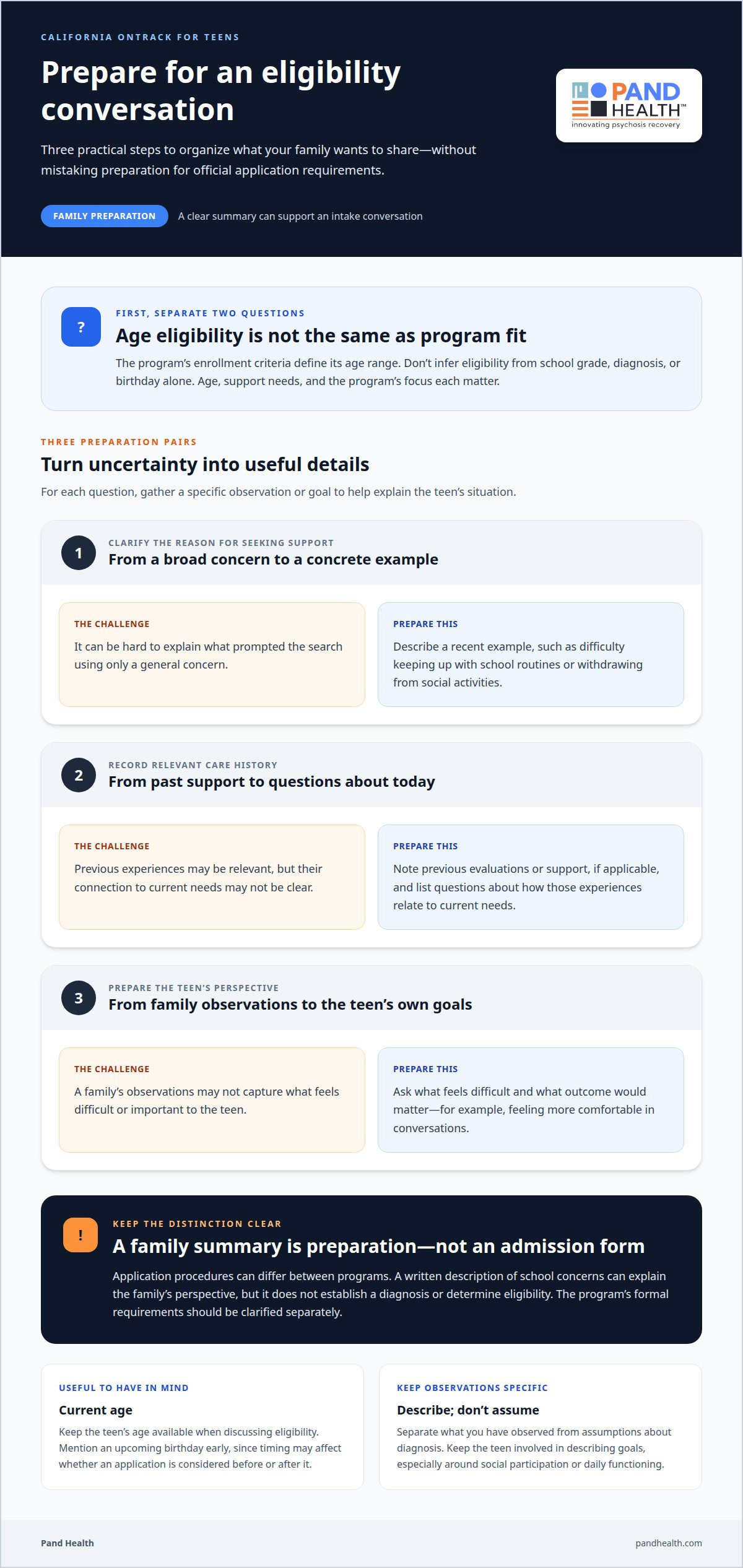
Families considering a teen program need to distinguish formal eligibility from preparation for an application. The exact age range is determined by the program’s enrollment criteria, not by the phrase “for teens” alone. Don’t infer eligibility from a teen’s school grade, diagnosis, or birthday without checking how the program defines its age threshold. For example, two students in the same grade may have different ages. Age is one part of the question; the program’s focus and the teen’s support needs also matter.
Before starting an application, write down the information that will help explain the teen’s situation. This preparation is useful for an intake conversation, but it is not a list of official application requirements. Include the teen’s current age, the main concerns prompting the search, and what support the family hopes to find. A concrete example could be noting changes in school participation alongside a goal of strengthening communication with peers. Keep observations specific and separate them from assumptions about diagnosis.
Families can organize their preparation in three practical steps:
- Clarify the reason for seeking support. Describe a recent example, such as difficulty keeping up with school routines or withdrawing from social activities.
- Record relevant care history. Note previous evaluations or support, if applicable, and identify questions about how those experiences relate to current needs.
- Prepare the teen’s perspective. Ask what feels difficult and what outcome would matter to them, such as feeling more comfortable in conversations.
These steps help families communicate clearly without treating a self-prepared summary as an admission form. Application procedures can differ between programs, so distinguish information a family gathers for discussion from documents or steps the program formally requires. For instance, a written description of school concerns can explain the family’s perspective; it does not establish a diagnosis or determine eligibility. Keep the teen involved in wording goals, especially when the application concerns social participation or daily functioning.
What do families and teens say about OnTrack for Teens? Every family’s experience is different. When considering feedback, look for specific accounts of communication, participation, and whether the program’s approach addressed the person’s needs, rather than relying on a broad positive or negative label.
What are the risks, limitations, or alternatives to OnTrack for Teens? A program may not match every teen’s age, needs, or preferred type of support. Families can consider whether a different approach, such as individual support or family-focused care, better addresses their priorities. Clear goals and an open discussion of the teen’s needs can help make that distinction.
Program age eligibility
Age eligibility is a practical starting point, but it doesn’t establish whether a program fits a teen’s needs. Families should distinguish a program’s stated age range from clinical suitability. A young person’s developmental stage, current concerns, and goals can all shape whether the program’s focus makes sense. For example, a teen seeking help with social participation may have different priorities from one whose main concern is maintaining school routines.
Don’t use grade level as a substitute for age. Students in the same grade can be different ages, and school placement alone doesn’t show whether someone meets an enrollment threshold. Instead, keep the teen’s current age and date of birth available when discussing eligibility. If a birthday is approaching, mention that timing early, since it may affect whether an application is considered before or after the birthday.
Age is one part of the fit discussion. Families can also clarify:
- Current needs: Describe the changes that prompted the search, such as reduced participation in class or difficulty connecting with peers.
- Desired support: Identify a concrete goal, like improving confidence during group conversations or returning to regular school activities.
- Developmental fit: Consider whether the teen is ready to participate in the program’s structure and communicate their own priorities.
- Timing: Explain any upcoming birthday, school transition, or change in living arrangements that could affect participation.
These details can help organize the discussion without turning family observations into a diagnosis. A parent might report that a teen has stopped attending social activities; that describes a concern, but doesn’t explain its cause. The teen’s perspective matters, too. They may describe anxiety about conversations, feeling overwhelmed, or wanting more independence. Those distinctions can help shape a useful conversation about support.
How does OnTrack for Teens compare with other teen treatment programs in Los Angeles? Compare the stated age range, treatment focus, participation expectations, and how each program supports the teen’s goals. The right fit depends on those differences and the young person’s needs, rather than a general ranking.
A simple comparison can help families weigh options. Record each program’s age criteria, main focus, format, and next step. Keep unanswered questions separate from known details, then use them in the eligibility conversation. This helps avoid assuming that programs serve the same age group or provide the same support. Start with a clear picture of your teen’s age, needs, and goals.
OnTrack for Teens Los Angeles Locations and Service Areas
For a Los Angeles family, location means more than a city name. A program’s physical office and the communities it serves are separate details. An address tells you where an appointment may take place; it doesn’t, by itself, define who can enroll. Keeping those questions separate helps families understand whether the program’s location and reach suit their circumstances.
Los Angeles covers a wide area, so travel can shape a teen’s ability to participate. A family in the San Fernando Valley, for example, may face different travel demands from a family near Downtown Los Angeles. These examples illustrate distance, not confirmed service boundaries. Consider the teen’s regular routes, school schedule, and the adult who would coordinate transportation before deciding whether a location is practical.
To plan for location and attendance, consider three practical points:
- Appointment address: Ask where in-person meetings take place and whether the address applies to every program activity.
- Geographic eligibility: Ask which Los Angeles communities fall within the program’s service area, rather than assuming the whole county is covered.
- Participation format: Ask whether activities require travel to one site or take place across multiple settings.
These points can prevent a common misunderstanding. A program may use “Los Angeles” to describe its location or audience, but that label alone doesn’t tell a family whether a particular neighborhood qualifies. For example, a teen living in the city and a teen living farther away may have different transportation needs, even if both families describe their location as Los Angeles. Eligibility and travel arrangements should be discussed as related but separate issues.
Families can also map the practical journey before planning participation. Note the starting neighborhood, the likely destination, school dismissal time, and who can accompany the teen. If a caregiver works near Culver City while a teen attends school in another part of Los Angeles, those daily routines may affect which appointment arrangements are workable. This exercise helps identify concrete logistics without assuming a specific office location or route.
When discussing service areas, use the teen’s actual home community rather than a broad label such as “greater LA.” Then ask how that location affects enrollment and attendance. For a family comparing options, a clear answer should distinguish the program’s address, its geographic eligibility, and the places where activities happen. That distinction makes it easier to judge access without mistaking a Los Angeles reference for a promise of coverage across every neighborhood.
What are the program hours, wait times, and appointment options?
Program hours, the first appointment, and the start of ongoing services are separate scheduling details. Ask about each before planning around school, work, or transportation. An initial appointment does not necessarily mean regular participation begins immediately. Clarify the expected steps from the first conversation to program activities.
Hours matter because a teen’s school day and family routines shape attendance. Ask which days and times activities take place, how long visits typically last, and how the schedule works during school breaks. If your teen has classes until late afternoon, an earlier appointment may conflict. Caregiver availability and travel time matter, too.
Wait time can refer to more than one point in the process. Separate the expected wait for an initial appointment from the wait to begin regular participation. The timing may depend on intake steps, program capacity, schedule fit, and whether the information needed to understand the teen’s needs is available. A family can keep those stages clear with a short list:
- First appointment: Ask what the appointment covers and what information helps prepare for it.
- Next step: Clarify what happens after the initial discussion and how the next appointment is arranged.
- Program start: Ask what determines the start date and whether scheduling depends on a particular group or activity.
- Ongoing schedule: Find out how families receive schedule changes and whom to contact about conflicts.
Appointment format is another practical detail. Ask whether an appointment is in person, remote, or offered in more than one format. Don’t assume that an initial meeting and later activities use the same format. For instance, a family may be able to discuss information remotely while the teen’s program activities follow a different arrangement. Knowing the format helps caregivers plan transport, privacy, and a suitable place for the teen to participate.
A calendar can help you assess whether the schedule is practical. Mark school hours, recurring commitments, caregiver availability, and travel time, then compare them with the program’s appointment options. If your teen has a regular school support meeting, mention the conflict when discussing scheduling. Track the timing of each stage separately so an initial appointment isn’t mistaken for the start of regular participation.
Clear information about hours, scheduling, and appointment format helps families plan around a teen’s school week and available support. Treat each detail separately rather than assuming “availability” means a single date.
For Student 2 Student, participants commit up to 140 hours during one school semester. Participants spend 20 hours on job skills and professional development and can complete up to 120 hours of hands-on service.
What mental health or substance-use issues does OnTrack for Teens treat?
California OnTrack for Teens focuses on early psychosis care. That focus does not mean every emotional, behavioral, or substance-use concern falls within the program’s scope. Describe what prompted your search, such as changes in thinking, social participation, school functioning, or cannabis use, and ask how it relates to the program’s care.
Psychosis is not the same as any single diagnosis or difficulty. Avoid diagnosing a teen based only on changes in behavior or school performance. Instead, share what you have observed and when it began. Your teen may describe the experience differently, and both perspectives can help inform an evaluation and discussion of support.
Substance use requires careful distinction, too. Cannabis-related psychosis is a specific concern; it isn’t interchangeable with all cannabis use or every substance-use problem. The teen program’s psychosis focus should not be taken as confirmation that it treats substance use on its own. If cannabis use is part of the concern, describe that directly and ask how it relates to the teen’s care needs.
Families can prepare a clear summary by separating observations from interpretations:
- Describe the change: Note a concrete example, such as a shift in school attendance or social activity.
- Give context: Explain when the change began and whether it coincided with a school or home transition.
- Include the teen’s view: Record the teen’s own description of what feels difficult or different.
- Mention substance concerns plainly: If cannabis or another substance is relevant, state that without assuming it explains every symptom.
A program’s focus, an evaluation, and a diagnosis are different things. Your account can help identify questions that need attention, but it cannot establish the cause of a teen’s experience. Reduced participation, for example, can have several explanations. A clinical evaluation considers the broader picture rather than treating one behavior as proof of a specific condition.
When psychosis-related concerns are part of the picture, ask how the teen’s needs are assessed and whether substance use changes the care discussion. Families can discuss a teen’s psychosis-related needs to understand the next step. Clear, specific information helps keep the conversation focused on the teen rather than assumptions about a label or a single behavior.
Pand Health: California OnTrack for Teens
Pand Health offers California OnTrack for Teens for families exploring support for a teen’s mental health needs. The program may be a relevant next step when concerns involve psychosis-related care, social participation, or rehabilitation goals. Social skills training and psychological and social rehabilitation can address different areas of support, while an evaluation for thought disorders and autism can help clarify concerns.
Families can begin a conversation by sharing what changes they’ve noticed, what the teen hopes to work toward, and what questions remain about eligibility or application steps. This gives the discussion a clear focus without assuming that one program fits every situation. To discuss your teen’s needs and possible next steps, contact Pand Health.
Choose a Next Step That Feels Clear
Deciding whether OnTrack for teens in LA may suit your family is one part of moving forward. Identify what matters most to your teen and bring those priorities into a conversation about care. Goals might include social connection, daily functioning, or a clearer understanding of thought-related concerns.
Pand Health offers social skills training, psychological and social rehabilitation, and evaluations for thought disorders and autism. These services address different needs, so your family’s concerns and goals can help shape where to begin. You don’t need to have every answer before asking about support.
Contact Pand Health for guidance about the options that may align with your teen’s needs. A thoughtful conversation can help your family identify a considered next step and move forward with greater clarity.
Frequently Asked Questions
What is OnTrack for Teens in Los Angeles?
OnTrack for Teens is an outpatient Coordinated Specialty Care program for teens experiencing early signs of psychosis or considered clinically high-risk. In Los Angeles, this team-based approach brings clinical and practical supports together rather than focusing on a single part of a teen’s life. For example, care may address mental health needs alongside school participation and family support. The program is intended for teens ages 13 to 17.
What services and programs does OnTrack for Teens provide?
California OnTrack for Teens brings together therapy, psychiatry, case management, and education support. This coordinated approach addresses clinical needs while supporting participation in school and everyday routines. Family psychoeducation can also help families understand psychosis-related concerns and support recovery. Pand Health supplements existing care teams; it does not replace them.
Who is eligible for OnTrack for Teens in LA?
OnTrack for Teens is designed for teens ages 13 to 17 who are experiencing early psychosis or are clinically high-risk for psychosis. Age alone doesn’t describe the program’s intended population; the young person’s mental health needs are also relevant. For example, a teen’s concerns about changes in thinking or functioning may be important to discuss during an eligibility conversation. A diagnosis should not be inferred from one behavior or observation.
How can teens enroll or get referred to OnTrack for Teens?
Contact Pand Health to discuss your teen’s needs and learn about the enrollment process. You can include a clinician or another support person already involved in your teen’s care. Before reaching out, note your main concerns, current supports, and questions about the program. This gives the conversation a practical starting point; a referral is not required.
How does OnTrack for Teens compare with other teen treatment programs in Los Angeles?
Compare programs by their stated age range, treatment focus, participation expectations, and how they address the teen’s goals. The best fit depends on the young person’s needs; no program can be ranked without considering those differences.
Disclaimer
This article is for information and educational purposes only, and can NEVER replace a proper medical evaluation. If you or a loved one may be suffering from psychosis or the prodomal symptoms of psychosis, get evaluated by a professional as soon as possible. Early diagnosis and treatment can be life-saving.