

Crisis care vs outpatient psychosis care, which is best.
The standard response to a mental health emergency in Southern California is often a frantic trip to the ER, but the most immediate choice isn't always the most effective for long-term health. While crisis psychosis care Los Angeles facilities provide vital stabilization, they are often just a temporary stop rather than a bridge to a full life. It's understandable to feel overwhelmed by the stress of the system or the fear that a single episode leads to permanent institutionalization. You want more than just a discharge paper, you want your loved one back.
We understand the emotional toll that rehospitalization takes on a family. This guide will help you navigate the complexities of local crisis care while revealing why augmented specialty care is the primary driver of lasting recovery. We'll explore the critical differences between emergency stabilization and evidence-based outpatient programs like California OnTrack. You'll discover how a structured roadmap can reduce the risk of future episodes and return individuals aged 13 to 40 to their classrooms and careers. Recovery shouldn't be a rare success. With the right specialized intervention, it becomes the standard expectation.
Key Takeaways
- Understand why traditional crisis psychosis care Los Angeles options focus on immediate stabilization, while augmented specialty care targets permanent recovery.
- Learn how the Coordinated Specialty Care model utilizes a team-based approach to provide a lifeline for families navigating early psychosis.
- Discover the importance of specialized curricula like cognitive remediation and social cognition training in restoring a sense of normalcy.
- Find out how integrated work and study programs empower individuals aged 13 to 40 to return to their goals without delay.
- Explore the evidence-based methods that help reduce inpatient stays and maintain a significantly lower rehospitalization rate.
Understanding Crisis Psychosis Care in Los Angeles
A psychosis crisis represents a profound breakdown in an individual's ability to distinguish reality from internal experiences. It often manifests through hallucinations, such as hearing voices others don't hear, or delusions, which are fixed, false beliefs that persist despite evidence. Finding crisis psychosis care Los Angeles often feels like navigating a labyrinth. The local mental health landscape is vast and fragmented, leaving families feeling isolated during the most terrifying moments of their lives. At Pand Health, we believe the narrative around these conditions must change. We operate under the firm conviction that recovery is the expectation, not the exception. The most critical factor in achieving this is addressing First Episode Psychosis (FEP) within the earliest possible window, as delay can lead to more complex challenges later.
Signs of a Psychotic Crisis vs. Early Warning Signs
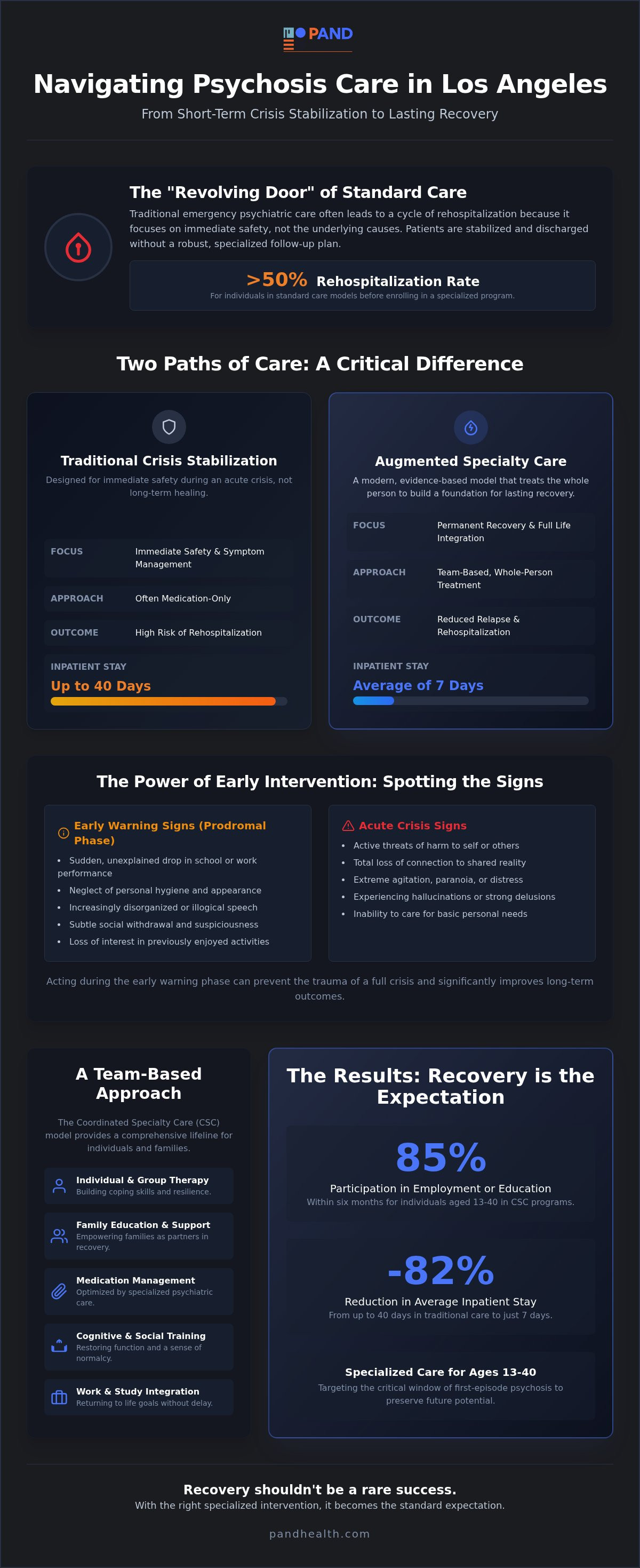
Differentiating between an acute crisis and the prodromal phase can be life-saving. An acute crisis involves imminent danger, a total loss of reality, or extreme agitation. However, early warning signs often appear months before a full-blown crisis occurs. Families might notice a sudden, unexplained drop in grades, neglect of personal hygiene, or increasingly disorganized speech patterns. Subtle social withdrawal is another hallmark, where a once-vibrant young person becomes suddenly reclusive or suspicious. Clinical studies into Early Intervention in Psychosis demonstrate that addressing these symptoms early significantly improves long-term cognitive performance and social outcomes. Acting during this window can prevent the trauma associated with a full-blown psychotic break and preserve the individual's future potential.
The "Revolving Door" of Emergency Psychiatry
Traditional emergency rooms and stabilization units in Los Angeles are designed for immediate safety, not long-term healing. Patients are often admitted for a few days to manage a crisis, medicated, and then discharged without a robust or specialized follow-up plan. This creates a "revolving door" effect where the underlying issues remain unaddressed. In standard care models, rehospitalization rates often exceed 50% for individuals before they enroll in a specialized program. While an ER can provide a necessary pause in an emergency, it rarely offers the psychological and social rehabilitation needed to thrive. Families need more than a temporary discharge. They need a comprehensive, outpatient-focused solution that bridges the gap between emergency intervention and long-term wellness.
Crisis Stabilization vs. Long-Term Psychosis Recovery
Inpatient hospitalization serves a specific, vital function: immediate safety. When a person is in the throes of a psychotic break, the priority is to prevent harm. However, many families mistake this stabilization for the entirety of treatment. While traditional crisis psychosis care Los Angeles facilities often result in stays lasting up to 40 days, Pand Health focuses on optimizing this period. By coordinating with local providers, we help reduce the average inpatient stay to just 7 days. This rapid transition is intentional. Long-term institutionalization can inadvertently cause trauma and disconnect individuals from their communities. Recovery begins the moment stabilization starts, shifting the focus from simply managing symptoms to restoring a sense of self.
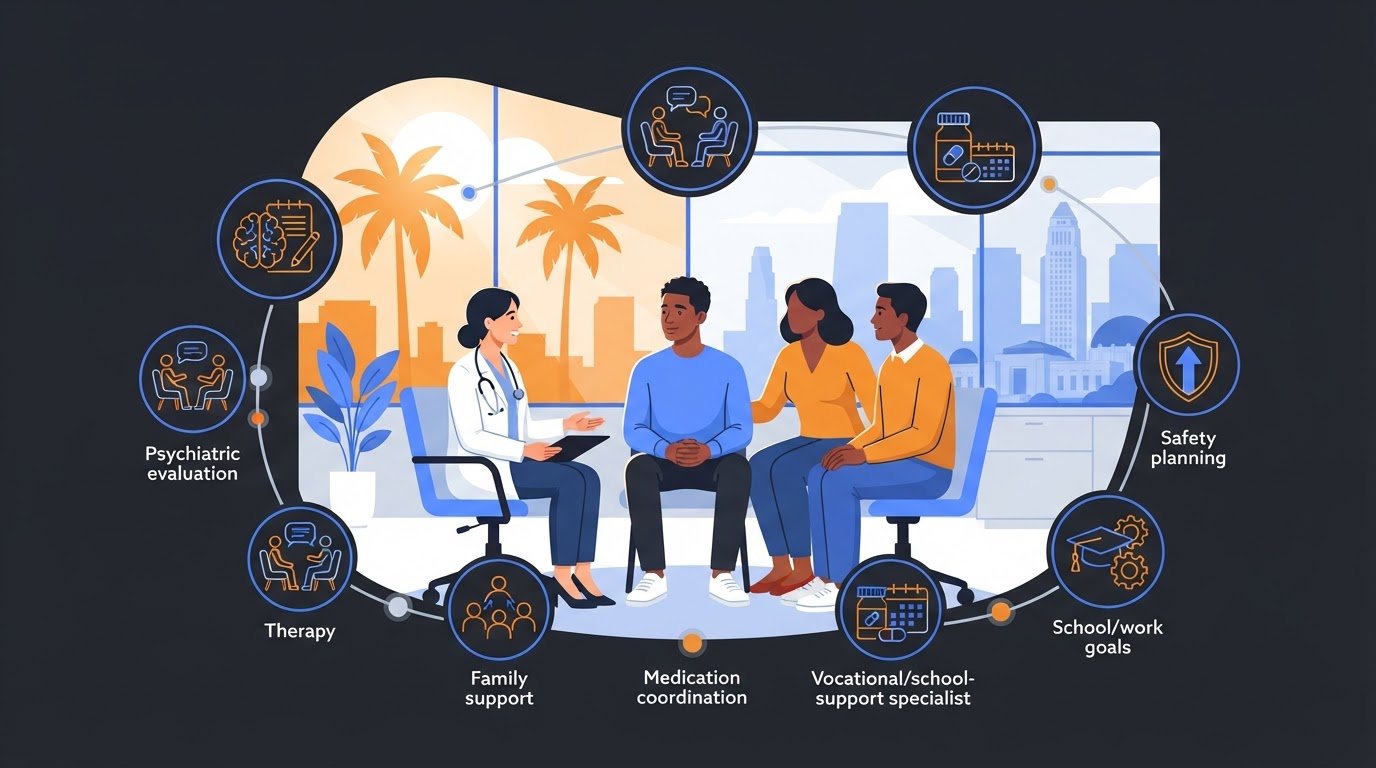
A medication-only approach is often the default in emergency crisis psychosis care Los Angeles settings, yet it rarely addresses the cognitive and social challenges that follow a crisis. Without intensive psychosocial support, the risk of a revolving door remains high. Effective treatment requires Coordinated Specialty Care (CSC), a team-based model that treats the whole person rather than just the diagnosis. This approach ensures that the transition from a hospital bed to a classroom or workplace is seamless. For individuals aged 13 to 40, this model is particularly effective, often leading to an 85% participation rate in employment or education within six months.
When is Inpatient Care Necessary in LA?
Determining the right level of care is a heavy burden for families. Inpatient care is necessary when there are active threats to self or others, or when an individual is unable to care for their basic needs due to severe disorientation. If you're unsure if a hospital visit is required, you might find clarity in our guide: Is the ER necessary? At Pand Health, we work closely with local hospitals to ensure that once a patient is stable, they can move quickly into our intensive outpatient environment, where the real work of recovery happens.
The Limitations of Traditional Outpatient Therapy
Standard once-a-week talk therapy is frequently insufficient for those navigating schizophrenia-spectrum disorders. These complex conditions require more than just a 50-minute session; they demand a multi-modal strategy. Generic therapy often lacks the specialized focus of our California OnTrack program, which provides up to 32 hours of intensive support per week. A critical component of this success is family psychoeducation, which empowers loved ones to become active partners in preventing relapse. If you feel that standard care isn't providing the progress you hoped for, reach out to our team to discuss a more comprehensive path forward.
The Augmented Coordinated Specialty Care (CSC) Model
The transition from hospital to home requires a bridge that standard models often fail to provide. Coordinated Specialty Care (CSC) is a team-based, evidence-driven approach specifically designed for early psychosis. While many programs in the region utilize the NIMH NAVIGATE framework as their foundation, Pand Health offers a significantly augmented version of this model. We provide between 24 and 32 intensive outpatient hours per client, which is a level of support rarely found in traditional crisis psychosis care Los Angeles. This high-touch environment makes us the only provider in Southern California delivering the full suite of APA-recommended cognitive remediation, Metacognitive Training (MCT), and Social Cognition and Interaction Training (SCIT). By increasing the frequency and depth of these interventions, we ensure that the progress made during stabilization isn't lost.
Metacognitive Training (MCT) and SCIT
Metacognitive Training (MCT) empowers individuals to "think about their thinking." It's a specialized process that helps patients identify and correct the cognitive biases that often lead to delusions or paranoia. By understanding the mechanics of their own thoughts, clients regain a sense of control over their reality. Social Cognition and Interaction Training (SCIT) builds on this by improving the interpersonal skills necessary for healthy relationships. Every MCT therapist at our facility is a certified instructor, ensuring that the clinical application of these techniques is both precise and effective. These sessions don't just teach coping; they rebuild the social confidence that psychosis often erodes.
Technology-Enhanced Cognition and Fitness
True recovery involves rebuilding the brain's executive functions, which can be impacted during a psychotic episode. We utilize computer-assisted brain training to target memory, attention, and problem-solving skills. This cognitive remediation is paired with high-intensity fitness coaching, as physical exercise is a proven catalyst for neuroplasticity. The data reflects the power of this combination. Over a 12-month period, our clients typically see their cognitive performance rise from the 33rd to the 50th percentile. This isn't just about symptom management; it's about restoring the mental sharpness needed to succeed in school and work. By integrating physical health with cognitive training, we provide a holistic path toward long-term stability that moves beyond standard crisis psychosis care Los Angeles.
Navigating the Recovery Journey: What to Expect
The shift from acute stabilization to active recovery is a delicate phase that requires a steady hand. While crisis psychosis care Los Angeles resources focus on the immediate storm, the journey back to a meaningful life is built on consistent, specialized support. We don't view medication as a standalone fix. Instead, we integrate psychiatric management with intensive psychosocial care to ensure that biological stability supports psychological growth. This holistic approach allows for indefinite program enrollment, providing a continuous safety net that adapts to the individual’s changing needs as they progress toward their goals.
The California OnTrack Timeline
The California OnTrack program follows a methodical three-step process to ensure no stage of recovery is rushed. It begins with a comprehensive psychiatric evaluation and a detailed assessment for thought disorders or autism. Once we establish a baseline, we move into intensive outpatient stabilization using specialized modalities like Cognitive Behavioral Therapy for Psychosis (CBT-P) and Dialectical Behavior Therapy for Psychosis (DBT-P). The final phase is functional reintegration through our Work-Study Program, which serves as the practical bridge back to daily life.
Achieving Functional Gains: School and Work
Success in recovery is measured by functional gains, not just the absence of symptoms. The data is clear. While only 6% of our participants are employed or in school at the time of enrollment, that number climbs to 85% after just six months of participation. This transformation is made possible through dedicated workplace and school advocacy. Our case managers work directly with institutions to secure accommodations, ensuring that a mental health challenge doesn't end an academic or professional career.
Reconnecting with peers and colleagues requires more than just clinical stability; it requires practical interpersonal tools. Our social skills training provides the clinical framework needed to navigate complex professional environments with confidence. We focus on the nuances of social interaction that psychosis can often disrupt, helping clients rebuild their social capital. If you're ready to move beyond temporary stabilization toward a future of genuine independence, contact us to explore our specialized programs.
Why Pand Health is the Standard for Psychosis Care in LA
Choosing the right path for recovery is a decision that shapes the future of a family. While many options for crisis psychosis care Los Angeles focus on the immediate management of symptoms, Pand Health provides a data-driven alternative that prioritizes long-term success. Our results speak to the efficacy of this specialized approach. We maintain a rehospitalization rate of just 6%, which stands in stark contrast to the industry average of 10%. This metric isn't just a number; it represents a fundamental shift in how we view mental health. By treating recovery as the expectation rather than the exception, we provide a level of stability that allows our clients to reclaim their lives with confidence.
Education is a cornerstone of our philosophy. We believe that informed families are the strongest advocates for their loved ones. To support this, we produce "The Mind Exposed" podcast, a dedicated resource that explores the complexities of psychosis, recovery, and clinical innovation. It serves as an accessible lifeline for those seeking to understand the science behind the treatment. When you're ready to move beyond temporary stabilization, the first step is a comprehensive evaluation. This assessment ensures that every aspect of the individual’s cognitive and psychological health is understood before the journey begins.
A Mission-Driven Approach to Recovery
Under the leadership of Lucidity Behavioral Health™, our mission is to provide scalable, evidence-based care that remains deeply personal. We don't believe in a one-size-fits-all model. Instead, we utilize the "Clubhouse Model" to facilitate community reintegration. This approach creates a supportive social environment where individuals can practice the skills they learn in clinical sessions. It bridges the gap between the therapy room and the real world, fostering a sense of belonging and purpose. We invite you to reach out to our team during your most difficult moments. We're here to offer more than just a service; we're here to offer a steady hand in the storm.
Contacting Pand Health in Los Angeles
Our facility is designed to be a sanctuary of specialized care in the heart of the city. We're located at 11500 W. Olympic Blvd., Suite 399, Los Angeles, CA 90064. If you have immediate inquiries or need to discuss the specific needs of a loved one, you can reach us directly at (424) 416-7892. We understand that the decision to seek help is often fraught with emotion and uncertainty. Our staff is prepared to guide you through the process with the professionalism and empathy you deserve. For a confidential consultation, please visit our contact page to begin the conversation about a future built on lasting recovery.
Reclaiming the Future After a Psychosis Crisis
Navigating the immediate aftermath of a psychotic episode is one of the most challenging experiences a family can face. While traditional crisis psychosis care Los Angeles provides the necessary foundation of safety, lasting transformation requires a move toward highly specialized outpatient intervention. We've seen that the "revolving door" of emergency stabilization can be replaced with a clear roadmap toward normalcy. By utilizing augmented specialty care, we focus on the restoration of cognitive and social function that allows individuals to return to their communities with confidence.
The evidence supports this shift in perspective. Our program maintains a documented 6% rehospitalization rate, and 85% of our participants successfully return to school or work within six months. With Certified Metacognitive Training (MCT) instructors and a team dedicated to your success, we ensure that recovery is a tangible reality. Don't let a crisis define the years ahead. Contact our Los Angeles psychosis specialists today to start the recovery journey. You don't have to navigate this storm alone; a life of independence and purpose is waiting.
Frequently Asked Questions
What is the difference between an ER visit and the California OnTrack program?
An ER visit is designed for immediate safety and stabilization during a psychiatric emergency, whereas California OnTrack is a comprehensive recovery program. While the ER focuses on the short term, our program utilizes a team-based approach to address cognitive and social health. We provide intensive outpatient hours that bridge the gap between crisis psychosis care Los Angeles hospitals and a return to daily life. This ensures that stabilization isn't just a temporary fix.
How long does the intensive outpatient psychosis program last?
The duration of the California OnTrack program varies based on the individual's specific needs and recovery goals. We offer an indefinite program enrollment option to provide continuous support throughout the reintegration process. Most participants engage in intensive stabilization and functional rehabilitation for several months to a few years. Our priority is ensuring that every client has the necessary time to build the skills required for long-term independence and stability without feeling rushed or unsupported.
Does Pand Health provide residential inpatient treatment?
Pand Health doesn't provide residential inpatient treatment or hospitalization services. We specialize exclusively in outpatient Coordinated Specialty Care. Our model is designed to be the logical next step after a patient is stabilized in a hospital setting. By focusing on intensive outpatient care, we help individuals return to their homes and communities faster. We work closely with local facilities to coordinate a seamless transition from acute crisis care to our specialized recovery environment.
What age groups are eligible for the California OnTrack program in Los Angeles?
The California OnTrack program is specifically designed for individuals between the ages of 13 and 40. This age range is critical because it captures the period when First Episode Psychosis most commonly occurs. Our curricula, including the Work-Study Program, are tailored to the developmental needs of adolescents and young adults. By focusing on this demographic, we can provide the highly specialized crisis psychosis care Los Angeles families need to preserve academic and professional futures.
Can Pand Health help with cannabis-induced psychosis?
Yes, we provide specialized cannabis induced psychosis rehab as part of our intensive treatment offerings. Drug-induced psychotic episodes require a specific clinical approach that addresses both the psychiatric symptoms and the underlying substance use. Our team conducts a comprehensive evaluation to differentiate these episodes from other thought disorders. We then implement a tailored recovery plan that focuses on neurological stabilization and preventing future recurrences through evidence-based psychosocial interventions and family education.
What is the success rate for returning to work or school after a psychotic episode?
Our participants experience a significant success rate, with 85% engaging in employment or education within six months of starting the program. This is a substantial increase from the 6% participation rate typically seen at the time of enrollment. We achieve these results through our Supported Education and Employment curriculum and active workplace advocacy. Our case managers work directly with schools and employers to ensure that clients have the accommodations necessary to thrive in professional environments.
Is family therapy included in the psychosis treatment plan?
Family therapy and psychoeducation are integral components of every treatment plan at Pand Health. We believe that recovery is a collaborative effort, so we empower families to become active partners in the process. Our clinicians provide the tools and knowledge necessary to understand the condition and support the individual's progress at home. This holistic approach reduces the emotional toll on loved ones and creates a stable, supportive environment that is essential for preventing future relapses.
How do I know if my loved one needs immediate crisis care or outpatient support?
Immediate crisis care is necessary if your loved one is an imminent danger to themselves or others, or is unable to care for their basic needs. In these acute situations, a hospital ER is the appropriate first step for stabilization. If the individual is symptomatic but physically safe, our intensive outpatient program is the ideal setting for long-term recovery. We recommend a comprehensive evaluation to determine the most effective level of care for their specific situation.
Disclaimer
This article is for information and educational purposes only, and can NEVER replace a proper medical evaluation. If you or a loved one may be suffering from psychosis or the prodomal symptoms of psychosis, get evaluated by a professional as soon as possible. Early diagnosis and treatment can be life-saving.