


Help for Disorganized Thinking: How Therapy and Assessment Work
What if losing the thread of a conversation is a symptom to understand, not a reason to label yourself? Help for disorganized thinking starts with careful assessment: disorganized thinking can occur with schizophrenia, but it isn’t a diagnosis on its own, and one difficulty with thought or speech doesn’t establish the cause.
If thoughts feel hard to organize, communicate, or follow, it’s understandable to want clear answers. This article explains how disorganized thinking may relate to schizophrenia, what thought blocking means, and how a professional evaluation can clarify the challenges and support needs involved.
You’ll learn what clinicians consider during an assessment and how therapy and practical support may help with organizing thoughts, communicating, and managing everyday activities. The aim is a clearer path forward, grounded in the person’s experience rather than assumptions.
Key Takeaways
- Learn how thought organization can relate to schizophrenia and schizoaffective disorder, and why the broader symptom pattern matters.
- Understand how executive-function challenges can affect planning, focus, and the ability to express ideas.
- See what thought blocking may look like and how it differs from losing track of a conversation for a moment.
- Find out how therapists assess thought challenges by considering communication, daily functioning, and personal history.
- Explore how therapy, rehabilitation, and family support can address practical communication and organization needs.
What Is a Disorganized Thought Process?
A disorganized thought process involves difficulty arranging ideas and communicating them clearly. It isn’t a diagnosis in the DSM-5. A thought disorder is a disturbance in cognition that affects language, thought, and communication. For example, someone may start describing a work problem, shift to an unrelated detail, then struggle to return to the original point. Seeking help for disorganized thinking can begin with noticing when these interruptions happen and how they affect everyday conversations.
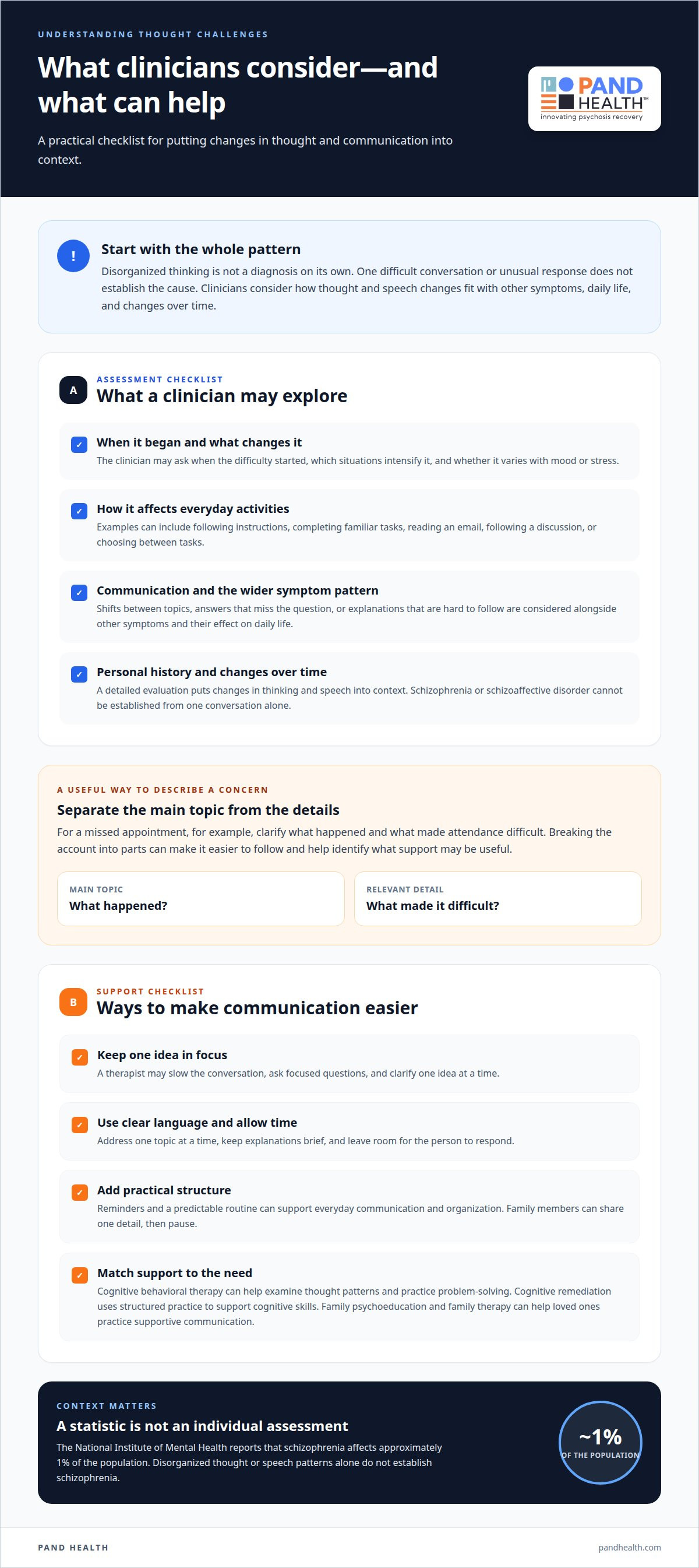
Thought organization can be affected by different circumstances. Severe stress may temporarily disrupt thinking, while cognitive difficulties can also occur with depression or psychotic disorders. No single definitive cause of disorganized thoughts has been established. A clinician considers when the difficulty began, what situations intensify it, and whether it affects activities such as following instructions or completing familiar tasks. One difficult conversation alone doesn’t explain the broader pattern.
Cognitive load is the mental effort needed to process information and complete a task. When demands come together, such as following spoken directions while planning the next step, information can feel overwhelming. A clinician may help organize a concern into its main topic, relevant details, and possible next action. For example, someone describing a missed appointment might separate what happened from what made attendance difficult. This can make the account easier to follow and clarify what support may help.
Depression can affect attention, memory, or decision-making. These cognitive symptoms often improve as depression is treated, though they may persist longer than mood symptoms. A clinician may explore whether reading an email, following a discussion, or choosing between tasks has become harder. Comparing these experiences across settings can help distinguish ongoing thought-organization challenges from difficulties that vary with mood or stress. The person’s own examples give the discussion a practical focus.
Cognitive behavioral therapy can help someone examine thought patterns and practice problem-solving. Cognitive remediation uses structured practice to support cognitive skills. These approaches may help improve thought organization and communication in schizophrenia. For instance, a clinician might help someone organize the main points they want to raise during an appointment. Seeking help for disorganized thinking can also focus on practical goals, such as making explanations easier to follow in daily conversations.
Therapists can slow a conversation, clarify one idea at a time, and help identify which details matter most. A person might describe a concern in a different order than expected; the therapist can ask focused questions to understand the intended meaning. If thoughts become distressing or there are concerns about safety, seek immediate help. In the United States, the Federal Communications Commission advises people in crisis to call 911. The Substance Abuse and Mental Health Services Administration advises people in crisis to call or text 988.
What Is Disorganized Thinking in Schizophrenia?
In schizophrenia, disorganized thinking can make it harder to connect ideas and communicate them clearly. It may show up in speech that shifts between topics, answers that don’t address the question, or explanations that are difficult to follow. For example, someone describing a grocery trip might move from the store to a television program without explaining the connection. The challenge can vary in severity and may improve with treatment and support, although some difficulties can persist. According to the National Institute of Mental Health, schizophrenia affects approximately 1% of the population.
Disorganized speech or thought patterns alone don’t establish schizophrenia. Clinicians consider how these experiences fit with other symptoms, their effect on daily life, and how they change over time. Schizoaffective disorder may also be considered when an assessment examines disorganized thinking alongside mood and psychotic symptoms. The distinction depends on the overall pattern, not one conversation or unusual response. A detailed evaluation helps put changes in speech and thinking into context.
In conversations, someone might lose the thread, repeat an idea, or find it difficult to organize an answer. These experiences can affect relationships, school, work, and routine tasks, especially when others expect a quick explanation. Support strategies can include using clear, simple language, allowing time to respond, and addressing one topic at a time. A family member asking, “Would you like to talk about the appointment or the ride there first?” offers a clearer path than combining both questions. In professional environments, organizations can also foster supportive practices through workplace neurodiversity training UK to better accommodate diverse communication styles.
Can medications cause or worsen disorganized thinking? Medication prescribed by a psychiatrist may help reduce schizophrenia symptoms, including disorganized thinking, and works best alongside therapy and practical strategies. A change in thinking during treatment doesn’t by itself show that medication caused it; the prescriber can assess the timing, symptoms, and treatment response. Don’t change prescribed treatment based on one difficult conversation. The clinician needs the broader picture, including whether the change persists and how it affects daily functioning.
How can family members support someone with disorganized thinking? They can speak calmly, keep explanations brief, offer reminders, and encourage a predictable routine. For example, a family member might share one appointment detail at a time, then pause so the person can respond. Family psychoeducation and family therapy can help loved ones understand thought challenges and practice supportive communication. These approaches focus on the person’s needs rather than correcting every unusual phrase. If disorganized thinking persists or disrupts daily life, professional evaluation can clarify what support may be appropriate.
How Can Therapy Help Organize Your Thoughts?
Executive dysfunction can make planning, sequencing, and shifting between tasks harder. Someone may know they need to prepare for an appointment but struggle to decide what to do first. In therapy, a clinician can identify the specific point of difficulty, such as starting, remembering steps, or finishing. This creates a clearer picture than simply describing the problem as poor organization. Personalized goals can then focus on skills that matter in daily life.
Therapy may build organization skills through practice with meaningful tasks. For example, a clinician might help someone break “prepare for work” into choosing clothes, packing needed items, and leaving on time. They can observe which steps feel difficult and adapt the plan accordingly. A written sequence, calendar, or reminder may support practice between sessions. The aim is to help the person express priorities, follow a plan, and adjust when an unexpected task interrupts.
A history of brain injury may be relevant when someone seeks support for changes in planning or concentration. A clinician can ask when the changes began and how they affect activities such as following instructions or managing appointments. For example, difficulty organizing a familiar morning routine may guide discussion of the person’s current needs. An assessment should consider personal history and daily functioning rather than assume a cause based on one symptom.
Choosing support for thought organization means looking for a clinician who will explore the person’s specific concerns and connect goals to everyday tasks. A useful discussion can cover what happens during a difficult conversation, which routines are affected, and what the person hopes to manage more easily. For instance, someone who loses track during meetings may need different support from someone who struggles to begin household tasks. Evaluation for thought disorders can help clarify persistent changes in thinking or communication that need closer assessment.
The “PACK backpack” organization method can be explored as a practical, task-based exercise. A clinician and the person might use packing a backpack as a concrete example, sorting required items from optional ones, then checking what is needed for a particular activity. They can notice whether choosing, sequencing, or remembering items creates difficulty. The exercise helps observe organization skills; it does not prove a diagnosis. Its steps can be adapted to the person’s needs and goals.
CBT may help identify and challenge unhelpful thought patterns while building problem-solving and idea-organization skills. For example, someone who feels overwhelmed by a form might work with a clinician to identify the next manageable action. Cognitive remediation may also target thought organization and related skills through structured practice. The clinician can review whether a strategy carries over to real situations, such as communicating a concern clearly or completing a routine task. Progress is understood through practical changes in the person’s daily experience.
Thought blocking
Disorganized thought processes can occur with schizophrenia, bipolar disorder, or certain psychotic disorders. Thought blocking is a specific interruption that can disrupt speech and make conversations difficult to continue.
Interruptions in the Flow of Thought
Thought blocking is a sudden interruption in someone’s train of thought that may leave them unable to continue speaking. For example, someone may begin describing a meeting, stop mid-sentence, and struggle to recall the point they were making. The pause can feel confusing for both speaker and listener, especially during an important conversation. A clinician considers when these interruptions happen, what was being discussed, and whether they affect communication or daily activities.
A disorganized thought process involves difficulty connecting ideas or keeping communication organized. Thought blocking describes a break in that flow, rather than every instance of pausing or forgetting a word. Someone may pause while searching for a name, then continue the same story clearly. By contrast, repeated interruptions across conversations may warrant assessment, particularly when they appear alongside other changes in thinking, behavior, or functioning. The context and pattern matter more than one isolated pause.
Schizophrenia can involve disorganized thinking that affects how someone speaks, shifts between topics, or responds to questions. Certain psychotic disorders may also involve disorganized thought processes. A clinician looks at the broader pattern instead of treating one unusual phrase as a diagnosis. For example, they may consider whether someone can explain everyday actions, follow a conversation, or return to its original topic. The assessment also considers changes over time and their impact on work, relationships, or routines.
Bipolar disorder can involve racing thoughts during mood episodes, with ideas moving rapidly from one topic to another. Disorganized thinking related to bipolar disorder typically emerges during mood episodes and may improve during periods of mood stability. For instance, someone might jump between plans while speaking quickly during a period of elevated mood. A clinician considers mood changes alongside speech and behavior, rather than assuming fast or shifting thoughts have one cause. This distinction helps guide assessment and support.
How therapists use thought ladders and mind maps
A thought ladder arranges ideas in sequence, while a mind map places a central topic beside related thoughts. A clinician may use these visual structures to explore how someone connects details, identifies a main point, or returns to a topic after distraction. For example, a mind map about a difficult appointment could place “appointment” at the center, with transport and questions branching out. These tools can make patterns easier to discuss without treating the diagram as a diagnostic test.
During a session, a clinician might invite the person to place one idea first, then add the next related thought. If the conversation shifts from an appointment to an unrelated concern, the clinician can help identify a connection or mark the change. A ladder may help organize actions, such as describing what happened before, during, and after a missed meeting. The person’s own words and priorities guide the exercise. These supports help explore communication, not judge whether someone’s thoughts are correct.
How therapists assess thought challenges
A professional evaluation is the first step toward identifying an appropriate level of care for persistent disorganized thinking. The clinician starts by asking what has changed and how those changes affect daily life. For example, difficulty following a conversation, remembering appointments, or completing familiar tasks gives useful context. The person’s own description helps the clinician understand which challenges feel most disruptive and what support they hope to gain.
Next, the clinician explores when the difficulty began and whether it varies across situations. They may ask whether organizing thoughts feels harder during stress, after poor sleep, or in particular conversations. Someone might explain that they can follow a quiet one-to-one discussion but lose track during a busy meeting. Comparing these experiences helps identify patterns without treating one moment as the whole story.
Assessment also considers communication and thought processes during the conversation itself. The clinician may notice whether answers stay connected to the question, whether topics shift abruptly, or whether the person needs extra time to express an idea. These observations are interpreted alongside the person’s account. For instance, pausing once to find a word is different from repeatedly losing the thread across several topics and settings.
Memory and everyday functioning offer further clues about the support that may help. A clinician can ask how the person manages a routine such as preparing for an appointment, keeping track of instructions, or completing work tasks. If the person remembers the appointment but forgets the materials needed, that points to a different challenge than not knowing where to begin. Practical details help connect evaluation to meaningful goals.
The clinician also considers personal history, changes over time, and the impact on relationships, work, or school. A family member’s observations can add context, especially when the person has noticed changes but struggles to describe them. With the individual’s involvement, a clinician may compare accounts of a recent conversation or routine. This helps distinguish an occasional lapse from a persistent pattern that affects functioning.
No single conversation explains every thought challenge. An assessment brings together reported experiences, observed communication, memory concerns, stress, and daily functioning to guide the next step. When thought changes appear suddenly or worsen notably over a short period, professional evaluation is especially important. A clear account of what changed, when it happens, and which tasks are affected can help move the discussion toward appropriate care.
If persistent changes in thinking or communication are affecting daily life, request a professional evaluation to discuss the next step.
Pand Health
Pand Health can help clarify persistent thought and communication challenges through evaluation for thought disorders and autism in Los Angeles. When disorganized thinking affects conversations, relationships, or daily routines, an evaluation can clarify the challenges and inform an appropriate direction for support. Psychological and social rehabilitation and social skills training can address practical functioning, while family psychoeducation can help loved ones understand and respond supportively. The focus is on the person’s needs and how thought challenges affect everyday life.
If you’re seeking professional support for these concerns, contact Pand Health to discuss the next step.
Make the Next Step About Your Goals
Progress can begin with a clearer understanding of what makes communication or daily tasks difficult. The right support should reflect the person’s priorities, whether they want to express ideas more clearly, strengthen everyday skills, or help family members respond constructively. Seeking help for disorganized thinking isn’t about demanding perfect speech; it’s about finding practical ways to support wellbeing and participation in daily life.
Pand Health offers evaluation for thought disorders and autism, social skills training, and psychological and social rehabilitation in Los Angeles. These services connect assessment with practical support for communication and everyday functioning. The next step is to contact Pand Health to discuss the challenges you’re noticing and the support that may fit.
Contact Pand Health to discuss support for thought challenges. With thoughtful assessment and care, a more manageable path forward can take shape.
Frequently Asked Questions
Are there therapies that improve thinking and communication?
Yes, therapy can help people strengthen thought organization, problem-solving, and communication skills. Cognitive behavioral therapy may help someone examine thought patterns and practice organizing ideas. Cognitive remediation uses structured exercises to work on cognitive skills. For example, a clinician might help someone prepare a concise account of a concern, then practice sharing it in a conversation. The approach depends on the person’s needs and everyday challenges.
When Should I Speak With a Mental Health Provider?
Speak with a mental health professional when thought or communication difficulties persist or interfere with relationships, work, school, or daily responsibilities. For example, repeatedly losing track of instructions or struggling to explain important concerns can be a reason to seek an evaluation. Sudden changes or notable worsening over a short period also call for professional assessment. Bring specific examples, including when the changes occur and which activities they affect.
What can cause disorganized thinking?
There isn’t one established cause of disorganized thoughts. Severe stress can temporarily disrupt thinking, and cognitive difficulties can accompany depression or psychotic disorders. Circumstances matter: someone may notice trouble concentrating during a stressful period, while another person experiences persistent difficulty across daily activities. A professional evaluation considers the timing, pattern, and impact of these changes rather than assigning a cause based on one confusing conversation.
What are common signs of disorganized thinking?
Common signs can include losing the thread of a conversation, shifting topics without a clear connection, giving an answer that doesn’t address the question, or struggling to explain how ideas fit together. For example, someone asked about an appointment might describe unrelated events and find it difficult to return to the question. One pause or unclear answer doesn’t establish a disorder; repeated changes that affect daily communication deserve attention.
When is disorganized thinking a medical emergency?
Seek immediate help if thoughts become intensely distressing or there are concerns about someone’s safety. In the United States, the Federal Communications Commission advises people in crisis to call 911, and the Substance Abuse and Mental Health Services Administration advises calling or texting 988. If a person may be in immediate danger, call 911. Stay with the person if it’s safe to do so, and describe the urgent concern clearly.
Which mental health conditions can cause disorganized thoughts or speech?
Disorganized thoughts or speech can occur with schizophrenia, bipolar disorder, and certain psychotic disorders. Schizoaffective disorder may also be considered when clinicians assess thought changes alongside mood and psychotic symptoms. Depression can involve cognitive difficulties, such as trouble concentrating. These conditions can’t be identified from speech alone; a clinician considers the broader symptom pattern, its course, and its effect on functioning before determining what may be contributing.
What treatments help with disorganized thinking?
Treatment depends on the underlying challenges and their effects on daily life. Therapy may include cognitive behavioral therapy or cognitive remediation, while a psychiatrist may prescribe medication for symptoms associated with schizophrenia. Combining therapy with practical support can address communication and everyday functioning. For example, care may focus on helping someone follow conversations at work while also addressing symptoms that make concentration difficult.
What coping strategies can therapists help develop to improve focus and organize thoughts?
A clinician can help develop personalized approaches, such as following a predictable routine, recording key information, or dividing a complicated task into manageable parts. For example, someone preparing for an appointment might organize questions under separate topics and set a reminder for when to leave. The clinician can review which supports fit the person’s needs, adjust them if they add strain, and help practice using them in real situations.
Disclaimer
This article is for information and educational purposes only, and can NEVER replace a proper medical evaluation. If you or a loved one may be suffering from psychosis or the prodomal symptoms of psychosis, get evaluated by a professional as soon as possible. Early diagnosis and treatment can be life-saving.