


Work support for people with schizophrenia in Los Angeles
Employment support for schizophrenia in Los Angeles can bring treatment and work goals into the same recovery plan. Supported employment for schizophrenia in Los Angeles may include Individual Placement and Support (IPS), structured day programs, referrals, help with job searches, and support with keeping a job. The right combination depends on a person’s goals, needs, and current support.
Wanting to work while managing schizophrenia can feel complicated, especially when symptoms affect concentration, confidence, or routine. Those challenges don’t rule out employment. Individualized support can make the path to work more manageable, including for people exploring supported employment for schizophrenia in Los Angeles.
This article explains how Individual Placement and Support (IPS) differs from structured day programs, what job-search and retention support can involve, and how employment goals can fit alongside mental health care. It also outlines questions individuals and families can use to consider a next step that respects the person’s pace and priorities.
Key Takeaways
- IPS connects employment goals with individualized support, helping people pursue competitive work while receiving mental health care.
- Job retention support can help address workplace challenges and adjust strategies as a person settles into a role.
- Job-search assistance can include clarifying work goals, preparing applications, and identifying suitable opportunities.
- Available programs and referral pathways vary, so understanding how each program works can help clarify a practical next step.
- Social skills training and psychological and social rehabilitation can support broader recovery goals alongside employment planning.
Individual Placement and Support (IPS)
Individual Placement and Support, or IPS, is an approach to employment that starts with a person’s work goals. Instead of requiring lengthy preparation before job searching, IPS connects employment planning with mental health support. For someone with schizophrenia in Los Angeles, that can mean pursuing a suitable job while coordinating practical assistance with their broader recovery needs.
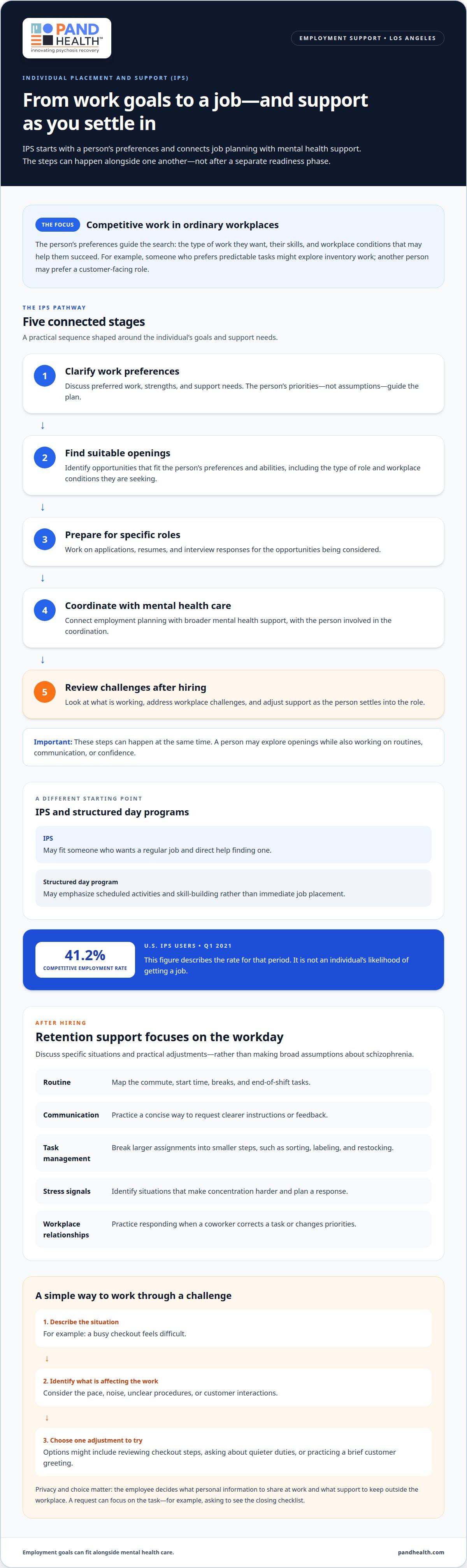
IPS focuses on competitive employment in ordinary workplaces. The person’s preferences guide the process, including the type of work they want, their skills, and workplace conditions that may help them succeed. Someone who prefers predictable tasks, for example, might explore inventory work, while another person may seek a customer-facing role. An employment specialist with Pand Health can help turn those preferences into a focused job search.
In Q1 2021, U.S. IPS users had a 41.2% competitive employment rate. This figure describes the rate for that period, not an individual’s likelihood of getting a job. It can help readers understand the model’s employment focus without promising a particular result for any person in Los Angeles.
A typical IPS process turns a broad goal into manageable steps. The sequence may include:
- Discussing the person’s preferred work, strengths, and support needs.
- Identifying job openings that fit those preferences and abilities.
- Preparing applications, resumes, and interview responses for specific roles.
- Coordinating employment planning with mental health care, with the person’s involvement.
- Reviewing workplace challenges after hiring and adjusting support as needed.
These steps can happen at the same time, rather than requiring a separate readiness phase first. Someone may explore openings while also working on routines, communication, or confidence. The employment plan should reflect the person’s priorities, not assume that everyone with schizophrenia needs the same pace or workplace.
IPS may fit someone who wants a regular job and direct help finding one. A structured day program, by contrast, may emphasize scheduled activities and skill-building rather than immediate job placement. The distinction matters: someone seeking supported employment for schizophrenia Los Angeles can discuss job-focused support, while someone who wants a predictable daily structure may prefer a different starting point.
As a practical first step, name one work preference, such as a preferred task or schedule. Then identify what support would make the next step clearer. This gives a conversation about job goals, search activities, and coordination with mental health care a concrete focus.
You can make your employment step manageable by choosing one concrete action and deciding what assistance is needed. A Westat resource from 2023 addresses IPS for people with co-occurring substance use disorder. A 2016 resource examines IPS effectiveness for young adults, offering further context for people weighing employment support.
Job retention support
Starting a job is one milestone; learning its routines is another. Job-retention support helps someone address workplace challenges after hiring while keeping their goals and preferences central. For example, a person who loses track of changing tasks might write down instructions and review priorities with a support person.
Early conversations can identify which parts of work feel manageable and where difficulties arise. A new employee might enjoy stocking shelves but feel overwhelmed by last-minute schedule changes. Naming the specific challenge makes it easier to consider a practical response, such as clarifying shift expectations or planning how to ask a supervisor for information.
Support can be organized around the person’s workday, rather than broad assumptions about schizophrenia. Useful areas to discuss include:
- Routine: Map the commute, start time, breaks, and end-of-shift tasks.
- Communication: Rehearse a concise way to request clearer instructions or feedback.
- Task management: Break a larger assignment into smaller steps, such as sorting, labeling, and restocking.
- Stress signals: Identify situations that make concentration harder and plan a response.
- Workplace relationships: Practice how to respond when a coworker corrects a task or changes priorities.
If a cashier finds a busy checkout difficult, for instance, a support conversation can break the challenge into parts. Is the issue the pace, noise, unclear procedures, or customer interactions? Each answer suggests a different strategy, such as reviewing checkout steps, asking about quieter duties, or practicing a brief customer greeting.
Privacy and choice matter throughout these discussions. The employee decides what personal information to share at work and what support to keep outside the workplace. A request can focus on the task rather than a diagnosis: “Could you show me the closing checklist?” is a direct way to ask for guidance.
When difficulties arise, a useful sequence is to describe the situation, identify its effect, and choose one adjustment to try. If a rotating schedule disrupts sleep and punctuality, the person could ask whether more predictable shifts are possible. Any workplace conversation should reflect the employee’s comfort and circumstances.
Retention support can change as the job does. Someone may need help with initial training, then later want to build confidence handling feedback or taking on new duties. Revisiting the plan after a role change keeps support relevant. Progress can be tracked through concrete signs, such as arriving prepared, completing agreed tasks, or knowing whom to ask for help.
Job search and supported employment
Job-search support can involve choosing a service model, understanding how work may affect benefits, and identifying local programs. In Los Angeles, these details help shape a practical employment plan.
Comparing Employment Service Options
Supported employment helps a person pursue regular paid work, with assistance tied to job searches and workplace needs. Vocational rehabilitation may address broader employment preparation, such as developing skills or preparing for a particular occupation. Sheltered employment generally takes place in a more structured setting than a typical community workplace.
The best fit depends on the person’s goal and preferred setting. Someone ready to apply for a community job may prioritize job-search and workplace support. Someone who wants to build skills first may consider vocational rehabilitation, while a structured environment may suit someone seeking a different pace. Compare the setting, the support offered, and how closely the plan follows the person’s preferences.
Work and Benefit Income Rules
People receiving SSI or SSDI can pursue employment with support, but work income can affect benefits. SSI and SSDI have different rules, so an SSI threshold should not be treated as an SSDI limit. The effect on benefits depends on the specific program and work income.
In California, SSI recipients who lose benefits because of work income may keep Medi-Cal coverage under 1619(b) while earning up to $64,517 per year. That figure applies to the stated Medi-Cal coverage provision, not as a general income limit for every benefit. A useful step is to include benefit planning in employment discussions before changing work hours or income.
Local Job Coaching Providers
Los Angeles’ Homeless Opportunity Providing Employment, known as LA’s HOPE, is a local employment initiative implemented by the Housing Authority of the City of Los Angeles, the Los Angeles Department of Mental Health, and the Los Angeles Community Development Department. Naming the agencies identifies the program implementers, but does not establish that each provides individual job coaching.
The supported-employment services described here are provided without fees. To understand whether a program fits, distinguish job placement and coaching from broader employment initiatives. Ask how referrals work, whether support continues after hiring, and how the program coordinates employment goals with behavioral health services. These details help clarify the support available without assuming every local program offers the same services.
What supported employment programs for people with schizophrenia are available in Los Angeles?
Los Angeles employment support can involve different models, from individualized job assistance to structured daytime activities. LA’s Homeless Opportunity Providing Employment, or LA’s HOPE, is one local employment initiative.
LA’s HOPE was implemented by the Housing Authority of the City of Los Angeles, the Los Angeles Department of Mental Health, and the Los Angeles Community Development Department. The program name identifies a local initiative; a person’s employment goal helps clarify which type of support to explore.
IPS is a job-focused approach for people seeking competitive employment. Someone might want help identifying suitable roles, preparing applications, or adjusting to work. IPS is an employment model, not necessarily the name of a specific Los Angeles program.
Structured day programs can offer scheduled activities and opportunities to practice routines or social skills. Someone who wants to build confidence through daily structure, for example, may prefer this setting before focusing on job applications. The person’s immediate goal helps distinguish this option from direct employment assistance.
To understand what a program provides, clarify its focus and how participation begins. Useful details include:
- Whether the program centers on finding competitive work, structured activities, or both.
- How referrals are made and what information the intake process considers.
- Whether support addresses applications, interviews, workplace adjustment, or job retention.
- How employment goals connect with behavioral health care.
- Whether the person’s preferred work and pace shape the plan.
These distinctions matter in practice. Someone ready to apply for a job may prioritize an employment-focused pathway. Someone who wants a predictable routine first may value structured activities. A person who has started working may need follow-up support with workplace adjustment.
In Los Angeles, a program’s name alone may not explain what support it provides. LA’s HOPE, for example, identifies a local employment initiative, while IPS describes an employment approach. Knowing the difference helps families discuss whether a pathway fits the person’s goal, such as seeking a community job or practicing a stable daily routine.
A clear next step is to write down one employment goal and one current barrier. “I want to apply for office work, but interviews feel difficult” gives the conversation a focused start. That example can help clarify whether job-search assistance, structured activities, or another form of support best matches the person’s needs.
LA’s HOPE is a local employment initiative implemented by the Housing Authority of the City of Los Angeles, the Los Angeles Department of Mental Health, and the Los Angeles Community Development Department. IPS is an employment approach, not the name of a specific Los Angeles program.
Does Medi-Cal or another program cover supported employment services in Los Angeles?
Payment and access are separate questions for someone seeking employment support in Los Angeles. The supported-employment services described here are provided without fees. That does not mean every service is paid for through Medi-Cal or that all programs use the same funding arrangement.
Medi-Cal coverage depends on the service and how it is offered through a person’s coverage and care arrangements. Job-search assistance, workplace coaching, and structured activities may be organized differently. A program focused on practicing work routines, for example, may use a different payment pathway from individualized employment support.
Keep three questions separate: Can the person participate? Does the service have a fee? Does Medi-Cal pay for it? A “no fee” service answers the second question, but not the third. This distinction helps prevent the assumption that a service is covered simply because it supports mental health or employment.
Before choosing a program, clarify the service and its funding arrangement. A focused discussion can cover:
- Service type: Is the support job search, job coaching, structured activity, or retention help?
- Payment: Is there a fee for participation, or is the service offered without fees?
- Coverage: Is Medi-Cal involved in paying for this specific service?
- Coordination: How does employment planning connect with behavioral health care?
These details matter for someone with Medi-Cal who wants help applying for work. They may find a no-fee employment service but still need to understand whether their health plan plays a role. Treating those questions separately makes the next decision clearer.
SSI and SSDI benefits also need to be considered separately from Medi-Cal payment for employment services. Work income can affect benefits, and SSI and SSDI follow different rules. Someone considering a job can include benefits planning in the employment conversation, especially before changing work hours or income.
Another program may support employment through a separate pathway rather than Medi-Cal billing. The key details are the service offered, how to access it, and whether a fee applies. A structured day program and direct job-search assistance, for instance, may have different purposes even though both support progress toward work.
For a clear decision, write down the service being considered and ask how participation, fees, and coverage relate to it. This simple distinction helps a person and family discuss employment support without confusing a no-fee service with insurance payment or assuming that one program’s rules apply to another.
Pand Health
Pand Health supports people in Los Angeles whose mental health needs intersect with work goals through psychological and social rehabilitation. Social skills training may help someone practice communication and everyday interactions relevant to workplace routines, while family psychoeducation can help loved ones understand recovery and provide informed support.
These services may be relevant when symptoms or social challenges make employment planning difficult, or when a person and family need broader support alongside a job search. Pand Health also offers evaluations for thought disorders and autism, which can help clarify concerns affecting daily life and care planning.
For support that addresses these needs, contact Pand Health.
Take the Next Step Toward Work
A meaningful employment plan can start with one clear priority: the kind of work the person wants to pursue. For people exploring supported employment for schizophrenia in Los Angeles, naming that goal can guide conversations about routines, social interaction, and support needs. The next step need not answer every question; it can simply clarify what would make work feel more manageable.
Pand Health offers psychological and social rehabilitation and social skills training to support broader recovery goals connected to daily life and workplace interactions. Evaluations for thought disorders and autism can also help clarify concerns that affect care planning. These services do not promise job placement, but they may be relevant when mental health care is part of a person’s wider employment journey.
Consider what feels most pressing now: understanding a support need, strengthening everyday skills, or involving family in recovery conversations. Contact Pand Health to discuss options and consider a next step that reflects the person’s needs and priorities. Progress can begin with a thoughtful conversation.
Frequently Asked Questions
How can someone with schizophrenia qualify for supported employment in Los Angeles County?
Eligibility depends on the specific program’s intake criteria, not diagnosis alone. Start by identifying whether the person wants competitive work, job coaching, or structured preparation. An intake conversation can clarify employment goals, current support needs, and how work fits with behavioral health care. “I want help finding part-time work and preparing for interviews,” for example, gives the conversation a practical starting point.
How do I apply for supported employment through Los Angeles County DMH or a service provider?
To apply, identify the relevant program and complete its referral or intake process. A practical first step is to describe the person’s work goal and the support they want, such as help with applications or workplace adjustment. Then gather the information requested for intake. Processes differ by program, so keep the program name and referral instructions together during follow-up.
Are Individual Placement and Support (IPS) programs available for schizophrenia in Los Angeles?
IPS is an employment model relevant to people with schizophrenia, while Los Angeles initiatives may use other approaches. LA’s HOPE is a named local employment initiative, but its name alone does not identify it as an IPS program. To distinguish models, look for an emphasis on the person’s work preferences, competitive employment, and coordination with mental health care.
What services do supported employment programs provide, such as job search, placement, and ongoing coaching?
Services can support different stages of employment, from choosing a suitable role to adjusting after hiring. Someone might need help describing past experience on an application, preparing for an interview question, or understanding a new workplace routine. A useful program conversation clarifies which types of support are available and how the person’s preferences guide the employment plan.
What should someone with schizophrenia consider when choosing a supported employment program in Los Angeles?
Consider whether a program’s approach matches the person’s current goal, preferred work setting, and desired level of support. Someone seeking a community job may prioritize direct employment assistance; someone building daily structure may prefer a different starting point. Also consider how the program handles communication, schedule changes, and coordination with existing behavioral health care, so expectations are clear from the outset.
Disclaimer
This article is for information and educational purposes only, and can NEVER replace a proper medical evaluation. If you or a loved one may be suffering from psychosis or the prodomal symptoms of psychosis, get evaluated by a professional as soon as possible. Early diagnosis and treatment can be life-saving.