
Teen and young adult social skills group schedules in Los Angeles
A teen’s age alone doesn’t determine whether a social skills group is the right fit. A social skills group for teens in Los Angeles should match the young person’s developmental needs and goals, while giving them opportunities to practice conversation, communication, and emotional regulation. For young adults ages 19-25, placement depends on individual goals, appropriate peer grouping, and current availability.
It makes sense to want more than conversation practice in a group setting. Weekly assignments and real-world practice can help connect what participants learn with the interactions they face outside the group. This article explains how social skills groups build those skills, what to consider when exploring schedules and age groups, and how professional social skills training may support teens and young adults as they work toward more confident communication.
Key Takeaways
- Weekly assignments and real-world practice can help teens apply communication skills beyond the group setting.
- Social skills support may be useful when social cues, friendships, or emotional regulation feel challenging.
- For young adults ages 19-25, group placement depends on individual goals, appropriate peer grouping, and current availability.
- Age-appropriate support can shape practice around a young person’s developmental needs.
- Conversation skills include listening, taking turns, and responding in ways that help interactions feel more reciprocal.
Weekly assignments and real-world practice
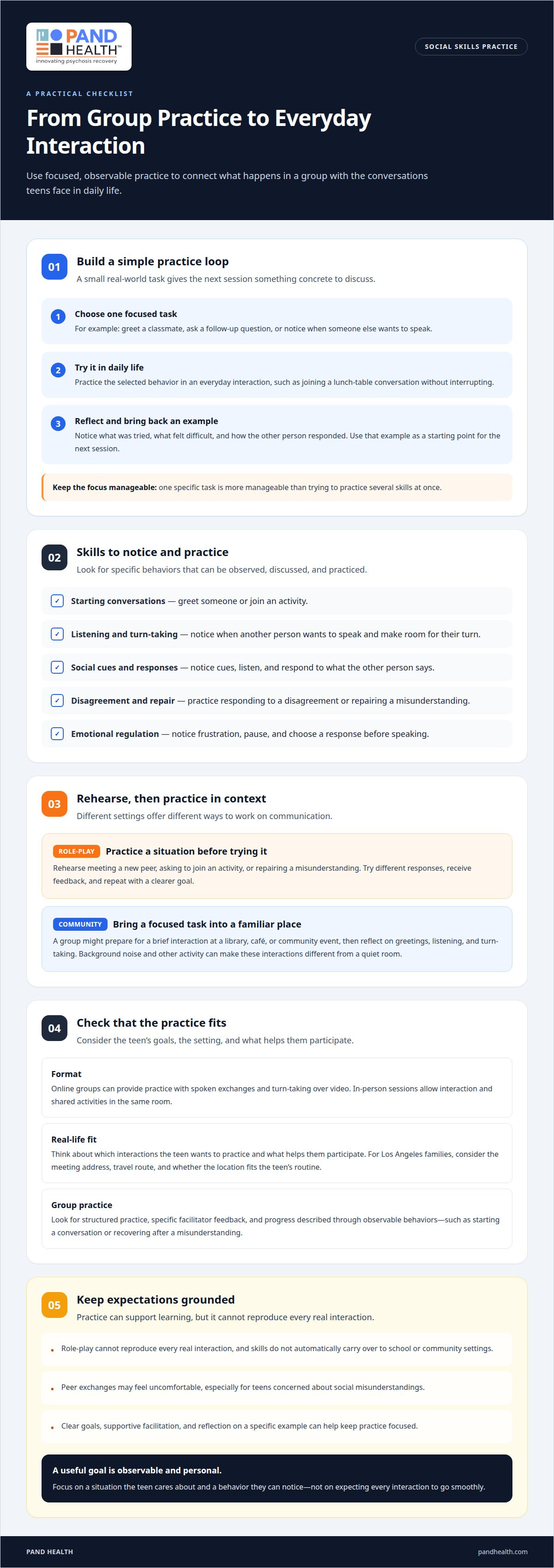
Practice between sessions can connect group learning with everyday interactions. A task might involve greeting a classmate, asking a follow-up question, or noticing when someone else wants to speak. The teen can then reflect on what they tried, what felt difficult, and how the other person responded. This gives the next session a concrete starting point.
Common skills include starting conversations, taking turns, noticing social cues, listening, and responding to disagreement. A teen might practice joining a lunch-table conversation without interrupting. Emotional regulation can also be part of the work: notice frustration, pause, and choose a response before speaking. The focus is on specific behaviors teens can observe and discuss, not on expecting every interaction to go smoothly.
Role-play gives teens a chance to rehearse a situation before trying it in daily life. A facilitator can set up a scenario, such as meeting a new peer, asking to join an activity, or repairing a misunderstanding. Teens can try different responses, receive feedback, and repeat the interaction with a clearer goal. This can make an unfamiliar conversation feel more structured while respecting each teen’s natural communication style.
Community-based practice brings social learning into familiar public settings. A group might prepare for a brief interaction at a library, café, or community event, then reflect on how greetings, listening, and turn-taking went. The setting matters: conversation in a quiet room differs from one with background noise or other activity. A focused task, such as asking for directions, is more manageable than trying to practice several skills at once.
Reviews can describe what families valued, but star ratings alone don’t show whether a group fits a teen’s goals. Look for specific examples of structured practice, facilitator feedback, and progress in observable behaviors, such as starting a conversation or recovering after a misunderstanding. Individual examples are more useful than assuming every participant will have the same experience.
Online groups can provide practice with spoken exchanges and turn-taking over video, while in-person sessions allow teens to interact and take part in shared activities in the same room. The right format depends on which interactions the teen wants to practice and what helps them participate. Practice between sessions can extend either format into everyday situations.
For families in Los Angeles, practical considerations include the meeting address, travel route, and whether the location fits the teen’s routine. A neighborhood name alone doesn’t show how manageable regular attendance will be. Also consider whether the group uses structured practice and specific feedback, and whether the facilitator’s experience fits the group’s needs.
Groups have limits: role-play can’t reproduce every real interaction, and practice doesn’t automatically carry over to school or community settings. Peer exchanges may also feel uncomfortable, especially for teens concerned about social misunderstandings. Clear goals, supportive facilitation, and reflection on a specific example can keep practice focused and help identify when additional support may be useful.
Social communication and emotional regulation
Social communication involves more than choosing the right words. A teen also needs to notice cues, interpret another person’s response, and decide when to speak or pause. Difficulty making or keeping friends, frequent misunderstandings, anxiety in social settings, or challenges with back-and-forth conversation may be reasons to seek support. Experiences differ, so useful goals focus on specific situations, such as responding when a classmate changes the subject.
Emotional regulation is closely connected to communication. A teen who feels embarrassed after missing a joke might withdraw; someone frustrated by an interruption might respond sharply. Identifying an emotion and its trigger can create a pause in which to choose what to do next. For example, a teen might practice saying, “I lost my train of thought. Can I finish?” instead of leaving the conversation.
Structured practice can make social situations easier to explore. A facilitator might introduce a scenario about an unanswered text, a disagreement over plans, or a friend who seems distracted. The teen can identify what they observed, consider more than one explanation, and choose a respectful next step. Distinguishing observable cues from assumptions matters: a delayed reply alone doesn’t explain why someone hasn’t responded.
Group conversations offer opportunities to practice reciprocity. Teens can work on asking a related follow-up question, acknowledging a peer’s point, and adding their own thought without taking over. After a peer describes a weekend activity, for instance, a teen might ask what they enjoyed most before sharing a similar experience. Feedback should address the behavior and its effect, not label the teen as awkward or difficult.
Progress is easier to discuss when a goal is observable. Instead of “be more confident,” a goal might be to greet a peer, stay in a conversation for a few exchanges, or pause to calm down during a disagreement. The teen can reflect on what helped, what felt uncomfortable, and what they might try next. One interaction won’t tell the whole story, but specific examples can show where support is useful.
Social skills support may be helpful when anxiety, social misunderstandings, or difficulty maintaining friendships affect everyday interactions. Group practice has limits: an exercise can’t reproduce every unpredictable exchange, and one communication style won’t suit every relationship. Goals should respect the teen’s individuality while building skills for situations they care about, such as joining a school activity or resolving tension with a friend.
Teen and young adult group schedule
A group schedule should make attendance practical and leave room for focused skill development. In Los Angeles, school hours, transportation, activities, and family routines can all affect which meeting time works. A teen might arrive tired after a long school day, while an earlier meeting could conflict with classes. Consider how the schedule fits the young person’s actual week, not just the available calendar slot.
Ask what a typical session includes and how activities are organized. A structured meeting might include a check-in, guided discussion, practice with a social situation, and time to reflect. A clear sequence helps participants know what comes next. For example, a teen might describe a difficult interaction, then rehearse a different response with peers. Session activities should connect to goals.
Enrollment usually begins by clarifying the teen’s needs and the situations they want to handle differently. Examples might include joining a school club, navigating a disagreement, or speaking up in class. The group’s age range, shared goals, peer fit, and current availability influence placement. For young adults ages 19-25, placement depends on individual goals, appropriate peer grouping, and current availability.
When reviewing schedule options, consider practical details that affect steady attendance:
- Meeting time: Compare the session time with classes, work, and regular commitments.
- Travel: Consider the route from school or home and how traffic may affect arrival.
- Group format: Find out whether sessions focus on discussion, structured activities, or community practice.
- Continuity: Ask how goals and progress are revisited across sessions.
These details matter because regular attendance gives participants opportunities to become familiar with peers and group routines. A teen who misses sessions because of a recurring schedule conflict may have fewer chances to practice a skill over time. A workable schedule supports participation, but it doesn’t replace a clear plan for what the group will address.
Before enrollment, expect a conversation about goals, age, needs, and group fit. Families can describe situations where communication feels difficult, while the professional considers appropriate peer grouping and available schedules. The next step is matching those details with a group whose structure supports the teen’s goals, such as practicing conversation or managing reactions during disagreement.
For teens and families in Los Angeles, a useful schedule supports regular attendance and meaningful participation. A calendar slot alone doesn’t show whether a group’s approach fits. Consider how the meeting structure connects to the teen’s goals and the practical demands of the week. That combination can make participation a purposeful part of their routine.
Age-specific social skills groups
Age is a starting point, not the only measure of group fit. Social skills support can look different at each developmental stage. A younger child might practice sharing materials or joining play, while a teenager may work on peer boundaries, group conversations, or handling changing plans. Activities and pace should reflect participants’ everyday social situations.
For a teenager, consider a group’s goals, peer composition, and practice methods. Ask how it addresses a situation the teen recognizes, such as entering a conversation at school or repairing a misunderstanding. A good fit offers age-appropriate discussion, structured opportunities to participate, and feedback focused on skills rather than criticism. Consider whether the teen can engage with the format and feels comfortable practicing alongside peers.
In Los Angeles, groups for teens with autism or ADHD may differ in structure, age range, and skills emphasized. A diagnosis alone doesn’t determine the best fit. Consider the teen’s communication goals, sensory or attention needs, and preferred ways of participating. The group’s approach should make expectations understandable and practice relevant to real interactions.
Developmental fit can matter more than age alone. Two teens in the same grade may differ in conversational experience, comfort in groups, or ability to recognize indirect cues. A facilitator can adapt an activity by clarifying instructions, allowing time to think, or offering a defined role in a shared task. These adjustments support participation without assuming every teen needs the same help.
Families can describe the settings where social interaction feels hardest, such as a crowded lunchroom, group project, sports practice, or conversation with unfamiliar peers. These details help identify whether the priority is starting conversations, staying on topic, interpreting responses, or managing frustration. Concrete goals make it easier to understand what the group will practice and how progress may be discussed.
Consider these fit factors as you compare age-specific approaches:
- Peer fit: Are participants working on social situations relevant to the teen’s life?
- Session structure: Do activities provide clear expectations and manageable ways to join?
- Individual goals: Can practice address a specific challenge, such as taking conversational turns?
- Feedback style: Does guidance identify useful next steps without treating differences as personal failures?
A group offers opportunities for practice and peer interaction, but it can’t make every social setting predictable. A teen who finds open-ended discussion difficult may benefit from clear prompts, while another may need time to observe before joining. Matching the format to the young person’s developmental needs, goals, and participation style helps make group work purposeful and respectful.
Conversation skills
Conversation is a shared process, not a script a teen must memorize. It involves starting an exchange, listening, responding, and noticing whether the other person wants to continue. A teen might greet a classmate, ask about a school project, then respond to the answer before changing topics. Practicing each step can make the sequence easier to recognize in everyday interactions.
Starting a conversation can feel difficult when a teen isn’t sure what to say. A group activity can offer low-pressure openings based on familiar interests, such as a music class, favorite game, or school event. Teens can try a greeting, add a relevant question, and practice responding to different answers. The goal is flexible participation, not delivering a perfect line.
Listening skills give a conversation room to develop. A teen can practice facing the speaker, allowing them to finish, and asking a follow-up question that connects to what they said. If a peer says, “I’m trying out for the school play,” a related response might be, “Which role are you hoping for?” This shows interest while keeping the exchange centered on both people.
Topic changes and pauses are also worth practicing. A conversation may shift from weekend plans to a class assignment, and a teen can work on following the change instead of repeatedly returning to an earlier subject. Silence doesn’t always mean an interaction has failed. A brief pause can give each person time to think, especially in a new or emotionally charged discussion.
Nonverbal cues add context, but they don’t provide certain explanations on their own. A peer looking away might be distracted, tired, or ready to move on. Teens can practice noticing several cues together, such as short answers and turning toward another activity. If the meaning is unclear, a respectful check-in like “Would you rather talk later?” can help avoid assumptions.
Feedback works best when it identifies an action the teen can repeat or adjust. Instead of “That was awkward,” a facilitator might say, “You asked a related question and gave your peer time to answer.” The teen can then try another approach, such as sharing a brief comment before asking a follow-up. Specific feedback supports learning without judging personality or communication style.
Conversation practice may cover joining a discussion, disagreeing respectfully, or repairing a misunderstanding. For example, a teen might say, “I thought you meant Friday. Did I misunderstand?” That checks the facts before assigning blame. If a teen would benefit from guided practice with these interactions, discuss social skills training as a possible support.
Pand Health: Social skills training
Pand Health offers social skills training for teens seeking structured support with communication and peer interactions. Through California OnTrack for Teens, this training is part of outpatient Coordinated Specialty Care, which includes therapy, psychiatry, case management, and education support. Families can contact Pand Health to discuss whether this program fits their teen’s needs.
Pand Health also provides psychological and social rehabilitation, as well as evaluations for thought disorders and autism. These services can support needs beyond conversation practice alone. The focus is on understanding the young person’s needs and connecting them with appropriate support.
Contact Pand Health to discuss social skills support for a teen.
Take the next step toward meaningful support
Choosing a social skills group for teens in Los Angeles can begin a broader conversation about what could help a young person participate more comfortably in daily life. Consider the situations they want to approach differently and the kind of support that feels relevant. Clear goals can guide a thoughtful discussion about next steps with Pand Health.
Pand Health offers social skills training, psychological and social rehabilitation, and evaluations for thought disorders and autism. These services address different needs, from practicing social interaction to understanding concerns that may affect a teen’s wellbeing. Contact Pand Health to discuss which support may fit the young person’s needs.
Progress can begin with identifying one meaningful interaction to work toward, then finding support aligned with that goal. Contact Pand Health about group support to discuss a path forward. With the right guidance, teens can build skills while remaining true to their own communication style.
Frequently Asked Questions
What do social skills groups for teens in Los Angeles offer?
A social skills group for teens in Los Angeles can provide structured support focused on a young person’s communication goals, such as participating more comfortably in a school activity or responding to peer feedback. Pand Health offers social skills training through California OnTrack for Teens, an early-intervention program for teens experiencing early signs of psychosis.
What age ranges and eligibility apply to teen social skills groups?
Age ranges depend on the program and the young person’s developmental needs. Social skills support can benefit children from preschool through adolescence, with activities adapted to developmental level. Pand Health’s California OnTrack for Teens serves teens ages 13-17 experiencing early signs of psychosis. For young adults ages 19-25, group placement depends on individual goals, appropriate peer grouping, and current availability.
How do schedules and enrollment work for teen social skills groups in Los Angeles?
Schedules and placement depend on the program, the teen’s goals, and suitable peer grouping. For an enrollment discussion, share the situations the teen wants help with, along with school or other regular commitments that affect participation. These details help clarify which group structure and meeting times may fit. For young adults ages 19-25, placement also depends on current availability.
best teen social skills groups Los Angeles reviews and outcomes
Reviews can describe what families valued, but ratings alone don’t establish fit. Look for examples of practice, facilitator feedback, and progress in observable skills. Experiences and outcomes vary.
Los Angeles teen social skills group locations and neighborhoods
Consider the meeting address, travel route, and whether the location fits the teen’s routine. A neighborhood name alone doesn’t show how manageable regular attendance will be.
Los Angeles teen social skills group providers credentials and approaches
Consider whether the facilitator’s experience fits the group’s needs and whether sessions include structured practice and specific feedback.
Disclaimer
This article is for information and educational purposes only, and can NEVER replace a proper medical evaluation. If you or a loved one may be suffering from psychosis or the prodomal symptoms of psychosis, get evaluated by a professional as soon as possible. Early diagnosis and treatment can be life-saving.