
Vocational Rehabilitation for Bipolar Disorder: A Clinical Path to Career Success
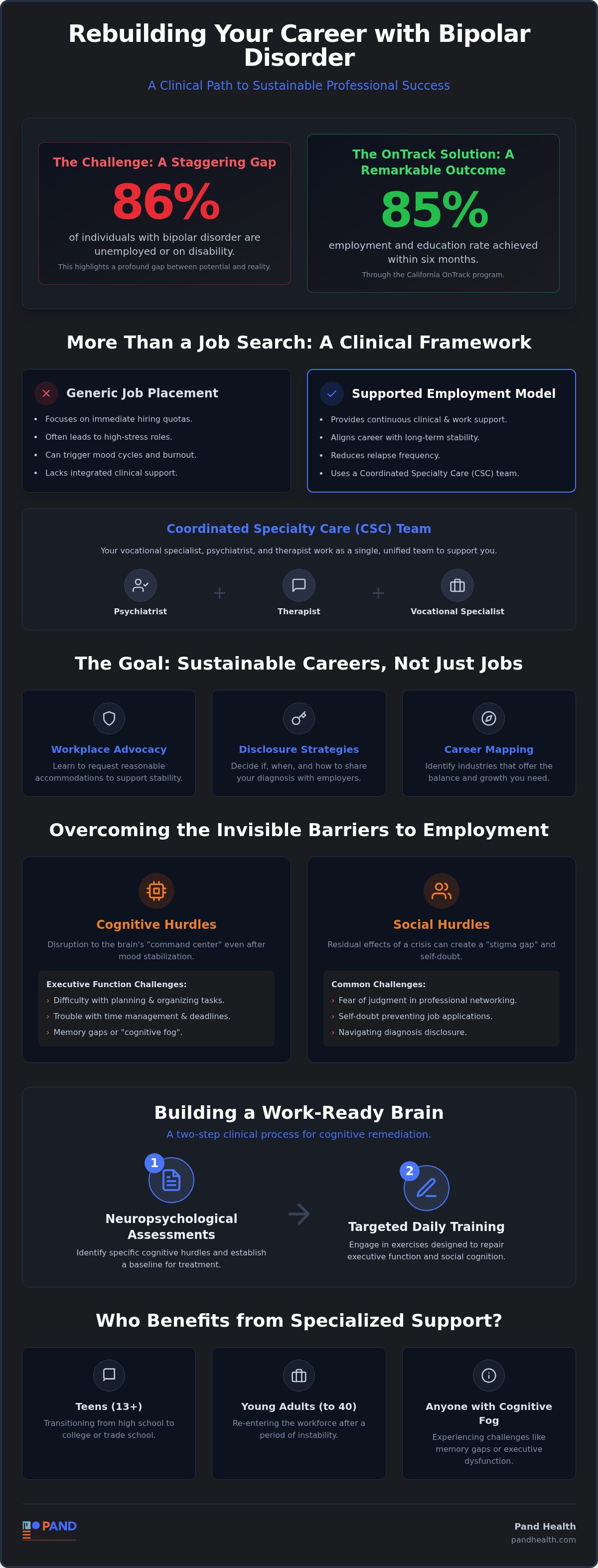
Did you know that research indicates up to 86% of individuals living with bipolar disorder are currently unemployed or on disability? This staggering statistic highlights a profound gap between professional potential and the reality of navigating a career while managing complex symptoms. You've likely felt the exhaustion of losing a job due to a sudden mood cycle or the cognitive fog that makes daily tasks feel insurmountable. It's common to feel that your career is constantly at the mercy of your diagnosis, leading to a cycle of anxiety and professional stagnation. Accessing specialized vocational rehabilitation for bipolar disorder is the first step toward breaking that cycle and reclaiming your independence.
We're here to provide a clinical path to success that prioritizes your long-term stability. Through our California OnTrack program at our Los Angeles clinic on Olympic Blvd, we help individuals achieve a remarkable 85% employment and education rate within six months. This article explores how we integrate APA-recommended cognitive remediation with personalized career support to restore your professional confidence. You'll learn how treating the underlying cognitive hurdles and social anxieties can lead to a sustainable, meaningful career. We believe that recovery is the expectation, and we're dedicated to helping you rebuild your professional life with precision and empathy.
Key Takeaways
- Understand how specialized vocational rehabilitation for bipolar disorder provides a clinical framework that goes far beyond traditional job placement.
- Learn why cognitive remediation is essential for repairing executive function and social cognition to ensure long-term career stability.
- Explore the methodology behind the California OnTrack program, which maintains an 85% employment and education rate for participants.
- Identify the specific steps for building a work-ready brain, starting with neuropsychological assessments and targeted daily training.
- Discover how families in Los Angeles can access specialized support for individuals aged 13 to 40 at our Olympic Blvd clinic.
What is Vocational Rehabilitation for Bipolar Disorder?
Vocational rehabilitation for bipolar disorder is far more than a simple job-search service. It's a structured, clinical framework designed to help you reintegrate into the professional world while managing the unique physiological and psychological demands of Bipolar I. While many agencies focus on basic resume building, our approach is rooted in the broader science of Psychiatric Rehabilitation. We view career success not just as an outcome, but as a vital component of your clinical recovery. This means we don't just help you find a job; we help you build the cognitive and emotional resilience required to keep it.
There is a significant difference between generic job placement and the "Supported Employment" model we utilize. Generic services often prioritize immediate hiring quotas, which can lead to high-stress roles that trigger mood cycles. In contrast, supported employment provides a continuous bridge between your clinical treatment and your work environment. For someone living with Bipolar I, the specialized approach is essential. Mood fluctuations and the cognitive "fog" that follows manic or psychotic episodes require a flexible, high-touch support system. We deliver this through Coordinated Specialty Care (CSC), an evidence-based model where your vocational specialist, psychiatrist, and therapist work as a single, unified team.
The Goal: Sustainable Careers, Not Just Jobs
Meaningful work acts as a powerful clinical protective factor. It provides the daily structure, social connection, and financial independence that can actually reduce the frequency of relapses. We focus on high-functioning career paths that align with your long-term ambitions rather than just entry-level positions. Our goal is to help you achieve professional normalcy through several key strategies:
- Workplace Advocacy: Learning how to request reasonable accommodations that support your stability.
- Disclosure Strategies: Deciding if, when, and how to share your diagnosis with employers to protect your rights.
- Career Mapping: Identifying industries that offer the balance and growth you need to thrive long-term.
Who Benefits from Specialized Vocational Support?
Our program is tailored for individuals between the ages of 13 and 40 who are navigating pivotal life transitions. At our Los Angeles clinic on Olympic Blvd, we see three primary groups who benefit most from this intervention. Teens transitioning from high school to the high-pressure environment of college or trade schools often need help establishing new routines. Young adults looking to re-enter the competitive LA workforce after a period of instability find that our California OnTrack program provides the steady hand they need. Finally, anyone experiencing persistent cognitive challenges, such as memory gaps or executive dysfunction, will find that our integrated clinical support is the key to regaining their professional edge.
The Cognitive and Social Hurdles to Employment
While mood stabilization is the cornerstone of clinical care, many professionals find that returning to work involves overcoming less visible obstacles. These barriers to employment are often rooted in cognitive and social shifts that persist even after a mood episode has subsided. Addressing these hurdles is a core component of effective vocational rehabilitation for bipolar disorder. It isn't just about managing energy levels; it's about repairing the "mental engine" required for complex, high-stakes professional environments.
For those living with Bipolar I, particularly when psychotic features have been present, professional networking can feel especially daunting. The residual effects of a crisis often leave a "stigma gap," where the individual feels a profound sense of self-doubt or fear of judgment. This internal friction can prevent talented professionals from applying for roles they are objectively qualified for. Success requires bridging this gap through supportive, clinically guided reintegration that addresses both the brain and the spirit.
Executive Function and Workplace Performance
Executive function acts as the brain's command center, responsible for planning, organizing, and time management. Bipolar I can disrupt these mental processes, making it difficult to prioritize tasks or meet tight deadlines under pressure. Research shows a direct link between these cognitive abilities and long-term job retention. Without addressing these specific deficits, even the most skilled worker may struggle to maintain their career trajectory. Cognitive remediation serves as a precise clinical tool for sharpening these mental gears and restoring professional efficiency.
Social Cognition and Interaction Training (SCIT)
Traditional social skills are often insufficient for the nuanced dynamics of a modern office. Social cognition refers to the ability to interpret subtle cues, such as a manager's tone or a colleague's body language. In some cases, residual symptoms can lead to misinterpreting feedback as personal criticism or even paranoia. We utilize Social Cognition and Interaction Training (SCIT) to help individuals accurately process workplace interactions and respond with confidence. This specialized approach is a key part of our Social Skills Training in Los Angeles, ensuring you can navigate professional relationships without fear. If you feel that cognitive or social hurdles are standing in the way of your career, contact our specialists to learn how we can help you move forward.
The California OnTrack Model: Integrating SEE and Clinical Care
Traditional vocational programs often struggle because they treat job placement as a separate entity from mental health treatment. At Pand Health, we've broken that silo by utilizing the California OnTrack program, which operates on an Augmented Coordinated Specialty Care (CSC) model. This approach ensures that your vocational specialist isn't just an employment counselor; they're a fully integrated member of your clinical team. By linking vocational rehabilitation for bipolar disorder directly to your therapeutic progress, we provide a level of synchronization that traditional state-run programs can't match.
The difference lies in the integration. In many state-run models, services are often fragmented, leaving the individual to navigate the gap between their doctor's office and their job search. Our model bridges this gap completely. A systematic review of vocational rehabilitation confirms that supported employment models are significantly more effective than traditional pre-vocational training. By aligning your career goals with your current mood state and cognitive capacity, we create a sustainable path forward that prioritizes your long-term wellness over short-term hiring quotas.
The SEE Curriculum: A Roadmap for Recovery
The Supported Education & Employment (SEE) curriculum is the clinical engine of our program. It provides case-managed support that is specifically designed to adapt to your unique needs. This isn't a one-size-fits-all approach. It includes high-intensity coaching that uses motivational interviewing to build your confidence and practical tools like resume building to prepare you for the Los Angeles market. For college students facing academic probation or administrative hurdles, our specialists provide direct school advocacy to ensure your education remains on track. It's a flexible, responsive curriculum that moves at your pace, ensuring you're supported through every transition.
Data-Driven Outcomes for Los Angeles Residents
We believe that recovery should be the expectation, not the exception. Our 2022-2024 cohort data demonstrates the power of this integrated approach, showing that 85% of participants are actively engaged in employment or education after just six months. This success isn't just about job titles; it's about clinical stability. Participants in our California OnTrack program see a reduction in rehospitalization rates to just 6%. We also monitor objective improvements in PANSS scores and cognitive percentiles to ensure your recovery is measurable and lasting. For those balancing both career and education, our LA Work-Study Guide for Mental Health Recovery offers specialized insights for local residents. If you're ready to see these results for yourself, contact our specialists at our Olympic Blvd clinic.
Building a Work-Ready Brain: Cognitive Remediation
A successful return to the workforce requires more than just a polished resume; it requires a brain capable of handling the cognitive load of a modern career. While traditional vocational rehabilitation for bipolar disorder often focuses on external job search skills, we prioritize the internal "cognitive engine." This process begins with a comprehensive neuropsychological assessment. This step allows our clinical team to identify specific gaps in memory, attention, and executive function that may have been impacted by mood cycles or psychotic features. By understanding your unique cognitive profile, we can tailor a recovery path that is both precise and effective.
Once the assessment is complete, we move into daily computer-assisted brain training. These sessions are designed to target the executive functions essential for workplace performance, such as cognitive flexibility and working memory. We then pair these cognitive exercises with high-intensity fitness coaching. Physical exertion acts as a biological catalyst, stimulating the release of brain-derived neurotrophic factor (BDNF) which promotes neuroplasticity. Finally, we bridge the gap between training and the office through real-world vocational assignments. This ensures that the mental sharpness you gain in the clinic translates directly into professional success.
Technology-Enhanced Recovery
Pand Health provides the only outpatient Coordinated Specialty Care program in Southern California that offers APA-recommended cognitive remediation. We've seen that consistency is the key to measurable percentile gains. Our protocol involves twice-daily sessions, a frequency that significantly accelerates the restoration of cognitive function. By treating the brain with the same rigor as a physical injury, we help you achieve the mental stamina required for high-functioning roles. If you're ready to rebuild your cognitive edge, schedule your neuropsychological assessment today at our Los Angeles clinic.
Metacognitive Training (MCT) for Professional Success
Professional environments are often fast-paced and socially complex, which can lead to cognitive biases like "jumping to conclusions." Metacognitive Training (MCT) is a specialized intervention that helps you recognize and correct these thought patterns before they impact your work performance. By building mental flexibility, you become better equipped to handle sudden workplace changes or constructive feedback without distress. Our vocational team includes certified MCT instructors who guide you through these exercises, ensuring you have the social and cognitive tools to thrive in any professional setting. This integrated approach ensures that your recovery is as sophisticated as the career you are building.
Navigating Vocational Success in Los Angeles
Selecting a provider for vocational rehabilitation for bipolar disorder in Southern California requires a discerning eye for clinical depth. In a city as vast as Los Angeles, generic job placement services often fall short because they fail to address the underlying psychiatric nuances of Bipolar I. Families should prioritize programs that utilize the Coordinated Specialty Care (CSC) model, where vocational specialists work in lockstep with psychiatrists and therapists. This integration ensures that career goals are never pursued at the expense of mood stability. When seeking support, look for the presence of the SEE curriculum, as it represents the gold standard for high-functioning recovery. At Pand Health, we believe that recovery is the expectation, and our specialized team serves as a dedicated guide through every professional transition.
The Role of Family in Vocational Recovery
Vocational success is rarely a solitary achievement; it's a collective journey that involves the entire support system. Family psychoeducation plays a vital role in this process by equipping loved ones with the tools to identify early warning signs of stress and prevent burnout during the job hunt. We've found that when families understand the cognitive and social nuances of the condition, they can provide the steady hand needed during moments of professional doubt. Our multi-family group therapy sessions offer a unique space for networking and shared experiences, helping to dissolve the isolation that often follows a mood cycle. These sessions allow families to learn from one another while building a community of resilience. You can learn more about these supportive frameworks in our guide to Family Psychoeducation in LA.
Starting Your Journey at Pand Health
Accessing high-tier vocational rehabilitation for bipolar disorder begins with a comprehensive clinical evaluation at our Los Angeles clinic. Located at 11500 W. Olympic Blvd., our facility is designed to provide a sense of safety and specialized care for individuals aged 13 to 40. The enrollment process for our California OnTrack program is methodical and reassuring. We start by identifying your specific cognitive profile and career ambitions to ensure your path is both realistic and ambitious. Whether you're a student looking to return to university or a professional ready to re-enter the workforce, our team provides the clinical scaffolding necessary for your success. We invite families to take the first step toward professional restoration by scheduling a consultation. Contact Pand Health today to learn more about how our California OnTrack Work-Study Program can help you achieve lasting career success.
Reclaiming Your Professional Future
Reclaiming your career after a bipolar episode requires more than ambition; it demands a precise, clinical strategy. By addressing the cognitive and social hurdles that often derail professional growth, you can move beyond survival toward a thriving, sustainable career. We've seen that the integration of the SEE curriculum and specialized cognitive training isn't just helpful; it's transformative. This approach ensures your career goals are supported by the same clinical rigor as your mood stabilization.
As the only outpatient Coordinated Specialty Care program in Southern California offering APA-recommended cognitive remediation, Pand Health provides the specific tools needed to repair executive function. Our data proves that this approach works, with 85% of our clients actively in school or working after just six months. Accessing specialized vocational rehabilitation for bipolar disorder ensures that your professional life is built on a foundation of stability and expert guidance. We believe that recovery is the expectation, not the exception. If you're ready to rebuild your professional identity with a team that understands the complexities of Bipolar I, we invite you to take the next step. Contact Pand Health for a Vocational Evaluation and discover how our California OnTrack program can guide you back to career success. Your professional potential remains intact; we're here to help you unlock it.
Frequently Asked Questions
Can I work while being treated for Bipolar I with psychotic features?
Yes, you can work while receiving treatment for Bipolar I with psychotic features. Our California OnTrack program is specifically designed to support individuals in the Los Angeles area as they reintegrate into the workforce. We believe that recovery is the expectation, and our data shows that 85% of our clients are successfully engaged in work or school within six months. By linking clinical care with vocational rehabilitation for bipolar disorder, we help you manage symptoms without sacrificing your career ambitions.
What is the California OnTrack Work-Study Program?
The California OnTrack Work-Study Program is a specialized component of our Coordinated Specialty Care model at our Olympic Blvd clinic. It utilizes the Supported Education and Employment (SEE) curriculum to provide case-managed support for teens and adults. This includes everything from resume building and interview coaching to school advocacy and motivational interviewing. It's a high-intensity, recovery-oriented framework that adapts to your current mood state to ensure long-term professional or academic success in the Los Angeles community.
How does cognitive remediation help with job performance?
Cognitive remediation improves job performance by targeting the specific mental gears needed for professional success, such as executive function, memory, and attention. At Pand Health, we provide the only outpatient program in Southern California offering APA-recommended, computer-assisted brain training delivered twice daily. This combination accelerates neuroplasticity, helping you overcome the cognitive fog that often follows a mood episode. By sharpening these skills, you can handle complex tasks and workplace demands with greater efficiency and confidence.
Is vocational rehabilitation covered by insurance in Los Angeles?
Insurance coverage for vocational rehabilitation services in Los Angeles varies depending on your specific provider and plan. Pand Health offers intensive outpatient treatment through our California OnTrack programs, which often include these services as part of a comprehensive clinical package. We recommend contacting our administrative team at our West Olympic Blvd location for a detailed benefits verification. We're dedicated to helping families navigate the financial aspects of care to ensure these vital recovery tools remain accessible.
What is the difference between supported employment and traditional job placement?
Traditional job placement typically focuses on immediate hiring, while supported employment is an evidence-based clinical intervention. Unlike generic services, our vocational rehabilitation for bipolar disorder links your employment goals directly to your psychiatric care. We use the SEE curriculum to provide ongoing coaching and workplace advocacy, ensuring the job fits your long-term stability needs. This model prioritizes career retention and meaningful work rather than just filling a vacancy, leading to significantly better long-term outcomes than siloed state programs.
How long does the vocational rehabilitation process take?
The timeline for vocational rehabilitation is personalized and depends on your unique recovery goals. However, our data-driven results show that 85% of participants in the California OnTrack program are actively working or in school after six months. While some individuals see significant gains in as little as three months, we offer indefinite program enrollment for continuous support. This allows us to provide a steady hand as you navigate different stages of your career or educational journey in Los Angeles.
Can Pand Health help me return to college after a medical leave?
Yes, we specialize in helping students return to college or trade schools following a medical leave. Through our Supported Education and Employment (SEE) curriculum, our specialists provide direct school advocacy to help you navigate administrative hurdles or academic probation. We work with institutions across Los Angeles to ensure reasonable accommodations are in place. This support, combined with cognitive remediation, ensures you have the mental stamina and structural assistance required to complete your degree successfully.
Does vocational rehab help with social anxiety in the workplace?
Vocational rehabilitation at Pand Health directly addresses social anxiety through specialized therapies like Social Cognition and Interaction Training (SCIT) and Metacognitive Training (MCT). These interventions help you interpret social cues accurately and manage the cognitive biases that can cause distress in professional settings. By building social confidence and mental flexibility, we help you navigate office dynamics and professional networking with ease. This clinical approach ensures you feel secure and capable in any Los Angeles workplace environment.
Disclaimer
This article is for information and educational purposes only, and can NEVER replace a proper medical evaluation. If you or a loved one may be suffering from psychosis or the prodomal symptoms of psychosis, get evaluated by a professional as soon as possible. Early diagnosis and treatment can be life-saving.