

Understanding 5150 Holds in Los Angeles: A Guide
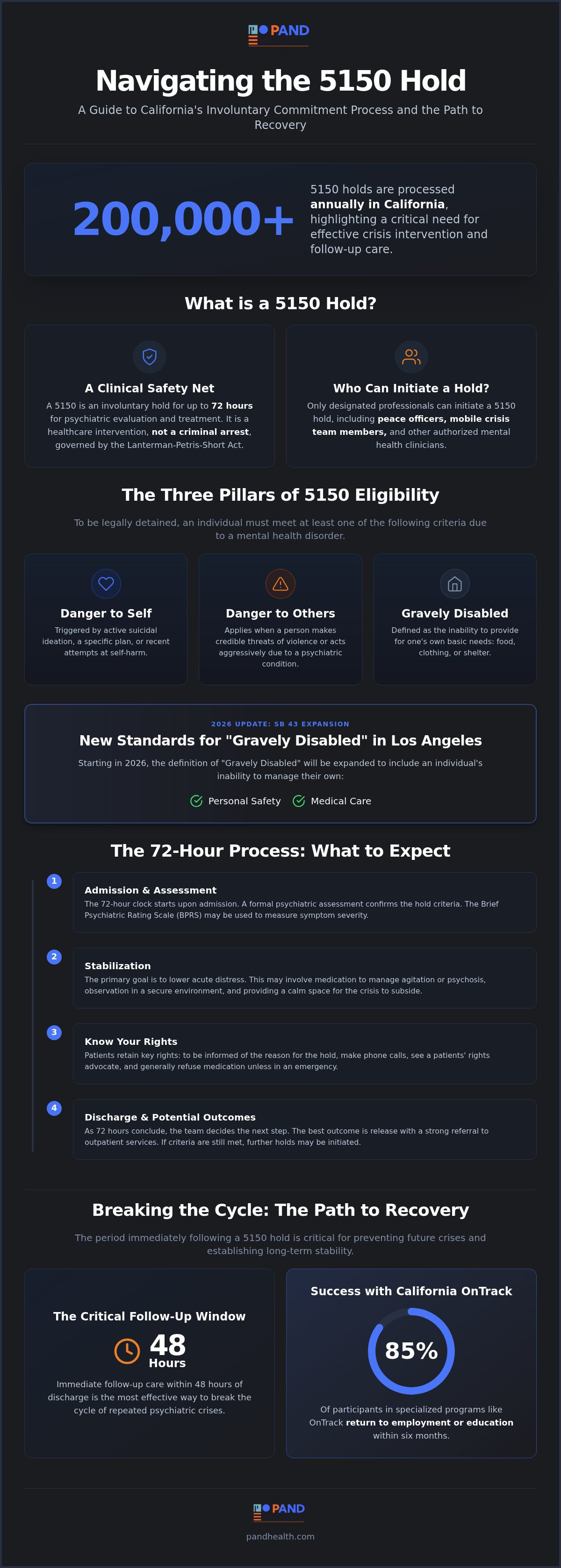
With over 200,000 5150 holds processed annually in California, the mental health system often feels like a revolving door rather than a bridge to lasting wellness. If you're feeling paralyzed by the fear of involuntary commitment or confused by shifting legal definitions, your anxiety is completely valid. It's exhausting to navigate a crisis when you don't know what comes after the initial 72 hours or how to stop the cycle of emergency hospitalizations.
This guide provides the clinical clarity you need to navigate the 2026 SB 43 expansions in Los Angeles, which now include personal safety and medical care in the definition of being gravely disabled. We'll examine the specific criteria for an involuntary hold, explain how to advocate for a loved one's rights, and outline a path toward long-term stability that begins the moment the hospital stay ends. By understanding the transition from crisis to specialized outpatient care, you can help your family member move toward a future defined by professional support and personal progress instead of emergency rooms.
Key Takeaways
- Understand the legal criteria for a 5150 hold in California and the specific steps involved during the initial 72-hour assessment and evaluation period.
- Navigate the 2026 SB 43 expansions in Los Angeles, which define "gravely disabled" to include an individual's inability to manage their own personal safety or medical care.
- Identify why immediate follow-up care within 48 hours of discharge is the most effective way to break the cycle of repeated psychiatric crises.
- Learn how specialized California OnTrack programs focus on long-term functional outcomes, helping 85% of participants return to employment or education within six months.
What is a 5150 Hold? Definition and Legal Criteria in California
A 5150 hold is a specific section of the California Welfare and Institutions Code that allows for the involuntary detention of an individual experiencing a mental health crisis. It lasts for a maximum of 72 hours. It's important to understand that this isn't a criminal arrest. Instead, it's a clinical safety net designed to provide immediate evaluation and treatment. This legal framework, governed by the Lanterman-Petris-Short Act, balances the protection of individual civil liberties with the urgent need for psychiatric intervention. The goal is always stabilization and safety, never punishment.
Only designated professionals can initiate a 5150. These include peace officers, members of mobile crisis response teams, or specific mental health clinicians authorized by the county. When someone is placed on a hold, they're transported to a designated psychiatric facility for a formal assessment. This period allows medical staff to determine the severity of the crisis and create a plan for what comes next.
The Three Pillars of 5150 Eligibility
To be legally detained, an individual must meet at least one of three specific criteria. Clinical teams look for evidence that a mental health disorder is directly causing these risks.
- Danger to Self: This is often triggered by active suicidal ideation, a specific plan for self-harm, or recent life-threatening actions. It's an immediate intervention to prevent loss of life.
- Danger to Others: This applies when an individual makes credible threats of violence or acts out physically toward others because of their psychiatric state.
- Gravely Disabled: This criteria involves a person's inability to provide for their own basic needs. Traditionally, this focuses on the inability to secure food, clothing, or shelter.
Rights of the Individual During a 72-Hour Hold
Being placed on an involuntary hold doesn't mean a person loses all their rights. Clinical providers are required to treat every individual with dignity and transparency. Patients must be informed of the reasons for their detention and the name of the facility where they'll be evaluated. They have the right to make phone calls to family or an attorney and can request the assistance of a patients' rights advocate. Additionally, patients generally have the right to refuse psychiatric medications unless an emergency situation requires immediate intervention to prevent harm.
The 5150 Process: What Happens During the 72 Hours?
The journey through a 5150 hold begins with transportation to a designated psychiatric evaluation facility. In Los Angeles, this usually involves law enforcement or a specialized ambulance service. Once the individual is admitted, the 72-hour clock begins. It's a period of intense clinical scrutiny designed to ensure safety while determining the underlying cause of the crisis. This timeframe acts as a stabilization window, allowing the acute intensity of a psychiatric episode to subside under professional supervision.
Intake involves a formal psychiatric assessment to confirm the legal criteria for the hold. During this time, medical staff observe the individual closely in a secure environment. Stabilization often begins immediately. This may include the administration of medication to manage acute symptoms like agitation, severe anxiety, or hallucinations. The goal is to lower the level of distress so a clear long-term plan can be formed. Discharge planning starts early, as the team evaluates whether the person can safely return home or requires more intensive support.
Assessment and Evaluation Procedures
Clinicians must work quickly to differentiate between substance-induced symptoms and primary psychosis. In Los Angeles, where co-occurring disorders are common, this distinction is vital for accurate treatment. Doctors often use the Brief Psychiatric Rating Scale (BPRS) to objectively measure symptom severity. This tool tracks changes in mood, thought patterns, and behavior over the three-day window. Family history and collateral information from loved ones are indispensable during this phase. They provide the context that a person in crisis might not be able to articulate, helping the team understand the baseline of the individual's mental health and any previous patterns of illness.
Potential Outcomes After the Initial 72 Hours
As the 72-hour maximum approaches, the clinical team decides on the next steps based on the patient's response to stabilization. The most favorable outcome is a release with a comprehensive referral to outpatient services. This occurs when the individual no longer meets the legal criteria for danger or grave disability. In other cases, a patient might agree to a voluntary stay extension, choosing to remain in the facility to continue their progress without the pressure of a legal hold. However, if the person remains a danger to themselves or others, or stays gravely disabled, the facility may recommend a 5250 hold. This is a 14-day involuntary extension that provides more time for intensive treatment. Understanding these transitions is essential for families, and you can contact a specialist to discuss how to support a loved one through this complex process.
SB 43 and the 2026 Expansion: New Standards for Gravely Disabled
January 1, 2026, marked a pivotal shift for mental health intervention in Los Angeles County. The implementation of Senate Bill 43 (SB 43) significantly updated the legal framework for involuntary holds, addressing gaps that left many families without options. Before this expansion, the definition of being gravely disabled was limited to an individual's inability to provide for their own food, clothing, or shelter. This narrow scope often prevented clinicians from intervening until a person reached a state of total physical collapse.
The new standards broaden the criteria to include an individual's inability to manage their personal safety or necessary medical care. This means a 5150 hold can now be initiated if a mental health disorder or a severe substance use disorder prevents someone from protecting themselves from harm or treating life-threatening medical conditions. For the first time, severe substance use is recognized as a standalone factor for a hold if it renders the person gravely disabled. This change provides a vital tool for families in Los Angeles who have watched loved ones cycle through the streets without a legal pathway to care.
Managing Care for Those Without Medical Insight
One of the most challenging aspects of a psychiatric crisis is anosognosia. This is a clinical condition where an individual is physiologically unable to recognize their own mental illness. It isn't simple denial; it's a lack of insight caused by the condition itself. The 2026 laws empower families to intervene earlier, recognizing that a person who cannot perceive their need for help is at the highest risk. By expanding the definition of grave disability, the law allows for professional stabilization before a situation turns tragic. It's also essential to distinguish these 5150 related interventions from Probate conservatorships. While Probate cases usually handle financial matters for the elderly, LPS conservatorships are specifically designed for those who remain gravely disabled after an initial psychiatric hold.
Advocating for Your Loved One in Los Angeles
When a crisis occurs, your role as a family member is to act as a bridge between the patient and the clinical team. You provide "collateral information" that a psychiatrist cannot see during a brief evaluation. To advocate effectively, you should document specific examples of how your loved one is failing to manage their safety or medical needs under the SB 43 criteria. Note instances of neglected infections, dangerous wandering, or the inability to seek help for physical pain. Sharing this history ensures the evaluating physician has a complete picture of the risk. For families seeking better ways to navigate these interactions, our resource on Family Psychoeducation Los Angeles provides communication strategies designed to support long-term recovery and reduce the stress of the intervention process.
Beyond the Crisis: Transitioning from a 5150 to Intensive Recovery
A 5150 hold serves as a vital emergency brake, but it's rarely a complete solution for long-term wellness. Many families in Los Angeles find themselves trapped in a "revolving door" of repeated hospitalizations because 72 hours of stabilization doesn't address the underlying cognitive challenges of a thought disorder. True recovery requires a bridge from the hospital bed to the community. Clinical data suggests that the most critical window for preventing a relapse is the first 24 to 48 hours following discharge. Without an immediate, structured transition, the risk of a secondary crisis remains high.
Coordinated Specialty Care (CSC) is the gold standard for breaking this cycle. By providing a multidisciplinary team approach, CSC focuses on the individual's long-term functional outcomes rather than just temporary symptom management. At Pand Health, our commitment to this model has yielded transformative results. While the industry average for rehospitalization sits at 10%, our enrolled participants see a rate of just 6%. This reduction is achieved by prioritizing community reintegration and specialized clinical interventions that start the moment a patient leaves the facility.
Why Intensive Outpatient Care Beats Repeated Hospitalization
Prolonged inpatient stays can sometimes hinder recovery by isolating individuals from their natural support systems. In many traditional settings, the average inpatient stay lasts roughly 40 days. However, our intensive outpatient model helps reduce that time to an average of just 7 days. This shift is possible through evidence-based practices including:
- Social Skills Training: Helping patients regain the confidence to interact with the world again.
- Metacognitive Training (MCT): Teaching individuals to recognize and manage the patterns of thought that lead to paranoia or delusions.
- Direct Community Support: Providing a lifeline during the most vulnerable 48 hours post-discharge.
The Role of the SEE Curriculum in Restoring Normalcy
Recovery is about more than the absence of symptoms; it's about the restoration of a meaningful life. We view returning to school or work as a clinical necessity for long-term stability. Our SEE (Supported Education and Employment) curriculum provides the vocational scaffolding needed to help young adults regain their independence. We're proud of our 85% success rate in education and employment participation after six months of treatment. For those ready to begin this journey, our LA Work-Study Guide offers a clear roadmap for vocational recovery. If you're ready to move beyond the cycle of crisis, reach out to our clinical team today to discuss a personalized transition plan.
Pand Health: Recovery-Oriented Care in Southern California
Pand Health operates with a clear philosophy: recovery is the expectation, not just a possibility. Our California OnTrack program serves as an augmented Coordinated Specialty Care (CSC) model specifically tailored for teens and young adults in Los Angeles. While a 5150 hold addresses the immediate danger, our team focuses on the complex period that follows. We specialize in First Episode Psychosis and schizophrenia-spectrum disorders, providing the niche expertise required to stabilize thought patterns and restore functional independence. Our approach integrates advanced interventions like Social Cognition and Interaction Training (SCIT) and Metacognitive Training (MCT) alongside computerized cognitive remediation. These aren't just clinical terms; they're the building blocks of a life reclaimed from the confusion of a psychiatric crisis.
By focusing on the unique needs of the local community, we provide a steady hand for families who feel overwhelmed by the mental health system. We understand that a crisis impacts the entire family unit, which is why our rehabilitation model is both intensive and human-centric. We don't just aim for the absence of illness. We strive for the restoration of normalcy, helping individuals reintegrate into their social circles and professional lives with confidence and specialized support.
Our Data-Driven Results for Los Angeles Families
We believe in transparency and measurable progress. Our clinical outcomes reflect the efficacy of the California OnTrack model through rigorous data collection. On average, our participants experience a documented 19-point improvement on the Positive and Negative Syndrome Scale (PANSS). This scale is a primary tool for measuring the severity of psychosis symptoms. Additionally, we've seen a 40% reduction in negative symptoms, such as social withdrawal and lack of motivation, as measured by the SANS scale over a nine-month period. Cognitive health is equally prioritized; our patients typically see cognitive performance gains that move them from the 33rd to the 50th percentile. These numbers represent real-world transformations: students returning to classrooms and young professionals resuming their careers.
Taking the Next Step After a 5150
The transition from an involuntary hold to outpatient care is often the most stressful time for a family. Navigating the aftermath of a 5150 requires a steady hand and a clear plan. Referring a loved one to the California OnTrack program is a straightforward process designed to provide relief during this transition. The first step is a comprehensive psychiatric evaluation conducted by our specialized team. During this assessment, we look beyond the crisis to understand the individual's history, strengths, and goals. We work closely with families to ensure that the initial hospitalization is the last crisis they have to face. By choosing a recovery-oriented path in Los Angeles, you're investing in a future where stability and normalcy are the standard, not the exception.
Moving Beyond the 72-Hour Safety Net
A 5150 hold is a critical first step in ensuring immediate safety, but it isn't the final destination. True stability happens when the 72-hour window closes and the work of rebuilding begins. With the 2026 expansion of SB 43, families in Los Angeles have more power than ever to intervene before a crisis escalates. However, the most effective way to break the revolving door of hospitalization is through specialized, data-driven outpatient care that prioritizes functional living.
At Pand Health, we offer Southern California's only augmented Coordinated Specialty Care (CSC) model. Our approach is designed to transform the recovery experience. While the industry average for rehospitalization is 10%, our participants maintain a 6% rate. Even more importantly, 85% of our patients return to work or school within just six months. You don't have to navigate this transition alone. Contact our Los Angeles team to transition from crisis to recovery and find a path that leads back to normalcy. There's real hope for a future where crises are replaced by consistent, specialized support.
Frequently Asked Questions
Can I visit my loved one while they are on a 5150 hold?
Visitation rights are generally protected under California law, but the specific facility's policies and the patient's clinical stability determine the timing. Most psychiatric units in Los Angeles have designated visiting hours for families. However, the treating physician may temporarily restrict visitors if they believe it would interfere with the patient's stabilization or safety. It is best to contact the facility's social worker to coordinate a visit and understand their specific safety protocols.
Will a 5150 hold show up on a background check in California?
A 5150 hold is a civil medical procedure, not a criminal arrest, so it does not appear on standard employment background checks. The record is part of a protected medical file under HIPAA and California privacy laws. While it won't show up for most jobs, it may be accessible during high-level federal security clearance reviews or specialized licensing applications involving firearms. For the vast majority of people, the hold remains a private medical event.
What is the difference between a 5150 and a 5250 hold?
The primary difference lies in the duration and the legal process required for detention. A 5150 is an initial 72-hour hold used for evaluation and immediate stabilization. If the clinical team determines that the individual still meets the criteria for being a danger or gravely disabled after those three days, they may file for a 5250 hold. This extends the stay for up to 14 days and includes a mandatory certification hearing to protect the patient's rights.
How much does a 5150 hold cost in Los Angeles?
The cost of an involuntary hold in Los Angeles depends on whether the individual is treated at a county-contracted facility or a private psychiatric hospital. Insurance coverage, including Medi-Cal or private providers, typically handles a significant portion of the stabilization costs. Because every facility has a different fee structure and every insurance plan offers varying levels of behavioral health coverage, you should consult with the hospital’s billing department or your insurance representative for specific financial details.
Can a 5150 hold be started for cannabis-induced psychosis?
Yes, a 5150 hold can be initiated for cannabis-induced psychosis if the individual's symptoms meet the legal criteria for danger to self, danger to others, or grave disability. When substance use triggers a severe break from reality, the priority is immediate safety and detoxification. Following the hold, specialized programs like California OnTrack can help address the underlying vulnerability to psychosis and prevent future substance-triggered episodes through targeted psychological and social rehabilitation.
What happens if my loved one is released before the 72 hours are up?
The 72-hour period is a maximum limit, not a required length of stay. If the evaluating psychiatrist determines the individual no longer meets the legal criteria for a hold, they must be released. Early release often leaves families feeling unprepared, which is why having an immediate follow-up plan is vital. Rapid enrollment in an intensive outpatient program within 48 hours of discharge is the most effective way to maintain the stability achieved in the hospital.
How do I get my loved one into the California OnTrack program after discharge?
Transitioning into the California OnTrack program begins with a specialized psychiatric evaluation to ensure the model fits the individual's needs. This program is designed for teens and adults who have experienced a first episode of psychosis. You can reach out to our team directly to coordinate a clinical intake. We focus on rapid community reintegration, helping 85% of our participants return to their education or employment goals within six months of starting treatment.
Does a 5150 hold affect gun ownership rights in California?
In California, being admitted to a facility under a 5150 hold results in a five-year prohibition on owning or possessing firearms. This restriction begins immediately upon the hold being initiated. Individuals have the right to petition the court for a hearing to restore their firearm rights before the five-year period ends. This legal consequence is designed as a safety measure during the recovery process to reduce the risk of harm during future psychiatric crises.
Disclaimer
This article is for information and educational purposes only, and can NEVER replace a proper medical evaluation. If you or a loved one may be suffering from psychosis or the prodomal symptoms of psychosis, get evaluated by a professional as soon as possible. Early diagnosis and treatment can be life-saving.