

Recovery from Psychosis Success Stories: Reclaiming Life with Evidence-Based Care
What if a first episode of psychosis wasn't the end of a promising career or a college degree, but rather a manageable detour on the path to a meaningful life? When a loved one experiences a break from reality, it's natural to feel a crushing sense of fear that they'll never be the same. You might worry about permanent disability or the painful sting of social isolation. These anxieties are valid, yet they don't have to be the final word on your family's future.
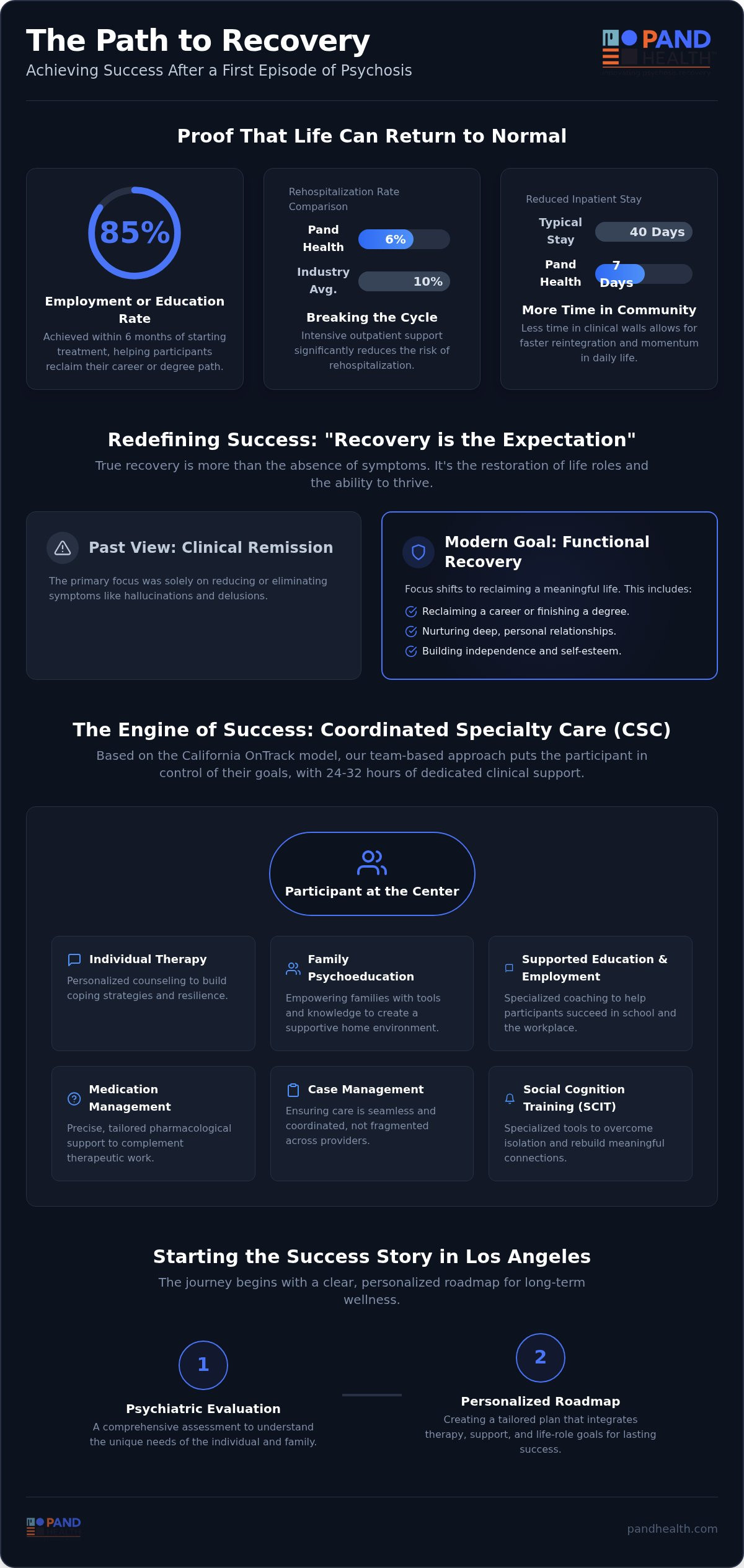
By exploring recovery from psychosis success stories, you'll see that functional recovery is an achievable reality when backed by specialized, coordinated care. We understand that you need proof that life can return to normal. At Pand Health in Los Angeles, we've seen our participants achieve an 85% employment or education rate within just six months of starting treatment. This article will guide you through the steps of reclaiming stability and show you how evidence-based programs transform a period of crisis into a journey of long-term success. You'll discover how a steady hand in the storm can help bridge the gap between clinical intervention and real-world achievement.
Key Takeaways
- Understand why "recovery is the expectation" and how shifting the focus to life roles like school and work changes the healing process.
- Learn how the California OnTrack model uses an augmented Coordinated Specialty Care approach to put participants in control of their own recovery goals.
- Explore real-world recovery from psychosis success stories where participants achieved an 85% employment or education rate within six months.
- Discover how specialized tools like Social Cognition and Interaction Training (SCIT) help individuals overcome isolation and rebuild meaningful community connections.
- Identify the first steps for families in Los Angeles, beginning with a psychiatric evaluation to create a personalized roadmap for long-term wellness.
The Path to Hope: Defining Success in Psychosis Recovery
True recovery is more than just the absence of hallucinations or delusions. While clinical remission focuses on the reduction of symptoms, functional recovery focuses on the restoration of life roles. At Pand Health, we operate under the belief that "Recovery is the Expectation." This philosophy shifts the focus from simply managing a disability to reclaiming a career, finishing a degree, and nurturing deep, personal relationships. Success isn't measured by a lack of struggle, but by the ability to thrive despite it.
This holistic view of thriving often includes attending to physical health as a way to boost self-esteem; for example, specialized clinics such as Padden Dental provide restorative care that helps individuals feel more confident as they step back into their life roles.
When someone experiences First Episode Psychosis (FEP), they enter what clinicians call the "critical period." These early years are vital for long-term outcomes. Modern recovery views of psychosis emphasize that early, intensive intervention can fundamentally change the trajectory of the condition. By intervening during this window, we move beyond simply stabilizing a crisis and begin the work of building recovery from psychosis success stories that last a lifetime. This proactive approach ensures that a single episode doesn't define a person's entire future.
Breaking the Cycle of Rehospitalization
One of the greatest fears for families in Los Angeles is the "revolving door" of psychiatric wards. Frequent hospitalizations can disrupt education and destroy a young person's self-esteem. Our data shows a different path is possible. Pand Health maintains a 6% rehospitalization rate, which is significantly lower than the 10% industry average. By providing intensive outpatient support, we've helped reduce the average inpatient stay from 40 days to just 7 days. This allows individuals to spend more time in their community and less time behind clinical walls, maintaining the momentum of their daily lives.
The Emotional Journey of the Family
A first episode of psychosis is often a traumatic event for the entire household. Parents and siblings frequently feel a mix of confusion, grief, and exhaustion. Creating a supportive recovery environment requires more than just treating the individual; it requires empowering the family. Through Family Psychoeducation in LA, we provide the tools necessary to navigate this complex journey. When families understand the clinical nuances and communication strategies needed for success, the home becomes a sanctuary for progress rather than a source of stress. This collective resilience is often the foundation for the most enduring success stories.
How Coordinated Specialty Care (CSC) Powers Success Stories
The foundation of effective treatment lies in a model known as Coordinated Specialty Care (CSC). At Pand Health, we utilize the California OnTrack model, which is an augmented version of the nationally recognized NIMH NAVIGATE framework. Unlike traditional mental health services that often feel disjointed, CSC is a team-based approach where the participant remains the primary driver of their own goals. It's a high-intensity program, dedicating between 24 to 32 hours of clinical support per client to ensure no detail of the recovery process is overlooked. This level of commitment is what transforms clinical data into real-world recovery from psychosis success stories.
While medication management is a component of the program, it's designed to support psychosocial care rather than replace it. Our psychiatric evaluations ensure that pharmacological interventions are precise and tailored to the individual's needs, serving as a stable platform for deeper therapeutic work. This integrated approach ensures that the medical and social aspects of healing work in harmony, rather than in isolation. To learn more about this model of compassionate outpatient support, you can discover Assure Psychiatry and their focus on culturally competent care.
The NAVIGATE Framework in Action
Success in the NAVIGATE framework comes from its multi-pronged structure. It combines individual therapy, family support, and specialized coaching for school or work. In a city as complex as Los Angeles, navigating the mental health landscape can be overwhelming for families. Our case management team acts as a vital guide, ensuring that care isn't fragmented across different providers. By keeping all specialists on the same page, we provide a seamless experience that allows the participant to focus entirely on their personal growth and functional gains.
Certified Expertise: Why Certification Matters
High-standard care requires more than just good intentions; it requires specialized training. Pand Health is the only outpatient CSC in Southern California offering specific APA-recommended therapies like Metacognitive Training (MCT). Our certified MCT instructors teach participants to "think about their thinking," which is a powerful tool for identifying and reducing the cognitive biases that lead to paranoia. This specialized intervention is a marker of our commitment to providing the most advanced, evidence-based tools available. If you're ready to explore these options, you can reach out to our team to discuss a personalized plan.
Case Study: Returning to Work and School After Psychosis
Reclaiming a career or education is often the most significant milestone in recovery from psychosis success stories. It signals a shift from being a "patient" back to being a student, professional, and peer. The engine behind this functional achievement is the Supported Education and Employment (SEE) Curriculum. This evidence-based framework doesn't wait for total symptom remission before encouraging vocational goals. Instead, it treats work and school as vital components of the healing process itself. By integrating these goals into the clinical treatment plan from day one, we help individuals maintain their identity and community standing.
The impact of this approach is evident in our recent data. In the 2022-2024 cohort, only 6% of participants were engaged in work or school at the time of enrollment. After just six months in the California OnTrack program, that number jumped to 85%. This transition back to a Los Angeles college campus or a fast-paced workplace is carefully managed to ensure long-term stability. Our team provides active workplace and school advocacy, which helps dismantle the barrier of stigma and ensures that necessary accommodations are in place for a smooth return.
The OnTrack Work-Study Program
Returning to the workforce requires more than just a job lead; it requires a renewed sense of confidence. The California OnTrack Work-Study Program focuses on the practical and emotional aspects of vocational success. Participants engage in resume building, motivational interviewing, and specialized social-skills training to prepare for the unique demands of the professional world. For a detailed look at the specific vocational steps involved, you can consult our LA Work-Study Guide. A dedicated Job Coach provides ongoing support, offering on-site or off-site guidance to help manage stressors and celebrate professional wins as they happen.
Overcoming Cognitive Fog with Remediation
One of the most persistent hurdles in recovery is "cognitive fog," which can make concentrating on tasks or following complex instructions feel nearly impossible. To address this, we utilize APA-recommended Cognitive Remediation. This "brain training" involves daily computer-assisted exercises paired with physical fitness to enhance neuroplasticity and mental clarity. The results are measurable and encouraging. On average, our participants see their cognitive performance jump from the 33rd percentile to the 50th percentile over a 12-month period. This improvement ensures that when someone returns to their career, their mind is sharp and prepared for the demands of their role.
In addition to cognitive training, maintaining healthy sleep patterns is vital for long-term stability; for instance, Enas Wellness provides specialized support for insomnia, demonstrating how targeted wellness and nutrition can enhance the recovery process.
Social Success: Rebuilding Friendships and Community
The aftermath of a psychotic episode often brings a hidden challenge: social disability. While clinical symptoms may subside, the ability to connect with others often feels fractured. Many young adults in Los Angeles find that their social circles have shrunk or that they feel profoundly "different" from their peers. This isolation isn't a permanent state, but rather a hurdle that can be cleared with the right tools. By focusing on social rehabilitation, we help individuals move from the fringes of their community back into the heart of active, vibrant lives. These moments of reconnection are the heartbeat of recovery from psychosis success stories.
We utilize the "Clubhouse Model" as a bridge to community reintegration. This approach provides a supportive environment where individuals can practice social roles without the fear of judgment. It serves as a vital transition point, allowing participants to regain their social footing before fully re-entering the fast-paced social life of Southern California. By treating social interaction as a skill that can be practiced and mastered, we remove the "tarnished" feeling that often follows a period of crisis.
Mastering Social Cues and Interaction
Psychosis can fundamentally interfere with how the brain processes social information. It's common for individuals to struggle with reading facial expressions or interpreting subtle social nuances. This often leads to paranoiac interpretations of neutral events, such as assuming a stranger's glance is a sign of hostility. To address this, we use Social Cognition and Interaction Training (SCIT). This evidence-based approach helps participants "unlearn" these reflexive biases and develop a more accurate understanding of social interactions. For a deeper look at how this methodology works, explore our Social Skills Training guide. By mastering these cues, young adults can navigate complex social landscapes with renewed confidence.
The Power of Peer Support
Isolation thrives in secrecy, but it dissipates in the presence of others who truly understand the experience. Within our social skills groups, participants find a space where they aren't defined by their diagnosis. Seeing a peer return to school or start a new job reduces the stigma of being the "guy who was sectioned." Multi-Family Group Therapy also plays a vital role by normalizing the experience for the entire household. It transforms the recovery process from a solitary struggle into a shared journey of growth. This collective empowerment is what makes the transition from a clinical setting to the real world so effective. If you're looking for a supportive community to start this journey, you can contact our Los Angeles office today to learn more about our group programs.
Starting Your Success Story in Los Angeles
The journey toward long-term wellness begins with clinical clarity. For many families in Southern California, the first step is a comprehensive psychiatric evaluation for thought disorders. This diagnostic process is essential for distinguishing between various clinical presentations and ensuring that the treatment plan matches the individual's specific needs. In a city as vast as Los Angeles, finding specialized care can feel overwhelming, yet our site serves as a dedicated lifeline for those in the midst of a crisis. By focusing on the "critical period" of intervention, we help turn a frightening experience into one of the many recovery from psychosis success stories we see each year.
Early intervention is the most reliable predictor of functional gains. Our data from the 2022-2024 cohort shows that when individuals enter the California OnTrack for Teens or California OnTrack for Adults programs between the ages of 13 and 40, they achieve remarkable improvements in both their clinical stability and their social engagement. We don't just aim for a reduction in symptoms; we aim for a complete return to the life the participant envisioned before their symptoms began. This proactive approach is what allows our participants to maintain an 85% employment or education rate, proving that a diagnosis doesn't have to derail a person's future.
What to Expect at Pand Health
The process starts at our Olympic Blvd. office with a thorough intake session designed to put the family at ease. Our team of specialists works collaboratively to create a tailored "Implementation Toolkit" for each individual. This toolkit isn't a static document; it's a dynamic roadmap that includes psychological rehabilitation, family psychoeducation, and vocational support. We maintain a rigorous commitment to data-driven results, ensuring that every participant's progress is monitored long-term to prevent relapse and support ongoing growth. This level of specialized attention is rare in traditional outpatient settings, making our program a unique resource for the local community as we build more recovery from psychosis success stories.
Taking the First Step
If you're noticing early signs of psychosis in a loved one, don't wait for the situation to escalate. Reaching out for professional help is the most courageous step a family can take. We also offer a Professional Training Curriculum for providers and educators who support individuals in recovery, ensuring that the entire care network is equipped with the latest evidence-based strategies. You can reach out to Pand Health Contact for immediate inquiries and to schedule an initial evaluation. Your family's path toward stability and success starts with a single, informed decision.
Reclaiming Your Path to Functional Wellness
A first episode of psychosis is a significant challenge, but it doesn't have to be a permanent barrier to your aspirations. By prioritizing early intervention and a coordinated specialty care model, you can shift the focus from crisis management to meaningful community reintegration. We've seen that when treatment addresses social skills and vocational needs alongside clinical stability, real transformation occurs. It's about moving beyond the label and back into the roles that define who you are.
These recovery from psychosis success stories are built on a foundation of rigorous, evidence-based tools. At Pand Health, our on-site specialists utilize certified MCT and SCIT therapies to empower participants in their daily lives. The results speak for themselves. Currently, 85% of our patients are in school or working within six months, and we maintain an industry-leading 6% rehospitalization rate. You don't have to navigate this storm alone. Our team provides the steady hand and specialized expertise needed to guide your family through this transition.
Start your recovery journey today; contact Pand Health in Los Angeles to learn how our specialized team can help your family find stability and a clear path forward. Recovery isn't just a clinical goal; it's the expectation we hold for every individual who walks through our doors.
Frequently Asked Questions
Is full recovery from psychosis actually possible?
Functional recovery is an achievable reality for the majority of individuals who receive specialized care. While the journey varies, our goal is the restoration of life roles rather than just symptom management. By focusing on recovery from psychosis success stories, we emphasize that participants can return to their previous levels of social and professional engagement. This approach ensures that a diagnosis is a manageable detour rather than a permanent disability.
How long does the California OnTrack program typically last?
The California OnTrack program is generally a two-year commitment, though the duration is tailored to each participant's unique progress. This timeframe allows for the intensive application of the NAVIGATE framework and ensures that functional gains are stabilized. We monitor progress closely throughout this period to provide a steady hand during the transition from clinical care to independent living, ensuring the foundation for long-term wellness is secure and sustainable.
Can my child return to college while in psychosis treatment?
Yes, returning to college is a primary goal for many of our participants. Through the California OnTrack Work-Study Program, we provide the necessary accommodations and advocacy to ensure a successful return to campus. Our 2022-2024 cohort data shows that 85% of participants are either working or in school within six months of starting treatment. We believe that maintaining educational momentum is a vital part of the overall healing process.
What is the difference between symptom remission and functional recovery?
Symptom remission refers to the clinical reduction of hallucinations or delusions, while functional recovery involves reclaiming one's life roles. You can be in remission but still struggle with social isolation or unemployment. True success occurs when an individual is not only symptom-free but also actively participating in their community, pursuing a career, or finishing their degree. We prioritize functional outcomes to ensure participants thrive in the real world.
How does Pand Health achieve such low rehospitalization rates?
Our industry-leading 6% rehospitalization rate is achieved through the high-intensity Coordinated Specialty Care (CSC) model. By providing 24 to 32 hours of clinical support per client, we catch potential setbacks before they become crises. This proactive approach has successfully reduced the average inpatient stay for our participants from 40 days to just 7 days. Our team-based method provides a safety net that traditional, fragmented care systems simply cannot match.
Is family therapy required for a success story?
Family therapy and psychoeducation are essential components of a successful recovery environment. When families understand the clinical nature of psychosis and learn effective communication strategies, the home becomes a sanctuary for progress. While the participant is the driver of their goals, the support of an informed family significantly improves long-term outcomes. We find that the most enduring recovery from psychosis success stories involve a collaborative effort between the individual and their loved ones.
Do you treat cannabis-induced psychosis specifically?
Yes, we offer specialized cannabis induced psychosis rehab for individuals whose symptoms are linked to substance use. This specific form of psychosis requires a nuanced approach that addresses both the psychiatric symptoms and the underlying patterns of use. For those seeking highly intensive residential care, exploring options like an afkickkliniek Zuid-Afrika can provide a dedicated roadmap toward sobriety and mental clarity through evidence-based interventions.
What should I do if my teenager is showing early signs of a thought disorder?
If you notice early signs like social withdrawal, disorganized thinking, or unusual beliefs, you should seek a professional psychiatric evaluation immediately. Early intervention during the "critical period" is the most effective way to maximize functional gains and prevent long-term disability. At our Los Angeles site, we provide comprehensive evaluations for thought disorders to help families get the answers they need. Taking action early can fundamentally change the trajectory of your child's future.