
Differential Diagnosis Psychosis vs Autism: A Clinical Guide to Accurate Assessment
When an adolescent suddenly withdraws from friends, struggles to process social cues, or voices unconventional thoughts, are you seeing longstanding neurodivergent traits or the first signs of a psychiatric crisis? Establishing an accurate differential diagnosis psychosis vs autism is one of the most urgent and complex challenges families face. Because both conditions can present with flat affect, intense sensory sensitivities, and profound social isolation, the fear of an incorrect label or inappropriate psychiatric medication is entirely justified.
You aren't alone if you've found the search for clinicians trained in both neurodevelopment and thought disorders exhausting. Fortunately, the clinical boundary between the two doesn't depend on surface-level social withdrawal. It rests on developmental trajectory, cognitive processing, and reality testing. In this guide, you'll gain a clear understanding of the key clinical markers that distinguish autism spectrum traits from early psychosis, alongside an actionable roadmap to secure a comprehensive, specialized psychiatric evaluation.
Key Takeaways
- Understand why tracing early childhood milestones and developmental trajectory provides the single most reliable foundation for separating lifelong neurodivergence from acute psychiatric onset.
- Discover how clinicians evaluate reality testing and belief conviction to establish an accurate differential diagnosis psychosis vs autism when shared traits like social withdrawal cloud the picture.
- Recognize the clinical distinctions between autistic burnout and the negative symptoms of schizophrenia to protect against diagnostic overshadowing and inappropriate medication.
- Learn what a multi-informant, multidisciplinary assessment entails, including the specific standardized tools required to evaluate complex cognitive and sensory presentations.
- Explore targeted, evidence-based care pathways that follow an accurate diagnosis, from neurodiversity-affirming support to Coordinated Specialty Care for early recovery.
The Clinical Challenge: Overlapping Symptoms in Autism and Psychosis
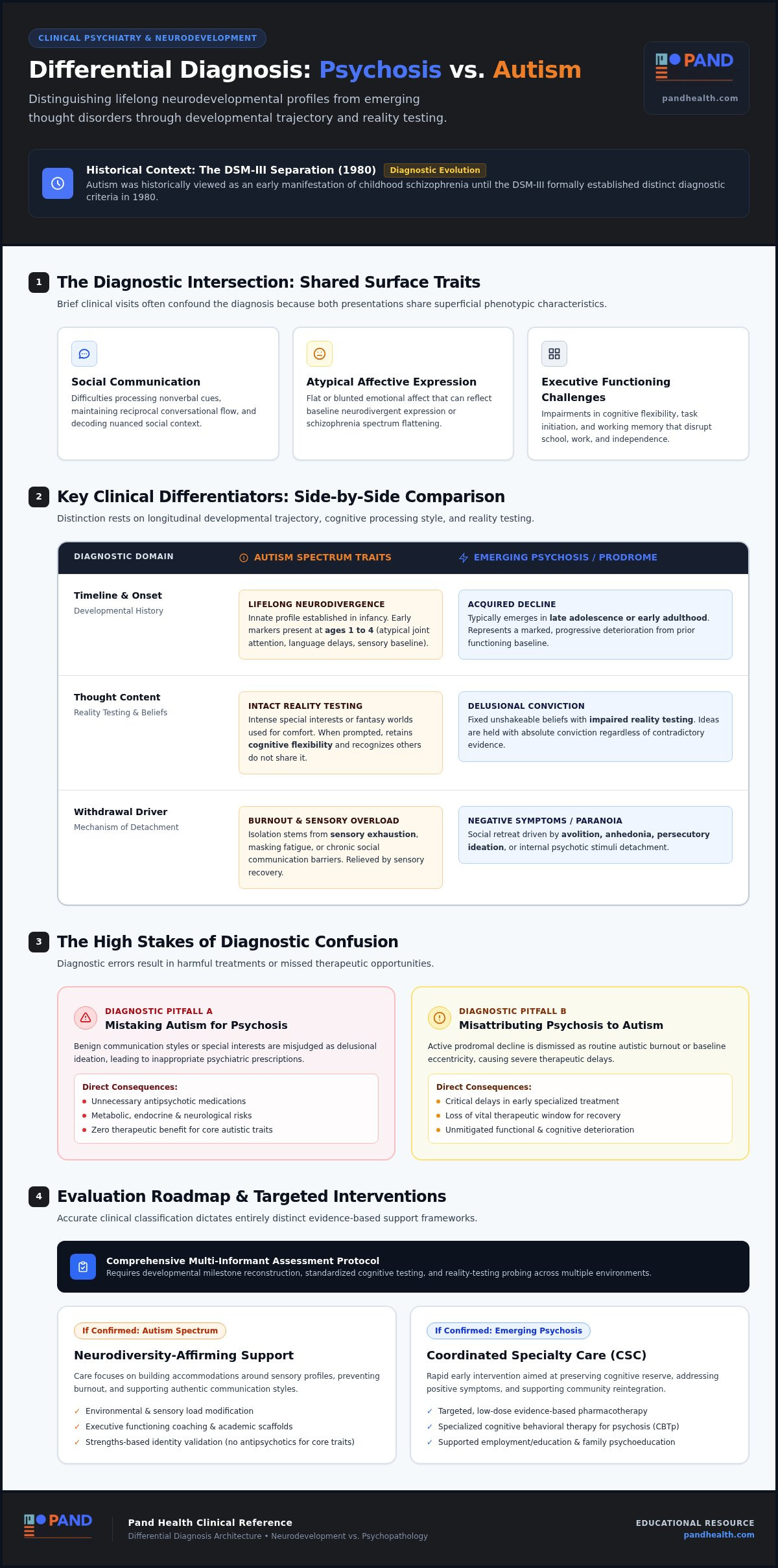
Psychiatric diagnostic boundaries are rarely tidy lines. When clinicians evaluate a young person demonstrating social isolation, atypical speech patterns, and emotional detachment, distinguishing between a lifelong neurodevelopmental profile and an emerging thought disorder is vital. In modern clinical psychiatry, establishing an accurate differential diagnosis psychosis vs autism requires disentangling phenotypic similarities that have confounded medicine for decades. Historically, autism was viewed as an early manifestation of psychosis; reviewing the historical context of the Differential Diagnosis of Childhood Schizophrenia and Autism reveals that autism was once categorized under childhood schizophrenia until distinct diagnostic criteria emerged in 1980 with the DSM-III. Today, precise clinical separation protects individuals from life-altering missteps.
Shared Phenotypes: Where Autism and Psychosis Converge
The diagnostic intersection between both conditions centers on negative symptoms and social processing deficits. Clinicians regularly encounter surface traits that appear virtually identical during brief office visits:
- Social communication differences: Difficulties interpreting nonverbal cues, reciprocal conversational rhythm, or subtle social context exist in both autism and the psychotic prodrome.
- Atypical affective expression: A flat or blunted affect can reflect an autistic individual's baseline expressive style, or it can signify the affective flattening typical of schizophrenia spectrum disorders.
- Executive functioning challenges: Impairments in cognitive flexibility, task initiation, and working memory manifest across both presentations, interfering with school, work, and independent living.
The Cost of Diagnostic Confusion
Conflating these phenotypes carries severe consequences for young people and their families. Mistaking benign autistic communication styles or idiosyncratic special interests for active delusional ideation often leads to unnecessary antipsychotic prescriptions. These medications carry metabolic, endocrine, and neurological risks, yet they offer zero therapeutic benefit for core autistic traits.
Conversely, misattributing an emerging psychotic prodrome to autistic burnout or baseline eccentricity delays access to critical intervention. An accurate differential diagnosis psychosis vs autism ensures families don't miss the therapeutic window to preserve cognitive function and build meaningful, strengths-based accommodations.
Key Differentiators: Developmental History, Reality Testing, and Symptoms
Understanding whether clinical distress stems from autism or an emerging psychosis hinges on two core clinical pillars: longitudinal history and reality testing. When untangling a complex differential diagnosis psychosis vs autism, clinicians look past isolated behaviors and examine the lifelong trajectory of functional development. Surface quirks don't reveal pathology on their own; context and chronicity do.
Timeline and Onset: Lifelong Neurodivergence vs. Acquired Decline
Autism is an innate neurodevelopmental profile present from infancy. Early developmental markers, such as atypical joint attention, sensory differences, or language delays during ages one to four, establish a stable neurological baseline. Psychosis, conversely, typically emerges in late adolescence or early adulthood. Families witness an acquired, progressive deterioration from previous academic and social functioning. In research detailing frameworks for Unraveling Complex Patient Presentations, mapping this functional decline against early milestones provides the most reliable foundation for accurate classification.
Thought Content: Special Interests vs. Delusional Conviction
Differentiating deep passions from delusions requires testing cognitive flexibility and insight. An autistic person may immerse themselves in an intricate fantasy universe or intense special interest for comfort, but they retain intact reality testing. When gently prompted, they understand that others don't share their private world. In contrast, psychotic delusions involve fixed, unshakeable conviction, frequently centering on persecutory or referential themes. True auditory or visual hallucinations are positive psychiatric symptoms that never occur solely due to an autism spectrum condition.
Communication Patterns: Pragmatic Differences vs. Formal Thought Disorder
Speech oddities can look deceptive during an office visit. Autistic communication often features literalism, pedantic phrasing, hyper-verbal monologues, or circumstantial details. The underlying logical structure, however, remains intact:
- Autistic pragmatic differences: Tangential speech usually connects back to a favored subject; given time and quiet, the speaker clarifies their narrative easily.
- Formal thought disorder: Psychotic speech exhibits structural breakdown, marked by derailment, loose associations, and poverty of content that fails to communicate clear meaning.
Stress exacerbates both presentations, but autistic disorganization resolves as sensory overload subsides. If your family is navigating this diagnostic ambiguity, reaching out for a specialized psychiatric evaluation provides the nuanced clarity necessary to protect your loved one's future.
Diagnostic Traps: Autistic Burnout, Sensory Overload, and Prodrome
Diagnostic traps often trip up evaluators when acute stress collides with neurodivergent vulnerability. Late-diagnosed individuals, particularly females who spent years camouflaging their traits through high-effort social masking, frequently reach a crisis point in early adulthood where exhaustion looks like psychiatric decompensation. During these crises, diagnostic overshadowing becomes a severe hazard: clinicians either write off emerging psychotic phenomena as baseline neurodivergence, or they misinterpret an autistic breakdown as schizophrenia.
Autistic Burnout vs. Schizophrenia Prodromal Withdrawal
Autistic burnout represents a state of profound physical, cognitive, and emotional depletion caused by chronic masking and unaccommodated sensory overload. The resulting skill regression, social withdrawal, and mutism closely mirror the classic negative symptoms of schizophrenia, such as avolition and anhedonia. Differentiating the two requires environmental observation:
- Response to accommodation: Autistic burnout gradually lifts when social demands drop, sensory stimulation ceases, and structured rest is introduced.
- Progression of negative symptoms: Prodromal psychotic withdrawal tends to persist or advance regardless of low-stimulus environments, driven by an intrinsic loss of drive rather than sensory depletion.
Sensory Sensitivities vs. Early Perceptual Hallucinations
Sensory processing differences represent another common point of confusion. An individual experiencing hyperacusis might report that ambient sounds feel deafening, piercing, or physically painful. During an assessment for a differential diagnosis psychosis vs autism, clinicians must evaluate whether the patient attributes anomalous sensory experiences to environmental stimuli or internal hallucinations:
- Sensory reactivity: The person knows the air conditioning hum is loud and distressing because their nervous system amplifies auditory input; reality testing remains intact.
- Prodromal perceptual changes: Sounds or shadows carry altered significance, morphing into whispered voices, distorted visual forms, or sinister omens that feel alien and ungrounded.
Disentangling these acute states requires clinicians to investigate what happens beneath the surface behavior. By analyzing whether distress stems from sensory exhaustion or slipping reality testing, evaluators protect patients from dangerous misclassification.
Comprehensive Clinical Assessment: What an Accurate Evaluation Requires
Diagnostic accuracy cannot rely on a single questionnaire or a thirty-minute psychiatric interview. Achieving a definitive differential diagnosis psychosis vs autism requires a multi-informant, multidisciplinary assessment conducted by clinicians experienced in both neurodevelopmental profiles and emerging thought disorders. Because traits intersect so closely, specialty clinics combine structured observation, developmental reconstruction, and psychopathology rating scales to eliminate diagnostic bias.
Gold-Standard Diagnostic Instruments and Protocols
Specialized evaluators pair neurodevelopmental measures with validated psychiatric instruments to map cognitive functioning alongside reality testing:
- Autism Diagnostic Observation Schedule (ADOS-2) and ADI-R: The ADOS-2 evaluates reciprocal social communication and restricted interests directly, while the Autism Diagnostic Interview-Revised (ADI-R) reconstructs early childhood development.
- Structured Interview for Psychosis-Risk Syndromes (SIPS): Evaluates attenuated positive symptoms, perceptual abnormalities, and deterioration in functioning to detect early prodromal states.
- Positive and Negative Syndrome Scale (PANSS): Measures the presence, severity, and character of active psychotic symptoms when acute decompensation is suspected.
- Neuropsychological battery: Measures executive functioning, processing speed, and working memory to uncover underlying cognitive profiles.
The Essential Role of Collateral History and Family Psychoeducation
Families provide the objective context clinicians need. Gathering report cards, early pediatric records, Individualized Education Programs (IEPs), and home videos helps clinicians confirm whether communication differences date back to toddlerhood or emerged suddenly in adolescence. Parents also notice early personality shifts, changes in self-care, or unusual suspiciousness long before overt symptoms appear.
Equipping caregivers with structured guidance transforms fear into informed advocacy. Exploring resources such as family psychoeducation Los Angeles allows families to understand their loved one's unique clinical trajectory and actively participate in recovery.
If you need specialized diagnostic clarity, contact our clinical team to schedule a comprehensive evaluation for thought disorders and autism.
Evidence-Based Pathways Following Diagnosis: Targeted Interventions
Arriving at a definitive determination isn't an end point; it's the gateway to recovery and purposeful adaptation. Once clinicians establish an accurate differential diagnosis psychosis vs autism, treatment shifts from uncertainty to action. Interventions diverge radically depending on whether a young person needs neurodiversity-affirming environmental adaptations, coordinated psychiatric intervention, or an integrated protocol addressing both conditions simultaneously.
Specialized Psychosocial and Cognitive Interventions
When an assessment confirms early psychosis, enrolling in an outpatient Coordinated Specialty Care (CSC) model offers the strongest prognosis. Within this framework, specialized psychotherapies address cognitive patterns without pathologizing the individual. Metacognitive Training (MCT) and Cognitive Behavioral Therapy for Psychosis (CBT-P) help individuals identify cognitive biases, test ungrounded assumptions, and reduce distress from anomalous experiences.
Social processing challenges, whether arising from autistic neurodivergence or psychotic negative symptoms, respond well to structured cognitive rehabilitation. Social Cognition and Interaction Training (SCIT) helps participants accurately interpret emotional cues, facial expressions, and complex social intentions. Pairing these interventions with evidence-based social skills training restores interpersonal confidence and dismantles defensive isolation.
Community Integration: Supported Education and Employment
Symptom stabilization alone doesn't equate to full recovery. True psychological wellness requires returning to meaningful roles in the community through supported education and employment. Autistic young adults benefit from sensory-friendly workplace accommodations, explicit task outlines, and executive functioning scaffolding. Individuals recovering from a first episode of psychosis need gradual academic re-entry, flexible scheduling, and stress-reduction protocols.
Outpatient programs bridge this transition by embedding vocational specialists directly into clinical care. Reviewing models like the LA work-study guide illustrates how structured supported employment drives long-term independence. Comprehensive coordinated specialty care programs utilize this tailored vocational approach to deliver documented high rates of employment or education engagement after six months, while significantly reducing rehospitalization rates.
Securing the right differential diagnosis psychosis vs autism transforms a frightening period of confusion into a clear roadmap for lasting health. When you are ready to pursue diagnostic answers or explore specialized care, connect with our clinical team at Pand Health.
Moving from Diagnostic Uncertainty to Targeted Support
Navigating the complex boundary of a differential diagnosis psychosis vs autism can feel overwhelming, but clarity changes everything. When clinicians ground their assessment in developmental timelines and reality testing rather than surface-level social withdrawal, the path forward becomes precise. Accurate identification ensures your loved one receives validating neurodevelopmental accommodations or timely, life-changing psychiatric intervention.
You don't have to carry this diagnostic search alone. Built on the NIMH NAVIGATE framework, Pand Health provides Southern California's only outpatient CSC program delivering certified MCT and SCIT. With a documented 85% employment and education engagement post-program, our multidisciplinary team is dedicated to guiding families toward lasting stability. Schedule a comprehensive diagnostic evaluation with Pand Health today to find the clinical clarity, personalized care, and renewed hope your family deserves.
Frequently Asked Questions
Can a person be diagnosed with both autism and schizophrenia?
Yes, an individual can receive dual diagnoses under DSM-5-TR guidelines. Historically viewed as mutually exclusive, modern clinical consensus acknowledges comorbidity when distinct psychotic features arise alongside neurodevelopmental differences. Research shows individuals diagnosed with one condition have an increased risk of developing the other. To warrant a dual diagnosis, prominent hallucinations or delusions must persist for at least one month beyond core autistic communication patterns.
How do clinicians distinguish between autistic special interests and delusions?
Clinicians distinguish them by evaluating cognitive flexibility and reality testing. An autistic special interest is an absorbing passion that brings joy or focus, and the individual recognizes that others don't share their private enthusiasm. Psychotic delusions, however, are unshakeable, fixed false beliefs often accompanied by paranoia, feelings of external persecution, or ideas of reference. Challenging a delusion provokes intense defensiveness or ungrounded rationale rather than flexible discussion.
What are the earliest warning signs that differentiate psychosis from autism?
The most critical difference is the sudden loss of previously mastered functional skills. Early prodromal psychosis typically presents in adolescence or early adulthood with sleep disruptions, paranoia, drops in school performance, and uncharacteristic distress regarding sensory perceptions. Autism, by contrast, is characterized by lifelong developmental patterns present since toddlerhood. A sharp, acquired break from an individual's established personality and cognitive baseline signals early psychosis rather than neurodivergent traits.
Why is developmental history from early childhood so critical in this evaluation?
Early childhood history establishes the baseline trajectory essential for an accurate differential diagnosis psychosis vs autism. Clinicians review pediatric milestones, school evaluations, and early caregiver reports from ages one through four. This retrospective view clarifies whether pragmatic communication quirks, sensory sensitivities, and social preferences have existed throughout life or whether they represent an insidious, recent regression marking the onset of a psychiatric illness.
Can severe autistic burnout cause hallucinations or psychotic symptoms?
Autistic burnout alone does not cause true psychiatric hallucinations or formal thought disorders. Severe burnout causes profound cognitive fatigue, executive dysfunction, temporary speech loss, and intensified sensory hypersensitivity. While intense stress can make an autistic individual experience perceptual distortions or hyper-focus on intrusive thoughts, these don't involve true hallucinations or loss of reality testing unless an independent, co-occurring psychotic episode is developing simultaneously.
What should a family do if they suspect an incorrect diagnosis was given?
Families should immediately seek a second opinion from a multidisciplinary specialty center trained in both neurodevelopment and thought disorders. In Los Angeles, specialized clinics evaluate adolescent and young adult presentations using comprehensive neuropsychological testing and structured observation scales. Obtaining school transcripts, early pediatric records, and family collateral details helps clinicians reassess diagnostic boundaries, ensuring medications and therapy regimens match the patient's genuine neurobiological needs.
How does social withdrawal in autism differ from the negative symptoms of psychosis?
Autistic social withdrawal is typically a protective response to sensory overwhelm, social exhaustion, or bullying, often preserving a desire for meaningful connection. In contrast, negative symptoms of psychosis, such as avolition and anhedonia, reflect an intrinsic deficit in the brain's reward and motivation circuitry. Clarifying these distinct root causes within a differential diagnosis psychosis vs autism ensures clients receive validating accommodations rather than ineffective or misdirected interventions.
Disclaimer
This article is for information and educational purposes only, and can NEVER replace a proper medical evaluation. If you or a loved one may be suffering from psychosis or the prodomal symptoms of psychosis, get evaluated by a professional as soon as possible. Early diagnosis and treatment can be life-saving.