


Communication Strategies for Families with Psychosis
What if the natural instinct to logically debate an ungrounded belief is the very thing driving your loved one further into distress? When routine household conversations suddenly devolve into terrifying arguments, it's easy to feel utterly drained, helpless, and isolated. You want to protect them, yet every attempt to reason with paranoia can feel like walking through a minefield where a single misplaced word might trigger a psychiatric emergency. Mastering targeted communication strategies for families with psychosis changes this exhausting dynamic, replacing constant vigilance with calm, intentional stability.
You shouldn't have to carry the persistent despair of feeling unheard or the dread of an impending crisis. In this guide, you will learn proven clinical frameworks that defuse acute conflict, lower expressed emotion, and rebuild trust with your loved one. We will explore how validating their emotional reality without reinforcing ungrounded delusions can safely de-escalate tension, transforming your home into a steady therapeutic sanctuary while encouraging meaningful clinical care.
Key Takeaways
- Recognize that ungrounded beliefs and resistance stem from neurocognitive changes rather than stubbornness, shifting how you interpret your loved one's distress.
- Implement structured communication strategies for families with psychosis that prioritize emotional validation over debating facts to safely lower conversational tension.
- Use the four-step LEAP method to bypass defensiveness, turning adversarial arguments into collaborative partnerships without validating delusions.
- Adopt predictable daily routines and single-step conversational pacing to protect your loved one from cognitive overload during ordinary interactions.
- Discover how structured family psychoeducation paired with specialized outpatient rehabilitation creates a sustainable foundation for long-term recovery.
Understanding How Psychosis Alters Communication and Perception
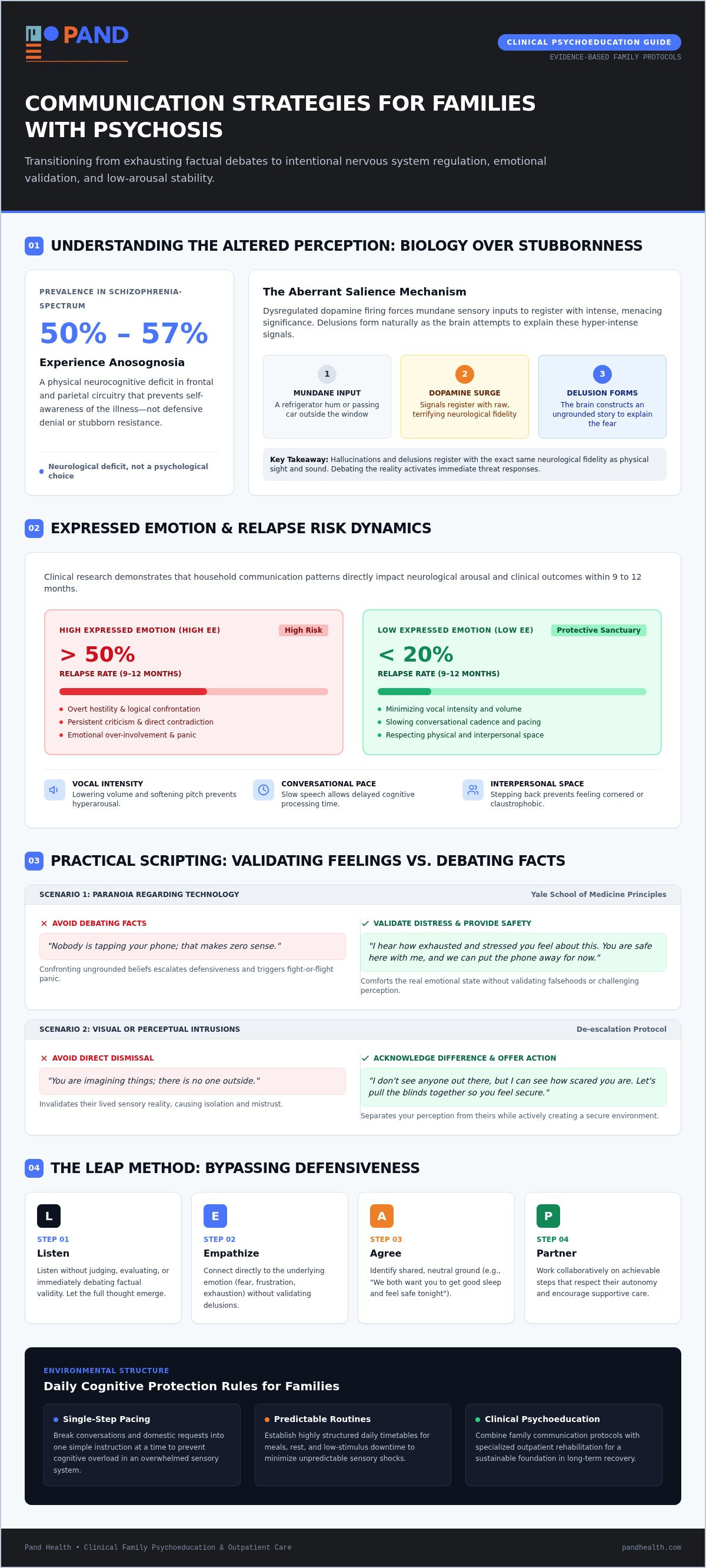
Living alongside psychosis requires shifting how you interpret ordinary interactions. Psychosis profoundly disrupts sensory gating, processing speed, and the brain's baseline interpretation of reality. When an ungrounded belief emerges, family members often assume the person is being defensive or stubborn. In reality, approximately 50% to 57% of people with schizophrenia-spectrum disorders experience anosognosia, a neurocognitive deficit originating in frontal and parietal circuitry that physically prevents self-awareness of the illness. Effective communication strategies for families with psychosis start by recognizing that an ungrounded belief is an involuntary brain state, not a choice.
A driving biological force behind these experiences is aberrant salience. Due to dysregulated dopamine firing, mundane sensory inputs, like a hum from the refrigerator or a passing car, become loaded with intense, menacing significance. Delusions naturally form as the brain scrambles to explain these hyper-intense sensory signals. Attempting to dismantle these perceptions through direct logical debate invariably backfires. Arguing against someone's perceived reality activates immediate threat responses, driving fear and pushing them further away.
The Neurobiology of Delusional Reality
Hallucinations and delusions do not feel like abstract thoughts; they register with the exact same neurological fidelity as physical sound or sight. When an overactive dopaminergic pathway assigns real-world presence to an internal cognition, telling your loved one that their experience isn't real feels identical to someone telling you the floor beneath your feet doesn't exist. Recognizing this biological reality shifts your role from an investigator debating facts to a steady anchor validating their distress.
The High Expressed Emotion Trap
When panic sets in, households often slide into a pattern known as high expressed emotion (EE), marked by overt hostility, persistent criticism, and emotional over-involvement. Clinical literature documenting high expressed emotion and relapse risk reveals that individuals returning to high-EE environments face relapse rates exceeding 50% within 9 to 12 months, compared to under 20% in low-EE homes. Managing environmental arousal directly shields an overstimulated nervous system:
- Minimizing vocal intensity: Lowering volume and softening vocal inflection prevents immediate nervous system hyperarousal.
- Reducing conversational pace: Slowing your speech gives an overwhelmed brain the critical processing time it needs to register meaning safely.
- Respecting interpersonal space: Stepping back physically prevents ordinary domestic interactions from feeling claustrophobic or intrusive.
Mastering these foundational communication strategies for families with psychosis creates a protective buffer, lowering expressional heat so genuine connection and healing can take root.
Core Principles of Communicating During Active Psychosis
During acute episodes, verbal interactions must shift from relational discussion to intentional nervous system regulation. Psychosis floods the senses, making complex sentences and rapid responses nearly impossible to process. Applying practical communication strategies for families with psychosis means stripping away debate, shortening statements, and slowing your cadence so words offer safety instead of confusion.
Validating Feelings Rather Than Facts
When ungrounded perceptions surface, address the emotional reality behind them instead of the delusion itself. Research from the Yale School of Medicine on approaches for talking to someone experiencing psychosis emphasizes that disputing claims heightens defensiveness, while validating distress lowers fight-or-flight arousal. You do not need to validate a falsehood to comfort a frightened person.
- Instead of: "Nobody is tapping your phone; that makes zero sense."
Try: "I hear how exhausted and stressed you feel about this. You are safe here with me, and we can put the phone away for now." - Instead of: "You are imagining things; there is no one outside."
Try: "I don't see anyone out there, but I can see how scared you are. Let's pull the blinds together so you feel secure."
Managing Tone, Body Language, and Spatial Environment
The physical environment heavily dictates whether a conversation stabilizes or escalates. Subtle somatic cues often register before spoken words, meaning your physical posture can either soothe or alarm an overstimulated nervous system. Establish physical safety and environmental clarity using these concrete adjustments:
- Angle your body: Stand or sit at a 45-degree angle rather than squaring off directly face-to-face, which can feel confrontational.
- Soften gaze and hands: Avoid prolonged, intense eye contact; keep your hands unclenched and visibly resting in an open position.
- Clear sensory input: Mute televisions, silence notifications, and dim harsh overhead lighting to eliminate excess cognitive friction.
Applying these communication strategies for families with psychosis builds everyday resilience. If navigating these intense moments at home feels overwhelming, connecting with compassionate clinicians for guided family therapy and evaluation support provides a structured path forward.
Evidence-Based Communication Frameworks: The LEAP Method
When illness awareness is absent, standard persuasion triggers instant defensiveness. Developed by Dr. Xavier Amador at the LEAP Institute, the LEAP framework (Listen, Empathize, Agree, Partner) provides families with a repeatable, clinically proven roadmap to navigate anosognosia. Rather than debating factual truth, this method builds an alliance around shared goals. Integrating LEAP into your daily communication strategies for families with psychosis turns adversarial standoffs into collaborative, low-conflict conversations.
Breaking Down the Four Stages of LEAP
The framework operates sequentially to bypass defensive barriers and restore interpersonal trust:
- Listen: Practice reflective listening without offering opinions, corrections, or reassurance. Simply repeat back what your loved one expressed in their own terms to confirm you genuinely understand their perspective.
- Empathize: Step into their emotional experience. If established guidelines for communicating with someone with psychosis teach us anything, it is that acknowledging terror or frustration disarms defensiveness without validating delusions.
- Agree: Identify points of common ground. Both of you might agree that constant tension is exhausting, that insomnia makes everything harder, or that maintaining independent housing is essential.
- Partner: Form an active pact to work on those mutual agreements together, deliberately stepping away from discussions about medical diagnoses or symptom labels.
Phrases to Use Versus Common Conversational Traps
Subtle shifts in vocabulary dismantle domestic tension and prevent power struggles. Replacing instinctive corrections with collaborative alternatives protects your loved one's dignity while maintaining safety:
- The Demand Trap: "You are sick and need to take your medication right now."
The Collaborative Shift: "I know how frustrated you are with feeling groggy, but you also mentioned wanting your sleep back. Could we ask the doctor if an adjustment could help you rest without that heaviness?" - The Dismissal Trap: "That's completely impossible; nobody is watching our house."
The Validating Shift: "That sounds terrifying to deal with all day. I want you to feel secure here, so let's check the locks together." - The Condescending Trap: "You're acting irrational, just calm down."
The Regulating Shift: "Things feel really loud and intense right now. Let's sit together in the quiet room for a few minutes."
Shifting these verbal patterns prevents chronic caregiver exhaustion and forms a solid bridge toward voluntary clinical engagement.
Step-by-Step Daily Communication Protocol for Families
Crisis de-escalation begins long before an emergency unfolds. Establishing predictable domestic rhythms prevents cognitive fatigue, creating an environment where an overwhelmed mind feels secure. Proactive communication strategies for families with psychosis focus on pacing, simplicity, and predictable morning check-ins using low-pressure open questions like, "How did you rest?" or "What would feel good to eat this morning?"
When domestic chores or self-care needs arise, bypass multi-step requests. Executive functioning takes a heavy hit during active illness. Instead of asking someone to clean their room, do laundry, and get dressed, offer a single concrete task: "Here is a clean shirt for today." Keeping instructions simple preserves mental energy and eliminates unnecessary friction. Incorporating structured routines, such as the evidence-based methods detailed in our guide to family psychoeducation in Los Angeles, gives households the daily stability required to sustain long-term resilience.
Collaborative Conversations About Care and Support
Framing clinical care around personal relief transforms medical conversations from battles into partnerships. Instead of insisting on clinical terms or labels, focus on tangible symptoms your loved one dislikes, such as restless insomnia, physical tension, or mental fatigue:
- Target functional relief: "You mentioned how exhausting it is to lie awake until 4 a.m. Let's ask the doctor if they have something to help your body physically reset."
- Position evaluations as discovery: Present formal psychiatric appointments as comprehensive wellness consultations aimed at uncovering personal strengths, reducing stress, and finding balance.
- Avoid ultimatums: Hard demands like "take this pill or you can't live here" invariably provoke social withdrawal, intense panic, and deep family alienation.
Establishing Boundaries and Preventing Caregiver Burnout
Kindness does not require enduring destructive behaviors. Setting firm boundaries communicates behavioral standards while maintaining total emotional warmth. If a conversation escalates into shouting, calmly state your boundary without hostility: "I love you and want to help you, but I can't stay in the room while you are raising your voice. I'm going to step outside for fifteen minutes so we can both reset."
Caregivers cannot pour from an empty cup. Seeking independent therapy to process ambiguous loss and chronic fear is essential for staying grounded. When you need clinical partners to help implement structured communication strategies for families with psychosis, contact our team at Pand Health to schedule a specialized clinical evaluation.
Clinical Family Psychoeducation and Specialized Care at Pand Health
Equipping your household with evidence-based communication strategies for families with psychosis is a vital first step, but domestic adjustments work best when paired with comprehensive outpatient rehabilitation. Standard community therapy often fragments care across separate providers who rarely coordinate. Coordinated Specialty Care (CSC) transforms this dynamic by wrapping an intensive, multidisciplinary clinical team around both the individual and their primary support network.
The California OnTrack Augmented Outpatient Model
Pand Health delivers the California OnTrack program in Los Angeles, tailoring intensive outpatient care to teens and adults navigating early psychosis and schizophrenia-spectrum conditions. As the only outpatient CSC program in Southern California offering certified Metacognitive Training (MCT), Social Cognition and Interaction Training (SCIT), and computer-assisted cognitive remediation, Pand Health directly targets the cognitive biases and social-processing deficits that fuel paranoid interpretations.
This augmented model embeds structured family psychoeducation and Behavioral Family Therapy into regular care, empowering parents and partners to act as confident, stabilizing allies. Paired with the Supported Education and Employment curriculum, clients receive continuous mentorship to resume school and career pursuits. Families seeking diagnostic clarity or outpatient support can reach out to the clinical team for specialized evaluations.
Documented Recovery and Functional Outcomes
Pairing intensive cognitive rehabilitation with low-expressed-emotion family environments produces rapid, measurable stability. Clinical data from the California OnTrack 2022–2024 cohort reveals how comprehensive outpatient care prevents institutional cycles:
- Vocational restoration: Client participation in competitive employment or academic coursework jumped from 6% at initial enrollment to 85% at six months.
- Hospital diversion: Psychiatric rehospitalization rates dropped from over 50% prior to program enrollment down to 6%.
- Reduced hospital duration: For clients who required brief stabilization, average inpatient psychiatric stays fell from 40 days down to 7 days.
When structured communication strategies for families with psychosis are reinforced by specialized clinical rehabilitation, long-term stability and genuine independence become the expectation rather than the exception.
Transforming Family Dialogue Into a Pathway for Lasting Recovery
Replacing instinctive debates with collaborative listening and low-arousal environments protects your relationship while soothing an overstimulated nervous system. Shifting away from direct reality-testing toward emotional validation allows you to partner on practical wellness goals instead of fighting over diagnostic labels. Implementing these intentional communication strategies for families with psychosis restores emotional safety and mutual trust under your roof.
Domestic adjustments become truly transformative when reinforced by specialized outpatient expertise. As the only Southern California outpatient program delivering certified MCT, SCIT, and cognitive remediation, Pand Health's California OnTrack model turns clinical innovation into sustainable independence. Our cohort achieved an 85% employment and education rate within six months, while reducing rehospitalization rates from over 50% down to just 6%. You don't have to navigate this journey alone. Connect with our specialized team to explore California OnTrack family programs and take a confident step toward enduring family wellness today.
Frequently Asked Questions
How do I respond when my loved one shares a delusion that is clearly impossible?
Respond directly to the emotional distress behind the delusion rather than debating its factual reality. You can say, "That sounds exhausting and terrifying, and I want you to feel safe here." Disputing their claims triggers defensiveness, while validating their fear helps calm their nervous system. By staying grounded, you maintain trust and avoid reinforcing the delusion.
What is the difference between agreeing with a delusion and validating an emotion?
Agreeing with a delusion means confirming false claims, like pretending you hear nonexistent voices or agreeing that people are monitoring the home. Validating an emotion focuses strictly on the human feeling. Saying "I can see how frightened and stressed you are" acknowledges their lived reality without reinforcing ungrounded perceptions. This distinction forms a cornerstone of effective communication strategies for families with psychosis.
Can high family stress or criticism trigger a psychotic relapse?
Yes, sustained family tension, criticism, and hostility significantly increase relapse risk. In clinical literature, high expressed emotion acts as a chronic psychosocial stressor that floods a vulnerable nervous system with stress hormones and destabilizes dopamine regulation. Maintaining a calm, supportive, and predictable home environment significantly reduces sensory overload, protecting your loved one's brain and promoting sustainable stability.
How can I encourage someone with psychosis to see a doctor if they refuse?
Shift the focus away from psychiatric labels and connect the visit to personal distress they want resolved, such as poor sleep or chronic exhaustion. Suggest a comprehensive health checkup to tackle those specific issues. In Los Angeles, specialized programs like Pand Health offer comprehensive outpatient evaluations where clinicians assess symptoms collaboratively, helping individuals engage in care without feeling coerced or defensive.
What should I do if a conversation escalates toward severe agitation or anger?
Disengage from the topic immediately and focus entirely on physical safety and emotional calming. Lower your voice, step back to give them physical space, and remove background noise. State a gentle boundary like, "I care about you, but let's take twenty minutes apart to breathe." If safety becomes an immediate concern, contact local mobile crisis teams or call 988 for guidance.
What is the LEAP method and why does it work better than logic?
Developed by Dr. Xavier Amador, LEAP stands for Listen, Empathize, Agree, and Partner. Traditional logic fails because anosognosia is a neurological deficit in self-awareness, not stubbornness. Trying to convince someone their perceptions are false triggers hostility. LEAP bypasses this defensiveness by finding shared ground, turning daily communication strategies for families with psychosis into collaborative problem-solving instead of exhausting arguments.
How does family psychoeducation help improve recovery outcomes in early psychosis?
Family psychoeducation equips households with practical coping skills, symptom literacy, and crisis-prevention frameworks. Research shows that structured family education drastically cuts hospital readmissions compared to standard care alone. When integrated into Coordinated Specialty Care models like California OnTrack in Los Angeles, family training helps parents and partners foster low-stress environments that directly support lasting educational and vocational recovery.
Disclaimer
This article is for information and educational purposes only, and can NEVER replace a proper medical evaluation. If you or a loved one may be suffering from psychosis or the prodomal symptoms of psychosis, get evaluated by a professional as soon as possible. Early diagnosis and treatment can be life-saving.