


What Negative Symptoms of Schizophrenia Can Look Like
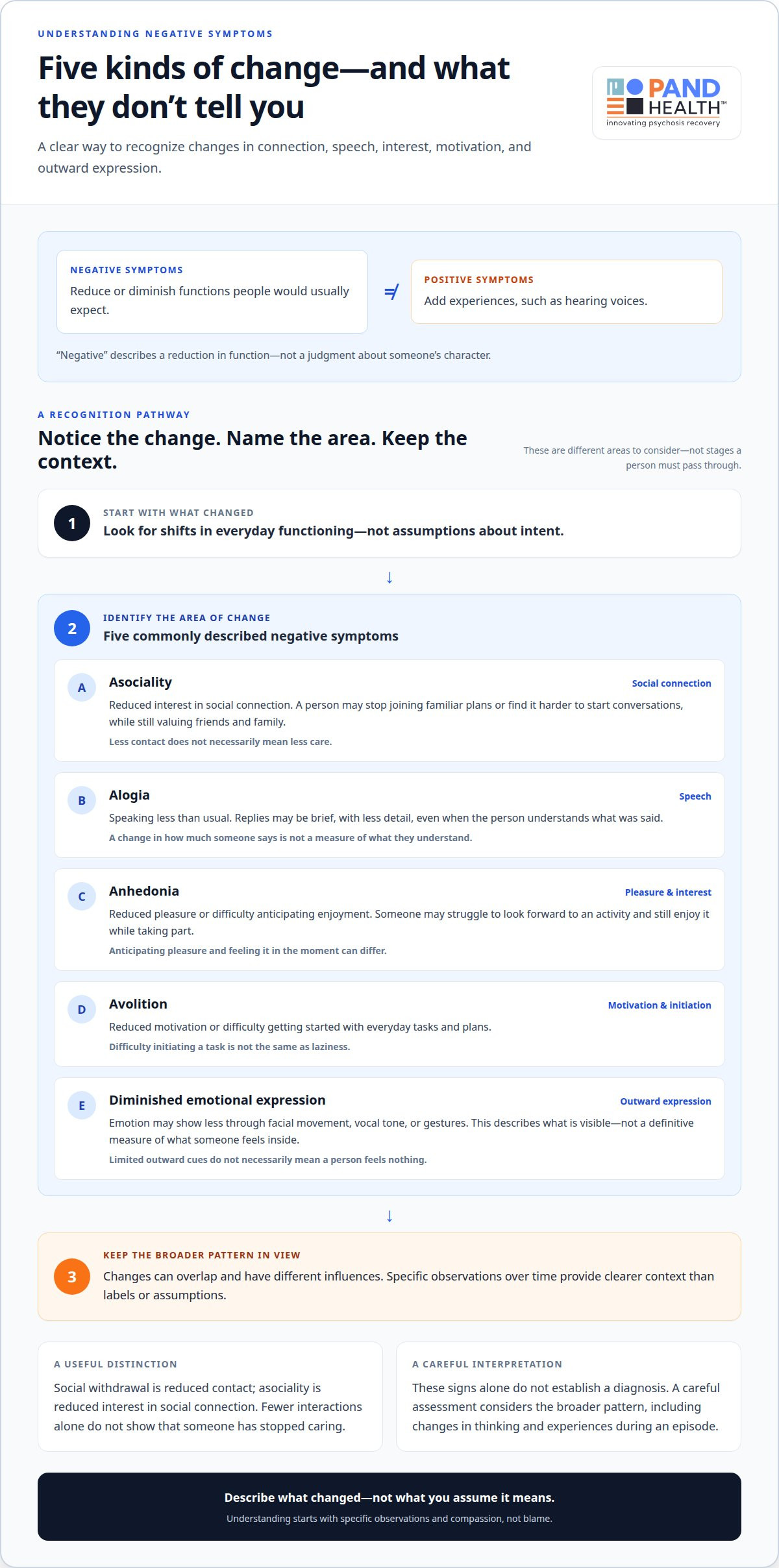
What are the negative symptoms of schizophrenia? They’re changes that reduce or diminish functions people would usually expect, rather than adding unusual experiences. Five commonly described symptoms are asociality, or reduced interest in social connection; alogia, or speaking less; anhedonia, or reduced ability to anticipate pleasure; avolition, or difficulty feeling motivated; and diminished emotional expression.
These changes can be difficult to recognize from the outside. A person who withdraws may still care about friends and family, even if connecting feels harder. Reduced facial expression doesn’t necessarily mean they feel nothing, and difficulty starting everyday tasks isn’t the same as laziness. Someone may also enjoy an activity while taking part, even if they struggle to look forward to it.
This article explains how each of the five symptoms may appear in everyday life, how they differ from positive symptoms such as hearing voices, and why changes in motivation, speech, emotional expression, interest, or social connection call for understanding, not blame. These signs alone don’t establish a diagnosis. Learning what they can mean can help individuals and families recognize when a thoughtful clinical evaluation may be useful.
Key Takeaways
- Learn how reduced motivation and emotional expression can affect daily life without revealing what a person feels inside.
- Understand why pulling away from relationships may reflect difficulty with social connection, not a lack of care.
- Recognize how alogia can change the amount and detail of someone’s speech.
- Explore why losing interest in activities can differ from being unable to enjoy them in the moment.
- See how an evaluation and supportive services can help make sense of these changes and identify appropriate next steps.
What are Negative Symptoms of Schizophrenia?
Negative symptoms reduce or diminish functions people would usually expect, while positive symptoms add experiences such as hearing voices. A person’s thinking, communication, motivation, emotional expression, or interest in relationships may change.
Core Negative Symptom Types
Five commonly described negative symptoms are anhedonia, avolition, asociality, alogia, and diminished emotional expression. Anhedonia involves reduced pleasure or difficulty anticipating enjoyment; avolition means reduced motivation. Asociality involves less interest in social connection, while alogia means speaking less than usual. Diminished emotional expression affects how emotion is shown outwardly.
These terms describe different changes, not a judgment about someone’s character. For example, a person may want to attend a family gathering but find it difficult to make plans or join conversations. They might answer with only a few words, even when they understand what was said. Identifying which changes are present helps families describe specific concerns instead of interpreting them as laziness, indifference, or deliberate avoidance.
Negative symptoms can persist, while positive symptoms may come and go. Negative symptoms may also appear several months or years before a first acute episode. Gradual changes, such as losing interest in hobbies or speaking less at home, can be difficult to distinguish from other causes. Negative symptoms are common in schizophrenia, but they aren’t required for a diagnosis.
Reduced Emotional Expression
Blunted affect, affective flattening, and reduced emotional expression describe a limited outward display of emotion. A person may show less facial movement, use a quieter voice, or make fewer gestures during a conversation. “Flat affect” is another term for this outward presentation. These descriptions focus on observable expression, not a definitive measure of what someone feels internally.
For instance, someone might hear welcome news with little change in facial expression or vocal tone. A family member could read this as disinterest, even though the person may care about the news. The difference between internal feeling and visible expression matters: limited outward cues can make everyday exchanges harder to interpret, especially when relatives expect enthusiasm or reassurance to be clearly shown.
Emotional expression can also vary by setting and interaction. A person might speak more freely with one trusted relative than in a group, or use gestures less often than before. Noticing specific changes over time gives a clearer account than relying on labels alone. It also keeps the conversation focused on what has changed, rather than assuming a lack of affection.
Emotional Disconnection
Emotional disconnection describes feeling detached from emotions or less connected to other people and everyday events. It can accompany reduced emotional expression, but refers to a person’s felt experience rather than only what others observe. Someone might say they feel distant from friends, or find it hard to identify an emotional response to a familiar activity.
This experience can be confusing for both the person and their family. A person may still value a friendship while finding it difficult to feel close or show warmth during a visit. Similarly, they may care about personal needs yet struggle to begin a routine task. Describing the specific experience helps others respond with understanding instead of treating distance or low initiative as intentional rejection.
Emotional disconnection can overlap with changes in motivation, interest, speech, and social contact. For example, someone might stop suggesting plans, give brief replies, and describe feeling detached from activities they once enjoyed. Considering these changes together provides useful context, but no single behavior establishes schizophrenia. A careful assessment looks at the broader pattern, including changes in thinking and experiences during an episode.
Asociality and social withdrawal
Asociality means reduced interest in social connection, while social withdrawal describes limiting or avoiding contact with other people. These changes can affect daily routines and relationships, even when someone still values the people around them.
Negative symptoms may make it harder to initiate conversations, keep plans, or take part in shared activities. For example, a person might stop joining a regular family meal or rarely reply to friends.
Asociality and Isolation
Asociality is reduced interest in social connection; isolation is the reduced contact that can follow. Distinguishing these ideas matters because fewer interactions don’t necessarily mean someone has stopped caring about others. A person might want companionship but struggle to begin an exchange, respond to an invitation, or sustain a conversation once it starts.
Social withdrawal can show up in small, repeated changes: declining a familiar invitation, leaving a group early, or spending more time alone at home. Others may describe these behaviors as rudeness or avoidance, particularly when the person gives little explanation. Reduced emotional expression can also make it harder for friends to recognize that connection still matters.
Social withdrawal can have different influences. Delusions or hearing voices may make social settings feel confusing or distressing, while negative symptoms can reduce the desire or initiative to engage. These experiences shouldn’t be treated as interchangeable. A clinician considers what the person reports, what has changed, and how the pattern affects everyday life.
Social Effects on Daily Life
Social withdrawal affects daily functioning when reduced contact interferes with relationships, shared responsibilities, or participation in work, school, and community life. It matters because an unanswered message or missed gathering can be misread as rejection, widening distance between someone and their support network.
For instance, a person may stop asking a sibling for help with errands or avoid a group activity they previously attended. Over time, fewer conversations can mean fewer chances to practice communication and maintain routines with others. The effects vary by person: someone may stay in touch with a close relative but withdraw from larger gatherings.
Families can describe observable changes without assigning blame: “You haven’t joined dinner this week” is more specific than “You don’t care about us.” This gives the person room to explain their feelings and experience. Consistent, low-pressure invitations can keep a connection open without demanding an immediate response.
Social skills training can help build interpersonal and communication capacities. It offers structured support for practicing interaction and communication.
Alogia and poverty of speech
Alogia means speaking less than usual and is also called poverty of speech. It may affect how much someone says or how much information their words convey.
Sparse Speech
Sparse speech describes a noticeable reduction in spoken words or spontaneous conversation. For example, someone who once shared details about their day might now answer, “Fine,” and stop there. This change matters because a short reply can be mistaken for disinterest, even when the person is listening and wants to stay part of the conversation.
Alogia can appear as fewer comments, longer pauses, or difficulty adding to a discussion. During a family meal, a person may respond when spoken to but rarely start a topic. Their speech may be clear, yet much briefer than relatives expect. Comparing communication with the person’s usual pattern helps describe the change more accurately.
Poverty of Speech
Poverty of speech refers to limited spoken content and is one way alogia may be described. A person might answer a question with a few words but offer little explanation or detail. This distinction matters: someone can speak briefly while still understanding a question, and short answers alone don’t show what they’re thinking.
For instance, when asked what happened at work, a person might say, “Busy,” without describing an event or how they felt. The listener can ask a clear, focused follow-up, then allow time for a response. Pressing for a long explanation can make the exchange feel demanding, while a patient pause leaves room for the person to continue.
Speech patterns also vary with the setting and topic. Someone may say little in a group conversation but speak more during a familiar one-to-one exchange. Comparing communication across situations provides useful context. One quiet conversation doesn’t establish a pattern; what matters is the broader change in speech and its effect on daily interactions.
Reduced speech is not the same as hallucinations, which involve experiences such as hearing voices that others don’t hear. The terms describe different kinds of symptoms. A clinician considers a person’s speech alongside other experiences, daily functioning, and changes over time. Medication effects, depression, and other factors can also matter when interpreting reduced speech.
Families can describe specific observations instead of assigning motives. “You answered with one word during our call” gives a concrete example; “You have nothing to say” assumes intent. This distinction can support a more respectful conversation and help explain what has changed. Alogia concerns reduced speech or content, not a measure of someone’s care or worth.
Anhedonia and loss of interest
Anhedonia involves losing pleasure in activities that previously felt enjoyable. It can also affect the ability to look forward to those activities, changing how a person approaches everyday life.
Loss of Interest
Anhedonia can appear as reduced interest in hobbies, conversations, or routines that once mattered. For example, someone who used to look forward to gardening may stop planning time for it. This change can affect motivation and daily structure, but it doesn’t automatically mean the person has stopped valuing the activity or the people connected to it.
Notice the specific shift: a person may no longer suggest a favorite movie, join a regular walk, or prepare for a familiar social event. These examples describe behavior, not its cause. A mental health evaluation considers the broader pattern, including mood, other symptoms, daily functioning, and changes over time.
Reduced Pleasure
Reduced pleasure means an activity may feel less rewarding, even when the person still takes part. The distinction matters because someone with schizophrenia may enjoy an experience in the moment while finding it harder to anticipate that enjoyment beforehand.
For instance, a person might smile during a visit with a friend but struggle to feel excited about the visit beforehand. Anticipating pleasure and experiencing it as it happens are different parts of the experience. This can help families understand why encouragement to “look forward to it” may not resolve the difficulty.
Interest and pleasure can change in different ways. One person may stop choosing music, while another still listens but enjoys it less. Someone else may attend a family meal yet find it difficult to engage. These individual examples are more useful than assuming everyone experiences anhedonia in the same way.
Changes in personal routines can also provide context. A person may lose interest in preparing a favorite meal or keeping up with ordinary hygiene. Such changes can reflect difficulty with motivation or pleasure, but they don’t explain the cause on their own. Depression, positive symptoms, environmental deprivation, and medication effects may also be relevant factors for clinicians to consider.
Therapy can be part of support for negative symptoms. Cognitive behavioral therapy may help address apathy and motivation. A care team may also consider how symptoms, daily routines, and treatment fit together. Discussing when interest changed and which activities still feel rewarding, for example, can clarify the person’s experience without treating anhedonia as a character flaw.
Families can offer specific, manageable invitations, such as listening to one song together instead of expecting someone to resume an entire hobby. The aim is to make room for participation without demanding enthusiasm. Tracking which activities feel different, and whether pleasure occurs during them, can give a clearer picture of the person’s changing experience.
Five negative symptoms of schizophrenia
Five commonly described negative symptoms affect different parts of daily life. Considering them together can help distinguish reduced motivation or expression from positive symptoms, which add experiences such as hallucinations.
- Anhedonia: reduced pleasure or difficulty anticipating enjoyment, such as no longer looking forward to a familiar hobby.
- Avolition: reduced motivation, which can make starting routine actions, such as preparing breakfast, difficult.
- Asociality: less interest in social connection, which may appear as rarely initiating plans with a friend.
- Alogia: reduced speech or speech content, such as brief replies during a conversation.
- Diminished emotional expression: fewer visible emotional cues, such as limited facial expression when sharing news.
These experiences can overlap, but they aren’t interchangeable. Someone may want to see a friend yet struggle to make plans, or attend a visit but speak little. Another person may continue an activity while finding it harder to anticipate pleasure. Separating motivation, social interest, speech, pleasure, and outward expression creates a clearer description than simply calling someone “withdrawn.”
Context matters, too. Negative symptoms may persist, while positive symptoms can come and go. A person might show less initiative while hallucinations or delusions are also affecting daily life. Negative symptoms can also be secondary to positive symptoms, medication-related movement symptoms, depression, or environmental deprivation. A change in behavior needs to be understood alongside the person’s experiences and treatment, not treated as proof of one cause.
The practical takeaway is to describe observable changes and their impact. For example, note that someone stopped attending a regular activity, gives shorter answers, or needs more support to begin ordinary tasks. These examples can help a care team understand what has changed in relationships and daily routines. They also help avoid confusing reduced outward expression with a lack of feeling or concern.
If changes in motivation, speech, or social connection occur alongside hallucinations or delusions, a psychosis evaluation can help clarify the situation. Request a same or next day psychosis evaluation to discuss these concerns.
Pand Health
Pand Health offers evaluations for thought disorders and intensive treatment for psychosis when changes in motivation, communication, or social connection raise concerns. Support may also include psychological and social rehabilitation, social skills training, and family psychoeducation. These services can address practical challenges in relationships and everyday participation, while helping families better understand psychosis and its effects.
Consider reaching out when these changes are affecting daily life or when you need guidance about evaluation and treatment options. Contact Pand Health to discuss next steps.
Take the Next Step Toward Support
Understanding what the negative symptoms of schizophrenia can look like can help you describe concerns clearly, but you don’t have to make sense of every change alone. A useful next step is to discuss how these changes affect daily life and what support may fit. In Los Angeles, Pand Health offers evaluation for thought disorders and autism, social skills training, and psychological and social rehabilitation. These services address evaluation needs and practical challenges in communication and social participation.
Whether you’re seeking support for yourself or someone close to you, a conversation can help clarify possible next steps. Share what you’ve noticed and what feels most difficult right now. Contact Pand Health to learn more about available support. Reaching out can be a thoughtful first move toward clearer guidance and continued progress.
Frequently Asked Questions
Can someone with schizophrenia live a full, successful life?
Yes. A schizophrenia diagnosis doesn’t determine a person’s abilities, goals, or future. With appropriate care and support, people can pursue relationships, education, work, and meaningful interests. Progress looks different for each person and may involve finding strategies that support daily routines or personal goals. Families can help by focusing on the individual’s strengths and choices, rather than defining them by symptoms.
What are the main negative symptoms of schizophrenia?
The main negative symptoms include avolition, anhedonia, asociality, alogia, and diminished emotional expression. They can affect different areas, such as starting tasks, looking forward to activities, maintaining social contact, speaking, or showing emotion outwardly. A clinician considers how these changes fit together and affect the person’s functioning. A single behavior, such as speaking little during one appointment, doesn’t establish a symptom pattern or diagnosis.
What is avolition in schizophrenia?
Avolition is marked difficulty starting and sustaining goal-directed activity. For example, a person may understand that laundry needs doing but struggle to begin or finish the task. This is different from choosing not to do it. When describing the concern, note which activities have changed, whether reminders help, and how the difficulty affects responsibilities or self-care.
What is anhedonia in schizophrenia?
Anhedonia is reduced pleasure or diminished interest in activities. It can affect both anticipation and enjoyment, though these experiences don’t always change in the same way. Someone might no longer seek out a favorite pastime yet still feel some pleasure while participating. Consider which activities have changed and whether enjoyment differs before, during, or after them. Those details help communicate the experience clearly.
What is asociality in schizophrenia?
Asociality is reduced interest in social connection. It can mean less desire to initiate contact, even with people someone values. This differs from simply preferring quiet time: a meaningful change may involve losing interest in relationships or regular social activities. Patterns can vary by setting, so describe changes across familiar situations, such as conversations at home and contact with friends.
What is diminished emotional expression or blunted affect in schizophrenia?
Diminished emotional expression, also called blunted affect, refers to fewer outward signs of emotion. A listener may notice less variation in facial movement, voice, or gestures. These observable cues don’t reveal the full extent of someone’s internal experience. If a loved one seems less expressive, describing the change without assuming how they feel can prevent misunderstandings and support more open communication.
How can negative symptoms be distinguished from depression or medication side effects?
Clinicians consider timing, mood, medication changes, movement symptoms, and the course of psychosis. For example, reduced initiative that begins after a medication change may call for a different review than a persistent change alongside low mood. Depression, medication-related movement symptoms, and environmental deprivation can contribute to negative-like changes. Sharing when symptoms began and how they vary gives the care team useful context.
What treatments can help negative symptoms of schizophrenia?
Care may combine medication review, therapy, family support, and rehabilitation. Cognitive behavioral therapy may help with apathy and motivation, while social skills training can support communication and interpersonal abilities. Family therapy or psychoeducation can help relatives understand symptoms and communicate more effectively. In Los Angeles, treatment planning can also consider how social and psychological rehabilitation may support a person’s everyday goals.
Disclaimer
This article is for information and educational purposes only, and can NEVER replace a proper medical evaluation. If you or a loved one may be suffering from psychosis or the prodomal symptoms of psychosis, get evaluated by a professional as soon as possible. Early diagnosis and treatment can be life-saving.