


Coping with auditory hallucinations through therapy and calming skills
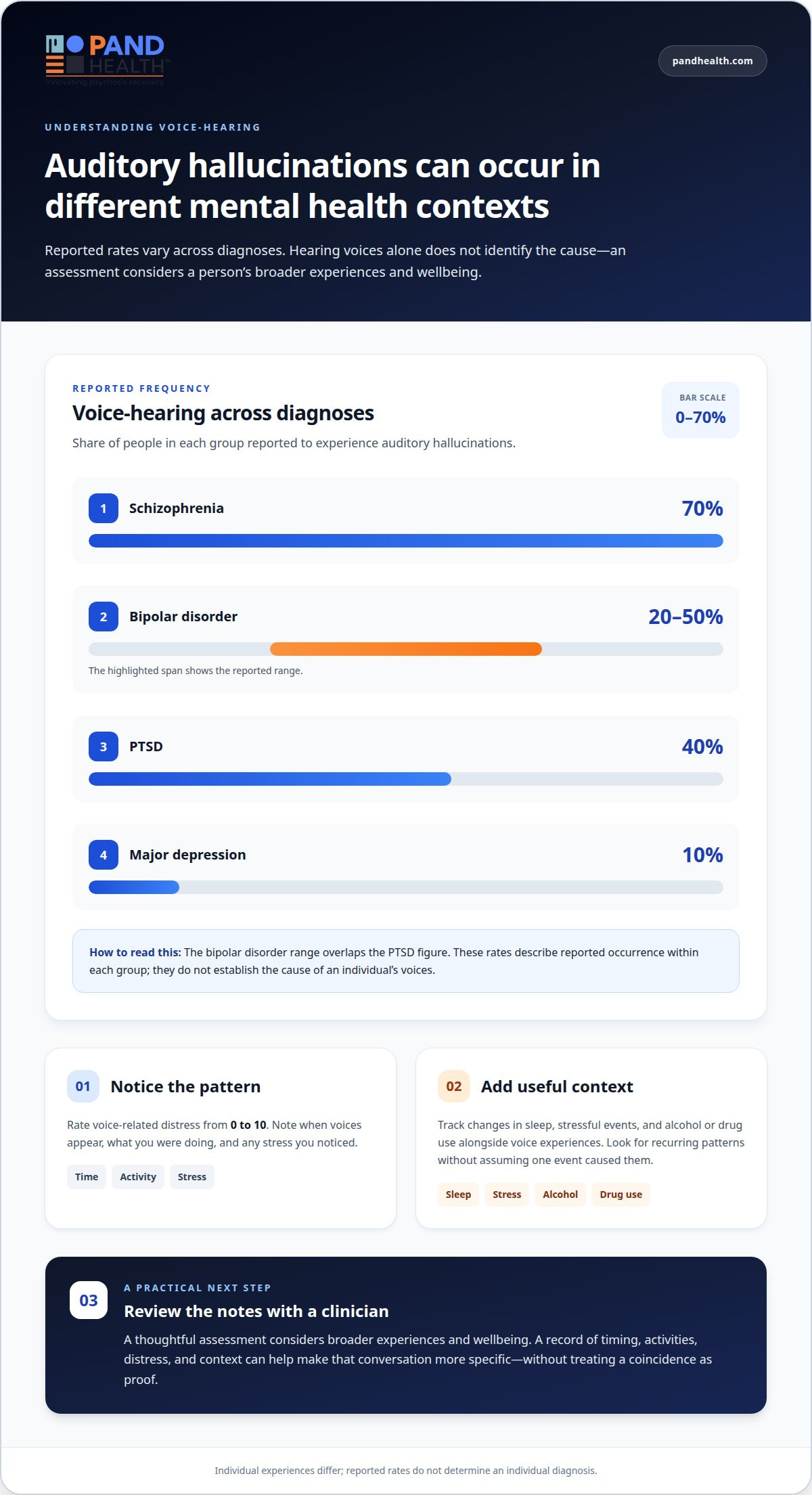
Auditory hallucinations occur in 70% of people diagnosed with schizophrenia, and they can also occur alongside PTSD, bipolar disorder, or major depression. Coping with auditory hallucinations may involve understanding possible triggers, receiving a thoughtful clinical assessment, and practising strategies such as CBT, grounding, and slow breathing. The experience can have different contexts, so support is most useful when it reflects how the voices affect the person’s daily life.
Hearing voices can feel frightening, exhausting, or isolating. You don’t have to dismiss those feelings or face the experience alone. Therapy can help you understand what’s happening and build practical ways to respond.
This article explores possible causes of auditory hallucinations and explains how therapy, CBT, breathing exercises, mindfulness, and self-compassion may help. You’ll also find calming skills to try and ways to notice which approaches work for you.
Key Takeaways
- Auditory hallucinations can have different causes. Tracking when they occur and how distressing they feel can help reveal patterns.
- Therapy can provide a nonjudgmental space to understand voice-hearing and identify coping approaches that fit your needs.
- Slow breathing and grounding can help bring attention back to the present when voices feel overwhelming.
- Mindfulness, acceptance, and compassionate self-talk offer ways to respond to difficult experiences without adding self-judgment.
- CBT can help you notice triggers, examine beliefs about voices, and practise strategies that support daily life.
1. What causes auditory hallucinations?
Auditory hallucinations can occur in different mental health contexts, so hearing voices alone doesn’t identify their cause. They occur in 70% of people diagnosed with schizophrenia; they’re also seen in 40% of people with PTSD, 20% to 50% with bipolar disorder, and 10% with major depression. An assessment considers the person’s broader experiences and wellbeing.
Notice when voices appear and how they affect daily life. Rate voice-related distress from 0 to 10, then note the time, activity, and any stress you noticed. This record can help you and a clinician identify patterns without assuming that one event explains the voices.
For an immediate coping strategy, shift attention to a specific activity: talk with someone you trust, read, or watch a favorite show. Practise selective listening by focusing on one sound, such as a clock ticking, then noticing traffic or birdsong. Rate how helpful the strategy felt on a 10-point scale each day.
Distraction works best as a chosen activity, not a demand to silence or deny the experience. If an activity leaves you more distressed, stop and try another approach. Positive self-talk can also help: “I’m hearing voices, and I can focus on this conversation now.”
Music may provide another distraction. Keep the volume low, use headphones if comfortable, and listen for up to 20 minutes at a time while doing another activity, such as drawing. Notice whether this helps you engage with the activity, rather than judging success only by whether the voices stop.
Avoidance can become unhelpful when it limits parts of life that matter to you. For example, skipping every social gathering because voices might occur can reduce connection without easing distress. Choose a manageable activity, such as a short conversation, and note what helped you stay engaged.
If voices feel frightening or overwhelming, move to a familiar, calmer setting and name visible objects around you. Contact someone you trust and make a safety plan together for difficult moments. If distress rises, use your 0-to-10 rating to describe what’s happening when seeking support.
Family and friends can listen without arguing about whether the voices are real. Ask what support would feel useful, suggest a specific activity together, and help the person keep track of distress and coping strategies. Family psychoeducation can help loved ones understand voice-hearing and respond with empathy.
Sleep, stress, alcohol, and drug use are useful details to track alongside voice experiences. Note changes in sleep, stressful events, and substance use without assuming they caused the voices. Prioritizing sleep, balanced meals, and regular physical activity can complement therapeutic and medical care.
2. How can therapy help with hearing voices?
Therapy can make it easier to talk about hearing voices without shame or judgment. Psychoeducation can explain that voice-hearing is an experience, not a personal failing or a complete description of someone’s identity. A therapist can ask what the voices are like, how they affect daily life, and what support feels respectful. This shared understanding can replace secrecy with language for describing experiences and seeking care.
A voice diary can help you and a clinician notice frequency, intensity, content, and patterns. For a baseline, record entries for one week, noting the time, what was happening, and the emotions that followed. You might rate voice activity, severity, content, and associated affect from 0 to 10 in the morning, afternoon, and evening. Add a separate 0-to-10 rating for how much voices interfere with social functioning.
An assessment can also explore what the voices mean to you. Clinicians may use PSYRATS to assess auditory-hallucination symptoms or the Beliefs about Voices Questionnaire-Revised to understand your relationship with voices. These measures can help structure a conversation about distress and beliefs. They’re options, not a checklist everyone must complete.
Some people find a planned voice-study period useful. For example, set aside 18.00 h to 18.30 h each evening to write about the voices, rather than analyzing them throughout the day. A two-week writing exercise can record voice content. If thoughts return outside that period, note them briefly and return attention to the activity at hand. A therapist can help decide whether this approach feels containing or increases preoccupation.
Voice-related imagery can be explored gently in therapy. You might describe an image that comes with a voice, such as a threatening figure or a particular setting, and notice the feelings it brings up. A therapist can help you consider what the image represents and practise responding in a grounded way. The aim is understanding, not forcing the image away.
To track possible triggers, add a simple context note to each diary entry: activity, surroundings, sleep, stress, and recent changes. Then review the week with a clinician and look for recurring links rather than treating one coincidence as proof. This can make therapy more specific and help identify which coping strategies to practise further.
Auditory hallucinations need urgent attention if someone may harm themselves or another person, cannot stay safe, or faces immediate danger. Seek emergency medical help in these circumstances. A trusted person can stay nearby while help is arranged.
3. Relaxation and breathing strategies
When voices feel intense, relaxation techniques can help direct attention to the present. Try relaxed breathing, muscle relaxation, or imagining a peaceful scene. Use one strategy at a time so you can notice its effect on your focus and tension. These skills can be useful even if they don’t make the voices disappear. For some people, coping with auditory hallucinations starts with choosing one manageable action.
For grounding, use your senses to notice what’s around you. Name three visible objects, such as a window, a chair, and a cup. Touch a nearby texture and describe it silently, perhaps smooth fabric or a cool tabletop. Then listen for a calming sound, such as a fan or birdsong. These details give your attention a clear direction when voices compete for it.
Slow breathing is another practical option. Breathe in gently through your nose and out through your mouth. Count each breath at a comfortable pace, aiming for about 8 to 12 breaths per minute. Keep the breath easy rather than forcing it. If counting feels distracting, follow the sensation of air moving instead.
- Diaphragmatic breathing: Place a hand on your abdomen and notice it move as you breathe. Let the movement guide a relaxed, steady rhythm.
- Muscle relaxation: Notice tension in your shoulders, release it, then move to your hands or jaw. Focus on one area at a time.
- Peaceful imagery: Picture a familiar place, such as a quiet garden. Bring attention to one detail, like sunlight on a path.
Practise these breathing exercises when you feel relatively settled, then try them during a more difficult moment. For example, pause during a routine activity, take several gentle breaths, and notice whether your attention returns to the task. The aim is to become familiar with the techniques, not to judge yourself by how quickly they work.
Mindfulness meditation and yoga can also help calm the mind and body and reduce the intensity of voices. In a brief mindfulness practice, sit comfortably and notice one breath, one sound, and one physical sensation. If attention moves toward voices, acknowledge that shift and gently guide it back to your chosen focus. During yoga, choose movements that feel manageable and keep attention on posture and breathing.
Keep a simple note of which strategy you tried and what happened afterward. For instance, record whether naming objects helped you feel grounded or slow breathing helped you continue reading. Comparing notes can show which techniques suit different moments. Coping with auditory hallucinations may mean adjusting your approach: if focusing on breathing feels uncomfortable, switch to an external grounding step, such as describing objects in the room.
4. Acceptance, mindfulness, and compassion
Acceptance means acknowledging that voices are present without treating their messages as facts or instructions. For example, you might say, “I hear a voice, and I’m choosing to finish breakfast.” This recognizes the experience while keeping attention on your own decisions. Acceptance isn’t approval, surrender, or a reason to stop using other coping strategies.
Try describing the moment in neutral, specific terms. Notice, “A voice is speaking, and I feel tense,” rather than criticizing yourself or arguing with every message. Then choose a next step, such as continuing a conversation or stepping outside for fresh air. This can help separate the experience from the choices you can make.
Mindfulness develops by returning your attention to what’s happening now. Choose a simple anchor, such as your feet touching the floor or the sound of a nearby fan. When your attention moves to the voices, notice the shift without judgment, then return to the anchor. The voices may remain, but practising this response can help you relate to them differently.
- Name the experience: Silently say, “I’m noticing a voice,” without debating its content.
- Notice one sensation: Feel your feet on the floor or your hands resting on a table.
- Choose a next step: Return to a task, speak with someone, or use another calming technique.
Compassion offers a kinder response to distress. Imagine how you would speak to a friend frightened by voices, then offer yourself similar words: “This is difficult, and I deserve support.” Positive self-talk doesn’t require pretending everything feels fine. It can counter self-blame and make room for a practical next step, like telling someone you trust how the experience affects you.
Acceptance and mindfulness shouldn’t become pressure to tolerate distress alone. If focusing inward increases the intensity of the voices or makes you feel less grounded, switch to an external activity. Describe objects in the room, talk with someone you trust, or return to a familiar routine. Choosing a different technique is a thoughtful adjustment, not a failure.
You can practise these skills by pairing a mindful response with an everyday activity. While making tea, for instance, notice the cup in your hand, name the emotion you’re experiencing, and decide what comes next. Later, reflect on what felt useful. A therapist can help adapt acceptance, mindfulness, and compassion practices to your experiences, goals, and existing support.
These practices are part of a broader approach to coping with auditory hallucinations that includes acceptance, mindfulness, and compassion. Positive self-talk offers another way to respond to difficult experiences without making self-criticism the focus.
5. Cognitive behavioral therapy
Cognitive behavioral therapy (CBT) helps people examine how thoughts, feelings, and behavior interact around voices. The goal isn’t to prove that an experience is unreal or force the voices away. Instead, therapy can help identify triggers, explore the meaning given to voices, and develop practical coping strategies. For example, someone might notice anxiety rising after hearing a critical voice, then plan a response that helps them return to a daily activity.
A therapist may use cognitive restructuring to examine a distressing belief. Start by writing down the belief, such as, “I can’t leave home because the voices will get worse.” Then consider what supports that prediction, what doesn’t, and whether a more balanced thought fits. “Leaving feels difficult, and I can take one manageable step” acknowledges the concern while making room for choice.
Conviction ratings can make changes in beliefs easier to notice. Rate how strongly you believe your explanation of the voices from 0 to 10 each day. Add a short note about what happened and what influenced the rating. The number isn’t a test or a measure of personal success. It gives you and your therapist a consistent way to discuss whether a belief shifts across different situations.
Behavioral approaches turn therapy insights into planned actions. A voice-avoidance hierarchy arranges avoided situations from less difficult to more difficult. For instance, someone who avoids conversation might start with a brief exchange with a trusted person. Behavioral experiments test a specific prediction in a planned, manageable way. Before trying one, agree with your therapist on the step, the prediction, and what you’ll observe afterward.
- Choose one situation: Identify an activity you’ve been avoiding because of voices.
- Record the prediction: Write what you expect might happen during that activity.
- Plan a small experiment: Select a manageable step and note what actually happens.
Practise chosen coping strategies daily, then review them after seven days. Record which strategy you used, the situation, and whether it helped you follow through with your plans. If an approach doesn’t fit, discuss what made it difficult and adjust the next step. Regular review helps therapy respond to real experiences rather than memory alone.
CBT works best as a collaborative process. You bring your observations and priorities; the therapist helps connect patterns and shape practical exercises. If family relationships are affected, family therapy can also create space to discuss communication and support. Contact Pand Health about family therapy as a next step in exploring support.
Pand Health: Social skills training
Pand Health offers social skills training for people seeking support with communication and connection in everyday situations. If hearing voices makes conversations or social activities harder, practising skills such as starting a discussion, expressing needs, and responding to others can support participation. Psychological and social rehabilitation can also help people work toward personal and community goals.
Family psychoeducation can help loved ones understand psychosis and respond supportively. An evaluation for thought disorders and autism may help clarify someone’s experiences. These services can complement the coping strategies discussed above, but they don’t replace urgent help when someone is in immediate danger.
To learn more about support at Pand Health, contact Pand Health.
Choose a next step that fits your needs
Progress can begin with a conversation about what feels hardest right now. You might want support with social situations, everyday routines, or understanding experiences that affect your wellbeing. Naming one priority can make it easier to explore a practical next step in coping with auditory hallucinations.
Pand Health offers social skills training and psychological and social rehabilitation for people working toward greater connection and participation in daily life. Evaluations for thought disorders and autism can help clarify concerns, while family psychoeducation can help loved ones understand how to offer support. These services address different personal and family needs.
If you’re ready to explore support, contact Pand Health to discuss your needs. You can take the next step at your own pace, with care focused on what matters to you.
Frequently Asked Questions
What causes auditory hallucinations?
Auditory hallucinations can occur alongside conditions such as schizophrenia, PTSD, bipolar disorder, and major depression. Hearing voices alone doesn’t establish a diagnosis or explain what’s causing them. A clinician considers the person’s wider experiences, mood, health history, and the effects on daily life. Sharing when the voices began and what else changed around that time can help make an assessment more informative.
How can therapy help with hearing voices?
Therapy can help someone understand how hearing voices affects emotions, relationships, and everyday choices. A therapist may help explore distressing messages and develop manageable responses, without requiring the person to argue with or obey the voices. For example, therapy might focus on staying engaged in a family conversation when voices interrupt. Family therapy can also help relatives discuss support and communication together.
Why do people with schizophrenia hear voices?
Hearing voices can occur with schizophrenia, but there isn’t one explanation that applies to everyone. The experience alone doesn’t reveal what a person believes about the voices or how they affect daily life. A psychiatric evaluation considers the broader pattern of symptoms and functioning. This fuller picture helps clarify an individual’s needs and experiences without relying on assumptions based on diagnosis alone.
How can grounding and distraction techniques help with hearing voices?
Grounding and distraction give attention a concrete focus beyond the voices, which may help someone continue an immediate task. For example, in a busy checkout line, silently describe the items on the conveyor belt, then focus on paying. If that feels unhelpful, choose another present-focused task, such as following a short conversation. A useful technique supports engagement without increasing distress.
What treatments help with auditory hallucinations, including therapy and medication?
Treatment may include therapy, medication, or other clinical approaches, depending on the person’s experiences and diagnosis. CBT can help identify triggers and build coping strategies. A healthcare professional may offer medication, which can eliminate hallucinations in many cases. Antipsychotic medications are often a first-line treatment for hallucinations in schizophrenia. Repetitive transcranial magnetic stimulation may be considered when medication alone hasn’t worked well.
How can sleep, stress, alcohol, or drug use affect auditory hallucinations?
Track changes in sleep, stressful events, and alcohol or drug use alongside voice experiences. This can help identify patterns, but it doesn’t prove they caused the voices.
Disclaimer
This article is for information and educational purposes only, and can NEVER replace a proper medical evaluation. If you or a loved one may be suffering from psychosis or the prodomal symptoms of psychosis, get evaluated by a professional as soon as possible. Early diagnosis and treatment can be life-saving.