


Psychosis: What It Is and What It Is Not in Los Angeles
Precision matters when discussing mental health. This article clarifies what psychosis is and is not, while addressing a common spelling question: “whatnot” is one word, not two. More formal alternatives include “et cetera,” “and so on,” “and so forth,” and “and what have you.”
It’s understandable to look for clear, respectful language when describing a complex experience. The words we choose can shape how a topic is understood, so it helps to distinguish clinical terms from casual shorthand and use each expression in the right context.
In the sections ahead, you’ll learn what psychosis means, what the term doesn’t mean, and how to distinguish “whatnot” from the separate phrase “what not.” This guide also explains when the more formal alternatives fit, helping you communicate clearly in Los Angeles and beyond.
Key Takeaways
- Choose “et cetera,” “and so on,” “and so forth,” or “and what have you” when a more formal alternative to “whatnot” suits the context.
- Use “whatnot” as one word when referring to miscellaneous things or, in the right context, a shelving unit.
- Keep “what not” as two words when the sentence means “which thing not to” do or choose.
- Learn how social skills training may support people working toward stronger social and daily-life skills.
Formal alternatives to whatnot
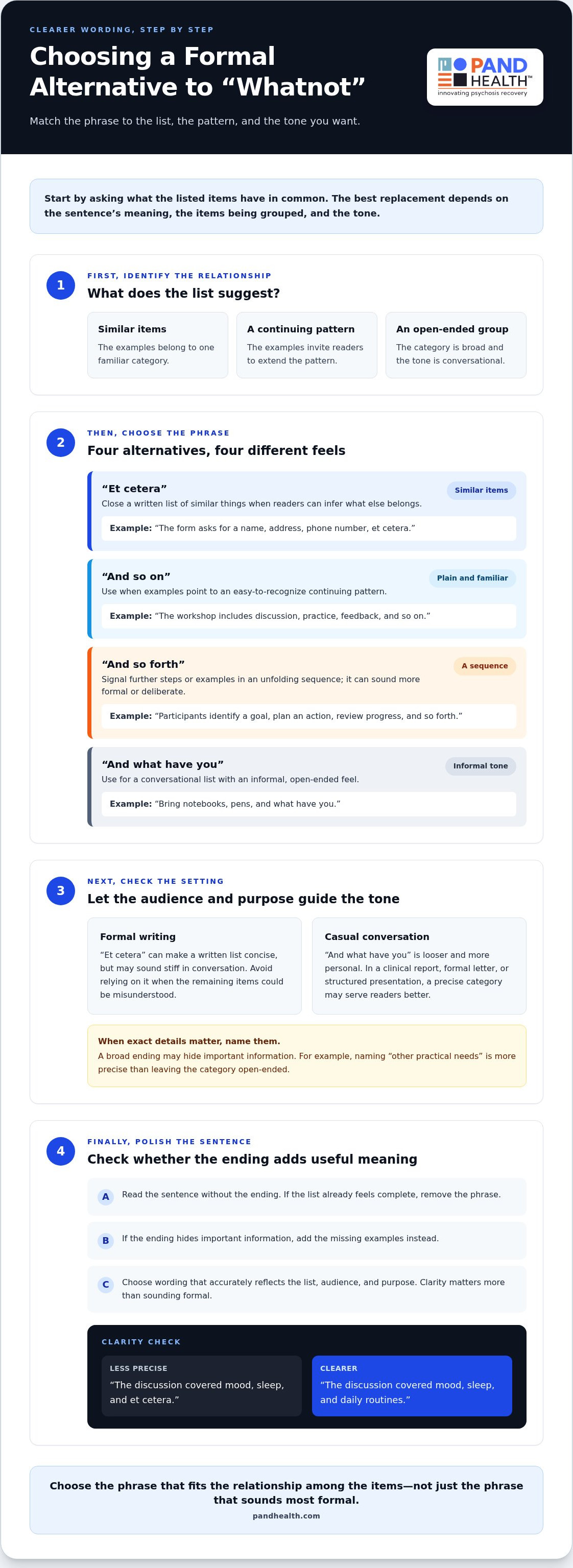
“Whatnot” often works in casual conversation, but formal writing calls for more precise wording. The best replacement depends on the sentence’s meaning, the items being grouped, and the tone you want. “Et cetera,” “and so on,” “and so forth,” and “and what have you” can all show that a list continues, but they don’t fit every sentence equally well. Choose a phrase that makes clear whether you mean similar examples, a continuing sequence, or an open-ended group.
Use “et cetera” when a list contains familiar items from the same category. For example: “The appointment covered sleep, medication, daily routines, et cetera.” This Latin phrase is common in formal writing, though it can sound stiff in conversation. It works best when readers can infer what else belongs in the group. If the remaining items are important or could be misunderstood, name them instead of relying on “et cetera.”
- “Et cetera”: Choose it to close a written list of similar things. Example: “The form asks for a name, address, phone number, et cetera.”
- “And so on”: Use it when examples suggest a continuing pattern. Example: “The workshop includes discussion, practice, feedback, and so on.”
- “And so forth”: Use it to signal further steps or examples in a sequence. Example: “Participants identify a goal, plan an action, review progress, and so forth.”
- “And what have you”: Consider it for a conversational list with an informal, open-ended feel. Example: “Bring notebooks, pens, and what have you.”
“And so on” is usually an accessible choice when a list’s pattern is easy to recognize. In “The group practiced introductions, turn-taking, listening, and so on,” the examples point to related communication skills. The phrase doesn’t identify every remaining item; it asks readers to extend the pattern. Use it when the omitted examples aren’t essential to the sentence’s purpose.
“And so forth” serves a similar purpose, though it can sound more formal or deliberate. Consider: “The plan includes setting a goal, choosing a manageable action, reviewing the result, and so forth.” The sequence suggests related stages without claiming to list every possible one. Use it for an unfolding series, not when readers need a complete procedure or a specific set of requirements.
“And what have you” is the most conversational option here. In “We discussed schedules, transportation, and what have you,” the phrase leaves the category broad. That can suit dialogue or an informal explanation. In a clinical report, formal letter, or structured presentation, a precise category may serve readers better. For example, “transportation and other practical needs” says more than an open-ended phrase.
To polish a sentence, first identify the relationship among the listed items. If they belong to one clear group, “et cetera” may fit. If the examples suggest a pattern, choose “and so on” or “and so forth.” For a conversational tone, “and what have you” may sound natural. Then read the sentence without the ending. If the list already feels complete, remove the phrase. If it hides important information, add the missing examples.
These alternatives also differ in tone. “Et cetera” can make a written list concise, but repeated use may seem mechanical. “And so on” is plain and familiar, while “and so forth” can emphasize continuation. “And what have you” is looser and more personal. In a Los Angeles workplace email, “Please bring identification, appointment paperwork, and so on” may be less precise than naming all required documents.
Clarity matters more than sounding formal. Compare “The discussion covered mood, sleep, and et cetera” with “The discussion covered mood, sleep, and daily routines.” The second version names the final category directly. When “whatnot” or one of its alternatives adds no useful meaning, deleting it is often the clearest edit. Choose wording that accurately reflects the list, audience, and purpose.
Because “whatnot” can also be a noun, context matters: it means either miscellaneous things or a freestanding open-shelving unit for displaying trinkets. The Oxford English Dictionary says “whatnot” has been in use since the mid-1500s. Its first cited furniture example is a 1808 letter in which Lady Sarah Spencer’s brother Bob was 16 years old.
Whatnot versus what not spelling
For the noun meaning miscellaneous things, spell “whatnot” as one word. The Oxford English Dictionary records the word’s history, including examples of its use in a list and as a name for furniture. The separate words “what not” can appear together in a sentence, but they aren’t an alternative spelling of that noun. The distinction depends on meaning and grammar, not just on how the words sound.
Use “whatnot” for assorted items or a miscellaneous collection. For example, “The drawer held batteries, spare keys, and whatnot” uses the one-word form. Here, “whatnot” functions as a noun referring broadly to other small things. If you can replace it with “miscellaneous items” without changing the sentence’s meaning, the one-word spelling is likely correct.
“Whatnot” can also name a piece of furniture. The Oxford English Dictionary says it has been used for an open stand with shelves since the early 1800s. Its first example of this furniture meaning comes from a letter dated December 21, 1808. In “A vase stood on the whatnot,” the word names the shelving unit, not a collection of objects. Context makes the meaning clear.
The word has a longer history as a term for miscellaneous things. The Oxford English Dictionary’s earliest example of “what not” is from John Palsgrave’s 1540 translation of The Comedye of Acolastus. The Oxford English Dictionary’s first example of “whatnot” at the end of an enumeration comes from Samuel Pepys’s diary entry dated December 21, 1663. These examples show spellings and uses across different historical contexts. For modern usage, write the noun as one word.
By contrast, “what not” can appear as two words when “what” and “not” have separate grammatical roles. Consider “I know what not to include.” Here, “what” introduces the thing under discussion, while “not” negates the action “include.” The phrase doesn’t mean assorted things or name furniture. Don’t combine the words just because they appear next to each other.
Compare these examples:
- One word: “We packed snacks, chargers, and whatnot.” The final noun refers to other miscellaneous supplies.
- Two words: “We discussed what not to pack.” The phrase identifies which things should be left out.
- One word: “A small lamp stood on the whatnot.” The noun refers to an open shelving unit.
- Two words: “She explained what not to place on the shelf.” The words belong to the sentence’s grammar.
When editing, use a quick three-part check. First, ask whether the word means “miscellaneous things” or names a shelving unit. If so, use “whatnot.” Next, check whether “what” points to something and “not” negates an action, as in “what not to say.” If so, keep the words separate. Finally, read the sentence aloud and make sure its meaning is clear from context, not sound alone.
The plural form offers another clue. “Whatnots” can refer to more than one open shelving unit displaying trinkets, but a plural form isn’t always needed. For example, “The shop displayed two whatnots” uses the plural furniture noun. In “They brought notebooks, pens, and whatnot,” the word refers to miscellaneous items and remains singular. Let the noun’s role in the sentence guide its spelling and number.
Choosing the right form prevents a small spelling difference from changing the sentence’s meaning. “I know what not to bring” describes something to leave behind; “I brought whatnot” describes assorted items. For a shelf, “whatnot” remains one word. Historical examples in the Oxford English Dictionary reflect this established spelling, while the surrounding words show whether the sentence needs a noun or two separate grammatical words.
During a final proofread, pause at each occurrence and check what role the expression has in that sentence. If it is the noun, keep the single-word form; do not substitute the two-word form for that noun. If the words are genuinely separate parts of the sentence, preserve the separation rather than treating them as the noun. This usage guide states the rule directly: “Whatnot” is spelled as one word and, according to this usage guide, is not spelled as the two separate words “what not.” That check keeps the spelling aligned with the intended use.
Pand Health: Social skills training
Pand Health offers social skills training for people seeking support with communication and social interaction. It can help when psychosis-related challenges affect everyday conversations, relationships, or participation in community life. Psychological and social rehabilitation can also support practical goals, while family psychoeducation helps relatives better understand mental health needs and ways to offer support. Additionally, those seeking broader guidance for personal growth and emotional well-being can look to professional therapy and consultation services like leapsinc.com.
If concerns involve unusual thoughts or social communication differences, an evaluation for thought disorders and autism may help clarify appropriate support. These services address different needs, so the next step depends on the person’s concerns and goals. Contact Pand Health to discuss social skills training or related support in Los Angeles.
Take the Next Step Toward Support
Clear language can help families talk about mental health, but it cannot replace attentive care when someone’s thoughts or daily interactions raise concern. Understanding what psychosis is and is not can be a starting point for a focused conversation about the support a person may need. For individuals and couples looking to navigate complex relational dynamics or personal challenges, Mindbender Counseling offers professional therapy to help strengthen communication and well-being.
Pand Health offers social skills training, psychological and social rehabilitation, and evaluation for thought disorders and autism. These services address distinct concerns, from practicing social interaction to clarifying thought-related needs. A conversation about the person’s circumstances and goals can help identify a useful direction.
Contact Pand Health for support and discuss a thoughtful next step. Seeking guidance can open space for clearer understanding and continued progress.
Frequently Asked Questions
What does “and what is not” mean?
“And what is not” connects an idea with something outside it, but its meaning depends on the surrounding sentence. In a discussion of psychosis, it can distinguish what the term describes from what it doesn’t. For example, “Understanding psychosis and what it is not” introduces both the definition and its boundaries. The phrase alone doesn’t define psychosis.
What are common alternatives to the phrase “and what is not”?
For a casual list ending, alternatives to “whatnot” include “et cetera,” “and so on,” “and so forth,” and “and what have you.” If you mean a contrast rather than a list, rephrase the sentence to state the distinction directly. For example, “what psychosis involves and what it excludes” may be clearer than “and what is not.” Choose wording that matches your intended meaning.
Disclaimer
This article is for information and educational purposes only, and can NEVER replace a proper medical evaluation. If you or a loved one may be suffering from psychosis or the prodomal symptoms of psychosis, get evaluated by a professional as soon as possible. Early diagnosis and treatment can be life-saving.