


Podcasts for Families Facing Mental Illness and Hard Talks
A hard family conversation needs more than the right words; it needs a thoughtful place to begin. A podcast for families dealing with mental illness can offer a starting point through conversations about parenting, family relationships, and how to discuss difficult experiences. Look for episodes that address both a child’s needs and the questions family members may be carrying.
If you’re worried about saying the wrong thing or unsure how to support your child while caring for the family as a whole, you’re not alone in wanting guidance that feels compassionate and practical. Listening can help you find language for concerns that are hard to raise, and perspectives that make complex experiences easier to discuss.
This article explores podcasts focused on difficult family conversations and parenting a child with mental illness. You’ll learn what different episodes may help with, how to choose a useful starting point, and how listening can complement more direct family support.
Key Takeaways
- Choose episodes around the conversation your family needs to have, such as discussing a diagnosis, offering support, or setting boundaries.
- Look for parenting-focused discussions that acknowledge both a child’s needs and the pressures caregivers may face.
- Personal stories can offer perspective and help families find language for experiences that may be difficult to discuss.
- Use practical podcast advice as a starting point for reflection, then consider what kind of support would help your family take a next step.
- Family psychoeducation and social skills training can address needs that listening alone may not resolve.
Honest conversations about difficult topics
A podcast can help families prepare for conversations about diagnosis, treatment, stigma, or safety. For example, a parent might listen before asking a child what support feels helpful. The goal isn’t to find a perfect script, but to make room for questions and feelings and identify a next step the family can take together.
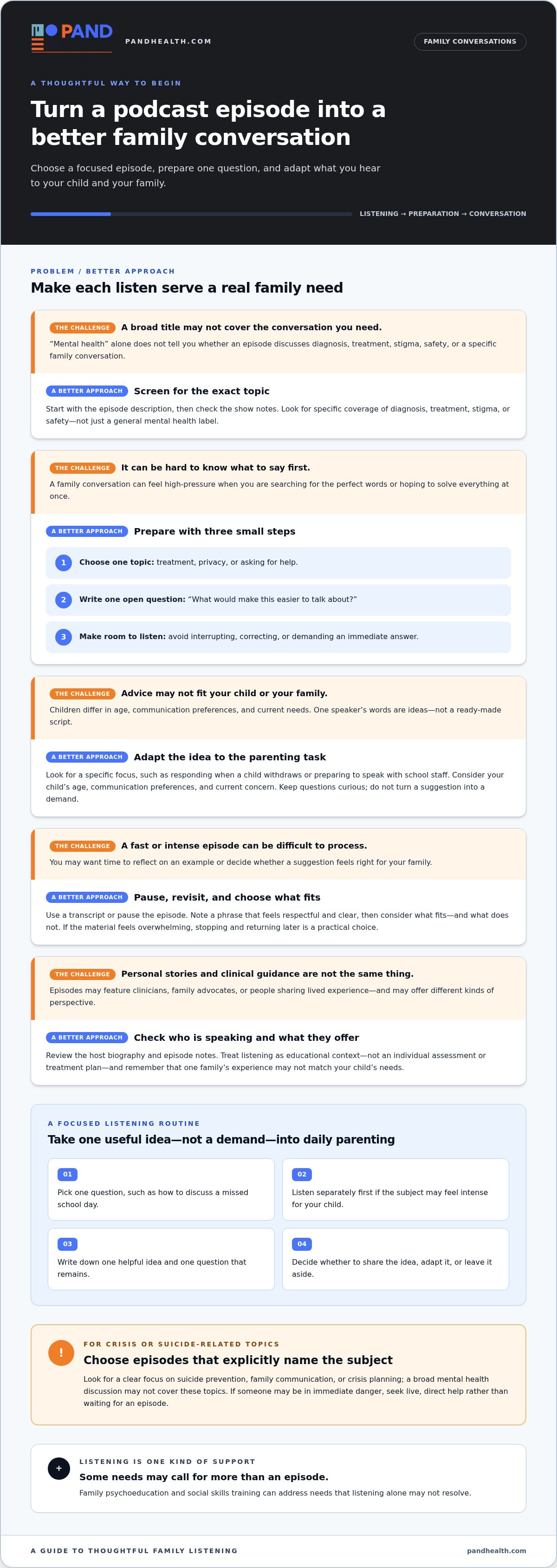
Which podcasts address crisis support and suicide prevention for families? Choose episodes explicitly focused on suicide prevention, family communication, or crisis planning; broad mental health discussions may not cover these topics. If someone may be in immediate danger, seek live, direct help rather than waiting for an episode to offer guidance.
Use the episode description as your first screening tool. Look for specific topics, such as talking with a loved one about suicidal thoughts or responding to a crisis. A title that only mentions mental health may not indicate whether the episode covers these difficult conversations. Check the show notes for details about its content.
Before listening, choose one question you hope the episode will help you consider. For example: “How can I ask my teenager what they need without rushing to solve everything?” Write it down, then note any phrases that feel respectful and clear. This keeps listening focused and gives you a practical starting point for a later conversation.
Use a transcript or pause button if an episode moves quickly or brings up strong feelings. Pause after a useful example, such as a speaker describing how they opened a difficult discussion. Consider what fits your family and what doesn’t. A host’s words can offer ideas, but your child’s age, communication style, and immediate needs should guide how you adapt them.
For a family conversation, try this three-step preparation:
- Choose one topic, such as treatment, privacy, or asking for help.
- Write one open question, such as “What would make this easier to talk about?”
- Decide how to listen without interrupting, correcting, or demanding an immediate answer.
These steps make listening preparation, not pressure. A family member can share a brief reflection, then give the other person time to respond. If the subject feels too difficult to raise together, note which part feels hardest. That detail can help clarify what kind of support or conversation may be useful next.
Choose carefully when the topic is suicide or crisis. Prioritize episodes that clearly name the subject and explain their focus, rather than assuming every family podcast covers prevention. Stop listening if the material feels overwhelming, and return to it later only if that feels useful. Pausing thoughtfully is a practical choice, not a failure to engage.
Parenting a child with mental illness
Parenting a child with mental illness can raise questions about care, school, privacy, and family routines. A useful episode should address a specific parenting task, such as responding when a child withdraws or preparing to speak with school staff. The best fit depends on your child’s age, communication preferences, and current concerns.
Where can I listen to recommended mental health podcasts, and are they free? Many shows are available through podcast apps such as Apple Podcasts and Spotify, and listening may be free; some platforms or content offer paid options. Read the episode description before pressing play, especially when the title touches on a sensitive subject.
Are any podcasts hosted by mental health professionals or family advocates? Some episodes are hosted by clinicians, while others feature family advocates or people sharing lived experience. Check the host biography and episode notes to understand whether a discussion offers clinical education, personal perspective, or both.
Are there podcasts for families dealing with specific conditions such as bipolar disorder, schizophrenia, or depression? Yes, families can search by condition and narrow results to parenting, treatment discussions, or family experiences. A condition-specific title can be a useful starting point, but an episode’s focus matters more than its label.
What should families consider when using podcasts for mental health information? Treat an episode as educational context, not an individual assessment or treatment plan. Consider who is speaking, what experience or expertise they describe, and whether the episode distinguishes personal stories from clinical guidance. One family’s experience may not match your child’s needs.
Use a short listening routine to make an episode relevant to daily parenting:
- Pick one question, such as how to discuss a missed school day.
- Listen separately first if the subject may feel intense for your child.
- Write down one helpful idea and one question that remains.
- Decide whether to share the idea, adapt it, or leave it aside.
For example, an episode about school attendance might prompt a parent to ask what feels hardest about the morning routine. Keep the conversation specific and curious. Avoid turning a podcast suggestion into a demand, such as insisting that a child use a coping strategy before hearing their perspective.
Tools can support different listening needs. Apple Podcasts and Spotify help families find shows and save episodes for later. A transcript can make a discussion easier to revisit, while playback controls let you pause when a topic needs time. If an episode raises concerns about your child’s wellbeing, use it to identify questions for a qualified professional rather than relying on a podcast alone.
Listening can help parents find language and perspective, while working with a professional such as Tracy Kimberg or seeking family psychoeducation offers a more structured way to understand mental health concerns together. Pair an episode with a practical parenting question, then consider what support could help your family address it.
What mental health topics do family-focused podcasts cover?
Family-focused podcasts can explore how mental health affects everyday relationships, not just symptoms or treatment. An episode might consider how a parent responds when a child stops joining family meals, or how siblings can ask questions without feeling responsible for recovery. These examples connect broad topics with familiar moments at home.
Diagnosis and treatment are common topics. Episodes may explain terms such as psychosis, depression, or anxiety, describe what an evaluation can involve, or discuss how families can prepare questions for a clinical appointment. Listen for clear distinctions between general education and personal opinion. A guest’s account can be meaningful without representing every family’s experience.
Communication is another useful focus. A discussion about listening without judgment may help a parent replace “You’re overreacting” with “What feels hardest right now?” Episodes about boundaries can offer examples of balancing care with privacy, such as agreeing on which personal details a teenager wants shared with relatives. These topics can support more respectful conversations.
Some shows address family roles and caregiver stress. An episode might examine how siblings react when attention shifts toward one child’s needs, or how a caregiver can recognize their own limits. These discussions can help families identify a practical topic to raise together, such as dividing household tasks or choosing a calmer time to talk.
Other episodes explore stigma, school, work, social connection, and recovery. A family may look for a discussion about telling a teacher that a student needs support or maintaining friendships during a difficult period. Focused search terms make discovery easier: combine the condition or concern with a family need, such as “depression and parenting” or “psychosis and family communication.”
Use episode tools to judge relevance before listening. Show notes summarize topics and identify guests; transcripts help you find a specific discussion; content advisories can flag sensitive material. These tools are especially useful when a family wants to avoid unexpected details or review one section together. Save a relevant episode and note the timestamp that addresses your question.
- Diagnosis and care: Useful for understanding terms and preparing appointment questions.
- Communication and boundaries: Offers examples for talking about privacy, support, and difficult feelings.
- Family relationships: Helps identify how siblings, parents, or caregivers may experience change.
- Daily life: Covers school, social connection, routines, and maintaining family roles.
Choose the topic that matches your family’s present concern rather than trying to cover everything at once. A podcast for families dealing with mental illness can offer a useful perspective on one question, while family psychoeducation provides a more structured way to learn together. Record what feels relevant, what needs clarification, and which conversation the episode may help you begin.
Are there podcasts featuring stories from families affected by mental illness?
Podcasts include interviews and first-person accounts from parents, siblings, partners, and people describing their own mental health experiences. A family story might trace when a parent noticed a change, how relatives responded, or what communication felt helpful afterward. These accounts offer perspective on lived experience, not a template every family should follow.
To find relevant episodes, search Apple Podcasts or Spotify with terms such as “family mental health story,” “parenting and depression,” or “sibling perspective.” Add a condition or relationship to narrow the results. For example, “parent and psychosis” may surface discussions a broad mental health search misses. Episode descriptions can help distinguish personal interviews from clinical education.
Story formats vary. A host may interview one family member, invite several relatives to describe the same period, or revisit a story across multiple episodes. A parent’s account of supporting a teenager through treatment may focus on practical family changes, while a sibling’s account may describe uncertainty about what to say. Listening to different perspectives can reveal how one event affects relatives differently.
Use stories to recognize questions, not to compare families. A guest may describe a choice that suited their household but not yours. Notice the context: the speaker’s relationship, the concern discussed, and the support they had. If an episode leaves out those details, treat its advice as personal experience rather than a universal recommendation.
Listening tools make personal stories easier to navigate. Apple Podcasts and Spotify let listeners search show titles and episode descriptions, then save episodes. A transcript can help locate a passage or revisit a phrase without replaying the full discussion. Playback controls are useful for pausing when a story feels intense or listening in shorter segments.
Before sharing an episode with relatives, consider its focus and tone. A story about diagnosis may feel different from one about recovery or family conflict. Read the description first, then decide whether to listen alone or together. For a shared listen, agree on one reflection question, such as, “What did this family do that felt useful?”
- Parent stories: Can offer insight into caregiving decisions and changing family routines.
- Sibling accounts: May help relatives name questions about their role and connection.
- First-person experiences: Can show how a person describes their own needs and support.
- Multi-voice interviews: Can reveal different perspectives on the same family experience.
A podcast for families dealing with mental illness can make personal experiences easier to encounter through someone else’s words. Keep the story’s specific context in view and note any questions it raises for your family. This helps listeners draw meaning without assuming another household’s experience predicts their own.
Which podcasts offer practical advice for supporting a loved one with mental illness?
Choose episodes that turn a broad subject into a specific support skill. A discussion about listening, for example, should explain how to make space for someone’s answer without immediately correcting or advising them. Episodes with a clear focus are easier to apply than conversations offering general encouragement without practical examples.
Search podcast apps using the concern you’re facing, such as “supporting a family member,” “mental health boundaries,” or “talking about treatment.” Then read the show notes. Look for an episode that describes its topic, identifies its guest, and makes clear whether it shares personal experience, professional education, or both.
A useful episode may help you prepare a respectful opening. If your loved one has become withdrawn, you could adapt a listening suggestion: “I’ve noticed you’ve been spending more time alone. Would you like to talk, or would company feel better?” The question offers a choice instead of demanding disclosure.
Practical discussions can also help families think about boundaries. An episode might prompt you to distinguish support from taking over: offer to attend an appointment, for example, while letting the person decide what they want to share. Specific examples help listeners consider what respectful support could look like in their own relationships.
Use a simple listening routine to bring one idea into daily life:
- Choose one episode that matches a current concern.
- Note one phrase or action that feels appropriate for your relationship.
- Adapt it to your loved one’s preferences and circumstances.
- Reflect afterward on what felt helpful and what needs a different approach.
Podcast tools can make this process easier. Apple Podcasts and Spotify let listeners search by topic and save episodes for later. Show notes identify the discussion’s focus, while transcripts make it easier to revisit a particular phrase. Pause or stop playback if an example feels too intense or doesn’t fit your situation.
The Mind Exposed Podcast is a resource families can explore for mental health conversations. As with any show, use the episode description to select material relevant to your question. Listening can offer language and perspective, while family support may call for more than an audio resource.
Keep the person’s autonomy central. Advice that sounds practical in an episode may not fit their needs, boundaries, or readiness. Offer an idea as an invitation, not a rule. For instance, ask, “Would it help if I listened with you?” rather than assuming they want to hear the same material.
If you’re looking for a next step beyond listening, Pand Health offers family psychoeducation and family therapy. A conversation can help clarify what kind of support may fit your family’s concerns.
Pand Health: Social skills training
Pand Health offers social skills training for people seeking support with communication and interaction skills. If a podcast raises questions about how mental illness affects family relationships, family psychoeducation can be a practical next step. Psychological and social rehabilitation may also support broader goals related to daily life and community participation.
Families can turn to Pand Health for structured support beyond listening or to better understand a loved one’s needs. Evaluation for thought disorders and autism can help clarify concerns that call for assessment. These services address different needs, so the right next step depends on your family’s questions and goals.
Contact Pand Health to discuss support for your family.
Take the next step toward family support
A podcast for families dealing with mental illness can help you find language for a hard conversation, but it doesn’t have to be your only source of support. Choose one concern you’d like to address, then consider what could help your family move forward with greater understanding and connection.
Pand Health offers social skills training and psychological and social rehabilitation, as well as evaluations for thought disorders and autism. These options may be relevant when your family is looking for structured support or clarity about specific concerns. The next step can be a conversation about what your family is experiencing and which kind of support fits those needs.
Contact Pand Health for support and discuss a path forward for your family. A thoughtful next step can begin with one question and a willingness to listen.
Frequently Asked Questions
What podcasts support families and caregivers of people with mental illness?
The Mind Exposed Podcast is a resource for families navigating mental health challenges. Caregivers can choose an episode that matches a current concern, then consider how its ideas might apply at home. For example, a family in Los Angeles could use a listening discussion to identify questions to explore through family psychoeducation, which helps relatives build understanding and support a loved one.
Which podcasts are specifically for parents of children with mental health conditions?
The Mind Exposed Podcast is a family-focused option parents can explore, though the most useful episode depends on the child’s situation. Look for episode descriptions that directly address parenting, family communication, or supporting a young person. A parent of a teen, for example, may prioritize discussions that respect the young person’s voice while helping caregivers offer support without taking over.
Disclaimer
This article is for information and educational purposes only, and can NEVER replace a proper medical evaluation. If you or a loved one may be suffering from psychosis or the prodomal symptoms of psychosis, get evaluated by a professional as soon as possible. Early diagnosis and treatment can be life-saving.