
Bipolar 1 Disorder: Symptoms, Mania, and the Path to Functional Recovery
What if a manic episode wasn't the end of your professional ambitions, but a turning point toward a more resilient version of yourself? For many families in Los Angeles, a diagnosis of bipolar 1 feels like a permanent fracture in a loved one's future. You might worry that the intensity of manic psychosis has caused lasting cognitive damage or that the resulting social isolation is an inescapable new reality. It's a heavy burden to carry, especially when the path forward seems obscured by clinical jargon and fear.
We understand these concerns and want to assure you that a diagnosis doesn't define the limit of a person's potential. This article provides a comprehensive look at the clinical complexities of the disorder while highlighting advanced, recovery-oriented strategies that prioritize social and vocational success. We'll examine the specific criteria for a diagnosis, the critical distinction between mania and other thought disorders, and how specialized interventions can restore a sense of normalcy. By focusing on functional gains in education and employment, we move beyond basic symptom management toward a future where recovery is the standard expectation.
Key Takeaways
- Define the core clinical criteria of bipolar 1 and distinguish it from hypomania to ensure an accurate understanding of the diagnostic process.
- Identify how psychotic features like grandiose delusions and hallucinations manifest within a manic state to better navigate a mental health crisis.
- Recognize the impact of cognitive and social skill erosion that follows mania, moving beyond mood stabilization toward long-term brain health.
- Learn why the first 72 hours of a manic break are vital for long-term outcomes and how specialized evaluations in Los Angeles provide a roadmap for care.
- Understand the NAVIGATE framework and Coordinated Specialty Care, which focus on restoring vocational success and social independence as the expectation for recovery.
What is Bipolar 1 Disorder? Defining the Manic Experience
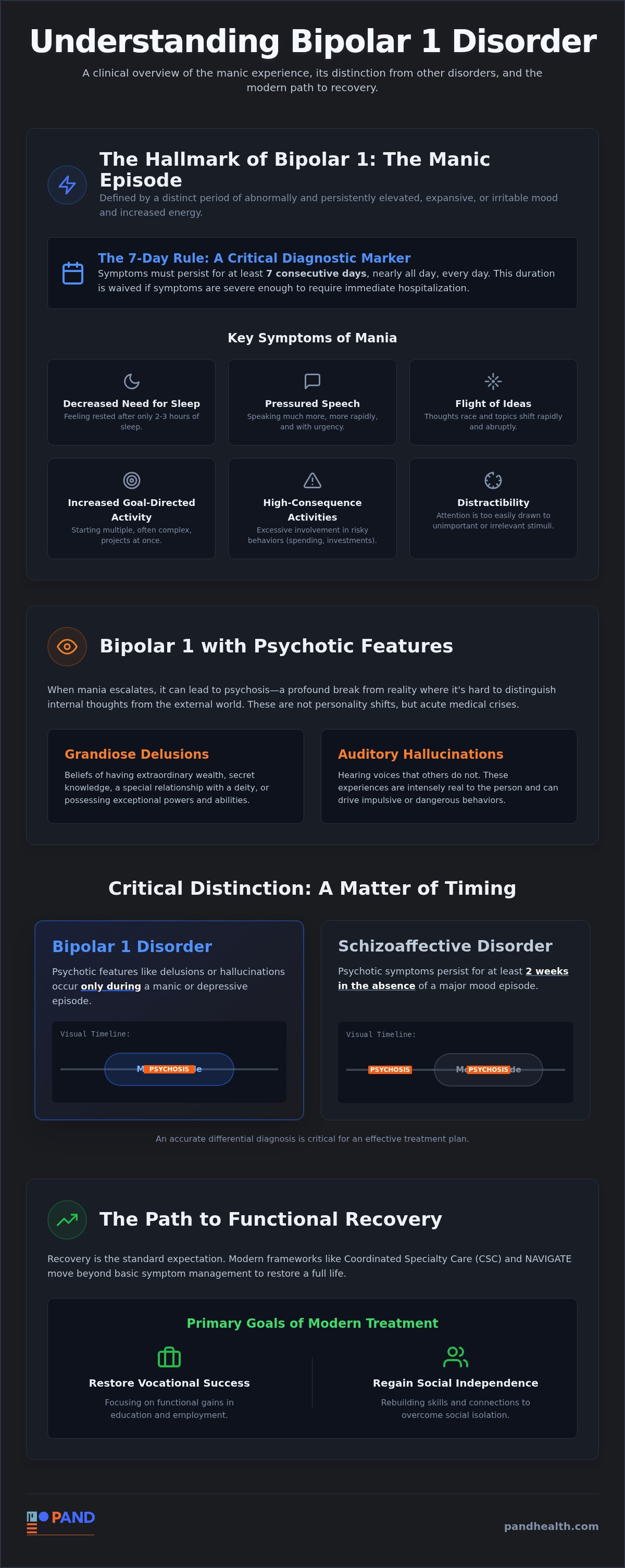
The clinical hallmark of Bipolar 1 Disorder is the presence of at least one full manic episode. While many people believe that a diagnosis requires a constant cycle between highs and lows, the DSM-5 criteria focus specifically on the severity and duration of the "high." In fact, while major depressive episodes are extremely common and often debilitating, they aren't strictly required for a bipolar 1 diagnosis. This distinction is vital because the treatment trajectory for a full manic break differs significantly from that of standard depression or even Bipolar 2. When mania reaches its peak, it often crosses the threshold into psychosis, which is why clinicians frequently categorize severe cases alongside thought disorders. It's a level of intensity that requires a specialized approach to safety and stabilization.
The 7-Day Rule: Identifying Clinical Mania
To meet the clinical definition of mania, the symptoms must persist for at least seven consecutive days, present most of the day, nearly every day. However, if the symptoms are severe enough to require immediate hospitalization to prevent harm to self or others, the duration requirement is waived. During this period, an individual might experience a significantly decreased need for sleep, often feeling fully rested after only two or three hours. This isn't just "having a lot of energy." It's a physiological shift that impacts every facet of behavior and decision-making. Other indicators include:
- Pressured speech or talking much more than usual
- Racing thoughts or the "flight of ideas" where topics shift rapidly
- An intense increase in goal-directed activity, such as starting multiple complex projects at once
- Excessive involvement in activities with a high potential for painful consequences, like impulsive spending or risky investments
Bipolar 1 vs. Schizoaffective Disorder
Distinguishing between a primary mood disorder and a primary thought disorder is one of the most complex tasks in psychiatry. In bipolar 1, psychotic features like delusions or hallucinations occur only during a manic or depressive episode. Conversely, schizoaffective disorder involves psychotic symptoms that persist for at least two weeks in the absence of a major mood episode. Because the overlap is significant, families often find themselves in a state of confusion during a crisis. Securing a comprehensive thought disorder assessment LA is a critical step in ensuring the treatment plan addresses the root cause rather than just the surface symptoms. An accurate differential diagnosis provides the steady hand needed to navigate the storm and begin the path toward functional stability. It's about finding the right lifeline when other avenues have failed to provide a clear direction.
Bipolar 1 with Psychotic Features: When Mania Meets Psychosis
Mania in bipolar 1 is more than just extreme energy; it can escalate into a profound break from reality known as psychosis. This state involves a loss of contact with the external world, making it difficult for the individual to distinguish between their internal thoughts and objective reality. According to the National Institute of Mental Health, the presence of mania and psychosis in Bipolar 1 often necessitates intensive clinical intervention to ensure safety. These episodes are not mere personality shifts but are acute medical crises that require a steady hand and specialized expertise to manage effectively.
Grandiose delusions are a frequent hallmark of this stage. An individual might believe they possess extraordinary wealth, secret knowledge, or a special relationship with a deity. Auditory hallucinations may also occur, where the person hears voices that others do not. These experiences are intensely real to the person experiencing them, often driving impulsive or dangerous behaviors based on these perceived truths. Because these symptoms can mimic other thought disorders, a nuanced clinical evaluation is the only way to ensure the correct treatment path.
Recognizing the Warning Signs of Psychotic Mania
Families often notice "flight of ideas," where a loved one's thoughts move so rapidly they can't keep up, or "pressured speech," where the person speaks with an urgent, unstoppable rhythm. Handling delusions of grandeur or paranoid suspicion requires a calm, non-confrontational approach; it's often best to validate the person's feelings without necessarily agreeing with the false belief. The prodromal phase of mania is the early period of subtle mood and behavioral shifts that precedes a full-blown episode, offering a critical window for intervention before a crisis occurs.
The Intersection of Cannabis and Bipolar 1
The use of high-potency THC is a significant risk factor for those predisposed to bipolar 1. Research suggests that cannabis can act as a catalyst, triggering or worsening manic psychosis and complicating the recovery process. For families in Los Angeles, addressing this requires more than just mood stabilization. It involves specialized cannabis induced psychosis rehab to manage the unique interaction between substance use and severe mood cycles. Dual-diagnosis support is essential for long-term stabilization, as it treats the psychiatric condition and the chemical trigger simultaneously. If you're concerned about a loved one's recent behavioral changes, you can reach out for a professional evaluation to determine the best path forward.
The Hidden Impact: Cognitive and Social Skill Erosion
Mood stabilization is often viewed as the finish line for bipolar 1 treatment, but for many, it's actually the starting block. Once the intensity of a manic episode fades, individuals frequently encounter a persistent "cognitive fog" that medication alone cannot clear. This aftermath impacts memory, attention, and executive function, making it difficult to return to work or school. According to Bipolar Disorder Information from NIMH, the disorder involves complex changes in brain activity that require more than just chemical balance to address. Functional recovery means rebuilding the mental infrastructure that mania often leaves in disarray.
Beyond internal cognition, there's the challenge of social reintegration. A public manic break can leave a trail of social isolation and misunderstood interactions. This erosion of social cognition makes it harder to read non-verbal cues or respond appropriately in group settings. Without targeted social skills training, the resulting loneliness becomes a significant risk factor for relapse. Rebuilding these connections is a vital part of the recovery process.
Cognitive Remediation: Rebuilding Brain Function
Computer-assisted brain training has become a cornerstone of advanced rehabilitation. These programs use targeted exercises to repair neural pathways damaged by psychosis or prolonged mania. We've seen that combining this mental training with physical fitness coaching creates a synergistic effect, as exercise boosts the neuroplasticity needed for cognitive gains. Our internal data from the 2022-2024 cohort shows that participants often move from the 33rd to the 50th percentile in cognitive scores after six months of intensive remediation. This improvement translates directly into better performance in vocational and educational environments.
Social Cognition and Interaction Training (SCIT)
Engaging with others again after a break from reality requires a specific set of tools. Social Cognition and Interaction Training (SCIT) helps individuals interpret social situations more accurately. This often involves Metacognitive Training (MCT) to address lingering paranoia or suspicious thoughts that can arise post-mania. By learning to "think about their thinking," patients can catch distorted perceptions before they lead to social withdrawal. This proactive approach prevents the profound isolation that so often follows a bipolar 1 diagnosis, ensuring that the individual remains connected to their community and their long-term goals.
Evaluation and Early Intervention in Los Angeles
Timing is everything during a manic episode. The first 24 to 72 hours of a manic break represent a critical window where rapid, specialized intervention can prevent the most severe social and vocational consequences. In a city as vast as Los Angeles, finding a psychosis specialist for young adults Los Angeles during this period can feel overwhelming, but it's the most vital step toward long-term stability. A specialized evaluation for bipolar 1 is designed to provide clarity during the chaos, offering a steady hand to families in crisis while ensuring the individual feels safe and understood.
Steps to Securing an Accurate Diagnosis
Securing a diagnosis is a methodical process that requires deep clinical expertise. It begins with a clinical interview and a thorough gathering of symptom history, where we look beyond the current crisis to understand the individual's baseline and previous mood patterns. We then perform a differential diagnosis to rule out other conditions, such as autism or primary schizophrenia, which can often present with overlapping symptoms but require different treatment approaches. Finally, we move past simple symptom suppression to create a recovery-oriented treatment plan. This roadmap prioritizes functional goals like returning to a university or maintaining a career, rather than just adjusting a prescription.
Family Psychoeducation: The Support System's Role
Effective recovery is never a solo journey. Through family psychoeducation Los Angeles, we equip parents and siblings with the tools to reduce environmental stress, which is a primary trigger for relapse. Families learn specific communication techniques to de-escalate tension during a crisis without invalidating their loved one's experience. This collaborative approach transforms the home environment into a place of healing rather than a source of anxiety. Active family involvement is the single most significant predictor of long-term functional success for individuals living with bipolar 1.
If you are currently navigating a crisis or seeking a second opinion, you can schedule a same or next day psychiatric evaluation to begin the stabilization process immediately.
The Path to Recovery: Coordinated Specialty Care (CSC)
Many traditional treatment models focus solely on symptom suppression, often leaving individuals in a state of "stable disability." Coordinated Specialty Care (CSC) represents a paradigm shift, moving beyond the older clubhouse model toward a high-intensity, evidence-based framework. At the heart of this approach is the NAVIGATE framework, a holistic system specifically designed for those navigating bipolar 1 and early-onset psychosis. By integrating psychiatric care with intensive psychosocial support, we ensure that the individual doesn't just manage their condition but actively moves toward a life of independence and purpose.
Our philosophy is simple: recovery is the expectation, not a rare exception. This mindset fundamentally changes the trajectory of treatment. Instead of asking how to avoid the next episode, we ask how a young adult can successfully return to their junior year of college or land a competitive internship. This forward-thinking perspective provides a lifeline to families who have previously been told that a severe manic break marks the end of their loved one's ambitions. It's about restoring the individual's future through specialized, human-centric care.
Supported Education and Employment (SEE)
Vocational success is one of the most powerful stabilizers for long-term mental health. Through our Supported Education and Employment (SEE) services, we provide practical tools like resume building and workplace advocacy to help individuals navigate the unique challenges of re-entering professional life. For those pursuing academic goals, the LA Work-Study Guide for Mental Health Recovery serves as a vital resource for balancing clinical needs with classroom demands. This isn't just about finding a job; it's about rebuilding the social and vocational identity that mania often strips away. Our data from the 2022-2024 cohort highlights the efficacy of this approach, with 85% of program participants successfully engaging in work or school within just six months of enrollment.
The California OnTrack Difference
Standard once-a-week therapy is often insufficient for the complexities of bipolar 1 with psychotic features. The California OnTrack program offers a more robust alternative, providing 24 to 32 hours of high-intensity outpatient care that addresses every facet of the individual's life. This integrated psychosocial model has proven to be remarkably effective by providing a steady hand in the storm of early recovery. We've seen rehospitalization rates drop to just 6%, compared to an industry average of 10%. For families in Southern California, this level of specialized care is available at our Olympic Blvd location in Los Angeles. If you're looking for a path that leads back to normalcy and success, you can reach out to our team to explore the next steps in your recovery journey.
Restoring the Future After a Manic Break
A diagnosis of bipolar 1 marks the beginning of a specialized recovery journey, not the end of a person's potential. We've moved beyond the era where symptom management was the only goal. True success is measured by a return to meaningful life roles. This is why our California OnTrack participants achieve an 85% participation rate in work or school within six months. By utilizing the only outpatient Coordinated Specialty Care program in Southern California to offer APA-recommended cognitive remediation, we repair the cognitive pathways that mania often disrupts. Our commitment to this high-intensity, holistic framework has resulted in a 6% rehospitalization rate, providing families with a level of stability that traditional therapy often misses.
You don't have to navigate this crisis alone. Our team provides the expert evaluation and integrated psychosocial care necessary to turn a period of instability into a foundation for long-term success. Contact Pand Health today for a specialized Bipolar 1 and psychosis evaluation in Los Angeles. We're here to act as your steady hand in the storm, providing a lifeline when you need it most. Recovery isn't just a possibility; it's the standard we strive for every day.
Frequently Asked Questions
What is the main difference between Bipolar 1 and Bipolar 2?
The primary distinction lies in the severity of the elevated mood episodes. Bipolar 1 requires at least one full manic episode that lasts at least a week or results in hospitalization. In contrast, Bipolar 2 involves hypomania, which is a less severe form of high energy that does not include psychosis or require urgent inpatient care. While both involve depressive cycles, the intensity of mania in the first type often necessitates more intensive clinical intervention.
Can Bipolar 1 cause permanent brain damage if left untreated?
Untreated manic episodes can lead to cognitive erosion, which impacts memory, attention, and executive function over time. While we avoid the term "permanent damage," repeated psychosis can alter neural pathways and make functional recovery more challenging if the brain isn't actively rehabilitated. This is why we prioritize APA-recommended cognitive remediation. By using computer-assisted brain training, we've helped clients move from the 33rd to the 50th percentile in cognitive performance, proving the brain can repair with specialized care.
Is Bipolar 1 considered a form of psychosis?
Bipolar 1 is classified as a mood disorder, though it frequently includes psychotic features during a manic episode. Psychosis is a symptom rather than the diagnosis itself and involves a loss of contact with reality through delusions or hallucinations. Because these symptoms overlap with schizophrenia-spectrum disorders, an accurate differential diagnosis is essential. Our intensive treatment for psychosis focuses on stabilizing these breaks from reality while addressing the underlying mood cycle that triggers them for long-term health.
How long does a typical Bipolar 1 manic episode last?
A clinical manic episode must last at least seven consecutive days to meet the diagnostic criteria for bipolar 1. However, if the symptoms are severe enough to require immediate hospitalization, the duration requirement is waived. Without professional intervention, some episodes can persist for several weeks or even months. Early intervention during the first 72 hours is critical because it significantly reduces the length of inpatient stays and prevents the further erosion of social and vocational skills.
Can you work a full-time job with a Bipolar 1 diagnosis?
Achieving and maintaining full-time employment is a realistic expectation for those in recovery. While a manic break can temporarily disrupt your career, our Supported Education and Employment (SEE) curriculum is designed specifically to bridge that gap. We've seen 85% of our clients return to work or school within six months of program enrollment. Through resume building, social skills training, and workplace advocacy, we help individuals transition back into the Los Angeles workforce with the tools they need.
What should I do if a family member is having a manic break in Los Angeles?
The first step is to secure an immediate, specialized psychiatric evaluation to ensure safety and clinical clarity. Pand Health offers same or next day psychosis evaluation services at our Olympic Blvd location in Los Angeles to provide a rapid lifeline for families. Avoid confrontational language and prioritize a calm environment while seeking professional guidance. Our California OnTrack program provides a comprehensive alternative to hospitalization, focusing on stabilizing the individual within their community while providing family psychoeducation.
Does insurance cover intensive outpatient programs for Bipolar 1?
Many commercial insurance plans provide coverage for intensive outpatient programs and Coordinated Specialty Care. While every policy differs, these programs are often recognized as medically necessary for stabilizing bipolar 1 with psychotic features. We recommend contacting your provider to verify your specific benefits for psychosocial rehabilitation and medication management. Our team can also assist in navigating these details during the evaluation process to ensure you understand the resources available for your family's recovery journey and long-term success.
Is cannabis use dangerous for someone with Bipolar 1?
High-potency THC is particularly dangerous for individuals with a predisposition to mania. Cannabis can act as a chemical trigger, inducing or worsening manic psychosis and leading to more frequent hospitalizations. For those struggling with this interaction, we offer specialized cannabis induced psychosis rehab in Los Angeles. Treating the substance use and the mood disorder simultaneously is essential for stabilization, as it addresses both the biological vulnerability and the environmental triggers that can cause a relapse.
Disclaimer
This article is for information and educational purposes only, and can NEVER replace a proper medical evaluation. If you or a loved one may be suffering from psychosis or the prodomal symptoms of psychosis, get evaluated by a professional as soon as possible. Early diagnosis and treatment can be life-saving.