Social Rehab Clubhouses: A Guide for Los Angeles Families
What if the most powerful tool for mental health recovery isn't a clinical intervention, but a sense of belonging? For many Los Angeles families, the period following a psychotic episode is defined by a painful silence. You see your loved one retreat from the world, losing their vocational drive and feeling like a "patient" rather than a person with a future. The Clubhouse model changes this dynamic by replacing isolation with intentional community. By becoming a member of a Clubhouse, individuals step into a "work-ordered day" where their talents are needed and their presence is essential.
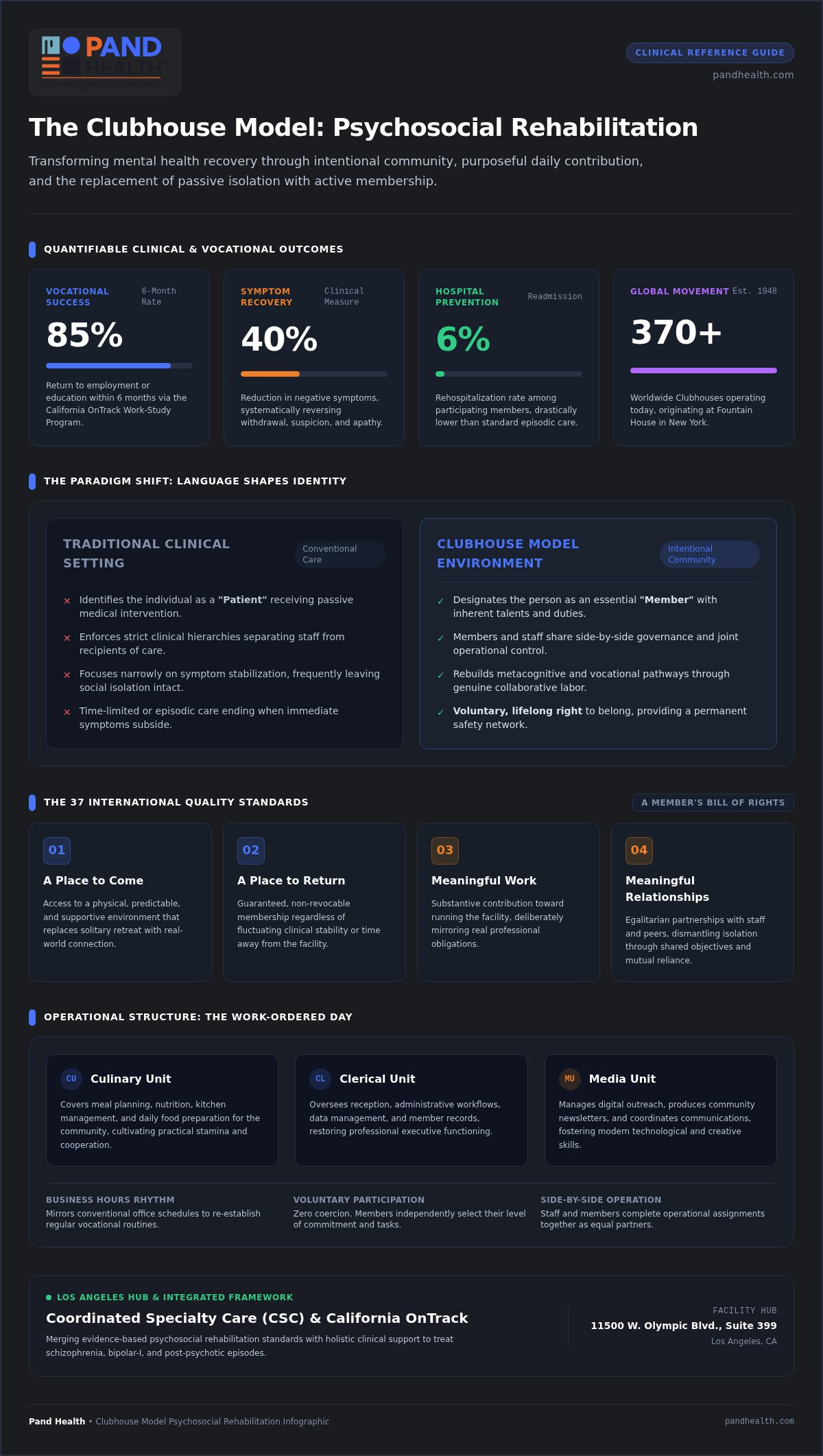
You'll discover how this community-driven approach transforms recovery by fostering deep social connections and a return to professional purpose. We'll explore how integrating these standards into programs like California OnTrack leads to tangible results, including an 85% rate of participation in work or school within six months. This guide previews the path toward reintegration and a reduced 6% rehospitalization rate at our facility at 11500 W. Olympic Blvd., Suite 399, Los Angeles. In this specialized care environment, recovery is the expectation, not the exception.
Key Takeaways
- Learn why the Clubhouse model shifts the focus from "patient" to "member," restoring dignity through a voluntary, work-ordered day.
- Explore the clinical evidence supporting this approach, including a 40% reduction in negative symptoms and a rehospitalization rate of just 6%.
- Understand how the California OnTrack Work-Study Program achieves an 85% success rate in helping individuals return to employment or education within six months.
- Discover how social rehabilitation integrates with the Coordinated Specialty Care framework to provide a holistic recovery environment.
- Find out how to access these specialized services at our Los Angeles hub on Olympic Blvd to begin the journey toward long-term wellness.
What is the Clubhouse Model? Beyond the Social Media App
The name "Clubhouse" has recently gained traction as a digital audio app, but in the context of mental health, it represents a deeply rooted legacy of recovery. The Clubhouse model of psychosocial rehabilitation is a community-based approach that began in 1948 with Fountain House in New York. Today, this movement spans over 370 locations globally. It's not a social media platform; it's a physical environment where individuals with serious mental illness find purpose through collective work and social connection. For families in Los Angeles, understanding this distinction is the first step toward finding a community that treats the person, not just the diagnosis.
The Concept of Psychosocial Rehabilitation
Psychosocial rehabilitation focuses on restoring the functional skills needed for independent living. For those managing schizophrenia or bipolar-I, clinical stability is only the beginning. True recovery requires an environment that repairs the social and cognitive pathways often damaged by long periods of isolation. Structured interaction within a supportive community reduces paranoia and suspicion by providing a safe, predictable milieu. In this setting, the community itself acts as the primary intervention. It helps individuals overcome "negative symptoms" such as withdrawal and apathy by offering a reason to engage with the world every day.
Member vs. Patient: Why Language Matters
Language shapes identity. Within this model, we strictly avoid the term "patient." This isn't a clinic where someone receives passive treatment; it's a community where everyone contributes. This shift in terminology is vital for dismantling self-stigma. When a person is viewed as a member, they gain a sense of ownership and responsibility that is often missing in traditional settings. They aren't defined by a diagnosis but by their ability to participate in a "work-ordered day." Clubhouse Membership is a voluntary, lifelong right. This permanence provides a stable foundation for those who have felt discarded, ensuring a supportive network is always available when they are ready to engage. If you are seeking this level of specialized care in Southern California, you can contact our team to discuss our integrated programs.
The 37 Standards: How a Clubhouse Operates
The operational integrity of a Clubhouse is maintained through a rigorous adherence to the Clubhouse International Quality Standards. These 37 principles serve as a bill of rights, protecting the dignity and autonomy of every member. They establish four fundamental rights: a place to come, a place to return, meaningful work, and meaningful relationships. Unlike clinical settings where staff maintain a strict hierarchy, these communities are managed side-by-side. Members and staff share governance, collaborating on daily operations and long-term planning. This partnership creates a "lifeline" effect. Support is not a temporary service; it is a permanent community that remains available regardless of a member's current level of clinical stability.
The Work-Ordered Day
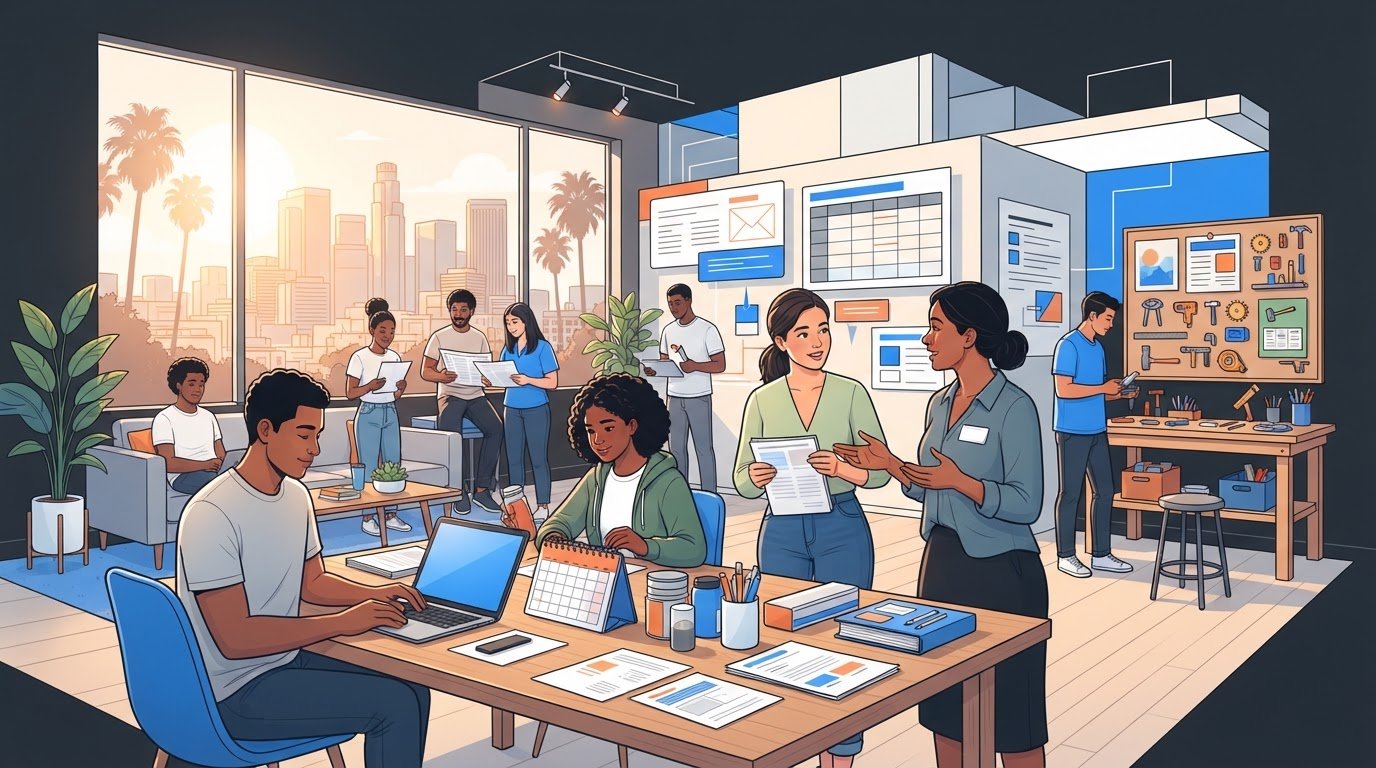
The community operates during standard business hours to facilitate a "work-ordered day." This structure provides a necessary rhythm for individuals who may have spent months in social isolation. Members join specific units, such as culinary, clerical, or media, to complete the essential tasks of the facility. For example, the media unit might manage digital outreach or produce a community newsletter. These tasks are designed to mirror real-world professional environments, allowing members to build vocational stamina. If you are interested in how these units help young adults reintegrate into school or careers, you might consider how our Los Angeles programs apply these vocational pillars.
Voluntary Participation and Choice
Coercion has no place in this model. Participation is entirely voluntary, which fosters a sense of genuine investment. Members choose their tasks and their level of involvement without fear of losing their membership. This freedom is a clinical necessity. By exercising the right to choose, members strengthen the metacognitive skills required for independent living. They learn to navigate social complexities and professional responsibilities at their own pace. This voluntary nature ensures that every step toward recovery is a personal victory rather than a clinical requirement. When individuals are given the power to direct their own lives, the transition from "patient" to "person" becomes a reality.
Clinical Benefits: Reducing Hospitalization and Improving Cognition
The effectiveness of this model is best measured by its ability to keep individuals stable within their communities. Data from Pand Health shows a rehospitalization rate of just 6%, which is significantly lower than the 10% industry average. This stability is supported by a systematic review on Clubhouse Model outcomes, which documents consistent reductions in psychiatric admissions. By providing a consistent social anchor, the Clubhouse environment prevents the crisis-driven cycles that often lead to acute care. It offers a sense of safety that clinical offices alone cannot replicate.
Beyond preventing crisis, this approach directly addresses the "negative symptoms" of schizophrenia, such as apathy and social withdrawal. We've observed a 40% reduction in SANS (Scale for the Assessment of Negative Symptoms) scores among participants. This improvement is often linked to the integration of Social Cognition and Interaction Training (SCIT). When members engage in daily collaboration, they aren't just completing tasks; they're rebuilding cognitive pathways. Our goal is to move members from the 33rd percentile in cognitive performance at enrollment to the 50th percentile by the 12-month mark.
Vocational Outcomes and Employment
Recovery is often defined by the ability to return to school or work. We utilize Transitional Employment (TE), where the community guarantees job coverage, and Supported Employment (SE), which provides ongoing coaching in community roles. Our California OnTrack Work-Study Program reports that 85% of participants are engaged in employment or education after six months. Engaging in meaningful work acts as a biological stabilizer for the brain by providing the structured stimulus required for neuroplasticity. This vocational focus ensures that members don't just stay out of the hospital; they move forward in their lives.
Reducing the Cost of Care
The economic impact of this model is profound for families and the healthcare system. While inpatient stays are often necessary during a crisis, they are incredibly costly and disruptive. By utilizing a community-based rehabilitation model, we've seen average inpatient stays drop from a 40-day baseline to just 7 days. This reduction represents a significant shift in how resources are used. Vocational reintegration provides long-term economic benefits by reducing dependency on disability services and fostering financial independence. It's a more sustainable, human-centric approach to long-term wellness.
Integrating Clubhouse Principles into Coordinated Specialty Care (CSC)
Coordinated Specialty Care (CSC) is recognized as the evidence-based gold standard for treating first-episode psychosis. It typically follows the NAVIGATE framework, a multidisciplinary approach that includes specialized medication management and individual therapy. However, clinical visits alone don't always address the social vacuum left by a mental health crisis. This is where the Clubhouse model serves as a vital "social engine" for the clinical CSC framework. It provides a real-world laboratory where members can practice the social and cognitive skills they develop in their clinical sessions. By combining these two worlds, we ensure that recovery isn't just about symptom management, but about functional living.
We augment this integrated model with computer-assisted brain training and structured physical fitness. These interventions are designed to spur neuroplasticity, helping the brain recover its processing speed and executive function. Family psychoeducation is equally essential. We provide intensive support to families within this community framework, ensuring that the progress made during the day is understood and supported at home. This holistic approach creates a consistent environment of care that surrounds the individual, reducing the risk of relapse and fostering long-term stability.
The California OnTrack Augmented Model
Pand Health delivers an augmented CSC model that goes beyond standard outpatient care. Our program provides 24-32 hours of intensive outpatient treatment weekly, which is the new standard for meaningful recovery in early psychosis. This includes clinical therapy seamlessly integrated with social rehabilitation. We employ certified Metacognitive Training (MCT) instructors who work within the community to help members identify and challenge the cognitive biases that often lead to paranoia or social withdrawal. This high-intensity approach ensures that recovery is a daily practice, not an occasional appointment.
Supported Education and Employment (SEE)
The vocational pillar of the Clubhouse translates directly into our Supported Education and Employment (SEE) services. We link the "Work-Ordered Day" to specific college and career trajectories. Our individualized job coaching and workplace advocacy in Los Angeles help members navigate the unique challenges of the local job market or academic environment. This ensures that vocational goals remain a central part of the clinical plan. For a deeper look at how this works, read our LA Work-Study Guide for Mental Health Recovery. To see how our augmented model can support your family's journey, reach out to our clinical intake team today.
Accessing the Clubhouse Model in Los Angeles
Locating specialized, recovery-oriented care in Southern California can be a daunting task for families navigating the aftermath of a psychotic break. While many resources are concentrated on the East Coast, the Clubhouse model has a dedicated and sophisticated home right here in Los Angeles. Our facility at 11500 W. Olympic Blvd. serves as a central hub for early psychosis intervention, providing a structured environment where young adults can rebuild their lives. We don't view our members as passive recipients of care; instead, we invite them into a community that values their contributions from day one. This local access is vital for maintaining the social ties that are so essential to long-term stability.
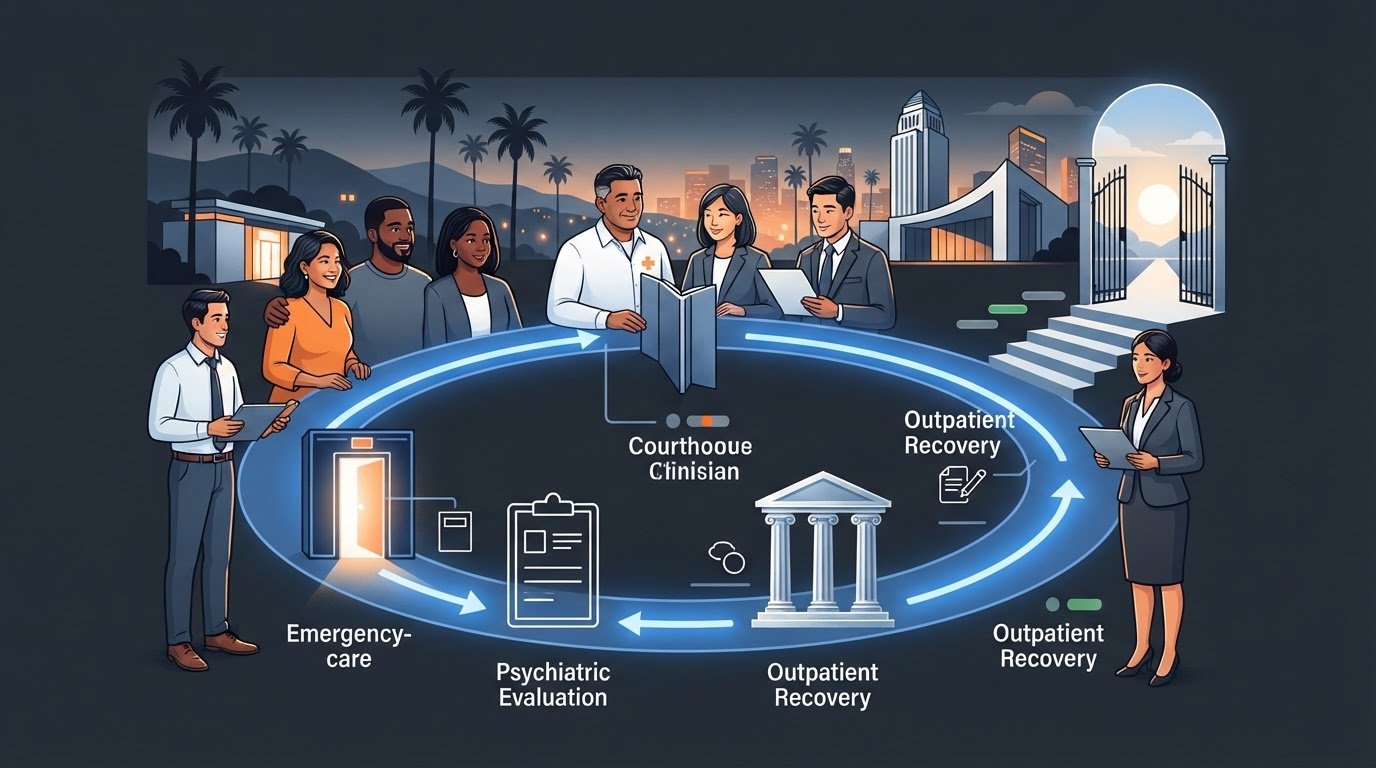
We understand that the first step toward recovery is often the hardest. That's why we've streamlined our intake process to be as supportive and efficient as possible. By providing a clear path from evaluation to participation, we help families move past the initial shock of a diagnosis and into a proactive phase of rehabilitation. Our team acts as a dedicated guide, offering niche expertise that provides direction when other avenues have failed. In this environment, the isolation of a mental health crisis is replaced by the steady rhythm of a community-focused life.
Eligibility and Referrals
Our program is specifically designed for adolescents and young adults between the ages of 13 and 40. Eligibility is centered on individuals experiencing First Episode Psychosis (FEP) or those within the schizophrenia-spectrum. We recognize that time is of the essence in early intervention, so we offer same-day or next-day psychosis evaluation services in LA. This rapid access ensures that families don't have to wait weeks for a clinical opinion during a crisis. For those ready to begin the work of reintegration, our Social Skills Training in Los Angeles provides a detailed framework for clinical recovery and reconnection.
Steps to Join the Pand Health Community
Joining our community begins with scheduling an initial visit to our facility at 11500 W. Olympic Blvd., Suite 399, Los Angeles. During this visit, you'll meet our clinical team and learn how the "work-ordered day" functions in practice. New members undergo a Social Skills Training assessment to identify their specific strengths and areas for growth. We help each individual set clear, tangible goals for their first 90 days, ensuring they feel a sense of purpose from the start. You can Contact Pand Health today to begin the path to reconnection. Recovery is the expectation, not the exception, and we're committed to the success of every individual who walks through our doors.
Reclaiming a Future Beyond the Diagnosis
The journey toward mental health stability doesn't have to be a solitary one. By embracing the Clubhouse model, families in Los Angeles can move past the limitations of traditional clinical settings and into a community that prioritizes human connection. We've seen how this intentional environment transforms recovery, helping members achieve an 85% employment or education rate within six months. This shift from isolation to purpose is the foundation of long term wellness.
As the only outpatient Coordinated Specialty Care program in Southern California providing APA recommended cognitive remediation alongside certified MCT instructors, we offer the specialized tools needed for lasting transformation. You don't have to navigate this storm alone. If your loved one is struggling with early psychosis, immediate intervention is the most effective way to secure their future. This proactive approach ensures that professional goals and social ties remain intact.
Please Schedule a Next-Day Psychosis Evaluation at Pand Health to begin the transition from patient to member. Recovery is the expectation, and your family deserves a partner who is as committed to that success as you are.
Frequently Asked Questions
Is a Clubhouse the same as a day treatment program?
A Clubhouse is distinct from a traditional day treatment program because it operates as a member-led community rather than a clinical facility. While day treatment focus is often on clinical stabilization, this model emphasizes social and vocational rehabilitation. Members choose their tasks and work alongside staff as colleagues. This egalitarian structure helps individuals move beyond the identity of a "patient" and into a role defined by their contributions and professional potential.
Do I need a referral to join a Clubhouse in Los Angeles?
You don't necessarily need an outside referral to begin the process at our Los Angeles facility. Pand Health provides same-day or next-day psychosis evaluation services to determine program eligibility. While the Los Angeles County Department of Mental Health uses standardized referral forms for county-run sites, our team at 11500 W. Olympic Blvd. can conduct the initial psychiatric assessment directly. This ensures families can access intensive support without navigating complex administrative delays.
How does the Clubhouse model help with social anxiety and paranoia?
The model addresses social anxiety and paranoia by providing a predictable, supportive milieu where social interaction is the primary tool for healing. We integrate Social Cognition and Interaction Training (SCIT) to help members interpret social cues more accurately. This reduces the suspicion often associated with psychosis. By working on collective tasks, members practice social skills in a low-pressure environment, which contributes to our documented 40% reduction in negative symptoms.
Can I continue seeing my current psychiatrist while participating in a Clubhouse?
Yes, you can maintain your relationship with an outside psychiatrist while participating in our program. The Clubhouse model is designed to augment clinical care through social and psychological rehabilitation. While we offer integrated medication management and psychiatric evaluations on-site, we frequently collaborate with external providers. Our focus is on providing the 24-32 hours of intensive outpatient support that traditional psychiatric office visits simply cannot offer on their own.
What is a 'work-ordered day' in mental health recovery?
A "work-ordered day" is a structured period during standard business hours where members and staff collaborate to run the community. This isn't just about keeping busy; it's about mirroring real-world professional environments to build cognitive stamina and vocational skills. Units like culinary or media provide meaningful tasks that require cooperation. This structure is a biological stabilizer for the brain, helping individuals transition from social withdrawal back into the workforce or school.
Is the Clubhouse model covered by insurance in California?
Coverage for these services in California is expanding through the BH-CONNECT 1115 waiver, which allows Medi-Cal to cover social rehabilitation. Many private insurance plans also cover the intensive outpatient components of our California OnTrack programs. Because we integrate these principles into a clinical Coordinated Specialty Care framework, families often find that their behavioral health benefits apply. We recommend a direct evaluation to verify your specific plan's coverage for our Los Angeles services.
How long do members typically stay in the program?
Membership in a community like this is traditionally a voluntary, lifelong right, though the intensity of participation varies based on individual needs. At Pand Health, we provide an augmented model that offers indefinite enrollment for continuous support. Most members see significant functional gains within six months, as evidenced by our 85% employment and education participation rate. The goal is to provide a steady hand for as long as the individual requires a community-based safety net.
What is the difference between transitional and supported employment?
Transitional Employment (TE) involves jobs where the community guarantees coverage if a member is absent, providing a high-security entry point into the workforce. Supported Employment (SE) refers to community-based jobs where the member is the employee of record, but receives ongoing coaching and advocacy from our team. Both are core pillars of our Supported Education and Employment (SEE) curriculum, helping members move toward independent employment at their own pace and comfort level.
Disclaimer
This article is for information and educational purposes only, and can NEVER replace a proper medical evaluation. If you or a loved one may be suffering from psychosis or the prodomal symptoms of psychosis, get evaluated by a professional as soon as possible. Early diagnosis and treatment can be life-saving.