

Setting Boundaries with a Psychotic Family Member: A Family Guide to Recovery
What if the firmest "no" you ever say to your loved one is actually the most compassionate act you could perform for their brain's recovery? Caring for someone experiencing delusions or hallucinations often feels like walking through a minefield where every word might trigger a crisis. You likely feel a crushing weight of guilt and chronic stress, fearing that setting boundaries with a psychotic family member will only push them further into a state of crisis. It's a heavy burden to carry alone, especially when you're worried about the safety of your own home.
You deserve to feel secure, and your loved one needs a stable, predictable environment to heal. This guide will show you how to replace fear with clinical communication strategies that restore your well-being and support their long-term wellness. We'll explore evidence-based techniques like family psychoeducation and structured limit-setting. These are the same methods that have helped specialized programs achieve rehospitalization rates as low as 6%, providing a lifeline when other avenues have failed. You'll learn how to transform your home from a place of constant tension into a foundation for lasting recovery.
Key Takeaways
- Understand boundaries as clinical guardrails that provide the stability necessary for your loved one's brain to heal and recover.
- Master the art of validating your family member's emotions without confirming their delusions to reduce conflict and de-escalate potential crises.
- Learn a step-by-step process for setting boundaries with a psychotic family member during their baseline state to ensure clarity, safety, and follow-through.
- Identify non-negotiable limits regarding physical safety and financial support to prevent caregiver burnout while promoting your loved one's independence.
- Discover how evidence-based frameworks like California OnTrack use family psychoeducation to significantly lower rehospitalization rates and restore a sense of normalcy.
What Does it Mean to Set Boundaries During Psychosis?
Setting boundaries with a psychotic family member is often misunderstood as an act of withdrawal or a purely self-protective measure. In a clinical context, we view these limits as the essential scaffolding that allows a fragmented mind to find its footing. When a loved one experiences a thought disorder, their internal world is chaotic and unpredictable. By establishing clear, consistent external structures, you provide the "guardrails" that help them distinguish between their internal distress and the external reality. This framework is a vital component of Personal Boundaries, adapted for the unique needs of psychiatric recovery.
We operate under the firm belief that recovery is the expectation. This journey begins by creating a structured environment where behavior is managed with compassion but without ambiguity. It's vital to distinguish between the person you love and the symptoms they're experiencing. A delusion is a symptom; however, the way that symptom manifests in the household requires a managed response. You aren't rejecting your family member; you're rejecting the chaos that prevents their progress.
Safety remains the non-negotiable priority. When a boundary is crossed that involves physical harm, threats, or a severe inability to care for oneself, the situation shifts from a household management issue to a medical emergency. In these moments, professional intervention is the only safe path forward to ensure the stability of the entire family unit.
Boundaries as a Recovery Tool
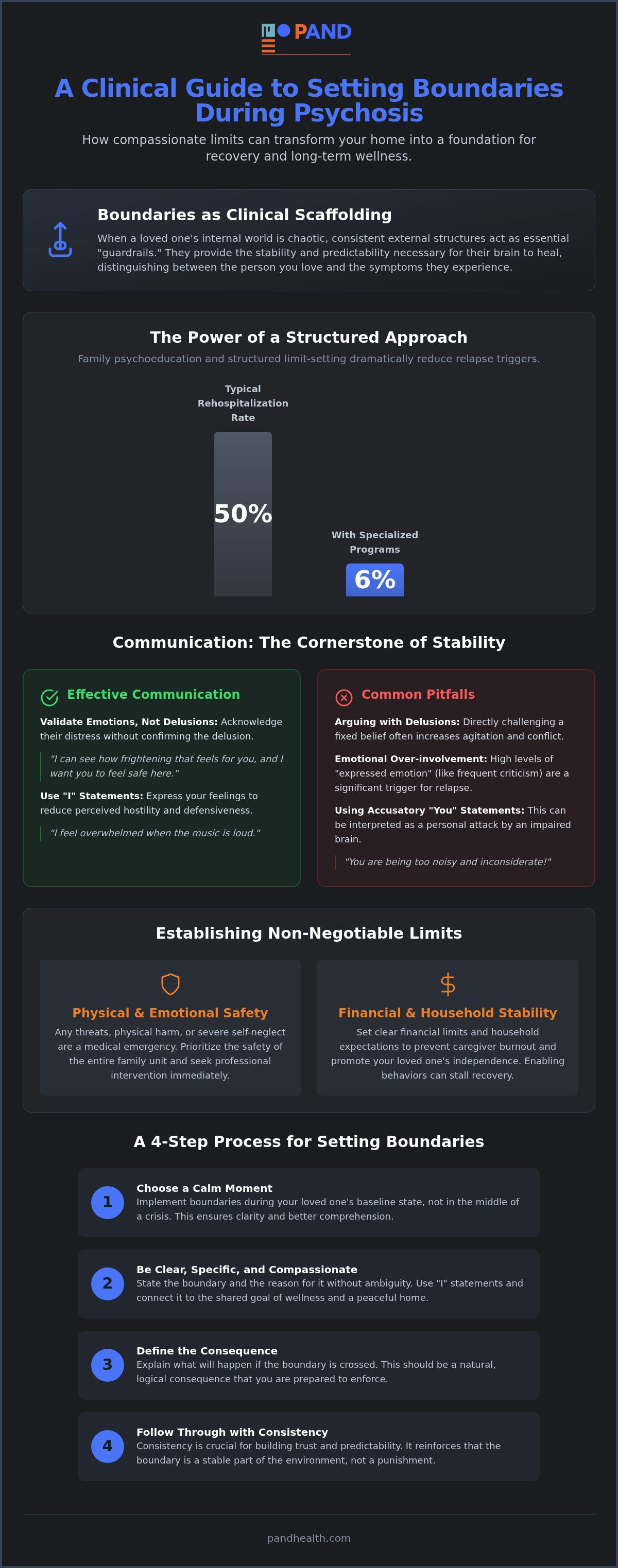
Research indicates that high levels of "expressed emotion," which includes frequent criticism or emotional over-involvement, are significant triggers for relapse. By maintaining firm limits, you lower the emotional temperature of the home. This predictability is a powerful antidote to paranoia and anxiety, as it reduces the number of "unknowns" your loved one must navigate. Clinical boundaries serve as the foundational environment required for effective cognitive remediation and long-term psychological stability. Utilizing these tools is a primary reason why specialized programs like California OnTrack see rehospitalization rates drop to 6%, a stark contrast to the 50% rate often seen prior to enrollment.
Common Misconceptions About Limits
Many caregivers hesitate to set limits because they feel like they're punishing someone who is already suffering. It's natural to feel guilt when saying "no" to a sick family member, but you should recognize that enabling behaviors often stall independent living goals. Allowing a loved one to bypass household expectations or safety rules doesn't help them heal; instead, it reinforces the cycle of the illness. Establishing limits isn't a sign of a lack of love. It's a commitment to the healthy version of your family member that is fighting to return to a baseline of wellness.
Communication Strategies for Families Facing Psychosis
Effective communication is the cornerstone of stability, yet it remains one of the most significant challenges when setting boundaries with a psychotic family member. During an episode, a loved one’s social cognition, which is the brain’s ability to process social information, is often impaired. They may perceive a neutral face as hostile or interpret a calm request as a personal attack. Understanding this clinical reality helps you detach from the conflict. Using "I" statements, such as "I feel overwhelmed when the music is loud," rather than "You are being too noisy," reduces perceived hostility and prevents the brain from entering a defensive state.
We also utilize Metacognitive Training (MCT) principles to help families manage these interactions. A common symptom in psychosis is "jumping to conclusions," where a single piece of information is treated as absolute proof of a delusion. Rather than arguing against the logic, you can gently model a different approach by suggesting, "I wonder if there might be another explanation we haven't considered yet." This subtle shift moves the conversation away from a power struggle and toward a collaborative exploration of reality.
The Art of Validation
Validation is not about agreeing with a hallucination; it is about acknowledging the very real terror or distress the person feels. If your family member believes they are being followed, you don't have to confirm the threat to show empathy. You might say, "I can see how frightening that feels for you, and I want you to feel safe here." This approach allows you to remain a compassionate ally while still holding a firm limit on behavior. Knowing What to Do if a Family Member Has Psychotic Symptoms involves mastering this balance between emotional support and objective reality.
Reducing High Expressed Emotion
Clinical data suggests a direct link between family communication styles and rehospitalization rates. High "Expressed Emotion" (EE), characterized by criticism, hostility, or emotional over-involvement, can act as a biological stressor that triggers a relapse. Lowering the "emotional temperature" at home involves speaking in a low, steady voice and avoiding lengthy arguments when a loved one is symptomatic. By practicing these de-escalation techniques, you protect your own peace and contribute to the 6% rehospitalization success rate seen in integrated care models. If you find these strategies difficult to implement alone, seeking professional family therapy can provide the specialized coaching necessary to navigate these complex dynamics.
Identifying Your Limits: What Can and Cannot Be Boundaried
Effective limit-setting is not a one-size-fits-all approach; it requires a strategic categorization of your household needs. Identifying your own limits is the first step in setting boundaries with a psychotic family member that actually stick. You must first establish the "floor" of acceptable behavior. Physical safety is the absolute, non-negotiable boundary. This includes a zero-tolerance policy for violence, threats, or the presence of weapons. Beyond safety, financial boundaries are vital. While you want to support their recovery, providing unrestricted funds can inadvertently enable dependency or substance use, which complicates the clinical picture.
Treatment participation often serves as a primary boundary for families providing housing. You might make enrollment in a Coordinated Specialty Care program like California OnTrack a condition of continued support. This isn't an ultimatum; it's a clinical necessity. Social boundaries also play a role, as you may need to limit who enters the home or how your loved one interacts with extended family to maintain a low-stress environment.
Categorizing Your Needs
We recommend creating a "Boundary Tier" list. At the top are safety and health essentials, such as medication management and attending scheduled psychiatric evaluations. Lower tiers might include lifestyle preferences, like noise levels or household chores. Substance use requires its own specific focus. For many, cannabis use acts as a catalyst for symptoms, making it essential to understand how to recover from cannabis-induced psychosis. A firm boundary regarding substance use is often the difference between stabilization and a revolving door of hospitalizations.
Recognizing When Symptoms Override Boundaries
It's crucial to distinguish between a behavioral choice and a clinical symptom. When a boundary is violated, ask if this is a "won't" or a "can't." Executive functioning deficits often mean the individual literally lacks the cognitive bandwidth to follow complex rules during an active episode. Because many individuals with thought disorders operate within the 33rd to 50th percentile for cognitive performance, their ability to process and retain boundary expectations is physically limited. If you notice a sudden inability to follow previously established rules, it may be a sign of clinical relapse rather than defiance. In these moments, the boundary doesn't need more force; it needs a clinical adjustment to ensure safety while the brain stabilizes.
How to Implement and Follow Through with Boundaries
Implementation is where the clinical theory of boundary setting meets the reality of daily life. Successful follow-through requires a methodical, step-by-step approach that prioritizes predictability over emotion. The first step is choosing the right moment. You should only discuss new expectations during a "Baseline State," which is a period when your loved one's symptoms are relatively quiet and their cognitive capacity is at its peak. Attempting to set a new rule during an active hallucination or a heated argument is counterproductive and often leads to escalation.
When you speak, keep your language concise and free from blame. Instead of saying, "You always make me feel unsafe when you pace," try, "I need the living room to be a calm space, so I'll ask you to go to your room if the pacing becomes intense." Once the boundary is stated, you must define the natural consequence using an "If-Then" framework. Finally, you must reinforce the positive. If your family member respects a limit, acknowledge that effort warmly. Positive reinforcement helps rewire the brain toward healthier social interactions and builds the trust necessary for long-term recovery.
The "If-Then" Framework
Effective consequences aren't punishments; they're predictable results of specific actions. For instance, you might say, "If you begin to use derogatory language, then I'll end this conversation and leave the room for 20 minutes." For this to work, the consequence must be immediate and directly related to the behavior. Consistency is the most difficult part of setting boundaries with a psychotic family member, but it's also the most rewarding. Avoiding "empty threats" is essential for clinical stability. If you fail to follow through, you inadvertently teach your loved one that your words aren't reliable, which can increase their anxiety and paranoia.
Maintaining Consistency Across the Family
A boundary is only as strong as the person most likely to break it. If one parent enforces a rule while a sibling ignores it, the inconsistency creates a stressful environment that can trigger a relapse. All family members must hold the same line to provide a unified sense of reality. Many families find success through Multi-Family Group Therapy, where they can align their goals and learn from others in similar situations. This collaborative approach often includes Social Skills Training in Los Angeles, helping the individual reintegrate into the community with a clear understanding of social expectations. If you need help aligning your family's approach, contact our clinical team for a specialized family evaluation to begin your journey toward a more stable home life.
Professional Support: The California OnTrack Approach
Pand Health specializes in bridging the gap between acute clinical stabilization and long-term community reintegration. We utilize the California OnTrack program, a Coordinated Specialty Care (CSC) model that treats psychosis as a family-centered challenge rather than an isolated individual diagnosis. This integrated approach is a primary reason our rehospitalization rate is only 6%, a significant contrast to the 50% industry average often seen before families find specialized intervention. By incorporating family psychoeducation directly into the treatment plan, we provide the clinical support necessary to sustain the progress made during the early stages of recovery.
The transition from setting boundaries with a psychotic family member to fostering their independence is facilitated by our Supported Education & Employment (SEE) Curriculum. This framework shifts the focus from managing symptoms to building a future. It empowers the individual to return to school or work with a specialized team behind them, ensuring that the boundaries established at home translate into professional and social success. This step is vital for moving the family dynamic from a state of constant crisis to a "recovery-oriented" lifestyle where progress is measurable and sustainable.
Family Psychoeducation in Los Angeles
Pand Health’s Behavioral Family Therapy provides a structured space where families learn to navigate complex dynamics without feeling like they're constantly in "enforcement mode." When a professional team guides the process, the burden of being the primary disciplinarian is lifted from the caregiver. This allows you to return to your role as a parent, spouse, or sibling while we handle the clinical oversight. For families seeking immediate insights, The Mind Exposed Podcast offers a deep dive into these methodologies, providing a lifeline of expertise for those in the Los Angeles area. A comprehensive community evaluation is often the first step in determining how our specialized tools can be tailored to your household's specific needs.
Building a Long-Term Recovery Plan
The ultimate objective of our California OnTrack Work-Study Program is to move beyond crisis management toward a recovery-oriented lifestyle. We don't just aim for the absence of symptoms; we work toward the presence of a thriving, independent life. This involves a gradual handoff where the individual takes ownership of their wellness, and family boundaries evolve into a system of mutual respect and community reintegration. It's about finding a path where your loved one thrives beyond their diagnosis. If you're ready to move from constant stress to a structured plan for wellness, contact Pand Health in Los Angeles to begin your family’s recovery journey.
Restoring Stability and Hope Through Clinical Guardrails
Establishing a structured environment isn't just about household rules; it's a vital clinical intervention. By setting boundaries with a psychotic family member, you provide the external stability their brain needs to begin the hard work of cognitive remediation. You've learned that validation doesn't mean agreeing with a delusion, and that firm consequences are acts of profound compassion. These strategies are the foundation of a recovery-oriented lifestyle that protects your well-being while fostering your loved one's independence.
Pand Health offers Southern California’s only augmented Coordinated Specialty Care (CSC) model, designed to move families from crisis to community reintegration. Our expert-led family psychoeducation has helped reduce rehospitalization rates to just 6%, offering a steady hand when other methods have failed. You don't have to navigate this storm alone. Start your family’s path to recovery with a clinical evaluation in Los Angeles today. Transformation is possible, and a sense of normalcy is within your reach.
Frequently Asked Questions
Is it okay to set boundaries with someone who is currently delusional?
Yes, setting boundaries is both appropriate and clinically necessary even during active delusions. While you should not argue with the content of the delusion, you must maintain limits on behavior to ensure a safe environment. Boundaries provide a predictable external structure that helps ground an individual when their internal world feels chaotic. They serve as essential guardrails that protect the stability of the entire household.
How do I handle a family member who refuses treatment but lives in my home?
You have the right to make continued housing or financial support contingent upon active participation in a treatment program. This is often referred to as "leveraged treatment" and is a compassionate way to ensure your loved one receives the care they need. Programs like California OnTrack provide the necessary clinical framework to support this transition, moving the family dynamic from enabling symptoms to fostering active recovery.
What should I do if my family member becomes aggressive when I set a boundary?
Prioritize immediate physical safety by de-escalating the situation and removing yourself from the environment if necessary. If the aggression includes threats of harm or physical violence, you must contact emergency services or a mobile crisis team immediately. Setting boundaries with a psychotic family member should never come at the expense of your own safety. Professional intervention is required when a situation moves beyond your ability to manage it at home.
Can setting boundaries actually help reduce psychotic symptoms?
Yes, boundaries can directly reduce the severity of symptoms by lowering "expressed emotion" within the home. High levels of criticism or emotional over-involvement act as biological stressors that can trigger a relapse or worsen hallucinations. By creating a calm, predictable environment with clear expectations, you lower the individual's overall anxiety. This stability allows their brain to focus on healing rather than reacting to perceived social or environmental chaos.
How do I explain these boundaries to other family members or siblings?
Explain that boundaries are clinical tools designed to support recovery rather than personal rejections or punishments. Use the "guardrail" analogy to help siblings understand that these limits provide the safety necessary for their loved one's brain to heal. It's vital that every person in the home enforces the same rules. Inconsistency creates confusion and stress, which can inadvertently undermine the progress your family member is making in treatment.
What are the signs that my loved one’s psychosis is escalating beyond my control?
Look for a total lack of sleep, increased agitation, or a sudden inability to follow previously established safety rules. If your family member stops eating, becomes catatonic, or expresses a desire to harm themselves or others, home management is no longer sufficient. These are clear clinical indicators that the individual requires higher-level professional intervention. In these moments, the most compassionate act is to seek immediate psychiatric evaluation and crisis support.
Is there a specific way to talk to a teen versus an adult about boundaries?
Teens generally require a more collaborative approach that acknowledges their developing need for autonomy, while adults may need boundaries tied to housing or financial independence. For adolescents, we often use the California OnTrack for Teens framework to integrate educational goals into the discussion. Regardless of the individual's age, the focus should remain on the "If-Then" framework, ensuring that consequences are predictable, immediate, and always focused on long-term wellness.
How can family therapy at Pand Health help with this process?
Family therapy provides an expert-led environment where you can learn specific de-escalation and communication techniques. Our clinicians help remove the "burden of enforcement" from your shoulders by acting as a neutral party in the recovery process. This professional guidance is a cornerstone of our 6% rehospitalization rate. We ensure that the entire family unit receives the education and support necessary to move from a state of crisis to a life of stability.
Disclaimer
This article is for information and educational purposes only, and can NEVER replace a proper medical evaluation. If you or a loved one may be suffering from psychosis or the prodomal symptoms of psychosis, get evaluated by a professional as soon as possible. Early diagnosis and treatment can be life-saving.