How to Recover From Cannabis induced Psychosis
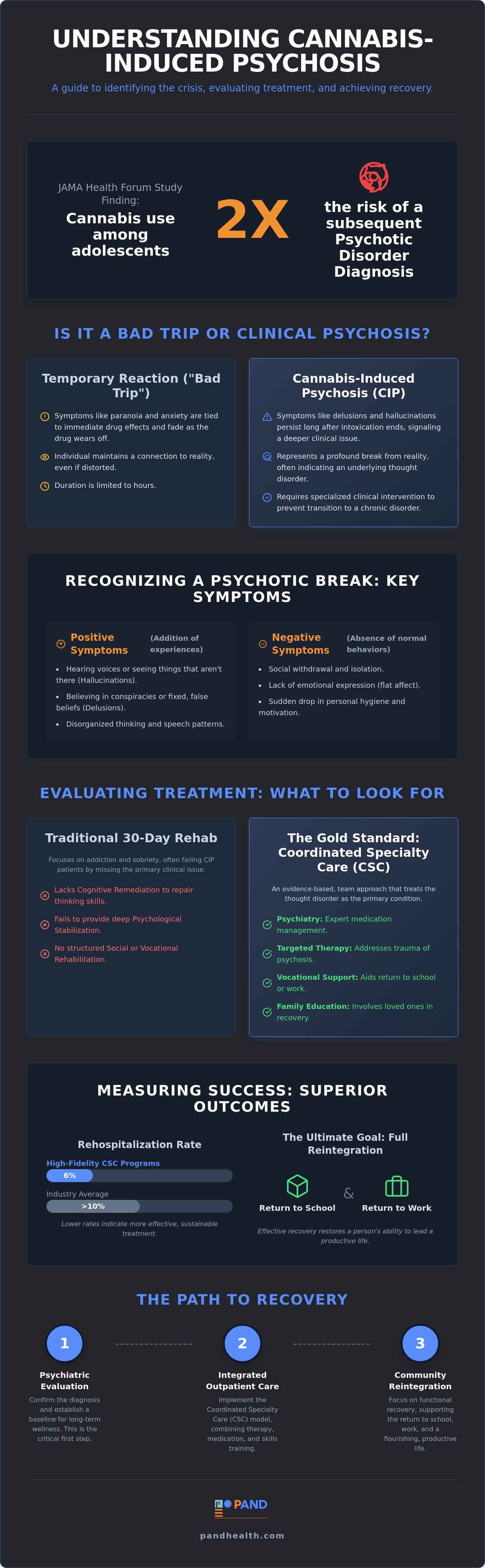
A 2026 study in JAMA Health Forum revealed that past-year cannabis use among California adolescents doubles the risk of a subsequent psychotic disorder diagnosis. For many families in Southern California, this isn't just a statistic; it's a terrifying reality. You might feel paralyzed by the fear that a loved one's reaction to high-potency THC has crossed the line into permanent schizophrenia. It's exhausting to watch traditional 30-day drug programs fail because they treat the substance use but ignore the underlying clinical emergency. Finding the best cannabis psychosis rehab Los Angeles offers requires looking beyond standard addiction models toward specialized, high-fidelity care.
We understand the weight of this crisis and the confusion that follows a psychiatric hospitalization. You'll learn how to identify specialized recovery processes that prioritize psychological stability and long-term wellness. This guide outlines the path toward full community reintegration, helping young adults return to school or work while preventing future hospitalizations. We'll preview the essential components of an effective outpatient recovery model that bridges the gap between clinical intervention and a flourishing, productive life.
Key Takeaways
- Distinguish between a temporary reaction to THC and a clinical cannabis-induced psychosis, which often requires specialized intervention for an underlying thought disorder.
- Identify the best cannabis psychosis rehab Los Angeles offers by ensuring the program follows the evidence-based Coordinated Specialty Care (CSC) framework.
- Compare the benefits of the NAVIGATE model against traditional dual diagnosis to find a treatment plan that addresses the specific needs of first-episode psychosis.
- Follow a precise roadmap for recovery that prioritizes a thorough psychiatric evaluation to confirm the diagnosis and establish a baseline for long-term wellness.
- Aim for superior outcomes like a 6% rehospitalization rate and full reintegration into school or work through high-fidelity, outpatient clinical care.
Identifying Cannabis-Induced Psychosis (CIP) vs. General Addiction
Cannabis-induced psychosis (CIP) is a distinct clinical event that requires a different level of care than standard substance use disorders. While many people associate cannabis with relaxation, for some, high-potency THC acts as a catalyst for a profound break from reality. This is not merely a "bad trip" or temporary intoxication that wears off in a few hours. Instead, CIP is a form of Substance-induced psychosis where the drug triggers persistent delusions, hallucinations, or disorganized thinking that outlasts the immediate effects of the substance. Understanding this distinction is the first step in finding the best cannabis psychosis rehab Los Angeles can provide for your family.
The window of time following a first psychotic episode is critical. Research from a 2026 study in JAMA Health Forum indicates that cannabis use among adolescents doubles the risk of developing a chronic psychotic disorder. When a young adult experiences this break, the brain is in a state of high plasticity. Early intervention during this "critical period" can prevent the transition from a substance-induced event to a lifelong thought disorder. Waiting for a traditional "rock bottom" often associated with addiction is dangerous here; the goal is to stabilize the brain before cognitive deficits become permanent.
The Red Flags of a Psychotic Break
Recognizing the signs of CIP involves looking beyond the drug use itself. Families should watch for specific "positive symptoms" like hearing voices or believing in conspiracies that have no basis in reality. However, "negative symptoms" are equally telling. These often manifest as social withdrawal, a lack of emotional expression, or a sudden drop in hygiene. These behaviors are frequently mistaken for laziness or typical teenage rebellion, but they actually represent the brain's inability to process social and environmental stimuli. If these signs appear, a specialized psychiatric evaluation in Los Angeles is necessary to determine if the individual is experiencing a first episode of psychosis.
Why Traditional 30-Day Rehabs Often Fail CIP Patients
Most traditional drug rehabs operate on an addiction-only model that focuses on sobriety and the twelve steps. While abstinence is necessary, it's rarely enough for someone with CIP. Just stopping the drug doesn't automatically repair the underlying cognitive deficits or the disrupted neural pathways. Traditional models often lack the clinical depth to provide:
- Cognitive Remediation: Specialized exercises designed to improve memory, attention, and problem-solving.
- Psychological Stabilization: Targeted therapy that addresses the trauma of the psychotic break itself.
- Social Rehabilitation: Intensive training to help the individual navigate school and work environments again.
Without these components, a 30-day program often results in a "revolving door" of hospitalizations. Effective recovery requires an integrated approach that treats the thought disorder as the primary concern, with the cannabis use as a complicating factor.
How to Evaluate a Los Angeles Psychosis Rehab Program
Evaluating a program for cannabis-induced psychosis requires a different set of criteria than choosing a standard drug detox. You aren't just looking for sobriety; you're looking for the restoration of a person's cognitive and social life. The best cannabis psychosis rehab Los Angeles can offer will be built upon the Coordinated Specialty Care (CSC) framework. This is a team-based model that integrates psychiatry, therapy, and vocational support into a single, cohesive plan. There is significant evidence that cannabis use is a contributory cause of psychosis, which means the clinical approach must treat the resulting thought disorder as a primary medical condition.
When you interview potential providers, ask specifically about their rehospitalization metrics. A high-quality program should be able to demonstrate success through data, such as a rehospitalization rate significantly lower than the industry average of 10%. Functional recovery, or the ability to return to school or work, is the ultimate benchmark. If a program only focuses on "staying clean" without providing the tools to reintegrate into the community, it's missing a vital piece of the recovery puzzle. Seeking a program that offers intensive treatment for psychosis ensures your loved one receives more than just a standard addiction-focused protocol.
Evidence-Based Protocols to Look For
Standard talk therapy isn't enough for someone recovering from a psychotic break. You should verify that the facility utilizes specialized modalities like Cognitive Behavioral Therapy for Psychosis (CBT-P) and Dialectical Behavior Therapy for Psychosis (DBT-P). These are tailored to help individuals manage hallucinations and regulate intense emotions. Other essential protocols include:
- Metacognitive Training (MCT): This helps individuals recognize and correct "thinking traps" like jumping to conclusions or paranoia.
- Social Cognition and Interaction Training (SCIT): This group-based intervention focuses on improving social skills and understanding social cues.
- Cognitive Remediation: This uses computer-assisted brain training to repair executive functions like memory and focus that are often damaged during a psychotic episode.
The Role of Family Psychoeducation
Recovery doesn't happen in a vacuum. For young adults, the family is the primary support system, yet many rehabs exclude parents from the clinical process. A top-tier best cannabis psychosis rehab Los Angeles provider will treat the family as an essential part of the treatment team. Look for programs that offer Behavioral Family Therapy. This isn't just "venting" in a circle; it's structured education that teaches families how to reduce stress at home, recognize early warning signs of a relapse, and communicate effectively during a crisis. This level of involvement is non-negotiable for long-term stability and prevents the isolation that often leads to future hospitalizations.
Augmented CSC vs. Traditional Dual Diagnosis: Which is Best?
Choosing the right clinical model is the most important decision a family can make after a psychotic episode. Many facilities in Southern California offer "Dual Diagnosis" programs, which treat addiction and mental health as separate, co-occurring issues. However, when searching for the best cannabis psychosis rehab Los Angeles provides, it's essential to look for an "Augmented" Coordinated Specialty Care (CSC) model. Unlike standard dual diagnosis, which often uses a generic approach to mental health, the CSC model follows the NIMH NAVIGATE framework. This framework is specifically designed for First Episode Psychosis (FEP), prioritizing the stabilization of the brain's neural pathways over a simple "stay sober" message.
The distinction is clinical and profound. A Cannabis-Induced Psychosis: A Clinical Review highlights that these events are often the first sign of a more complex thought disorder. Traditional dual diagnosis rarely offers the 24 to 32 hours of weekly intensive psychosocial support required to manage these complexities. Augmented CSC models provide this higher level of care, ensuring that every hour spent in treatment is directed toward rebuilding the individual's executive function and social identity. This high-intensity outpatient approach allows for a level of precision that a standard 30-day program simply cannot match.
The Impact of Cognitive Remediation
Recovery isn't just about the absence of symptoms; it's about the restoration of capability. Cognitive Remediation is defined as a critical recovery tool that uses computer-assisted training to target the core cognitive deficits associated with psychosis. This isn't just "studying." It's a structured intervention that repairs the focus and memory typically damaged by high-potency THC use. When paired with high-intensity fitness, which boosts brain-derived neurotrophic factor (BDNF), cognitive remediation helps individuals return to the 50th percentile of cognitive performance. This synergy creates a neuro-protective environment that helps the brain resist future psychotic triggers.
Indefinite Enrollment vs. Fixed-Term Programs
Traditional rehabs often operate on a 30, 60, or 90-day clock. Clinical reality suggests that recovery from a psychotic break doesn't have a fixed expiration date. The transition back to college or a career is a vulnerable time where stress can easily lead to a relapse. Programs that offer indefinite enrollment provide a safety net that remains in place as the individual tests their new skills in the real world. This continuous support often includes specialized Social Skills Training in Los Angeles, which is vital for rebuilding the social confidence lost during months of isolation. By removing the pressure of a graduation date, families can focus on the slow, steady progress of genuine transformation.
Steps to Start Cannabis Psychosis Recovery in Los Angeles
Starting the recovery journey requires a methodical approach that moves beyond the immediate crisis. To find the best cannabis psychosis rehab Los Angeles provides, families must prioritize diagnostic precision over speed. The process begins with a comprehensive psychiatric evaluation for thought disorders. This isn't just a standard drug screening; it's a deep clinical dive to rule out organic causes, such as neurological issues, and confirm the CIP diagnosis. Getting this right ensures that the treatment plan targets the actual cognitive disruption rather than just the substance use.
After the initial diagnosis, the focus shifts from acute stabilization to an intensive outpatient program. High-fidelity care models integrate Supported Education and Employment (SEE) goals from the very first week. This forward-looking approach is vital for young adults whose lives have been interrupted by a psychotic break. Statistics from specialized CSC programs show an 85% employment and education participation rate at the six-month mark. Finally, engaging in family psychoeducation is the most effective way to prevent future relapses. It builds a protective environment where everyone understands the early warning signs and knows how to maintain long-term stability.
What to Expect During the Initial Evaluation
Specialized assessments differ significantly from standard check-ups. Clinicians use specific diagnostic tools to identify individuals who are clinically high-risk (CHR). They look for subtle changes in perception, social behavior, or speech patterns that often precede a full psychotic break. During this time, it's helpful to adopt a "recovery is the expectation" mindset. Specialists don't just aim for the absence of symptoms; they aim for the restoration of a full, meaningful life. This phase is about establishing a lifeline of expertise when other avenues have failed.
Navigating the Los Angeles Mental Health Landscape
Finding the right care in a vast city requires local knowledge and clinical advocacy. Many specialized programs are located near West Olympic Blvd and surrounding LA areas, providing a central hub for high-end outpatient care. When interviewing providers, you must advocate for evidence-based therapies like Metacognitive Training (MCT) and Social Cognition and Interaction Training (SCIT). Managing the logistics of a 30-hour weekly intensive program is a significant commitment, but it provides the clinical dosage necessary for genuine brain health. If you're ready to move toward a solution, you can schedule a psychiatric evaluation with a team dedicated to the success of the individual.
Why Pand Health is the Standard for CIP Rehab in Southern California
Pand Health stands as the definitive choice for families seeking the best cannabis psychosis rehab Los Angeles provides because it moves beyond the limitations of standard care. While many centers offer general addiction services, Pand Health is the only outpatient Coordinated Specialty Care (CSC) program in Southern California with certified Metacognitive Training (MCT) instructors. This distinction is vital. It means that treatment isn't just about stopping substance use; it's about correcting the "thinking traps" and cognitive disruptions that high-potency THC can trigger. By focusing on the underlying thought disorder through the California OnTrack program, the team provides a rigorous yet deeply human path to recovery.
The data reflects this commitment to excellence. For the 2022-2024 cohort, Pand Health documented a 6% rehospitalization rate, which is significantly lower than the industry average of 10%. This success stems from an integrated approach that values community reintegration and high-level social skills as much as clinical stabilization. The goal is never just to discharge a patient, but to ensure they have the tools to stay healthy and productive in their own environment. This specialized focus provides a sense of direction when other traditional avenues have failed.
Measurable Outcomes: Beyond Symptom Management
Clinical progress at Pand Health is tracked through rigorous benchmarks. One primary indicator of success is the 19-point improvement in PANSS (Positive and Negative Syndrome Scale) scores seen among participants. This data point represents a tangible reduction in the symptoms that often make daily life impossible. Even more telling is the functional recovery rate. Within six months of starting the program, 85% of clients return to work or school. This level of reintegration is achieved through the California OnTrack Work-Study Program, which provides the vocational support necessary to bridge the gap between treatment and real-world success. Additionally, the "Mind Exposed" approach ensures that families aren't left behind. Through family therapy and psychoeducation, parents and siblings gain the clinical insight needed to support their loved one's transformation.
A Lifeline for Los Angeles Families
In the wake of a psychotic break, families often feel lost in a storm of clinical jargon and conflicting advice. Pand Health acts as an authoritative expert and a steady hand, offering a lifeline through niche expertise. The program utilizes innovative technology-enhanced cognition to help young adults repair executive functions, making the recovery process both modern and effective. It's a high-end, specialized institution that remains personal and human-centric. If you're navigating the aftermath of a cannabis-induced crisis, don't settle for a generic rehab model. You can contact Pand Health for a specialized psychosis evaluation to begin the journey toward lasting stability and a return to normalcy.
Restoring Hope and Functional Stability After Cannabis Psychosis
Recovery from cannabis-induced psychosis is a complex journey that demands more than just sobriety; it requires the restoration of the mind and the spirit. By prioritizing the Coordinated Specialty Care model over traditional addiction-only rehabs, you're choosing a path that addresses the brain's unique needs during a first episode of psychosis. Finding the best cannabis psychosis rehab Los Angeles provides is about securing a future where your loved one doesn't just survive but thrives in their community.
Pand Health offers a lifeline through its exclusive regional provision of APA-recommended MCT and SCIT. Our data-driven results include a 6% rehospitalization rate and an 85% rate of clients returning to school or work within six months. This isn't just treatment; it's a dedicated partnership in transformation. Begin the Path to Recovery with Pand Health’s California OnTrack Program and take the first step toward a stable, flourishing future. You aren't alone in this storm, and a return to normalcy is possible.
Frequently Asked Questions
What is the difference between cannabis-induced psychosis and schizophrenia?
Cannabis-induced psychosis is a clinical event triggered specifically by substance use, while schizophrenia is a chronic, long-term mental health condition. While the acute symptoms like hallucinations may appear identical, a substance-induced event can resolve once the drug is cleared. However, for many young adults, this break serves as the first sign of an underlying schizophrenia-spectrum disorder. A specialized psychiatric evaluation is necessary to distinguish between a temporary reaction and a developing thought disorder.
How long does rehab for cannabis-induced psychosis typically last?
Recovery from a psychotic episode does not have a fixed expiration date, but intensive phases often last several months. Unlike traditional 30-day detox programs, high-fidelity recovery models utilize indefinite enrollment to support the transition back to college or a career. This extended duration allows for the gradual restoration of cognitive functions and ensures the individual has a safety net during the vulnerable months following their initial stabilization.
Can a person fully recover from a psychotic break caused by marijuana?
Yes, full recovery and successful community reintegration are achievable with the right clinical intervention. Success is measured by a return to baseline cognitive performance and the ability to resume school or work. Specialized programs that follow the Coordinated Specialty Care framework see an 85% success rate for employment and education participation at the six-month mark. Early intervention during the first episode is the most significant factor in ensuring a positive long-term outcome.
Does insurance cover intensive outpatient programs for psychosis in Los Angeles?
Many intensive outpatient programs for psychosis are covered by insurance, though specific benefits vary by provider. Most families utilize PPO plans to access the best cannabis psychosis rehab Los Angeles offers, as these plans often provide better coverage for specialized mental health services. It is helpful to look for providers who offer transparent billing for Coordinated Specialty Care, which integrates multiple therapies into a single, team-based treatment plan.
What is Coordinated Specialty Care (CSC) and why is it recommended?
Coordinated Specialty Care (CSC) is a team-based, evidence-based framework specifically designed for treating first-episode psychosis. It is the gold standard recommended by the NIMH because it integrates psychiatry, individual therapy, family education, and vocational support. By treating the individual's life holistically rather than just managing symptoms, CSC programs significantly reduce rehospitalization rates. This model provides the clinical dosage necessary to repair the neural pathways disrupted during a psychotic break.
How do I know if my teenager needs a specialized psychosis program or just drug rehab?
If your teenager is experiencing hallucinations, delusions, or extreme social withdrawal, they need a specialized psychosis program rather than a standard drug rehab. Traditional addiction facilities focus primarily on sobriety and the twelve steps, but they often lack the tools to treat cognitive deficits. Choosing the best cannabis psychosis rehab Los Angeles provides ensures your child receives cognitive remediation and metacognitive training, which are essential for treating the underlying thought disorder.
What role does social skills training play in psychosis recovery?
Social skills training is vital for rebuilding the interpersonal confidence that is often lost during a psychotic break. Psychosis can lead to isolation and a diminished ability to read social cues, which makes returning to school or work incredibly stressful. This training provides a structured environment to practice communication and conflict resolution. By improving social cognition, individuals are better equipped to navigate the complexities of daily life without experiencing the stress that triggers relapse.
How can I support my child after they finish a rehab program?
Continued family psychoeducation and maintaining a low-stress home environment are the most effective ways to support long-term stability. Families should stay engaged with their clinical team to recognize early warning signs of a potential relapse before it becomes a crisis. Encouraging participation in work or study programs also helps your child regain their sense of identity. Success is a collaborative effort that values both the science of treatment and the lived experience of the family.
Related reading
- What is Coordinated Specialty Care?
- Early / first-episode psychosis program
- Metacognitive Training (MCT)
- Social Cognition and Interaction Training (SCIT)
- Cognitive health and cognitive remediation
- Jumping to conclusions bias
- Cannabis-induced psychosis
- The architecture of cannabis-induced psychosis
- Learning about psychosis and thought disorders
- Genesis of psychosis: how delusions form