Can Cannabis Psychosis Come Back? What Recurrence Can Mean
Can cannabis psychosis come back even after someone stops using cannabis? Yes, symptoms can return, but recurrence isn’t inevitable, and a change in symptoms doesn’t automatically reveal the cause. It’s understandable to feel anxious after an episode, especially when you’re trying to tell whether signs are lingering, returning, or pointing to something else.
The timing and pattern of symptoms matter. Psychosis may recur after cannabis use resumes, persist after the initial episode, or be part of a condition that needs a broader clinical assessment. Stopping cannabis can reduce one important risk, but it can’t answer every question about an individual’s experience.
This article explains what recurrence can mean, which factors may influence risk, and why careful evaluation and follow-up matter. It also covers practical ways to support safety and recovery without escalating distress. For people ages 13-35 in Los Angeles, Pand Health’s outpatient Coordinated Specialty Care brings clinical and psychosocial support together while working alongside existing care teams. The goal is a clearer understanding of what’s happening and a thoughtful path forward, without assuming that every person’s experience will follow the same course.
Key Takeaways
- Can cannabis psychosis come back? Symptoms can return, but recurrence isn’t inevitable, and symptoms alone can’t confirm their cause.
- Renewed cannabis use may be relevant, but clinicians consider the full symptom course and personal context when assessing changes.
- If symptoms shift, note what changed and when, reduce exposure to intoxicating substances, and share your observations with the care team.
- Coordinated Specialty Care brings clinical and practical supports together while working alongside existing clinicians.
- For eligible people ages 13-35 in Los Angeles, coordinated support may include psychiatry, psychotherapy, family psychoeducation, and case management.
Can Cannabis Psychosis Come Back? What the Evidence Can, and Cannot, Tell You
Yes. Psychotic symptoms can return after a cannabis-related episode, but recurrence isn’t inevitable. If you’re asking, “can cannabis psychosis come back?” the most accurate answer is that it can, while the likelihood and meaning of a change depend on the person’s symptoms, history, and circumstances. One person’s experience can’t predict another’s course.
Psychosis describes experiences such as hallucinations, delusions, or difficulty distinguishing what is real. Cannabis-induced psychosis is a clinical diagnosis considered when psychotic symptoms develop during or soon after cannabis intoxication or withdrawal, are more than expected from those effects, and aren’t better explained by another condition. Not every unusual experience after cannabis use means someone has this disorder. A clinician assesses symptoms and timing in context.
The distinction matters because recurrence describes what happened, not why. Changes in sleep, stress, medication, substance exposure, or health can be relevant to an assessment, but none should be assumed to explain symptoms without clinical evaluation. A general overview of cannabis-induced psychotic disorder discusses its clinical context, but an online summary cannot determine what is happening for a particular person.
What does recurrence mean after cannabis-related psychosis?
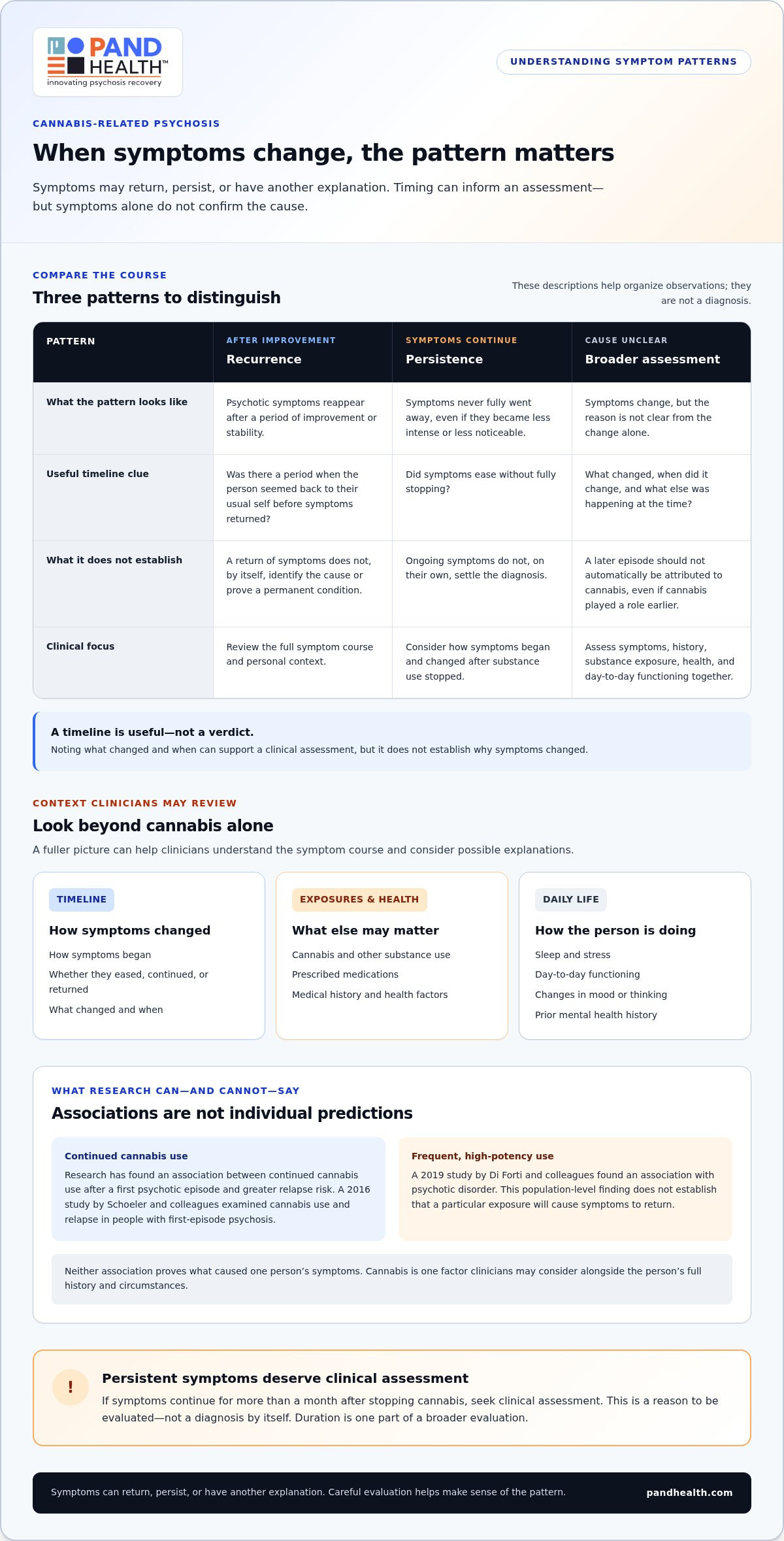
Clinicians may use “recurrence” or “relapse” to describe psychotic symptoms that reappear after a period of improvement or stability. For example, someone who had stopped hearing voices and later begins hearing them again may be experiencing a return of symptoms. That pattern differs from symptoms that never fully went away, even if they became less intense or less noticeable.
Memory alone may not capture the timeline clearly. It can help to note what changed, when it changed, and whether there was a period when the person seemed back to their usual self. These details support assessment, but they don’t establish the cause. Later symptoms shouldn’t automatically be attributed to cannabis, even if cannabis played a role in an earlier episode.
Does returning psychosis mean recovery is impossible?
No. A recurrence by itself doesn’t prove that someone has a permanent condition or that improvement is no longer possible. It does mean the change deserves attention, especially if symptoms affect sleep, daily responsibilities, relationships, or a person’s sense of safety. Support and follow-up may need to continue while clinicians clarify the pattern.
Assessment can include how symptoms began, how they have changed, substance use, medical factors, and prior mental health history. The DSM-5-TR diagnostic framework notes that psychotic symptoms persisting after substance use stops may lead clinicians to consider other explanations. Duration is one part of a broader evaluation, not a stand-alone test. If symptoms continue for more than a month after stopping cannabis, that is a reason to seek clinical assessment, not a diagnosis in itself.
Takeaway: Symptoms can return, persist, or have another explanation. Recurrence is possible, not certain, and it doesn’t settle the question of diagnosis or long-term outcome. A careful assessment can help make sense of the course and guide support without treating one episode as a prediction of the future.
Why Cannabis-Related Psychosis Symptoms May Persist or Return
After a psychotic episode, the course can differ from person to person. Symptoms may ease, continue at a lower level, or become noticeable again. Renewed cannabis exposure is one factor clinicians may consider, but it doesn’t explain every change or prove what caused it. Health, sleep, stress, other substance use, and a person’s mental health history may also inform an assessment.
Research points to an association between continued cannabis use after a first psychotic episode and a greater risk of relapse. For example, a 2016 study by Schoeler and colleagues examined cannabis use and relapse in people with first-episode psychosis. An association is not a prediction for an individual, and it cannot show that cannabis is the only factor behind a particular person’s symptoms.
How cannabis exposure may relate to returning symptoms
THC is the intoxicating component of cannabis most often discussed in relation to psychotic symptoms. Research by Di Forti and colleagues, published in The Lancet Psychiatry in 2019, found an association between more frequent use of high-potency cannabis and psychotic disorder. That finding describes a population-level relationship. It doesn’t establish that a particular product or exposure will cause symptoms to return.
Cannabis products can differ in THC content and composition, and people can respond differently. A clinician may ask about the product, frequency, amount, and timing of use to understand the context. Trying cannabis again to see what happens isn’t a reliable way to assess personal risk. If there’s a history of psychosis, discuss substance-related questions with the care team.
Why clinicians consider the broader clinical picture
Assessment is more useful when it looks beyond cannabis alone. Clinicians may review the symptom timeline, day-to-day functioning, sleep, prescribed medications, substance exposure, medical history, and changes in mood or thinking. This helps distinguish a possible return of symptoms from symptoms that never fully settled or from another health concern.
Depending on the person’s presentation, an evaluation may also explore whether a condition such as schizophrenia, bipolar I disorder, or schizoaffective disorder is relevant. Psychotic symptoms can occur in different clinical contexts, so recurrence by itself doesn’t prove any one diagnosis. A comprehensive psychosis evaluation can bring these details together and guide follow-up.
What the evidence can tell you: THC-containing cannabis is a clinically relevant exposure to discuss, particularly after psychosis, but studies cannot tell a person whether symptoms will return or when. The absence of a predictable timeline isn’t a reason to dismiss changes. It’s a reason to seek individualized guidance rather than rely on general statistics or self-testing.
For people ages 13-35 in Los Angeles, Pand Health provides outpatient psychosis evaluation and Coordinated Specialty Care that supplements existing clinicians. A discussion about psychosis evaluation can help individuals and families consider what assessment and support may fit the situation.
Recurrence, Persistent Symptoms, or Another Condition: How They Differ
A return of psychotic symptoms can raise difficult questions: Did a new episode begin, did the earlier symptoms never fully resolve, or is another condition involved? The timing of symptoms may offer useful context, but it can’t answer those questions on its own. The distinctions below are prompts for a clinical conversation, not a checklist for diagnosing yourself or someone you care about.
| Pattern to discuss | What someone may notice | Why assessment matters |
|---|---|---|
| Symptoms appear to return | After a period of improvement, unusual beliefs, perceptions, or confused thinking become noticeable again. | A clinician can explore the change, its timing, and possible contributing factors. |
| Symptoms may be continuing | Some experiences never fully settled, even if they became less intense or less disruptive for a time. | Tracking the full course can help distinguish ongoing symptoms from a new episode. |
| Another explanation may be relevant | Changes in thinking or behavior occur alongside other health, mood, medication, or substance-related concerns. | Assessment can consider a wider range of explanations instead of assuming cannabis is the cause. |
What may suggest symptoms have returned?
Noticeable changes from the person’s own recent baseline can be worth discussing. They might include a return of strongly held beliefs that others don’t share, hearing or seeing things others don’t, or speech and thinking that become difficult to follow. There’s no fixed checklist. What matters is the individual’s pattern and whether the change affects daily life, relationships, or safety.
If concerning changes appear, contact the person’s care team promptly for guidance. For individuals seeking convenient access to a physician to discuss emerging medical concerns or coordinate care, telehealth platforms such as AskMyDoc.ca demonstrate how virtual doctor appointments can make initial medical consultations more accessible. A brief record of what changed and when can make the conversation clearer. You don’t need to decide whether this is recurrence before asking for help.
Why a professional assessment may consider other explanations
Psychosis-like symptoms can occur in different clinical contexts. A clinician may review the symptom history, overall health, medications, cannabis and other substance exposure, mood, and changes in everyday functioning. Depending on the presentation, assessment may explore whether conditions such as schizophrenia, bipolar I disorder, or schizoaffective disorder are relevant. Considering these possibilities doesn’t mean any one diagnosis has been established.
Pand Health’s Comprehensive Psychosis Evaluation Services may include psychiatric, medical, neurological, cognitive, and functional assessment. This broader view can help inform care and follow-up, but an evaluation doesn’t guarantee a particular diagnosis or outcome.
Only a qualified clinician can assess an individual presentation and determine what the symptoms may mean. A timeline is one part of that assessment, not a verdict. Whether symptoms started soon after cannabis use, continued beyond an initial episode, or appeared after a period of improvement, timing alone cannot establish the cause, predict the future course, or confirm a diagnosis. If you’re wondering, “can cannabis psychosis come back?” remember that the answer describes a possibility, not a conclusion about any one person.
What to Do if Psychosis Symptoms Return After Cannabis Use
If psychosis symptoms seem to be returning, respond steadily rather than deciding on your own what caused them. Focus first on immediate safety, then share the changes with the person’s care team. A clear, practical plan can reduce confusion for the person experiencing symptoms and for those supporting them.
- Notice what has changed. Describe specific observations, such as unusual beliefs, hearing or seeing things others don’t, confusion, or difficulty managing familiar tasks. Avoid arguing about whether an experience is real.
- Reduce immediate risks. While seeking clinical guidance, avoid cannabis and other non-prescribed intoxicating substances. Keep the environment calm, and reduce access to hazards if you can do so safely.
- Contact the existing care team. Explain what you’ve noticed, when it began, and whether symptoms are changing. Ask for guidance on the next appropriate step. Don’t stop or change prescribed medication without clinical advice.
- Document observations. Write down symptom changes, sleep, substance exposure if known, medication changes, and effects on daily functioning. This record can help clinicians understand the course without requiring you to diagnose it.
How family or trusted supporters can respond
Use a calm voice and short, respectful statements. Acknowledge that the person seems distressed without confirming or challenging unusual beliefs. Ask what would help them feel safer, and offer practical support, such as helping them reach their care team. With the person’s involvement when possible, share relevant observations with their clinicians. Family members can also explore family psychoeducation for psychosis recovery to build understanding and supportive communication.
Support doesn’t mean managing everything alone. If the person already has a treatment team, follow its guidance and explain clearly if symptoms are worsening or affecting safety.
When the situation may need urgent help
If someone is in immediate danger, has a serious medical emergency, or can’t be kept safe, call 911 in the United States or go to an emergency department. Don’t wait for an outpatient appointment in an emergency. For mental health distress that isn’t an immediate emergency, call or text 988 in the U.S. to reach the 988 Suicide & Crisis Lifeline. If you’re unsure which response is appropriate, prioritize immediate safety and seek urgent help.
Outpatient evaluation and ongoing care can support assessment after symptoms change, but they don’t replace emergency evaluation when there’s immediate danger. For people ages 13-35 in Los Angeles, Pand Health provides outpatient psychosis evaluation and Coordinated Specialty Care that works alongside existing clinicians. To discuss psychosis evaluation and care, contact Pand Health.
How Coordinated Psychosis Care Can Support Recovery in Los Angeles
Questions about recurrence often bring another concern: what kind of support can help a person move forward? Coordinated Specialty Care (CSC) brings clinical and practical supports together around a person’s needs. It can support recovery and ongoing assessment, but it can’t guarantee that symptoms won’t return or replace emergency care when there’s immediate danger.
What coordinated specialty care may involve
The National Institute of Mental Health’s RAISE initiative studied CSC for first-episode psychosis. Pand Health’s approach is based on NAVIGATE, a CSC model associated with that work. This describes the framework behind care, not a promise of a particular result for any individual.
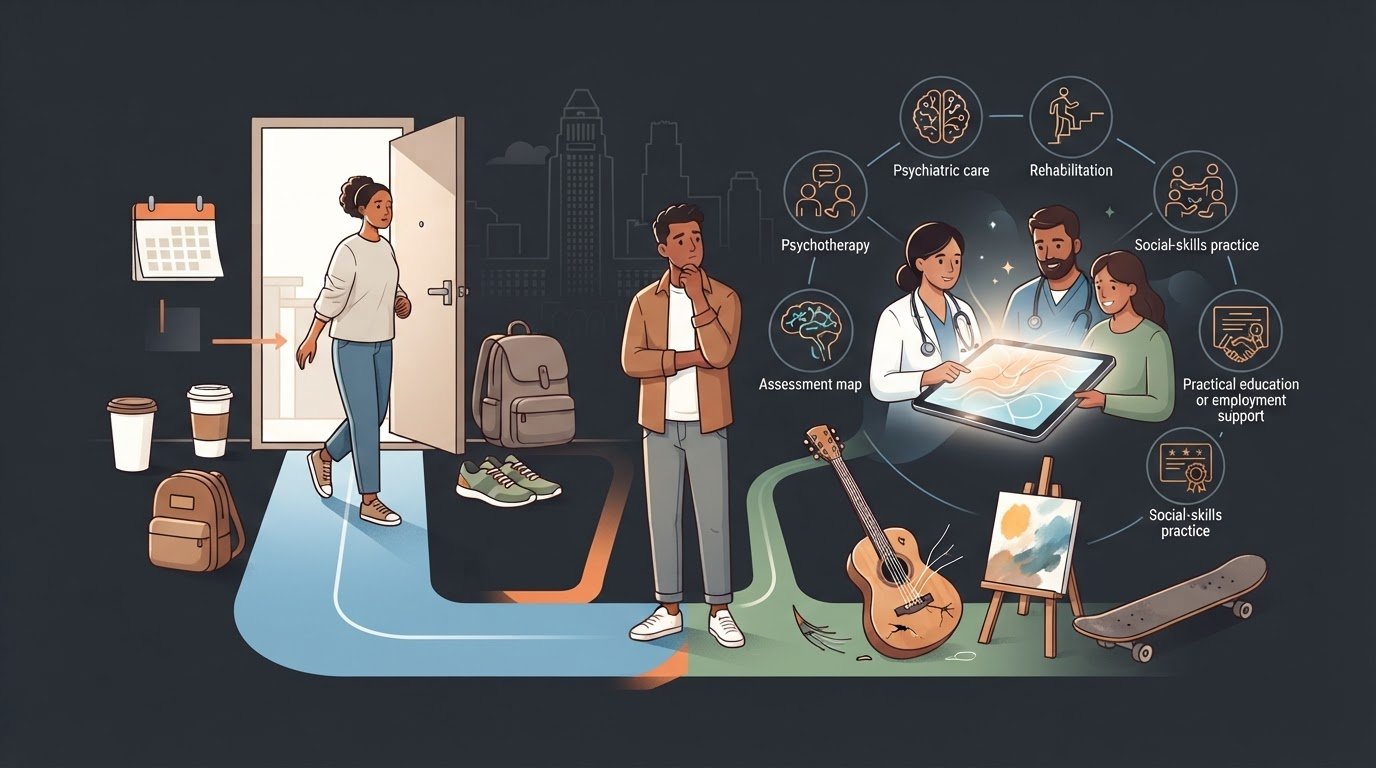
Depending on assessed needs, coordinated support may include psychiatry, advanced psychotherapy, family psychoeducation, and case management. These services can help align clinical care with daily goals, relationships, and education or work. Medication decisions remain with qualified prescribers, and CSC is designed to work alongside a person’s existing clinicians, not displace them.
Discussing an evaluation and next steps with Pand Health
For people ages 13-35 in Los Angeles, Pand Health provides outpatient Comprehensive Psychosis Evaluation Services, including for individuals experiencing cannabis-induced psychosis. An evaluation may consider psychiatric, medical, neurological, cognitive, and functional factors to inform care planning. It doesn’t guarantee a diagnosis, a specific treatment recommendation, or a particular outcome.
If symptoms have changed, a clear account of what the person and family have noticed can help start a useful conversation. Share relevant history, current concerns, and the names of clinicians already involved. With appropriate coordination, Pand Health supplements existing care teams and works in tandem with other clinicians, supporting a connected approach rather than asking families to manage uncertainty alone.
People wondering, “can cannabis psychosis come back?” may find it reassuring to know that follow-up can help clinicians respond to changes and revisit care as circumstances evolve. That does not mean recurrence can always be prevented. The next step is an individualized discussion about the person’s needs and whether an outpatient evaluation or coordinated support may be appropriate.
Eligible Los Angeles families can contact Pand Health about an evaluation to discuss next steps. Recovery is the expectation, not the exception.
Take the Next Step With Thoughtful Support
Uncertainty about whether symptoms might return can make it difficult to know what to do next. You don’t have to resolve every question before seeking guidance. Sharing concerns with the person’s care team can help shape a plan grounded in their current needs, preferences, and circumstances.
For eligible people and families in Los Angeles, Pand Health offers outpatient support that works alongside existing clinicians. Its Coordinated Specialty Care model is based on the NIMH NAVIGATE framework, and Pand Health was featured in The Wall Street Journal for its coordinated specialty care model. These details describe the care approach, not a promise that symptoms won’t recur or that every person’s path will be the same.
If you’re still asking, “can cannabis psychosis come back?” remember that possibility doesn’t determine what will happen for one person. The next step can be a thoughtful conversation about evaluation and ongoing support. Learn how Pand Health supports psychosis recovery, or contact Pand Health to discuss an evaluation in Los Angeles.
Recovery is the expectation, not the exception. With individualized care and steady support, there is room to move forward.
Frequently Asked Questions
Can cannabis psychosis come back after someone stops using cannabis?
Yes, symptoms can return after cannabis use stops, but that possibility doesn’t mean they will. If you’re asking “can cannabis psychosis come back?” the answer for one person depends on their symptom course and broader health context. Note changes in sleep, thinking, or daily routines, and share them with a qualified clinician. An individualized assessment can help clarify what may be happening and what support is appropriate.
How long can psychosis symptoms last after cannabis use?
There isn’t one timeline that applies to everyone. Some people improve sooner, while others may have symptoms that last longer or fluctuate. Duration alone can’t establish the cause or predict what will happen next. If symptoms continue, worsen, or interfere with ordinary activities such as attending school or preparing meals, arrange clinical assessment. A dated symptom and sleep log can help the clinician understand how things are changing.
Does one episode of cannabis-induced psychosis mean someone has schizophrenia?
No. One episode, by itself, doesn’t establish schizophrenia. Psychotic symptoms can arise in different clinical contexts, and clinicians consider the person’s history, symptoms over time, functioning, and other health factors before reaching a diagnosis. If a diagnosis is being discussed, ask what information supports it and what follow-up is planned. A careful assessment can help distinguish what is known from what still needs observation.
Can psychosis return even if someone has not used cannabis again?
Yes, psychotic symptoms may appear or continue even without renewed cannabis use. That doesn’t automatically mean cannabis caused the change, nor does it identify another diagnosis. A clinician may consider medication changes, sleep disruption, medical concerns, mood symptoms, and the earlier symptom history. If new experiences affect someone’s safety or ability to manage daily life, seek clinical guidance rather than waiting to determine the cause at home.
What should a family do if psychosis symptoms return?
Stay calm, speak respectfully, and avoid arguing about unusual beliefs or perceptions. Offer practical help, such as sitting with the person or helping them reach their care team, and share specific observations with clinicians when appropriate. If someone is in immediate danger or cannot be kept safe, call 911 or go to an emergency department. In the United States, call or text 988 for mental health crisis support when there’s no immediate emergency.
Can a person recover after cannabis-induced psychosis?
Recovery is possible, though each person’s path and support needs differ. Progress may involve more than symptom changes, such as rebuilding confidence, relationships, or a routine at school or work. A care plan can be reviewed as needs change, and setbacks don’t erase earlier progress. It’s reasonable to hold hope while staying connected with clinicians who can help assess the person’s experience and guide ongoing support.
Can someone receive Coordinated Specialty Care while keeping their current clinician?
Yes. Pand Health’s Coordinated Specialty Care supplements existing care teams and works in tandem with other clinicians, rather than replacing them. With the person’s permission, care providers can coordinate around shared goals and clarify who is supporting different needs. Pand Health provides outpatient services in Los Angeles for individuals ages 13-35. Families can discuss how an evaluation and coordinated support may fit alongside the person’s current clinical care.
Disclaimer
This article is for information and educational purposes only, and can NEVER replace a proper medical evaluation. If you or a loved one may be suffering from psychosis or the prodomal symptoms of psychosis, get evaluated by a professional as soon as possible. Early diagnosis and treatment can be life-saving.