
Psychosis Treatment in Los Angeles: A Resource Guide to Recovery
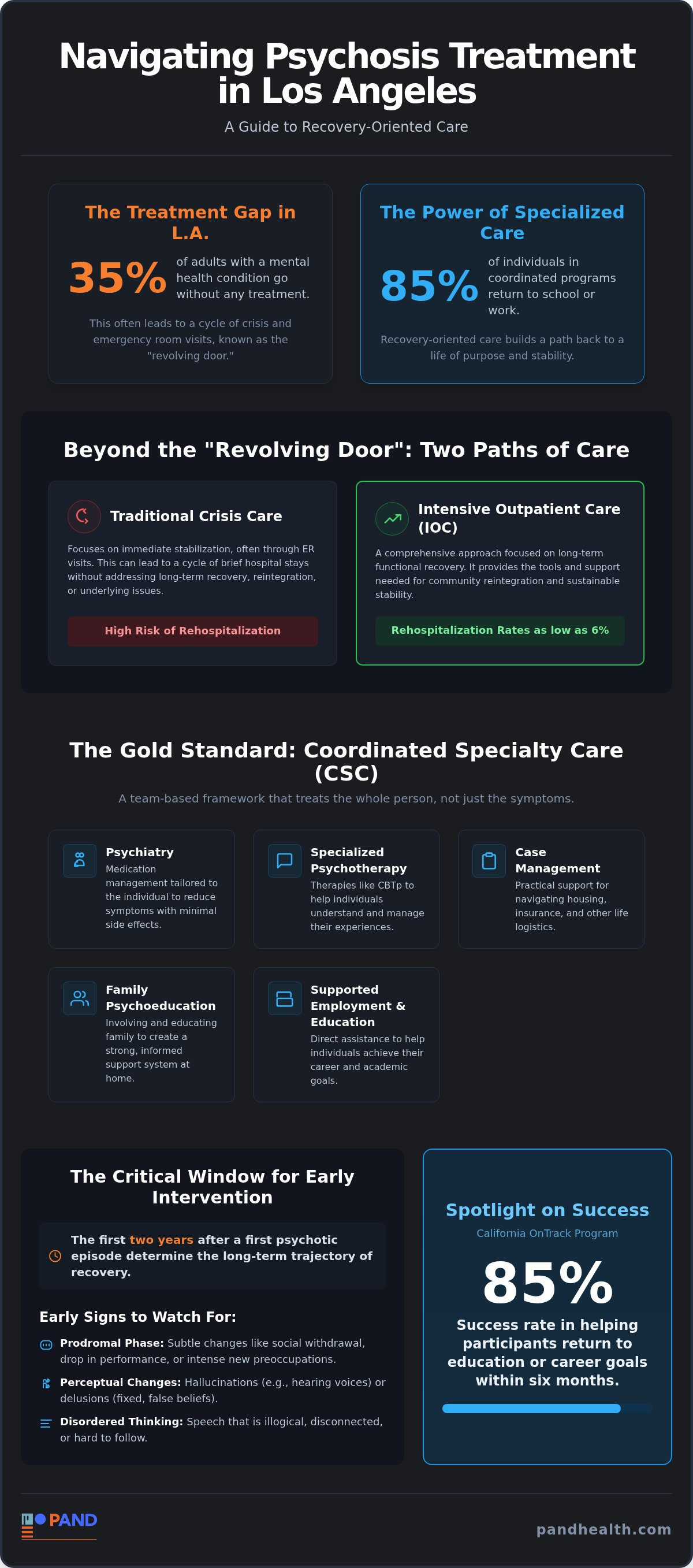
Did you know that while over 35% of adults in Los Angeles with a mental health condition go without treatment, those who access specialized, coordinated recovery programs see a return to school or work at a rate of 85%? It's exhausting to navigate a fragmented mental health system, especially when you're caught between revolving-door ER visits and the heavy fear that a diagnosis might mean permanent social isolation. You deserve a path that leads somewhere other than a hospital waiting room. Finding effective psychosis treatment in Los Angeles requires looking beyond the immediate crisis to find a program that treats the whole person, not just the symptoms.
We understand the frustration of feeling like a steady hand is missing during the storm. This guide will help you understand the complex landscape of local resources and discover why specialized, recovery-oriented care is the key to long-term stability. We'll examine the critical differences between emergency stabilization and comprehensive rehabilitation, explain how the new 2026 Behavioral Health Services Act impacts your options, and show you how evidence-based models like California OnTrack significantly reduce the risk of rehospitalization. You'll learn how to find a lifeline that supports not just clinical wellness, but a genuine return to education and employment.
Key Takeaways
- Shift your perspective from viewing psychosis as a permanent disability to understanding it as a treatable condition that responds to specialized intervention.
- Explore the five pillars of Coordinated Specialty Care, the clinical gold standard for psychosis treatment los angeles that prioritizes both medical stability and community reintegration.
- Learn to distinguish between immediate crisis resources, like the 988 lifeline, and the intensive outpatient care needed to reduce rehospitalization rates to as low as 6%.
- Gain insights into specialized support for individuals aged 13 to 40, including targeted recovery programs for cannabis induced psychosis.
- Discover how the California OnTrack program achieves an 85% success rate in helping participants return to their education or career goals within six months.
Understanding the Psychosis Treatment Landscape in Los Angeles County
Psychosis is often misunderstood as a terminal diagnosis or a sign of permanent disability. This misconception creates unnecessary despair for families who feel a diagnosis is the end of a normal life. In reality, modern clinical approaches treat psychosis as a manageable condition, much like a chronic physical illness that requires specialized care to reach remission. The landscape of psychosis treatment los angeles is broad, but it's often fragmented. While the Los Angeles County Department of Mental Health (LACDMH) provides essential crisis intervention through mobile response teams and safety-net services, these resources are designed for immediate safety rather than long-term functional recovery.
Families in Southern California frequently struggle to find high-intensity, early-intervention care because the system is heavily weighted toward emergency stabilization. Research shows that the first two years following a psychotic episode represent a "critical window" where clinical decisions determine a person's long-term trajectory. Early intervention in psychosis is vital because it prevents the brain from undergoing further structural changes and stops the erosion of social and professional ties before they become permanent.
Common Signs and Symptoms to Watch For
Recognizing the onset of symptoms early can change the entire course of recovery. Families should look for these specific indicators:
- The Prodromal Phase: This involves subtle changes like social withdrawal, a sudden drop in academic performance, or a new, intense preoccupation with eccentric ideas.
- Hallucinations and Delusions: It's critical to distinguish between sensory experiences that aren't there, like hearing voices, and fixed, false beliefs that persist despite evidence to the contrary.
- Disordered Thinking: This often manifests as speech that's difficult to follow or a loss of logical connection between thoughts.
First Episode Psychosis (FEP) is the term used to describe the first time someone experiences these symptoms, and it's the primary target for modern, recovery-oriented intervention.
The Challenges of Traditional Care in Southern California
Traditional mental health models in Los Angeles often function as a "revolving door" for families in crisis. A person is taken to an ER, stabilized for a few days, and then released with a referral that may have a six-month waitlist. This cycle fails because it treats the immediate crisis but ignores the underlying need for community reintegration. Los Angeles' sprawling infrastructure also complicates access; specialized clinics are often concentrated in specific hubs, leaving many neighborhoods underserved. Without a dedicated bridge between the hospital and daily life, the risk of rehospitalization remains high. Families seeking a more robust path can contact a specialized provider to find a program that prioritizes staying in school or at work while receiving psychosis treatment los angeles.
The Gold Standard: Coordinated Specialty Care (CSC) in Southern California
Coordinated Specialty Care (CSC) represents a paradigm shift in how we approach psychosis treatment los angeles. Rather than isolated appointments with disparate providers, CSC uses a team-based framework validated by the NIMH RAISE study. This model operates on the belief that recovery isn't just about symptom suppression; it's about reclaiming a life of purpose. The five pillars of this approach, psychiatry, specialized psychotherapy, case management, family psychoeducation, and supported employment or education, work in unison to provide a safety net that catches individuals before they fall into chronic disability.
While public initiatives like the LA County Early Psychosis Intervention (EPI-LA) provide these core services, augmented models in the private sector go further. These advanced programs integrate cognitive remediation and intensive psychosocial training to address the subtle cognitive deficits that often linger after hallucinations fade. By moving beyond the basics, these specialized teams ensure that recovery is the central expectation, not a rare exception. This holistic integration is what allows participants to move from a state of crisis to a state of thriving.
Evidence-Based Psychotherapies for Psychosis
Effective therapy for psychosis isn't a one size fits all approach. Cognitive Behavioral Therapy for Psychosis (CBT-P) helps individuals reframe distressing experiences, while Metacognitive Training (MCT) specifically targets the "jumping to conclusions" bias often associated with paranoia and suspicion. For those struggling with social cues, Social Cognition and Interaction Training (SCIT) provides the tools needed to rebuild meaningful relationships. These interventions are designed to empower the individual, providing them with a practical toolkit to navigate a world that may feel overwhelming or suspicious.
Cognitive Remediation and Brain Health
A return to high-level functioning requires more than just talk therapy. Cognitive remediation uses computer-assisted brain training to sharpen executive function, memory, and attention. When paired with physical fitness coaching, these interventions accelerate the brain's ability to heal and adapt. Programs that prioritize these high-intensity interventions see remarkable outcomes, such as an 85% participation rate in employment or education within six months. If your family is looking for a path back to normalcy, you can reach out for a specialized evaluation to see how an augmented CSC model can provide a lifeline.
LA Mental Health: Crisis Care vs. Intensive Outpatient
Understanding the difference between crisis response and long-term psychosis treatment los angeles is essential for family stability. When an immediate safety risk exists, the 988 Suicide & Crisis Lifeline or LACDMH crisis teams provide necessary intervention. These services are designed to stabilize, not to rehabilitate. Many families look toward LPS conservatorships or probate court when situations feel out of control, but these legal avenues are often difficult to secure and don't provide the specialized clinical support required for true recovery. They're often a temporary fix for a complex, long-term challenge.
Intensive Outpatient Programs (IOP) offer a flexible, rigorous alternative to restrictive inpatient stays. They allow individuals to remain in their community and maintain social ties while receiving high-level care. Evidence-based models like Coordinated Specialty Care (CSC) have demonstrated superior outcomes compared to standard community mental health. For instance, while the industry average for rehospitalization sits around 10%, specialized CSC programs can reduce this rate to just 6%. This success stems from focusing on functional goals like employment rather than just symptom management.
Emergency vs. Proactive Treatment
Knowing when to go to the ER is a common point of confusion. An ER visit is necessary if there's an immediate threat of harm to self or others. If the situation involves worsening hallucinations, disorganized thinking, or social withdrawal without immediate danger, a proactive approach is more effective. Seeking same-day or next-day evaluations for thought disorders can prevent a full-blown crisis. We encourage families to contact a specialist early to establish a plan before emergency intervention is the only option left.
The Role of Family in the Recovery Journey
Recovery doesn't happen in a vacuum. It requires a shift from being a caregiver who manages a patient to being a recovery partner who supports an individual. Family psychoeducation is the bridge for this transformation. You can refer to the Family Psychoeducation in LA Guide for specific communication strategies that reduce stress at home. Multi-family groups in Los Angeles also provide a vital community of shared experience, helping families realize they aren't alone in this process. This community support is often what provides the "lifeline" families need to stay the course during difficult months.
Identifying the Right Treatment Pathway for Teens and Young Adults
Navigating the transition-age years, typically between 13 and 25, presents unique developmental challenges that require a highly specialized clinical hand. In Los Angeles, the prevalence of high-potency cannabis has led to an increase in cannabis-induced psychosis, a condition that requires a specific rehabilitative approach rather than standard psychiatric care. Families must also consider how neurodivergent traits, like those found in Autism or ADHD, may overlap with or complicate a psychosis diagnosis. A generic clinic often lacks the niche knowledge to tease these factors apart. When searching for psychosis treatment los angeles, it's vital to prioritize programs that integrate vocational and educational support from day one. Recovery is measured by the ability to return to a meaningful life, not just the absence of symptoms.
The local landscape for young adults is competitive and high-pressure. Whether a student is trying to maintain their GPA at a local university or a young professional is starting their first job, the clinical team must act as a bridge back to these environments. This requires a shift in perspective where the clinic isn't just a place for therapy, but a center for professional and social development. By focusing on the specific needs of the 13 to 40 age demographic, specialized providers can offer a lifeline that traditional, broader mental health systems often miss.
The California OnTrack Model for Early Intervention
The California OnTrack program stands as a leader in early intervention, offering tailored pathways for both teens and adults. Unlike traditional models that may have strict discharge dates or short-term goals, a differentiator for long-term stability is indefinite program enrollment. This allows the clinical team to stay with the individual through various life transitions, providing a steady hand as they navigate the ups and downs of recovery. Social skills training is a key component here, helping young people rebuild their social lives and confidence after an episode. This isn't just about clinical wellness; it's about restoring the ability to connect and thrive in a peer environment.
Supported Education and Employment (SEE)
For many young adults in LA, the primary goal is returning to campus or the workforce. Supported Education and Employment (SEE) provides dedicated case management for college students navigating the complexities of university life after a leave of absence. Workplace advocacy is equally important, helping individuals find and maintain meaningful employment that respects their recovery needs. You can find more specific vocational tips in the LA Work-Study Guide. If your child is struggling to bridge the gap between treatment and daily life, you can schedule a same-day psychosis evaluation to begin building a personalized recovery plan that prioritizes their future.
Pand Health: Leading Early Psychosis Intervention in Los Angeles
Pand Health stands as a specialized beacon for those seeking psychosis treatment los angeles, operating from a dedicated site on Olympic Blvd. This center isn't just another clinic; it's the only program in Southern California featuring certified instructors in Metacognitive Training (MCT) and Social Cognition and Interaction Training (SCIT). These advanced methodologies, combined with the California OnTrack programs, create a rigorous yet compassionate environment where recovery is the expected outcome. By focusing on the 13 to 40 age demographic, the clinical team provides a highly niche level of expertise that addresses the specific social and vocational hurdles young adults face.
The intake process is designed to be as seamless as possible for families in distress. It begins with a comprehensive psychiatric evaluation, often available with same or next day service. This initial assessment goes beyond a simple diagnosis. It looks at the intersections of thought disorders, neurodivergence, and environmental stressors to build a truly personalized roadmap. This thoroughness ensures that the treatment plan targets the root causes of distress rather than just masking symptoms.
Data-Driven Recovery Results
The effectiveness of this model is grounded in measurable success. In the 2022 to 2024 cohort, participants showed a 19 point improvement in PANSS scores, which measures the severity of psychotic symptoms. Over a nine month period, there was a documented 25% reduction in the Brief Psychiatric Rating Scale (BPRS). These aren't just clinical markers; they represent a return to clarity and stability. Most importantly, Pand Health maintains a 6% rehospitalization rate, significantly outperforming the 10% industry average. While many systems focus on short term stabilization, this data shows that an intensive, coordinated approach keeps individuals out of the hospital and in their lives. After six months, 85% of participants are actively engaged in employment or education.
Taking the Next Step Toward Wellness
Navigating the financial side of specialized care can feel overwhelming, but the intake team helps families understand their out of network benefits to make high end intervention accessible. During the initial evaluation for thought disorders, you'll meet with experts who act as a steady hand during what is often a chaotic time. They'll explain the transition from clinical care to community reintegration, ensuring you have a clear understanding of the path ahead. If you're ready to move beyond basic crisis management, you can Request a confidential evaluation at Pand Health. This simple step can be the lifeline that changes the trajectory of a loved one's life.
Reclaiming a Life of Purpose and Stability
Recovery from psychosis is about more than just managing symptoms; it's about restoring a person's future and their sense of self. The path forward involves understanding that while Los Angeles offers many crisis services, the key to long-term stability lies in an augmented Coordinated Specialty Care model. This framework bridges the gap between emergency stabilization and a successful return to daily life. Finding the right psychosis treatment los angeles means choosing a program that views recovery as the standard expectation rather than a rare exception.
Pand Health provides a unique lifeline through the only outpatient CSC program in Southern California with certified MCT instructors. Our data-driven approach delivers results that change lives. We've documented an 85% return-to-work or school rate within six months and a rehospitalization rate of only 6%, which is significantly lower than the industry average. You don't have to navigate this complex system alone. We invite you to begin your journey to recovery with a specialized evaluation at Pand Health. A brighter, more stable future is within reach, and we're here to guide you every step of the way.
Frequently Asked Questions
What is the difference between schizophrenia and a first episode of psychosis?
First Episode Psychosis (FEP) is the initial period when someone experiences a break from reality, while schizophrenia is a long-term diagnosis that may follow if symptoms persist. Early intervention focuses on FEP to change the trajectory of the disorder. By providing specialized psychosis treatment los angeles families can often prevent the condition from becoming a permanent disability. FEP is the primary target for modern recovery models because the brain is most responsive to intervention during this critical window.
Does Los Angeles County offer free psychosis treatment for those without insurance?
Los Angeles County provides public mental health services through the Department of Mental Health (LACDMH) for individuals who are uninsured or have Medi-Cal. These safety-net programs, like EPI-LA, offer essential crisis stabilization and maintenance care. For families seeking augmented, high-intensity recovery models, private providers like Pand Health can assist in navigating out-of-network insurance benefits. While public options exist, specialized private programs often provide more intensive psychosocial support and vocational integration.
How long does a typical psychosis recovery program last in Los Angeles?
Recovery is a non-linear process, so program length varies based on individual needs. While many standard programs have strict discharge dates, a key differentiator for long-term stability is indefinite program enrollment. This allows the clinical team to support individuals through various life transitions, from returning to campus to starting a first career. Most participants show significant functional gains, such as returning to school or work, within the first six months of intensive treatment.
Can cannabis use really cause a psychotic episode in young adults?
High-potency cannabis use is a significant factor in the local mental health landscape and can trigger a psychotic episode in vulnerable young adults. This is often referred to as cannabis-induced psychosis. It requires a specific rehabilitative approach that addresses both the substance use and the underlying thought disorder. Specialized programs in Los Angeles provide targeted interventions to help individuals clear the cognitive fog and regain their baseline functioning after a drug-triggered break.
What is the rehospitalization rate for psychosis patients in specialized programs?
Specialized Coordinated Specialty Care (CSC) programs significantly reduce the need for repeat hospital stays. While the industry average for rehospitalization sits around 10%, our data shows a rate of only 6% for those enrolled in intensive, recovery-oriented care. This reduction is achieved by providing a steady hand during the transition from inpatient stabilization to community life. By focusing on relapse prevention and daily support, these programs offer a safer alternative to the traditional revolving-door system.
Is it possible for someone with a thought disorder to graduate college or hold a job?
A diagnosis does not mean the end of a career or education. In fact, 85% of individuals in our specialized psychosis treatment los angeles program return to work or school within six months of enrollment. We use a Supported Education and Employment (SEE) curriculum to provide workplace advocacy and campus support. This ensures that young adults don't just manage their symptoms but actually thrive in their chosen professional and academic environments.
What should I do if my teen is hearing voices but refuses to go to the hospital?
If your teen is hearing voices but isn't an immediate danger to themselves or others, you can pursue a proactive, same-day psychiatric evaluation instead of a forced hospital visit. Many young people resist the ER because it feels punitive or scary. A specialized outpatient setting offers a more human-centric, less restrictive environment for an initial assessment. If a safety crisis escalates, the 988 Suicide & Crisis Lifeline provides immediate mobile support across Los Angeles County.
How does cognitive remediation help with memory and focus after psychosis?
Cognitive remediation uses computer-assisted brain training to repair the executive function and memory deficits that often follow a psychotic episode. When paired with high-intensity fitness coaching, this intervention helps rewire the brain for better focus and processing speed. It's an essential component for anyone looking to return to a high-pressure academic or work environment. This data-driven approach moves beyond talk therapy to address the biological aspects of cognitive health and recovery.
Disclaimer
This article is for information and educational purposes only, and can NEVER replace a proper medical evaluation. If you or a loved one may be suffering from psychosis or the prodomal symptoms of psychosis, get evaluated by a professional as soon as possible. Early diagnosis and treatment can be life-saving.