
Metacognitive Training (MCT): A Comprehensive Guide to Recovery from Psychosis
What if the secret to overcoming persistent paranoia isn't arguing with the thoughts themselves, but learning to outsmart the specific "thinking errors" that create them? You may find that while medication provides a foundation, it doesn't always quiet the social suspicion that makes holding a job or staying in school feel impossible. It is frustrating when traditional talk therapy feels too confrontational or simply ineffective for the unique challenges you face. At Pand Health, we believe recovery is the expectation, not the exception, for young adults in Los Angeles.
This guide explores metacognitive training (MCT), a specialized intervention that serves as a "backdoor" to reality testing. Instead of challenging the content of your beliefs, MCT uses a non-confrontational, often playful approach to help you recognize cognitive biases like "jumping to conclusions" before they turn into delusions. You'll discover how this method, integrated into our California OnTrack program, helps individuals aged 13 to 40 achieve a 6% rehospitalization rate. We will detail how mastering your mental blind spots leads to improved social functioning and a successful return to a work-study environment, providing a steady hand as you reclaim your future.
Key Takeaways
- Learn how metacognitive training shifts the focus from what you think to how you think, providing a non-confrontational path to managing paranoia.
- Identify common "mental shortcuts," such as jumping to conclusions, that contribute to delusional thinking and social suspicion.
- Understand the specific structure of an MCT program, including the eight modules designed to improve mood, self-esteem, and social cognition.
- Discover how the California OnTrack program integrates these specialized therapies with vocational support to help young adults return to school and work.
- Gain insight into why recovery is the expectation, supported by data showing a 6% rehospitalization rate for those using this comprehensive model.
What is Metacognitive Training (MCT)? Correcting Thinking Errors
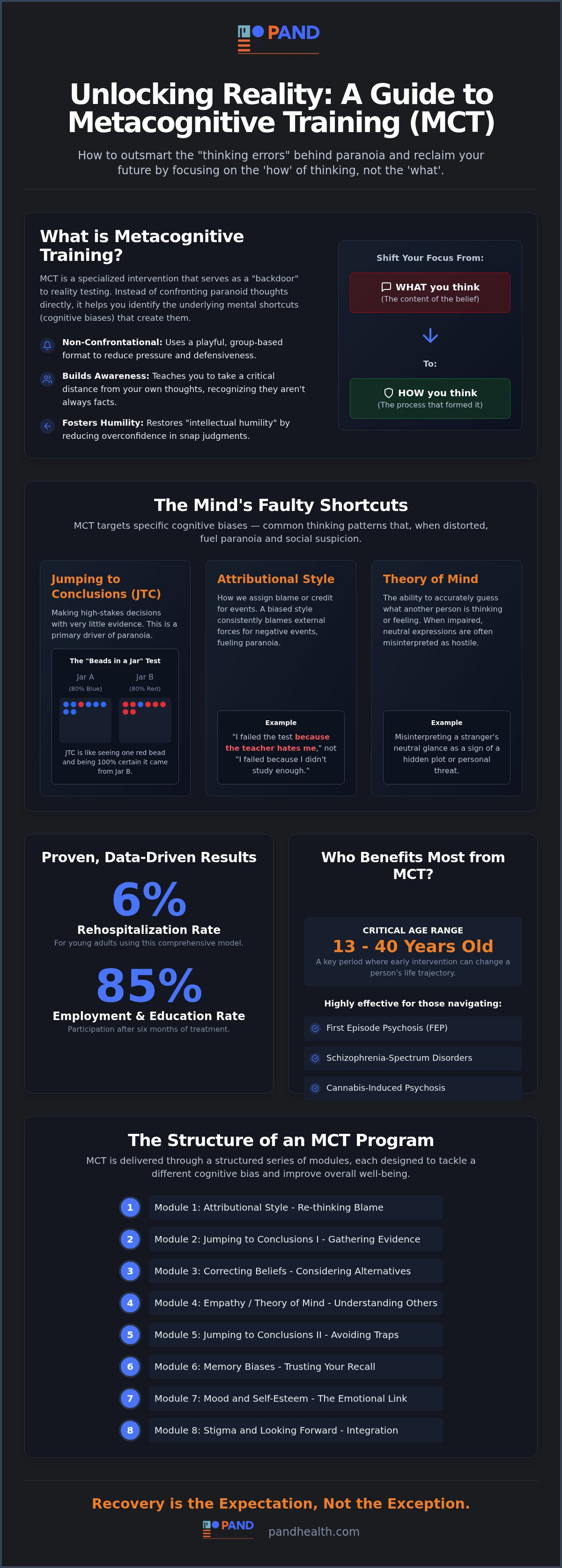
Understanding the architecture of a thought is often more powerful than trying to argue with the thought itself. Metacognitive training (MCT) is a specialized psychological intervention that focuses on the "how" of thinking rather than the "what." While traditional therapies might focus on the specific details of a paranoid belief, MCT looks at the underlying cognitive biases, or thinking errors, that allow those beliefs to take root. This approach helps individuals recognize when their brain is taking a "mental shortcut" that could lead to distress or social withdrawal.
Unlike some traditional forms of talk therapy that can feel confrontational or overly clinical, Metacognitive Training (MCT) is typically delivered in a playful, group-based format. This setting reduces the pressure on the individual. Instead of defending a belief, participants engage in exercises that highlight how everyone’s brain can be tricked. This process builds "metacognitive awareness," which is the vital ability to take a critical distance from your own thoughts and realize that a first impression isn't always a fact.
The Goal of MCT: Beyond Symptom Management
The primary objective of this training is to restore what clinicians call "intellectual humility." In the context of psychosis, it’s common to feel an intense overconfidence in errors, such as being 100% certain that a stranger’s glance is a threat. MCT helps lower that certainty. By reducing this overconfidence, young adults can better navigate the social suspicions that often interfere with school or professional life. This data-driven focus contributes to our 85% employment and education participation rate after six months of treatment. The shift is profound; you move from being a "patient" defined by symptoms to becoming a "student of your own mind," learning to spot your mental blind spots before they cause a crisis.
Who Benefits Most from Metacognitive Training?
At Pand Health, we've seen that this intervention is most transformative for young adults between the ages of 13 and 40. This age range is critical because it often encompasses the First Episode Psychosis (FEP) or high-risk clinical states where early intervention can change the entire trajectory of a person's life. Metacognitive training is highly effective for those navigating schizophrenia-spectrum disorders and is a cornerstone of our specialized cannabis induced psychosis rehab. Whether the challenges are rooted in a primary thought disorder or triggered by substance use, the goal remains the same: providing the tools needed for a stable, long-term recovery. If you or a loved one are experiencing these challenges, you can contact our team to learn more about our specialized evaluation and treatment options.
Understanding Cognitive Biases: The "Shortcuts" of the Mind
The human brain is wired for efficiency. It constantly seeks patterns to make sense of the world, but for those experiencing psychosis, these "shortcuts" can become distorted. In a metacognitive training environment, we refer to these as cognitive biases. These aren't personal failings; they are biological habits that can be unlearned through consistent practice and specialized guidance. This focus on retraining the mind is shared by other therapeutic fields; for example, Achieve Hypnotherapy helps individuals address deep-seated mental patterns to improve their overall well-being.
One major focus is "Attributional Style." This describes how we assign blame or credit for events. Someone with high social suspicion might consistently attribute negative events to external, malicious forces, which fuels paranoia. Similarly, "Theory of Mind" refers to our ability to accurately guess what another person is thinking. When this is impaired, a neutral expression or a muffled conversation can be misinterpreted as a sign of hidden hostility or a personal plot.
Jumping to Conclusions is perhaps the most well-known bias addressed in MCT. To illustrate this, instructors often use the "beads in a jar" experiment. Imagine two jars: one with 80% red beads and one with 80% blue beads. If someone sees just one red bead and immediately declares the jar is the "red jar" with 100% certainty, they are demonstrating JTC. They've made a high-stakes decision based on very little evidence.
In the real world, this looks like misinterpreting a stranger’s glance on a busy Los Angeles street or in a crowded college lecture hall. Without enough evidence, the brain decides the glance is a direct threat. By practicing the exercises within our metacognitive training curriculum, young adults learn to wait for more data before reaching a conclusion. This simple pause reduces the intensity of paranoid beliefs and is a key reason why our participants experience a 6% rehospitalization rate.
Overconfidence in Memory and Perception
Another critical barrier to recovery is the Bias Against Disconfirming Evidence (BADE). BADE is the cognitive rigidity that keeps a delusion locked in place by causing a person to ignore facts that prove them wrong. It acts as a mental filter that only lets in information that supports a specific, often distressing, belief.
MCT doesn't just tell someone they are mistaken. It uses "aha" experiences, which are playful, interactive moments where the brain realizes it made a mistake in a safe, low-stakes game. These moments help soften the overconfidence that fuels delusions. If you're interested in how these techniques can support a return to work or school, you might consider reaching out for a specialized evaluation to see if this approach fits your needs.
MCT vs. CBT vs. Cognitive Remediation: A Comparison
Navigating the path to recovery often involves understanding which clinical tools are best suited for specific challenges. Along this journey, specialized providers like Norton Wellness offer psychiatric and mental health services for adults that focus on stabilizing and supporting the individual. Families frequently encounter a variety of acronyms that can feel overwhelming during a crisis. To find the right fit, it's helpful to view these therapies as different layers of a comprehensive recovery plan. While they share the goal of stability, they target different aspects of how the brain processes information and experiences.
Cognitive Behavioral Therapy for Psychosis (CBT-P) typically focuses on the "what" of a symptom. It helps individuals examine the content and meaning of specific voices or distressing beliefs. In contrast, metacognitive training (MCT) focuses on the "how." It looks at the underlying thinking patterns, such as jumping to conclusions, that allow those beliefs to persist. These therapies are not mutually exclusive; rather, they are most effective when used together within an "augmented" model of care.
We specifically recommend metacognitive training for young adults, aged 13 to 40, who struggle with high levels of social suspicion or "fixed" delusional ideas. MCT is ideal for group settings because it allows participants to build social skills in real-time. By observing how others interpret the same information, individuals learn to broaden their own perspectives in a safe, non-threatening environment. This group dynamic is a cornerstone of the Pand Health social skills training pillar, which focuses on helping young people reconnect with their communities.
The Role of Computerized Cognitive Remediation
While MCT targets social-cognitive patterns, Cognitive Remediation acts as "fitness for the brain." It utilizes computer-assisted exercises to strengthen foundational hardware like memory, attention, and processing speed. At Pand Health, our California OnTrack program integrates 2x daily computer-assisted training sessions paired with physical fitness. This is a vital distinction: Cognitive Remediation builds the executive function necessary to actually apply the lessons learned in MCT. When a person's attention and memory are sharper, they are better equipped to catch their own "thinking errors" before they lead to social withdrawal. This integrated approach is a primary reason why 85% of our participants successfully return to school or work within six months. If you are ready to explore these specialized options, you can contact our team for a consultation.
What to Expect in a Certified MCT Program
Entering a session should feel like walking into a collaborative workshop rather than a clinical exam. A typical metacognitive training session lasts between 45 and 60 minutes. We conduct these in small groups to foster a sense of community and shared learning. The curriculum consists of eight core modules designed to dismantle the cognitive habits that sustain psychosis. These modules cover essential topics like "Social Cognition," which explores how we interpret the intentions of others, and "Mood and Self-Esteem," which addresses the emotional weight of living with a mental health challenge. Other modules focus on attributional styles and the bias against disconfirming evidence. Throughout every session, we maintain a firm stance: recovery is the expectation, not the exception.
The group environment in metacognitive training is intentionally non-threatening. Unlike individual therapy where the focus is solely on personal history, MCT uses neutral examples and interactive games to illustrate how anyone’s brain can be tricked. This shared experience reduces the stigma often associated with "thinking errors." By laughing together at a visual illusion or a logic puzzle, participants build the resilience needed to face more personal challenges. This atmosphere of mutual support is essential for young adults who may have felt isolated by their symptoms or previous clinical experiences.
The Importance of Certified MCT Instructors
Pand Health therapists are specifically certified to deliver this evidence-based protocol. This ensures "fidelity to the protocol," meaning the therapy is delivered exactly as intended by the developers. We are currently the only regional provider in Southern California offering this level of certified expertise. This specialized knowledge helps us maintain a 6% rehospitalization rate, which is significantly lower than the 10% industry average. For families seeking even more ways to support brain health and mental regulation, you can visit Neurobics to learn about their professional neurofeedback training.
We measure progress using tools like the PANSS scale, where participants typically see a 19-point improvement. However, the true measure is "functional gains," like returning to school or a career. This focus is why 85% of our participants are active in school or work after six months. You can explore our LA Work-Study Guide for more details on these outcomes. If you're ready to begin, please contact our team for an evaluation.
MCT in Los Angeles: The California OnTrack Difference
Pand Health stands as a specialized leader in Southern California, offering a level of care that bridges the gap between clinical research and real-world recovery. By staying connected to the broader clinical research ecosystem through platforms like trialport, we ensure our programs reflect the latest advancements. Our facility, located at 11500 W. Olympic Blvd., Los Angeles, is the only regional provider delivering metacognitive training within an augmented Coordinated Specialty Care (CSC) model. This holistic framework doesn't treat symptoms in isolation. Instead, it weaves together certified MCT, precise medication management, family therapy, and intensive vocational support to create a lifeline for families in crisis. We believe that for young adults aged 13 to 40, recovery should be the expectation, not the exception.
The true power of metacognitive training is revealed when a person steps back into their community. Our California OnTrack Work-Study Program utilizes a specialized SEE curriculum that directly links clinical progress to professional success. For instance, job coaches work alongside therapists to help clients apply MCT skills, like reducing the tendency to jump to conclusions, during high-pressure workplace interactions. When a young adult can pause and re-evaluate a stressful social cue at work, they avoid the spiral of suspicion that leads to withdrawal. This integrated approach is why our rehospitalization rate is only 6%, compared to the 10% industry average. This data-driven focus provides families with a sense of direction when other avenues have failed. By stabilizing the "how" of thinking, we help individuals maintain the 85% employment and education participation rate our program is known for.
Getting Started with Early Intervention in LA
The path to stability begins with clarity. We encourage families to start with a comprehensive evaluation for thought disorders to ensure the treatment plan is perfectly tailored to the individual's needs. Our intake process for the California OnTrack program is designed to be thorough yet reassuring, moving at a pace that respects the family's experience while prioritizing urgent clinical needs. Our goal is to provide a premium standard of intervention that is both rigorous and deeply human. Whether you're navigating a first episode or seeking a more effective long-term strategy, our team provides the niche knowledge and steady hand required to navigate the storm. You don't have to face this alone; you can Contact Pand Health for a psychiatric evaluation and MCT consultation to begin the restoration of normalcy today.
Reclaiming Your Future with Specialized Care
Recovery is the expectation when you have the right tools to navigate mental blind spots. By focusing on the cognitive biases that fuel social suspicion, metacognitive training empowers young adults to move beyond symptom management and toward true community reintegration. This specialized approach provides a steady hand during the most challenging times. As the only provider in Southern California with certified instructors, we ensure that every session follows the rigorous protocols necessary for lasting transformation.
The results of this integrated care are clear. Our participants experience a 6% rehospitalization rate and an 85% participation rate in employment or education after just six months. These aren't just statistics; they represent lives restored and futures reclaimed. If you're ready to move past the thinking errors that hold you back, our team is here to guide you every step of the way. You can Schedule a Consultation for Metacognitive Training in Los Angeles to begin your journey toward stability and success. You don't have to face this storm alone.
Frequently Asked Questions
Is Metacognitive Training a form of group therapy?
Yes, it is primarily delivered in small groups of three to ten participants. This format is intentional because it allows individuals to learn from others' perspectives in a safe, non-confrontational setting. While individual versions exist, the group dynamic helps normalize the experience of "thinking errors." This social interaction is a key component of our augmented model, helping young adults in Los Angeles build confidence as they prepare for community reintegration.
How long does an MCT program typically last?
A standard metacognitive training cycle consists of eight core modules, usually delivered once or twice per week. Each session lasts approximately 45 to 60 minutes. While the initial cycle takes about two months to complete, many participants choose to repeat specific modules to deepen their awareness. This steady, methodical pace ensures that the skills for recognizing cognitive biases become a natural, stable part of an individual's daily life and recovery journey.
Can MCT help if my child is still hearing voices?
Yes, MCT is designed to supplement other treatments like medication and family therapy for those experiencing auditory hallucinations. While it focuses on the "how" of thinking rather than the specific content of voices, it helps reduce the distress and certainty associated with these experiences. By lowering overconfidence in mental errors, individuals often feel more stable and less overwhelmed by their symptoms as they work toward returning to a school or work environment.
Do I need a formal diagnosis of schizophrenia to start MCT?
No, a diagnosis of schizophrenia is not a prerequisite for starting this program. Metacognitive training is highly effective for anyone experiencing First Episode Psychosis, high-risk clinical states, or cannabis-induced psychosis. Our team provides a comprehensive evaluation for thought disorders to determine if this intervention is the right fit for your specific challenges. We focus on the individual's needs and their potential for recovery rather than just a diagnostic label.
How is MCT different from standard Social Skills Training?
Social Skills Training focuses on external behaviors, such as eye contact or conversation flow, while MCT targets the internal "thinking errors" that happen before an interaction. For example, MCT helps you catch a "jumping to conclusions" bias before it leads to social withdrawal. By addressing these mental shortcuts, individuals find it much easier to apply external social skills in high-stakes environments like a professional workplace or a busy college campus. For families exploring how specialized allied health services can further assist in managing behavioral challenges, you can discover YesAbility and their positive behaviour support programs.
Coverage varies depending on your specific insurance provider and plan. As part of our comprehensive California OnTrack program, MCT is typically integrated into a broader package of services that includes psychiatric evaluation and vocational support. We recommend contacting our administrative team directly so we can help you navigate your benefits. We are committed to providing a clear understanding of how these evidence-based services fit within your family's coverage and financial planning.
What happens if we miss a session of the 8-module cycle?
Missing a session is manageable, as the modules are designed to be modular and repetitive. While attending the full cycle provides the most benefit, our instructors can provide brief summaries or allow participants to join the missed module during the next rotation. Consistency is important for achieving our 6% rehospitalization rate, but we understand that life in Southern California requires flexibility. We work closely with families to ensure progress remains steady despite occasional scheduling conflicts.
Are the MCT instructors at Pand Health specifically certified?
Yes, every instructor at Pand Health is specifically certified to deliver the official MCT protocol with clinical fidelity. This certification is vital because it ensures the therapy is delivered exactly as intended by the developers for maximum efficacy. We take pride in being the only provider in Southern California offering this level of specialized expertise. This commitment to professional standards is why we see such high success rates in community reintegration for our young adult clients.