
5250 Holds: A Guide for Los Angeles Families
What if the standard psychiatric hold wasn't a dead end, but the catalyst for a sustainable recovery? For many Los Angeles families, the transition from a brief 72-hour evaluation to a 14-day 5250 hold feels like a descent into a complex and frightening legal system. You aren't alone in feeling overwhelmed by the clinical terminology or the fear of long-term institutionalization. It's natural to feel anxious about how "grave disability" criteria might impact your loved one's future, especially as California expands these legal definitions under SB 43.
We understand that you need more than just a temporary safety measure; you need a clear, authoritative path forward. This guide explains the legal requirements of a 5250 hold and identifies the specific rights your family possesses during certification review hearings. Beyond the legalities, we'll show you how to transition from crisis intervention to specialized, long-term recovery models that prioritize community reintegration and professional development. You'll learn how to move past the "revolving door" of hospitalizations and access the rigorous, compassionate care necessary for lasting psychological stability and wellness.
Key Takeaways
- Understand the legal criteria that transition a short-term evaluation into a 14-day 5250 hold, including the specific definitions of "grave disability" under current California law.
- Identify your right to a Certification Review Hearing within the first four days and the essential role of a Patient Advocate in protecting your loved one's legal rights.
- Learn why traditional hospitalization is often insufficient for long-term wellness and how to break the "revolving door" cycle of frequent crisis interventions.
- Discover the five pillars of Coordinated Specialty Care, such as family psychoeducation and social skills training, that provide a roadmap for lasting psychological stability.
- Explore how specialized outpatient programs like California OnTrack utilize cognitive remediation to help individuals successfully return to school, work, and community life.
What is a 5250 Hold? Legal Criteria and Definitions
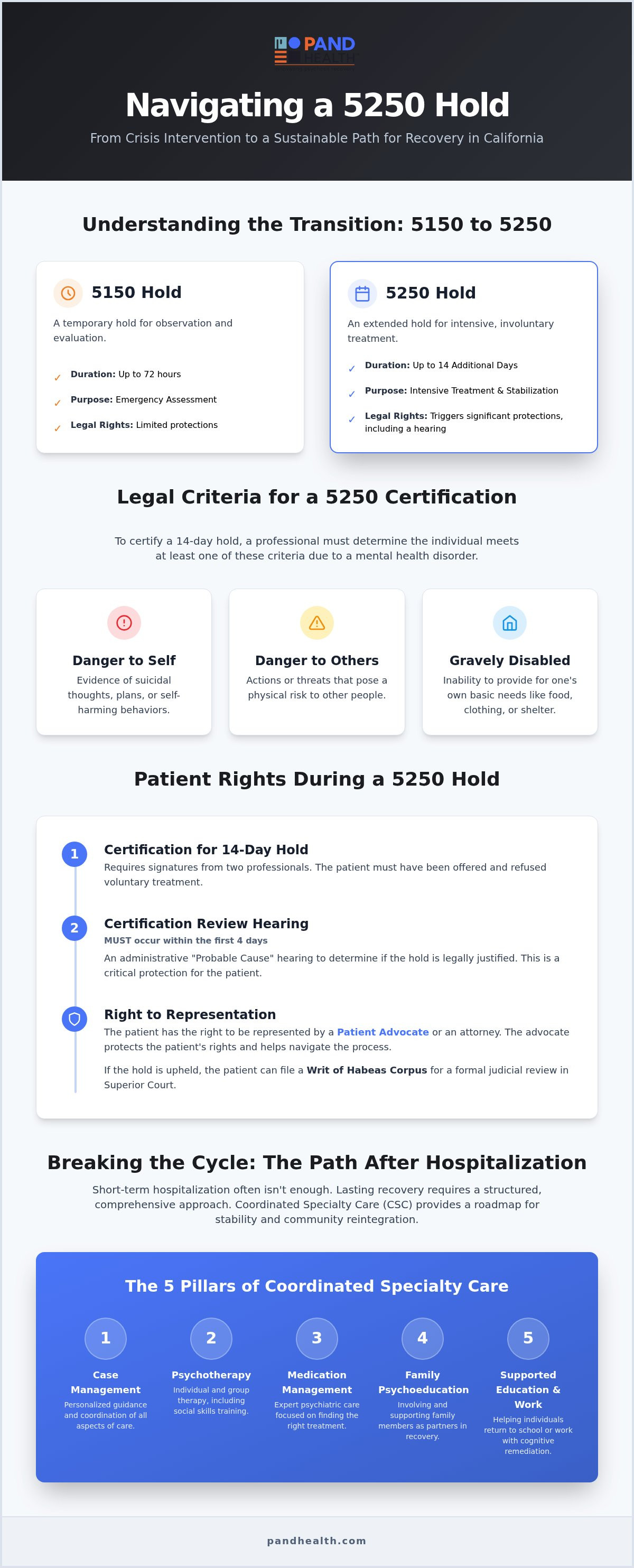
Section 5250 of the California Welfare and Institutions Code provides the legal framework for an involuntary 14 day psychiatric hold. It's a critical extension of the initial 72 hour observation period, designed for individuals who require intensive treatment rather than just short term assessment. This process is governed by the Lanterman-Petris-Short Act, which balances the need for public safety and clinical intervention with the protection of individual civil liberties. A 5250 hold isn't a permanent commitment; it's a structured window for stabilization that allows clinicians to develop a more comprehensive care plan.
To certify someone for this hold, a professional must determine that the person meets at least one of three specific criteria. These legal benchmarks ensure that involuntary treatment is reserved for those in genuine crisis:
- Danger to self: Evidence of suicidal ideation or self harming behaviors.
- Danger to others: Threats or actions that pose a physical risk to people in the community.
- Gravely disabled: An inability to provide for basic personal needs, such as food, clothing, or shelter, due to a mental health disorder.
Unlike the initial observation period, this certification is classified as intensive treatment. This means the facility is no longer just watching for symptoms; they're actively implementing psychiatric interventions, medication management, and therapeutic protocols to address the underlying crisis.
The Legal Requirements for Certification
A 14 day hold requires a formal certification signed by two professionals at the evaluating facility. Typically, this includes a physician or psychologist and another licensed staff member who has personally examined the individual. They must document that the person has been offered, but is either unable or unwilling to accept, voluntary treatment. This legal safeguard ensures that involuntary measures remain a last resort for those who cannot currently recognize their need for care. It's a moment of high tension for families, but it's also the point where professional expertise provides a steady hand in the storm.
5150 Vs. 5250: Key Differences
While a 5150 hold lasts only 72 hours, a 5250 hold extends care for up to 14 additional days. This longer duration triggers significant legal protections that aren't present during the initial three days. Within the first four days of the certification, the facility must conduct a Certification Review Hearing, often called a "Probable Cause" hearing. At this stage, the individual gains the right to a patient advocate or legal representation to contest the hold. These rights ensure the process remains transparent and clinically justified, offering families a clearer understanding of the legal path ahead.
Understanding Your Rights: The Certification Review Hearing
Transitioning from the initial observation period to a 14 day certification can feel like losing control over your loved one's care. However, the law provides specific safeguards to ensure that a 5250 hold remains clinically and legally justified. Within the first four days of the certification, the facility must conduct a "Probable Cause" hearing. This is an administrative review, not a criminal trial, to determine if the clinical staff has met the Legal Criteria and Definitions required for involuntary detention. You have the right to be represented by a Patient Advocate or an attorney who can cross-examine the facility’s evidence and present your family's perspective. A Patient Advocate is a neutral party who ensures the individual's rights are protected and helps translate complex legal jargon into understandable terms for everyone involved.
If the hearing officer upholds the hold, the individual still has the right to file a Writ of Habeas Corpus. This is a formal judicial review conducted in a Superior Court, where a judge evaluates the legality of the detention. These layers of protection exist to prevent unnecessary institutionalization and to ensure that the patient's voice isn't lost in the clinical process. It's a steady hand in the storm, ensuring that civil liberties aren't sacrificed for the sake of convenience.
What Happens During a 5250 Hearing?
The hearing usually takes place at the hospital facility. A Hearing Officer reviews the medical records and listens to testimony from the treating psychiatrist. Families play a vital role here. The Hearing Officer doesn't look for a "cure" but rather for evidence that the criteria for detention no longer exist. By providing proof of a stable home environment and a viable discharge plan, you can demonstrate that the crisis can be managed safely outside the hospital. Presenting a documented schedule of follow-up appointments and a clear housing plan can effectively counter the hospital’s argument for continued involuntary care. Testimony regarding your "willing and able" support can be the deciding factor in securing a release.
Challenging Grave Disability
Grave disability is legally defined as an inability to provide for basic personal needs, specifically food, clothing, and shelter. It's often the most subjective criteria used in a 5250 certification. We help families challenge this by building robust outpatient plans that prove a support system is ready to intervene immediately. Pand Health works with families to structure intensive outpatient support that satisfies these legal requirements, ensuring the transition from the hospital is both safe and permanent. Under California law, an individual cannot be deemed gravely disabled if they can survive safely with the help of a responsible third party who is willing and able to provide for their food, clothing, and shelter.
Moving from a legal crisis to long term stability requires a roadmap that goes beyond the hospital walls. If you're currently navigating this process, you can reach out for specialized guidance on building a sustainable recovery plan that prioritizes your family's wellness.
The Revolving Door: Why Hospitalization Isn’t Enough
The "revolving door" is a painful and exhausting cycle where individuals are stabilized in a hospital only to return weeks later. In California, rehospitalization rates for psychosis patients often exceed 50% before they enroll in specialized, data driven programs. While a 14 day 5250 hold provides a necessary safety net, it's rarely enough to foster long term independence on its own. This two week window is a high stakes period where families must look beyond the immediate crisis and plan for a transition to Coordinated Specialty Care. It's a steady hand in the storm, but the goal must be a permanent exit from the hospital system. Protecting the individual's legal standing is vital, and you can learn more about those protections by Understanding Your Rights: The Certification Review Hearing.
The Gap Between Crisis Stabilization and Recovery
Stabilization isn't the same as recovery. Symptoms often return shortly after discharge from a 5250 hold because the underlying cognitive and social challenges remain unaddressed in a standard hospital setting. Traditional outpatient therapy frequently lacks the intensity and specific focus required for First Episode Psychosis. To break the cycle, patients need evidence based interventions like Social Skills Training and Cognitive Remediation. These methods help restore the brain's executive functions and social intuition, which are often damaged during a psychotic episode. Without this functional rehabilitation, a person is simply waiting for the next crisis to occur.
Functional Outcomes vs. Symptom Management
Recovery is defined by a return to normalcy, not just the management of symptoms. Returning to work or school immediately after a crisis is one of the most effective ways to prevent relapse and build a sense of purpose. When an individual remains isolated at home after discharge, the risk of a new crisis spikes significantly. We prioritize rapid reintegration through specialized tools like our Work-Study Program. This approach ensures that the person doesn't just "get better" in a sterile clinical setting; they thrive in their actual community. At Pand Health, recovery is the expectation, not the exception, and that journey starts the moment the hospital doors open.
Coordinated Specialty Care: The Path After a 5250 Hold
While a 5250 hold ensures immediate safety, the real work of transformation begins at discharge. Coordinated Specialty Care (CSC) is the evidence based gold standard for treating first episode psychosis. Developed through the NIMH NAVIGATE framework, CSC moves away from isolated symptom management toward a holistic team approach. Research shows that while traditional care models often see rehospitalization rates above 50%, CSC can reduce that number to as low as 6%. This dramatic shift occurs because the model addresses the person's entire life rather than just their diagnosis.
The framework relies on five essential pillars: personalized medication management, specialized psychotherapy, family psychoeducation, supported education and employment, and assertive case management. By integrating these services, families in Los Angeles can find a steady hand to guide them through the complexities of early recovery. It is a premium standard of care that prioritizes both the science of treatment and the lived experience of the family.
Transitioning to the California OnTrack Program
Transitioning out of a 5250 hold into a structured outpatient environment is the most critical step in preventing a relapse. At Pand Health, we provide an augmented version of the California OnTrack program. We believe intensity is the key to stability. Our model involves 24 to 32 hours of clinical engagement per client, which is significantly higher than standard outpatient programs. We combine APA recommended cognitive remediation with physical fitness and brain training to restore executive function. Relationships often suffer during a crisis, so we utilize Social Cognition and Interaction Training (SCIT) to help individuals rebuild their social intuition and reconnect with loved ones.
Supported Education and Employment (SEE)
True recovery requires a return to a meaningful life. Supported Education and Employment (SEE) is a cornerstone of our methodology, offering dedicated job coaching and school advocacy. We don't just treat symptoms; we help our clients navigate the practical challenges of the classroom and the workplace. The results speak for themselves. After six months in our program, 85% of our patients are actively engaged in work or school. This reintegration is supported by our intensive Social Skills Training, which provides the tools necessary for long term professional and personal success.
If you're looking for a specialized alternative to the revolving door of hospitalizations, contact our team today to learn how we can support your family's journey toward wellness.
Pand Health: Specialized Psychosis Recovery in Los Angeles
Pand Health serves as a specialized guide for families moving beyond the immediate crisis of a 5250 hold. We don't just aim for stabilization; we strive for the restoration of a full, independent life. Our philosophy is simple: recovery is the expectation, not the exception. This mindset drives our commitment to providing the most advanced, evidence based interventions available in Southern California. As the only outpatient program in the region offering APA recommended cognitive remediation, we address the cognitive deficits that often lead to the "revolving door" of hospitalizations discussed earlier.
Our clinical approach integrates Metacognitive Training (MCT) and Dialectical Behavior Therapy (DBT) specifically adapted for psychosis. These methodologies help individuals recognize and correct the cognitive biases that fuel delusional thinking and emotional dysregulation. By focusing on both the science of the brain and the lived experience of the individual, we provide a steady hand to help families navigate the complexities of long term wellness. Whether you are seeking a psychiatric evaluation in West Los Angeles or a comprehensive recovery plan, our team is equipped to lead the way.
Data-Driven Results for Los Angeles Families
The success of our augmented Coordinated Specialty Care model is backed by rigorous, documented data. On average, our patients experience a 19 point improvement in PANSS scores over a nine month period, reflecting a significant reduction in symptom severity and a return to baseline functioning. Our intensive outpatient support has also been instrumental in reducing the average inpatient stay for our clients from 40 days down to just 7 days. For families seeking deeper insights into the legal and clinical nuances of Section 5250, our podcast, The Mind Exposed, serves as an essential resource for education, validation, and hope.
Getting Started with Pand Health
Located on W. Olympic Blvd in West Los Angeles, our primary site is designed to be a center of excellence for psychiatric evaluation and intensive rehabilitation. Our intake process is streamlined to support those experiencing First Episode Psychosis, cannabis induced psychosis, or complex thought disorders. We provide a clear path that moves away from the trauma of involuntary holds toward a future of community reintegration and professional success. If your family is ready to transition from crisis management to a dedicated, high standard recovery plan, you can contact us for a thought disorder assessment to begin the journey home.
Breaking the Cycle of Involuntary Care
Navigating the complexities of a 5250 hold is one of the most challenging experiences a family can face, but it doesn't have to define your loved one's future. Empowering yourself with knowledge about certification review hearings is the first step toward reclaiming stability. More importantly, you now have a roadmap to transition from short term crisis stabilization to a high standard of recovery that prioritizes long term independence and community reintegration.
As the only outpatient program in Southern California providing APA recommended cognitive remediation, we employ certified MCT instructors who specialize in thought disorder recovery. Our data driven approach has successfully reduced rehospitalization rates to just 6%, significantly outperforming the 10% industry average. You don't have to manage this journey alone. We invite you to Schedule a Comprehensive Evaluation at Our Los Angeles Clinic to begin building a sustainable path forward. Recovery isn't just a possibility; it's the expectation we hold for every individual we serve.
Frequently Asked Questions
What happens at the end of a 5250 hold?
At the end of the 14 day period, the facility must release the individual, transition them to voluntary status, or seek a further involuntary hold. If the person no longer meets the legal criteria for being a danger or gravely disabled, they're discharged. This is the optimal time to transition into a specialized program like California OnTrack to prevent relapse. Our data shows that structured outpatient support can reduce rehospitalization from over 50% down to just 6%.
Can a 5250 hold be extended beyond 14 days?
Yes, a hold can be extended under specific circumstances. If a person remains suicidal, a 5260 hold can add 14 more days of intensive treatment. If the person remains gravely disabled, a 5270 hold can extend the stay by an additional 30 days. These extensions require new certifications. We help families navigate these transitions by building robust outpatient plans that demonstrate a safe, supported environment exists outside the hospital walls.
Does a 5250 hold stay on my record in California?
A 5250 hold is a confidential medical record rather than a criminal one. While it doesn't appear on a standard criminal background check, it's recorded in California's Department of Justice database regarding firearm eligibility. Your privacy is protected under HIPAA and the Confidentiality of Medical Information Act. However, certain professional licenses or high security clearances might require disclosure. It's important to focus on recovery to ensure these records reflect a past crisis rather than an ongoing disability.
Can I lose my right to own a firearm after a 5250 hold?
Yes, being certified for a 14 day hold results in an automatic five year ban on owning or possessing firearms in California. This restriction begins the moment the 5250 certification is signed. While there's a legal process to petition the court for the restoration of these rights, the primary focus during this time should be on clinical stability. Our programs in Los Angeles emphasize long term wellness and social reintegration to help individuals move beyond the limitations of a crisis.
How do I get a loved one released from a 5250 hold?
You can support a loved one's release by participating in the Certification Review Hearing and demonstrating a "willing and able" support system. Providing a concrete plan for food, clothing, and shelter can effectively challenge a "gravely disabled" designation. We assist Los Angeles families by creating intensive outpatient recovery plans that satisfy legal requirements for safety. By showing that professional care is already arranged, you provide the hearing officer with a viable, less restrictive alternative to involuntary detention.
What is the difference between an LPS and a probate conservatorship?
An LPS conservatorship is specifically for individuals who are gravely disabled due to a mental health disorder and is governed by the Lanterman-Petris-Short Act. It's designed for involuntary treatment and usually lasts for one year. In contrast, a probate conservatorship is typically for elderly individuals or those with physical disabilities who cannot manage their daily lives or finances. LPS conservatorships require a higher level of legal scrutiny and frequent clinical reviews to ensure the individual's rights are protected.
Is there an alternative to hospitalization after a 5150?
Intensive outpatient programs and Coordinated Specialty Care serve as powerful alternatives to the "revolving door" of hospitalization. Pand Health offers the only program in Southern California that combines APA recommended cognitive remediation with high intensity fitness and social skills training. These models allow individuals to stay in their Los Angeles communities while receiving 24 to 32 hours of weekly clinical support. This approach has been proven to reduce the length of inpatient stays from an average of 40 days to just 7 days.
How much does intensive outpatient psychosis treatment cost in LA?
The cost of intensive outpatient treatment in Los Angeles depends on the specific level of care and insurance coverage. While we don't provide a single flat rate, we offer comprehensive psychiatric evaluations to determine the most effective treatment path for your family. Our California OnTrack program is a premium, data driven model that includes certified MCT instructors and specialized job coaching. We're committed to helping families navigate their options to ensure access to the highest standard of psychosis recovery.
Disclaimer
This article is for information and educational purposes only, and can NEVER replace a proper medical evaluation. If you or a loved one may be suffering from psychosis or the prodomal symptoms of psychosis, get evaluated by a professional as soon as possible. Early diagnosis and treatment can be life-saving.