Top Autism Treatment and Evaluation in Los Angeles
For a young adult on the spectrum, the transition to independence often feels less like a milestone and more like a cliff. You've likely felt the frustration of generic ABA programs that seemed helpful in childhood but now feel inadequate for the complexities of adult life. It's exhausting to watch your child struggle with social nuances while you worry if they'll ever find a place in the professional world. Finding effective autism treatment in Los Angeles shouldn't feel like a guessing game between outdated behavioral methods and clinical uncertainty.
This article reveals how specialized social cognition training and comprehensive evaluations are redefining recovery for young adults in Southern California. We'll examine the critical difference between managing symptoms and building a path toward college or a career. You'll discover how a sophisticated, integrated approach to psychological rehabilitation can provide the diagnostic clarity your family needs and the measurable progress your child deserves. We're moving beyond basic behavior modification to focus on the high-level social skills that lead to real-world success and lasting stability.
Key Takeaways
- Understand the critical role of differential diagnosis in distinguishing between autism symptoms and early signs of complex thought disorders to ensure the right intervention.
- Discover why modern autism treatment in los angeles is shifting away from basic behavioral modification toward advanced social cognition training for young adults.
- Learn how Social Cognition and Interaction Training (SCIT) helps individuals decode "between the lines" of human interaction for better relationship building.
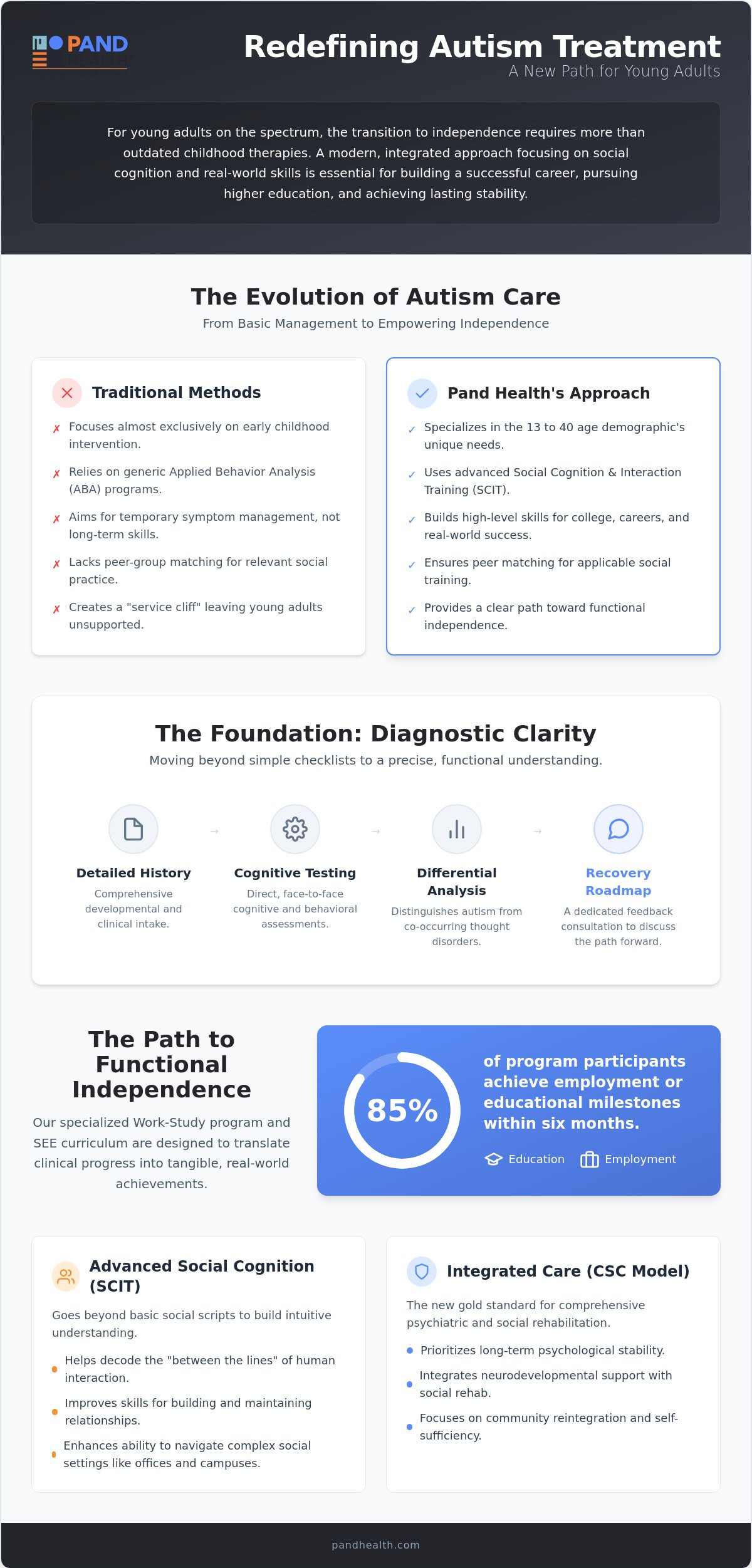
- Explore the path to functional independence through specialized work-study programs that help 85% of participants achieve employment or educational milestones within six months.
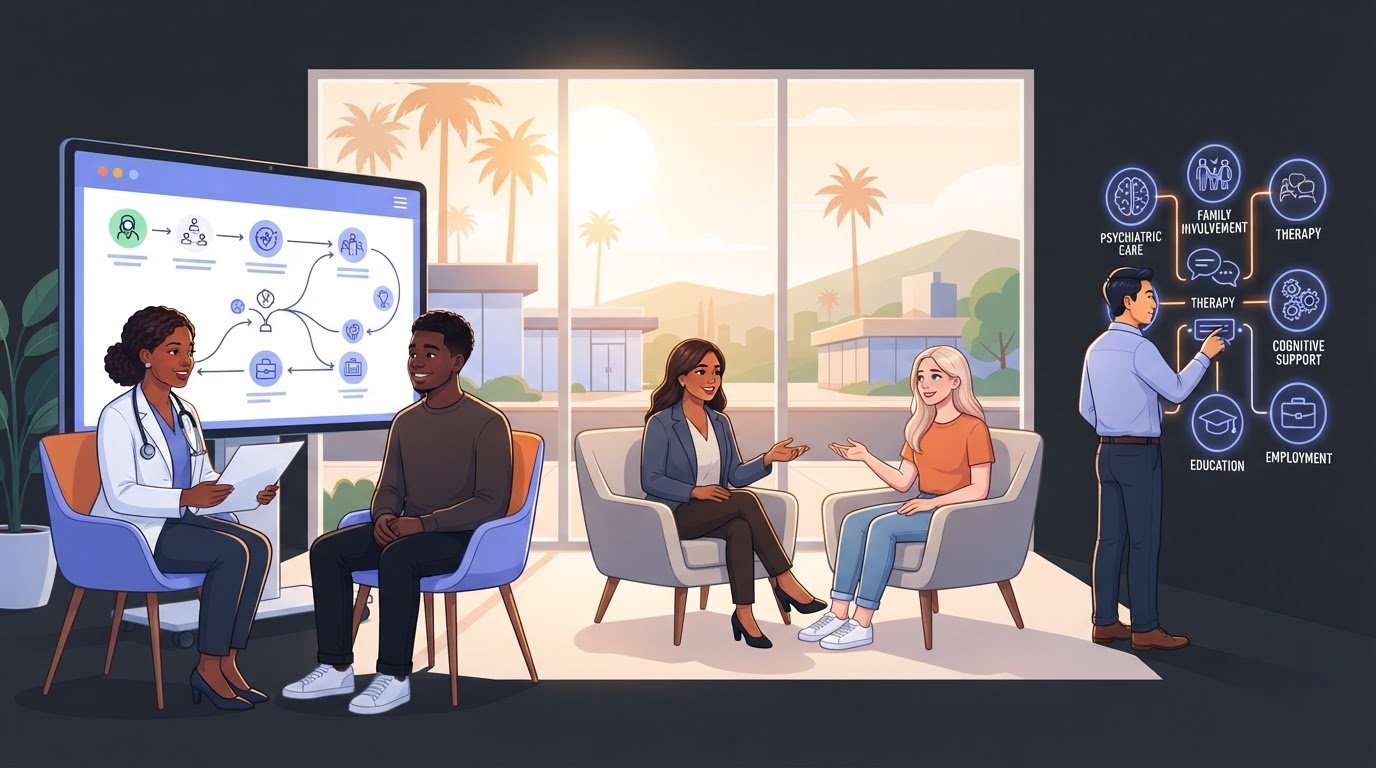
- Identify the benefits of an integrated Coordinated Specialty Care model that prioritizes long-term psychological stability and community reintegration over temporary symptom management.
The Evolution of Autism Treatment in Los Angeles
For decades, the standard for autism treatment in los angeles focused almost exclusively on early childhood intervention. While these early behavioral foundations are vital, they often fail to address the complex social and vocational hurdles that emerge during the transition to adulthood. Traditional Applied Behavior Analysis (ABA) might help a child follow a routine, but it rarely equips a young adult to manage the nuanced social landscapes of a professional workplace or a university campus. This gap in care creates a "service cliff" where individuals aged 18 to 40 find themselves without the specialized support required for true independence. Families often feel abandoned by a system that prioritizes pediatric milestones over adult self-sufficiency.
Modern clinical practice is moving toward a more sophisticated understanding of neurodiversity. We recognize that the needs of a 22-year-old are fundamentally different from those of a toddler. Effective autism therapies must evolve beyond basic behavioral modification. At Pand Health, we bridge this gap by integrating neurodevelopmental support with intensive social rehabilitation. Our approach acknowledges that recovery is the expectation, not just a distant hope. By focusing on the specific challenges of the 13 to 40 age demographic, we ensure that young adults in Southern California have a clear path toward the restoration of normalcy and professional success.
Why Age-Specific Care Matters in Southern California
The social demands placed on students in Los Angeles high schools and universities are exceptionally high. A one-size-fits-all approach to social skills fails because it lacks peer-group matching. A 19-year-old struggling with social cues needs to practice with others facing similar collegiate challenges, not in a pediatric clinic filled with primary school posters. Transitioning to adult-oriented clinical settings allows for a focus on executive functioning and professional communication. Peer matching ensures that the social training is relevant, relatable, and immediately applicable to the individual's daily life in a competitive urban environment.
The Intersection of Neurodiversity and Mental Health
It's common for neurodiversity to overlap with other clinical challenges. Many young adults find that autism co-occurs with profound social anxiety or even early signs of thought disorders. Identifying these layers requires a steady hand and a high level of diagnostic expertise to ensure that treatment addresses the root cause rather than just the surface symptoms. Without diagnostic clarity, families often cycle through generic services that do not age well. The augmented Coordinated Specialty Care (CSC) model serves as the new gold standard for integrated psychiatric and social rehabilitation. This model provides a comprehensive framework that values both the science of treatment and the lived experience of the family, ensuring that no stone is left unturned in the pursuit of long-term wellness.
Specialized Diagnostic Evaluations: Getting Clarity in Complex Cases
Achieving diagnostic clarity is the cornerstone of effective autism treatment in los angeles. For many families, the journey toward support is stalled by a lack of precision. It's not uncommon for symptoms of autism to overlap with Schizotypal Personality Disorder or emerging thought disorders. Without a sophisticated psychiatric evaluation, a young adult might receive a generic label that fails to account for their unique cognitive profile. At Pand Health, we move beyond simple checklists. We utilize nuanced assessment tools to create a functional understanding of how a patient’s brain processes information. This allows us to tailor interventions that address specific cognitive strengths and weaknesses rather than just managing surface behaviors. Our evaluation process typically includes:
- Detailed clinical history and developmental intake
- Direct face-to-face cognitive and behavioral testing
- Scientific scoring and comprehensive differential analysis
- A dedicated feedback consultation to discuss the roadmap for recovery
The Role of Thought Disorder Assessments
Expert psychiatric oversight is essential when navigating the intersection of neurodiversity and mental health. The autism treatment and intervention landscape is complex, particularly when psychosis symptoms begin to mask or mimic autism traits. Identifying individuals who are "clinically high-risk" during their teen years requires a level of expertise that goes beyond pediatric developmental medicine. In Southern California, families often face a systemic crisis of long waitlists, with some diagnostic assessments booking out 18 months or more. Additionally, under California's Assembly Bill 951 effective in 2026, insurers can't require a new diagnosis for those already identified as having autism. This makes getting the initial evaluation right more important than ever. Our goal is to provide a steady hand during what is often a period of significant family crisis, ensuring that every patient receives the specialized care they need to thrive.
Family Involvement in the Evaluation Process
A comprehensive evaluation is never a solitary process; it requires the active participation of those who know the patient best. We use family psychoeducation to gather an accurate developmental history, which is vital for distinguishing between lifelong neurodiversity and recent onset psychiatric challenges. By integrating family therapy into the initial diagnostic phase, we provide parents with a lifeline of information and support. This holistic approach ensures that the family isn't just a bystander but a partner in the recovery journey. We also encourage families to explore the Mind Exposed Podcast as a supplemental resource for understanding these complex clinical layers. If you are seeking a clear path forward, our evaluation for thought disorders and autism can provide the answers your family has been searching for.
Advanced Social Cognition and Interaction Training (SCIT)
Traditional social skills groups often focus on the mechanics of "what to do" in a conversation, but they frequently skip the internal processing required to navigate complex human dynamics. SCIT represents a paradigm shift in autism treatment in los angeles. This evidence-based protocol moves beyond the rote memorization of social scripts. Instead, it targets the underlying mechanisms of social cognition. Participants learn to read "between the lines" of human interaction, deciphering subtle facial expressions and the hidden intentions of others. This is particularly crucial for young adults who find themselves in high-stakes environments like university seminars or corporate boardrooms where social nuance is the currency of success.
Pand Health stands as the exclusive regional provider of these APA-recommended protocols in an outpatient setting in Southern California. While research at institutions like the UCLA Center for Autism Research and Treatment continues to push the boundaries of what we know about neurodiversity, we focus on the clinical application of these breakthroughs. Our program includes computer-assisted brain training to accelerate cognitive remediation. This technology helps retrain the brain to process information more efficiently, providing a foundation for the more complex social work that follows. It's a rigorous, data-driven approach that ensures recovery isn't just a goal but a measurable outcome, contributing to our 85% success rate in employment and education participation.
Metacognitive Training (MCT) for Complex Social Needs
MCT addresses the complex social needs of young adults by correcting "cognitive biases." These are the mental shortcuts that can lead to social withdrawal or even paranoia in high-stress situations. By learning to recognize these biases, individuals can better navigate workplace politics and professional hierarchies. Our certified MCT instructors ensure treatment fidelity, providing a high standard of care that is both innovative and grounded in proven methodology. This focus on "thinking about thinking" allows patients to gain a level of self-awareness that traditional behavioral therapy often misses.
Social Rehabilitation and Community Reintegration
The true test of any clinical intervention is how well it translates to real-world environments. We prioritize moving skills from the quiet of the clinic to the active streets of West LA and beyond. Building "social stamina" is essential for long-term success in college or professional settings. For families seeking a deeper understanding of these methods, we recommend our Social Skills Training in Los Angeles: A Clinical Guide to Recovery and Reconnection. This integrated approach ensures that the progress made in our sessions leads to a life of independence and meaningful community engagement.
Functional Recovery: The Work-Study Program and SEE Curriculum
Clinical stabilization is often viewed as the finish line in many medical settings, but for a young adult on the spectrum, it's merely the starting point. True recovery is measured by the ability to engage with the world, whether that means attending a university lecture or holding a steady job. This focus on functional independence is what distinguishes the most effective autism treatment in los angeles. At Pand Health, we operate on the principle that recovery is the expectation. Our results back this up; 85% of our participants are actively engaged in work or school within six months of starting our program.
Central to this success is our SEE (Supported Education & Employment) curriculum. This evidence-based framework provides the scaffolding necessary for young adults to thrive in competitive environments. Our clinic provides a premium standard of autism treatment in los angeles that prioritizes community reintegration. We don't just treat the individual in isolation. We act as advocates in the workplace, helping Los Angeles employers understand the unique strengths of neurodiverse hires. By fostering inclusive environments, we ensure our patients have a fair chance to demonstrate their professional value.
Supported Education for College Students
Navigating the academic rigors of institutions like UCLA, USC, or Santa Monica College (SMC) can be overwhelming for those with executive functioning challenges. Our specialized support team provides coaching that bridges the gap between the therapist's office and the professor's lecture hall. We focus on time management, organizational strategies, and self-advocacy skills. This case management approach ensures that academic setbacks don't lead to clinical regressions, allowing students to maintain their momentum toward graduation.
Vocational Rehabilitation and Job Coaching
The transition to the workforce requires more than just a polished resume. We provide interview preparation tailored specifically for the social nuances that autistic young adults often find challenging. Through motivational interviewing, we help individuals overcome the paralyzing fear of workplace failure. These real-world outcomes are a primary reason why our rehospitalization rate is just 6%, significantly lower than the 10% industry average. Meaningful employment provides the structure and purpose essential for long-term psychological stability. If you're ready to move toward independence, our California OnTrack Work-Study Program offers the comprehensive support needed for a successful career.
Choosing Pand Health for Autism and Social Rehab in Los Angeles
Selecting the right partner for autism treatment in los angeles is a decision that fundamentally shapes the trajectory of a young adult's life. Pand Health offers a level of psychosocial depth that is unique in Southern California. As the only outpatient Coordinated Specialty Care (CSC) program in the region providing both Social Cognition and Interaction Training (SCIT) and Metacognitive Training (MCT), we offer a sophisticated intervention that goes far beyond traditional clinical models. Our data-driven approach isn't just about theory; it's about measurable change. We have documented 19-point improvements on clinical syndrome scales, illustrating the tangible progress our patients achieve during their time with us.
Conveniently located at 11500 W. Olympic Blvd, our center serves West LA families who are looking for a high-standard care provider close to home. We operate under a simple but profound mantra: recovery is the expectation. This isn't just a slogan; it's the foundation of our industry-leading outcomes. By setting the bar high, we help our patients and their families move past the limitations of a diagnosis and toward a life of purpose, stability, and community reintegration. We understand that you aren't just looking for a service; you're looking for a steady hand in a storm.
The California OnTrack Difference
The California OnTrack program is designed for maximum impact, offering 24 to 32 hours of intensive outpatient treatment per client. This high-dosage approach ensures that the skills learned in the clinic are deeply internalized and ready for real-world application. Unlike programs that force a transition after a set period, we offer indefinite enrollment. This allows for continuous, long-term support that adapts as the individual grows and faces new life challenges. To stay connected with the latest research and family education, we encourage our community to listen to The Mind Exposed Podcast, which serves as a valuable resource for navigating complex mental health landscapes while remaining grounded in clinical truth.
Getting Started with Your Lifeline
Taking the first step toward a new future begins with a comprehensive psychiatric evaluation. We recommend scheduling this as soon as possible to gain the diagnostic clarity required for effective autism treatment in los angeles. For your first consultation at our Olympic Blvd location, please bring any previous diagnostic reports, current medication lists, and a record of the patient's developmental history. This information helps our team build a precise, individualized roadmap from day one. You don't have to navigate this transition alone. Take the first step toward recovery with Pand Health and discover a path built on expertise, empathy, and proven results.
Your Roadmap to Functional Independence
Navigating the complexities of adulthood requires more than clinical stabilization; it demands a specialized approach that values an individual's potential for a full, productive life. By prioritizing diagnostic clarity and advanced social cognition training, we bridge the gap between neurodevelopmental support and real-world success. Our outcomes reflect this commitment, with an 85% employment and education participation rate among our graduates. Supported by certified MCT instructors and an industry-leading 6% rehospitalization rate, our model provides a standard of care that is both rigorous and deeply human.
Securing the right autism treatment in los angeles is the definitive step toward restoring normalcy for your family. We invite you to schedule a comprehensive psychiatric evaluation at our Los Angeles clinic to begin building a personalized path to independence. The transition to adulthood doesn't have to be a period of fear; with the right expertise and a steady hand, it becomes a journey of growth and achievement. Recovery is not just a hope; it's the expectation we hold for every young adult we serve.
Frequently Asked Questions
What is the best autism treatment for young adults in Los Angeles?
The most effective approach for young adults is an augmented Coordinated Specialty Care (CSC) model that prioritizes social cognition and functional independence. This specialized autism treatment in los angeles moves beyond childhood behavioral modification to address the complex vocational and relational needs of individuals aged 13 to 40. By focusing on psychological rehabilitation, young adults can build a sustainable path toward professional success and community reintegration.
How does SCIT (Social Cognition and Interaction Training) help with autism?
SCIT helps individuals by retraining the brain to process social information more accurately in real-time. Instead of simply memorizing social scripts, participants learn to decode facial expressions, identify hidden intentions, and understand the nuances of human interaction. This evidence-based protocol is essential for navigating the high-stakes social environments of university campuses and professional workplaces where social "stamina" is required.
Is there a difference between autism and a thought disorder assessment?
Yes, although the symptoms can overlap, a thought disorder assessment specifically identifies signs of psychosis or disorganized thinking that may mask autism traits. Achieving diagnostic clarity through a comprehensive psychiatric evaluation is the first step toward effective treatment. It's vital to distinguish between lifelong neurodiversity and emerging clinical conditions to ensure the intervention plan targets the correct cognitive mechanisms.
Does Pand Health accept insurance for autism evaluations in LA?
California's SB 946 mandate requires state-regulated health plans to cover medically necessary behavioral health treatment for autism without age or dollar caps. Additionally, Assembly Bill 951, effective in 2026, prohibits insurers from requiring a new diagnosis for those already identified as having autism. We recommend families contact their insurance provider to verify their specific benefits for a doctoral-level psychiatric evaluation at our clinic.
How long does the California OnTrack program last for young adults?
The California OnTrack program offers indefinite enrollment to provide continuous, long-term support as patients navigate various life transitions. The intensive outpatient phase typically involves 24 to 32 hours of clinical engagement per client for maximum impact. This flexible duration ensures that young adults have a steady hand to guide them through college, career entry, and eventual independence.
What are the success rates for employment after autism treatment at Pand Health?
We see an 85% participation rate in employment or education within six months of starting our specialized work-study program. This outcome is significantly higher than industry averages and is supported by our 6% rehospitalization rate. By integrating the SEE (Supported Education & Employment) curriculum, we ensure that clinical progress translates directly into functional independence and professional achievement.
Can autism treatment help with social anxiety in teens?
Specialized autism treatment in los angeles often addresses co-occurring social anxiety by building social competence and correcting cognitive biases. When teens learn to navigate social cues with confidence, the paralyzing fear of social failure begins to dissipate. Our approach focuses on building social stamina in real-world environments, helping teens move from social withdrawal to active engagement with their peers.
Where is Pand Health located in Los Angeles?
Our clinic is conveniently located at 11500 W. Olympic Blvd, providing an accessible hub for families throughout West Los Angeles. This location serves as the primary site for our intensive outpatient programs, psychiatric evaluations, and family therapy sessions. We've designed our space to be a professional yet supportive environment where recovery is the daily expectation for every individual we serve.
Disclaimer
This article is for information and educational purposes only, and can NEVER replace a proper medical evaluation. If you or a loved one may be suffering from psychosis or the prodomal symptoms of psychosis, get evaluated by a professional as soon as possible. Early diagnosis and treatment can be life-saving.