
Thought Disorder Assessment in LA: Diagnosis & Recovery
What if the "revolving door" of hospitalizations isn't a failure of willpower, but a symptom of an imprecise diagnosis? For many families, the struggle to distinguish between complex autism presentations and emerging psychosis creates a paralyzing sense of uncertainty. Securing a specialized thought disorder assessment LA is the first step toward reclaiming a sense of stability. It’s about moving past the fear of a permanent label and toward a clinical baseline that actually mirrors the individual's reality.
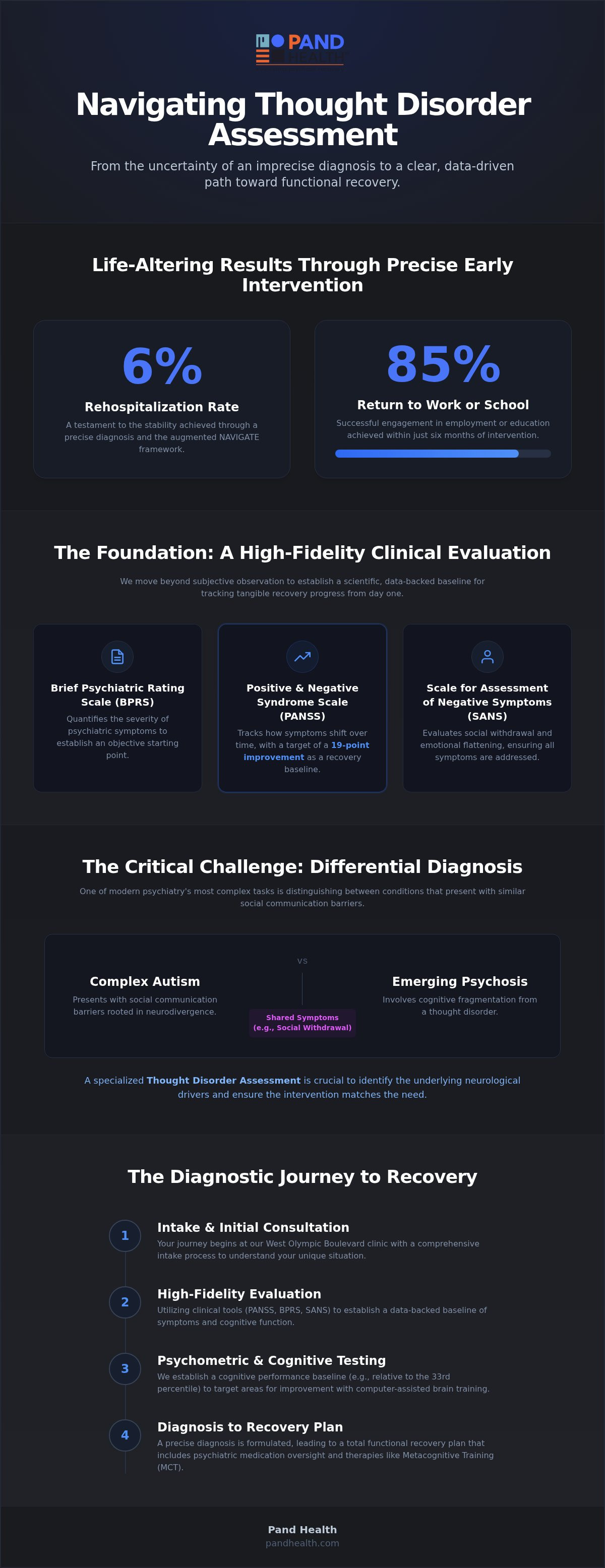
You likely feel exhausted by the search for early intervention programs that offer more than just crisis management. We understand that you need a roadmap that leads back to school or work, not just another prescription. This article explores how Pand Health utilizes the augmented NAVIGATE framework to transform assessments into life-altering recovery plans. We'll examine the data behind our 6% rehospitalization rate and show you how a precise diagnosis facilitates a return to 85% engagement in employment or education within just six months.
Key Takeaways
- Learn how a specialized thought disorder assessment LA identifies subtle cognitive patterns that general evaluations often miss.
- Discover how clinical tools like the PANSS scale provide a data-backed baseline to track tangible recovery progress from day one.
- Understand why the augmented NAVIGATE framework and Metacognitive Training (MCT) are essential for reducing rehospitalization risks.
- See how precise early intervention leads to an 85% success rate for returning to work or school within six months.
- Explore the diagnostic journey at our West Olympic Boulevard clinic, including intake procedures and psychiatric medication reviews.
Understanding Thought Disorder Assessment in Los Angeles
A thought disorder assessment LA serves as a sophisticated clinical mirror, reflecting the intricate cognitive and communicative patterns that define an individual's mental landscape. This specialized psychiatric evaluation isn't merely a diagnostic hurdle; it's a deep dive into how a person processes information and expresses thoughts. By Understanding Thought Disorder through a rigorous lens, clinicians can identify the subtle shifts in reality testing that separate conditions like schizophrenia from schizoaffective disorder or bipolar-I with psychotic features.
In Southern California, where the pace of life is relentless, recognizing symptoms like disorganized speech, persistent delusions, or sudden social withdrawal is vital for long-term brain health. These aren't just personality changes. They are biological signals that the brain requires immediate, specialized support. An accurate assessment provides the baseline needed to move from confusion to a structured recovery path.
The Critical Need for Early Psychosis Intervention
The window of opportunity in mental health is often defined by the Duration of Untreated Psychosis (DUP). Research consistently shows that the longer a person experiences psychosis without intervention, the more challenging the road to recovery becomes. Los Angeles families often find themselves in a high-risk phase, where they notice a loved one becoming increasingly eccentric, suspicious, or isolated. Recognizing these early warning signs allows for a proactive approach. The California OnTrack model, specifically designed for individuals aged 13 to 40, prioritizes this early window. It transforms a potential crisis into a manageable path toward stability, focusing on brain plasticity and the restoration of normal function before symptoms become deeply entrenched.
Differential Diagnosis: Psychosis vs. Autism
One of the most complex challenges in modern psychiatry is distinguishing between the social communication barriers found in autism and the cognitive fragmentation of a thought disorder. Both can manifest as social withdrawal or difficulty following a conversation, leading to frequent misdiagnosis. Pand Health specializes in this nuanced differential diagnosis. We look beyond the surface behaviors to understand the underlying neurological drivers. Whether a young adult requires specialized support for neurodivergence or intensive treatment for a first-episode psychosis, an accurate thought disorder assessment LA ensures the intervention matches the need. For many, this includes Social Skills Training, which provides a bridge to reconnection regardless of the specific diagnosis, helping individuals navigate the complexities of social life with renewed confidence.
Core Components of a High-Fidelity Clinical Evaluation
A high-fidelity clinical evaluation is the cornerstone of effective treatment. It moves beyond subjective observations to establish a scientific baseline. This process begins with the Brief Psychiatric Rating Scale (BPRS), a tool used to quantify the severity of psychiatric symptoms. By establishing this initial data point, clinicians can measure progress with objective clarity. For families beginning thought disorder assessment LA, this data provides the first sense of tangible direction in a often-confusing landscape.
Tracking recovery requires even more granular detail, which is why we utilize the Positive and Negative Syndrome Scale (PANSS). This scale doesn't just identify symptoms; it tracks how they shift over time. At Pand Health, we aim for a 19-point PANSS improvement as a baseline for what patients can expect during their recovery. The Diagnostic Journey also incorporates the Scale for the Assessment of Negative Symptoms (SANS). This specialized tool evaluates social withdrawal and emotional flattening, ensuring that the often-overlooked "negative" symptoms of a thought disorder are addressed with the same urgency as more visible "positive" symptoms like delusions. This comprehensive approach is always paired with psychiatric medication oversight to ensure biological stability matches psychological progress.
Psychometric Testing and Cognitive Baseline
We believe that recovery is measurable. During the assessment, we establish a cognitive performance baseline, often identifying where an individual sits relative to the 33rd percentile of their peers. This data isn't used to limit potential but to fuel it. Once we understand the current cognitive landscape, we implement computer-assisted brain training to bridge the gap. Cognitive remediation is the process of strengthening neural pathways through targeted exercises. This evidence-based intervention, recommended by the APA, is a critical follow-up to the initial assessment, ensuring the brain has the "hardware" necessary to support long-term psychological health.
Family History and Psychoeducation Integration
In Southern California’s Coordinated Specialty Care (CSC) programs, the family is never an afterthought. We integrate Behavioral Family Therapy into the very first stages of the diagnostic phase. This isn't just about gathering history; it's about building a support system that understands the science of the diagnosis. Family psychoeducation helps parents and siblings interpret assessment results without the weight of stigma or fear. When the entire support system is aligned with the clinical roadmap, the risk of crisis drops significantly. If you're ready to move toward a data-backed recovery plan, you can contact our Los Angeles team to begin the evaluation process.
Why Pand Health’s Assessment Model Leads in Southern California
Pand Health elevates the standard of care by moving beyond the traditional ceilings of mental health treatment. While many clinics offer basic evaluations, a thought disorder assessment LA at our facility serves as the essential gateway to the California OnTrack program. This model is an augmented version of the NIMH NAVIGATE framework, specifically redesigned to address the complexities of first-episode psychosis with greater intensity. By integrating these specialized protocols, we achieve a 6% rehospitalization rate, significantly outperforming the 10% industry average. This isn't just about maintaining stability. It's about a measurable 19-point improvement in PANSS scores that signals a true, functional return to health.
Our approach transforms the diagnostic process into a predictive roadmap. We don't just identify symptoms; we identify potential. By using data-driven benchmarks, we provide families with a clear vision of what the next year of recovery will look like. This level of transparency is rare in psychiatric care, yet it's exactly what families in crisis need to feel a sense of agency and hope.
Certified Expertise and Specialized Protocols
Expertise in this niche field requires more than general psychiatric training. Pand Health stands as the only provider in Southern California with certified Metacognitive Training (MCT) instructors. This distinction is vital because MCT targets the specific cognitive biases that fuel delusional thinking, providing patients with the tools to "think about their thinking." We pair this with APA-recommended cognitive remediation and Social Cognition and Interaction Training (SCIT) to ensure a holistic recovery. Our clinical team utilizes evidence-based thought disorder assessment techniques to ensure every protocol is documented and transparent. When families see the rigorous science behind our methods, the path forward becomes both clear and reassuring.
The Role of Technology in Modern Assessments
We utilize a sophisticated Learning Management System (LMS) to maintain absolute clinical fidelity across all treatment modules. This technology ensures that every patient receives the exact intervention prescribed by their initial thought disorder assessment LA. Innovation at Pand Health also extends to the physical body. We've found a powerful synergy between high-intensity fitness coaching and cognitive remediation. This dual approach stimulates brain plasticity, leading to 50th percentile cognitive gains within the first 12 months of treatment. These data points inform the initial assessment, allowing us to predict and promote success with a level of precision that traditional models simply cannot match. We don't just hope for progress; we engineer it through the intersection of science and human-centric care.
The Diagnostic Journey: What to Expect at Our Los Angeles Clinic
The journey toward lasting stability begins at our specialized hub located at 11500 W. Olympic Blvd., Suite 399, Los Angeles, CA 90064. We've designed this space to function as a sanctuary for families seeking clarity in a complex mental health landscape. The process starts with a meticulous intake and a psychiatric medication review. This ensures that any biological interventions are perfectly calibrated to the individual's needs from day one. A thought disorder assessment LA at our clinic isn't a one-time event; it's the start of a monitored recovery. We utilize structured monthly interviews to track progress, ensuring the clinical roadmap remains responsive to the individual's evolving needs.
We understand that the first appointment can feel daunting. Our goal is to provide a steady hand during this transition, moving you away from the "revolving door" of hospitalizations and toward a future defined by growth. If you are ready to begin this process, you can Contact Pand Health for a preliminary consultation with our clinical team.
Preparing for Your First Appointment
To ensure a comprehensive evaluation, we ask families to bring any available medical history, previous school records, and a detailed list of current or past medications. These documents help our clinicians build a complete picture of the individual's journey. We also recognize the emotional toll this process takes on the support system. To prepare emotionally, many families find "The Mind Exposed Podcast" to be a valuable resource for understanding the nuances of recovery. Our clinic operates under a clubhouse model, which provides a supportive, non-clinical environment. This approach prioritizes human connection and dignity, making the diagnostic experience feel personal rather than institutional.
Navigating the Los Angeles Mental Health System
Finding a path through the local mental health system requires more than just clinical expertise; it requires advocacy. Pand Health coordinates directly with Los Angeles schools and workplaces to ensure our clients have the support they need for successful reintegration. Following a thought disorder assessment LA, individuals often transition into our "Supported Education & Employment" (SEE) curriculum. This curriculum is specifically designed to bridge the gap between clinical recovery and real-world success. We frequently help families weigh the benefits of intensive outpatient care versus traditional inpatient stays. In Southern California, our augmented CSC model offers a high-intensity alternative that allows individuals to recover within their community, maintaining the vital bonds of family and friendship.
Moving From Diagnosis to Total Functional Recovery
"Recovery is the expectation, not the exception!" This isn't just a tagline at Pand Health; it's the clinical reality we strive for with every individual. While a thought disorder assessment LA provides the necessary diagnostic clarity, the ultimate objective is total functional recovery. We define success by an individual's ability to live, work, and thrive within their community. Our data shows that 85% of our clients are engaged in employment or education within just six months of entering the program. This high level of engagement is a direct result of moving beyond symptom management and focusing on the restoration of a meaningful life.
Social rehabilitation plays a critical role in this transition. By addressing the cognitive and social barriers identified during the initial assessment, we help individuals reintegrate into their Los Angeles communities with renewed purpose. This process isn't about simply "getting through" a crisis. It's about building a sustainable future where the individual feels empowered to pursue their goals. We don't just want you to feel better; we want you to live better.
The California OnTrack Work-Study Program
The California OnTrack Work-Study Program represents the culmination of our assessment and treatment model. This specialized curriculum focuses on practical reintegration through resume building, motivational interviewing, and direct workplace advocacy. We understand that clinical gains must translate into professional and educational success to be truly transformative. Our team works as a bridge between the clinical setting and the real world, ensuring that employers and educators understand the support needed for long-term success. Unlike many programs that have a strict cutoff, we offer indefinite enrollment. This provides a continuous safety net for our clients in Southern California, allowing them to navigate the ups and downs of their professional lives with expert guidance.
Long-Term Success and Relapse Prevention
Sustainable recovery requires a significant investment of time and specialized care. We provide between 24 and 32 hours of intensive treatment per client, ensuring that every facet of their well-being is addressed. A key metric in our social recovery model is the 40% reduction in SANS scores, which measures the "negative" symptoms that often lead to social isolation. By reducing these barriers, we pave the way for genuine connection and community involvement. This comprehensive approach is why our rehospitalization rates remain so low compared to industry averages. We don't just treat the disorder; we support the person. If you're ready to move past the diagnosis and toward a life of functional success, we invite you to schedule a comprehensive evaluation today.
Reclaiming a Future Beyond the Diagnosis
The transition from confusion to clarity is a profound turning point for any family. By prioritizing a specialized thought disorder assessment LA, you're choosing a path that values long-term functional success over temporary symptom management. We've seen how our augmented NAVIGATE framework transforms lives, resulting in a 6% rehospitalization rate that sits well below the 10% industry average. This isn't just about achieving clinical stability; it's about the 85% of our clients who successfully return to school or work within six months of starting their journey.
At our hub on West Olympic Boulevard, we provide the steady hand needed to navigate these complex challenges. We believe that every individual deserves a roadmap that leads back to their community and their personal ambitions. The data confirms that with the right diagnostic precision and specialized support, total recovery is a tangible reality. You don't have to navigate this storm alone. Our team is here to guide you toward a future defined by growth, reconnection, and lasting wellness.
Request a Comprehensive Thought Disorder Assessment in Los Angeles
Frequently Asked Questions
What is the difference between a standard psychiatric evaluation and a thought disorder assessment?
A thought disorder assessment is significantly more granular than a standard psychiatric evaluation. While a standard evaluation focuses on general mood and behavior, this specialized assessment utilizes validated tools like the PANSS and BPRS to measure cognitive fragmentation and reality testing. It establishes a scientific baseline that allows clinicians to distinguish between conditions like schizophrenia and schizoaffective disorder with much greater precision.
How long does a comprehensive thought disorder assessment take at your LA clinic?
A comprehensive thought disorder assessment LA typically spans several hours across multiple sessions to ensure absolute clinical accuracy. This process includes an initial intake, a meticulous psychiatric medication review, and structured clinical interviews. This thorough approach allows our team at the West Olympic Boulevard clinic to capture a complete picture of an individual's cognitive landscape before beginning treatment.
Do you provide assessments for teenagers experiencing their first psychotic episode?
Yes, we specialize in early intervention for teenagers and young adults through our California OnTrack for Teens program. We focus on individuals between the ages of 13 and 40, as this is the most critical window for protecting long-term brain health. Our assessments are designed to identify the "high-risk" phase of first-episode psychosis, allowing us to implement a recovery roadmap before symptoms become entrenched.
Is a thought disorder assessment the same as a schizophrenia test?
No, a thought disorder assessment is a much broader diagnostic tool than a simple test for schizophrenia. It is designed to evaluate a wide spectrum of psychotic and cognitive disorders, including bipolar-I with psychotic features and schizoaffective disorder. The goal is to provide a nuanced differential diagnosis that informs a personalized recovery plan rather than simply applying a broad clinical label.
Can an assessment distinguish between cannabis-induced psychosis and a chronic thought disorder?
Our clinical team specializes in the complex task of distinguishing between substance-induced symptoms and primary thought disorders. By analyzing the onset of symptoms and specific cognitive markers, we can determine if a person requires cannabis-induced psychosis rehab or a long-term plan for a chronic condition. This distinction is vital because the medication strategies and social rehabilitation needs for these two pathways differ significantly.
What are the next steps if my child is diagnosed with a thought disorder in Los Angeles?
Following a diagnosis, the immediate next step is usually enrollment in the California OnTrack program. This coordinated specialty care model provides a bridge to the "Supported Education & Employment" curriculum and social skills training. We also coordinate directly with local Los Angeles schools and workplaces to advocate for your child, ensuring they have the necessary accommodations to thrive in their community.
Do you accept insurance for evaluations at Pand Health?
Pand Health operates as a specialized, private-pay provider to ensure a premium standard of intervention and clinical fidelity. We provide families with a "Superbill" that can be submitted to PPO insurance plans for potential out-of-network reimbursement. In accordance with federal law, we also provide a "Good Faith Estimate" of all expected costs at least one business day before the assessment begins.
How does the California OnTrack program use assessment data to prevent rehospitalization?
The California OnTrack program uses initial thought disorder assessment LA data to target specific cognitive deficits with surgical precision. By aiming for a 19-point PANSS improvement and tracking progress through our Learning Management System, we address the root causes of instability. This data-driven methodology is why our rehospitalization rate is only 6%, compared to the 10% industry average found in traditional care models.
Disclaimer
This article is for information and educational purposes only, and can NEVER replace a proper medical evaluation. If you or a loved one may be suffering from psychosis or the prodomal symptoms of psychosis, get evaluated by a professional as soon as possible. Early diagnosis and treatment can be life-saving.