

Rebuilding Connection: How to Make Friends After Psychosis
What if the most significant obstacle to your social recovery isn't a lack of character, but a temporary glitch in the cognitive tools you use to interpret the world? It's deeply painful to feel like an outsider in your own life, especially when you're constantly over-analyzing social cues or wondering how to make friends after psychosis without the fear of being judged. You might feel as though the person you were before your episode has vanished, leaving you unsure of how to bridge the gap between isolation and community.
We understand that the journey back to social health feels daunting, but recovery is the expectation. This guide offers a structured, expert-led approach to overcoming social anxiety and reclaiming your identity. We'll explore how evidence-based cognitive tools can help you rebuild trust in your own social perceptions. By the end of this article, you'll have a clear roadmap for managing anxiety and building a supportive circle of friends who value you for who you are today.
Key Takeaways
- Understand that social recovery is a fundamental pillar of rehabilitation, and feeling "different" is a common, manageable part of the healing process.
- Learn how evidence-based frameworks like Metacognitive Training (MCT) help you manage social anxiety by addressing the tendency to jump to conclusions.
- Gain a clear, five-step roadmap for how to make friends after psychosis, focusing on low-stakes social settings and the power of active listening.
- Manage the complexities of your personal history with the "Onion Layer" approach, ensuring you maintain control over your medical narrative while building trust.
- Discover how specialized social skills training and programs like California OnTrack provide the structured support needed to bridge the gap back to school and work.
The Challenge of Building Friendships with Social Anxiety After Psychosis
Social recovery is more than just the absence of symptoms; it's a core pillar of your overall rehabilitation. After a psychotic episode, it's common to feel as though you've fallen behind your peers or that your social identity has been fractured. This sense of being "different" isn't a failure of character. It's often the result of how psychosis temporarily disrupts the brain's ability to process complex social cues. When you're learning how to make friends after psychosis, you aren't just battling nerves; you're often recalibrating how you perceive and interact with the world around you.
Many survivors describe living through a "normalcy filter." This is the exhausting, constant effort to act exactly like everyone else to avoid suspicion or judgment. This hyper-focus on appearing "normal" consumes the mental energy you would otherwise use to enjoy a conversation. It turns a simple coffee date into a high-stakes performance, making social interaction feel like a chore rather than a connection. Validating this exhaustion is the first step toward moving past it.
Why Social Anxiety Feels Different Post-Psychosis
General social anxiety usually involves a fear of being boring or disliked. Post-psychosis anxiety is more specific, often centered on the fear of "sounding crazy" or having a symptom noticed by others. This is complicated by "negative symptoms" like a flat affect, where your facial expressions or tone might not match your internal emotions. Social cognition refers to the mental processes we use to perceive, interpret, and respond to the intentions and behaviors of others. When these processes are temporarily out of sync, building a friendship requires more conscious, structured effort.
The Burden of Self-Consciousness
There is often a "skeleton in the closet" feeling, where you carry your mental health history like a secret that could ruin a relationship if revealed. This leads to intense hyper-vigilance, where you analyze every word for potential "red flags." This mental monitoring has a high psychological cost, leading to burnout and social withdrawal. To combat this, try a brief "reality check" exercise: if you worry you said something "weird," ask yourself if you would judge a friend for saying the same thing. Usually, the answer is no. Understanding how to make friends after psychosis involves realizing that most people are focused on their own lives, not scrutinizing your every word.
Rebuilding Your Social 'Muscles' with Evidence-Based Tools
Psychosis can act like a temporary injury to the brain's social processing center. Just as an athlete uses physical therapy to regain mobility after a strain, you can use evidence-based clinical tools to retrain your mind. Learning how to make friends after psychosis becomes significantly more manageable when you address the underlying cognitive mechanics. These interventions aren't just traditional therapy; they're a form of brain training designed to sharpen your focus, memory, and social perception.
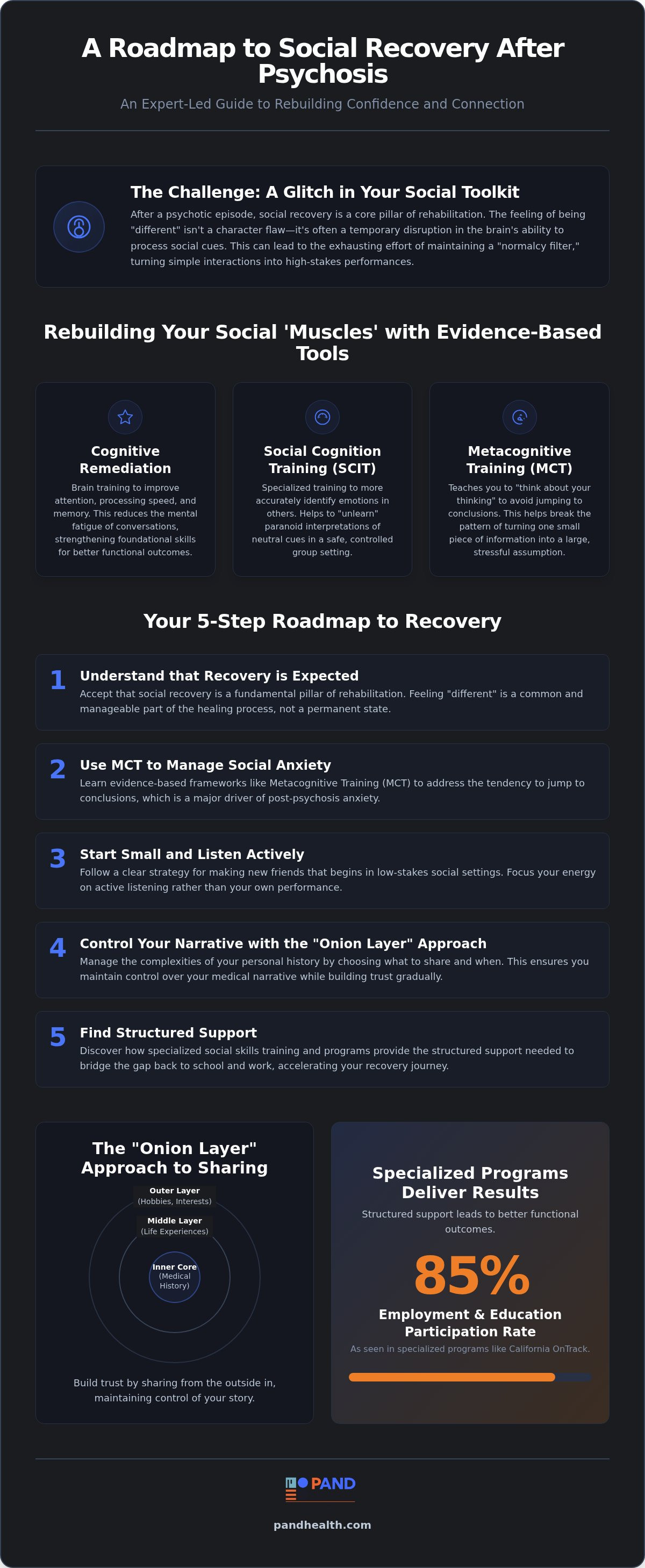
Cognitive Remediation is a vital part of this process. It focuses on improving executive functions like attention and processing speed. This is essential because even a brief conversation requires significant "mental bandwidth." You have to remember what the other person said, plan your response, and ignore environmental distractions simultaneously. By strengthening these foundational skills, you reduce the mental fatigue that often leads to social withdrawal. Evidence shows that focusing on these cognitive "muscles" leads to better functional outcomes, including an 85% employment and education participation rate seen in specialized programs like California OnTrack.
Understanding Social Cognition and Interaction Training (SCIT)
SCIT is a specialized training program that helps you identify emotions in others more accurately. Often, psychosis can lead to a "bias" where neutral facial expressions seem angry or suspicious. In a group setting, SCIT allows you to practice identifying these cues and "unlearning" paranoid interpretations. It provides a safe, controlled environment to test social scenarios before you encounter them in the real world. As the only outpatient program in Southern California offering SCIT, we've seen how this specific training helps individuals feel more grounded and less reactive during social encounters.
Metacognitive Training: Thinking About Your Thinking
Metacognitive Training (MCT) addresses "jumping to conclusions," a common cognitive pattern where one small piece of information leads to a massive, often stressful, assumption. MCT teaches you to "think about your thinking." It creates a mental buffer between an automatic thought and your emotional reaction. For example, if a new acquaintance doesn't text back immediately, MCT helps you pause before assuming they've rejected you. This "don't believe everything you think" approach is a powerful tool when you are learning how to make friends after psychosis. If you're ready to start practicing these skills in a supportive environment, contact our specialized team to explore our local social rehabilitation options.
A 5-Step Strategy for Navigating New Friendships
Rebuilding a social circle after a crisis requires a methodical approach rather than a leap of faith. While some online forums suggest "just being yourself," we recognize that when you're figuring out how to make friends after psychosis, you need more than just encouragement. You need a strategy that respects your energy levels and cognitive load. This process isn't about rushing back into the deep end; it's about wading in slowly until the water feels comfortable again.
Success in social reintegration often relies on the following five steps:
- Choose Low-Stakes Environments: Prioritize settings where the focus is on a shared task, such as an art class, a coding workshop, or a community garden. This removes the pressure of constant eye contact and direct interrogation.
- Practice Active Listening: Focus intensely on the other person's words rather than your own internal "filter." This naturally reduces the exhaustion of the normalcy filter and makes you a valued conversationalist.
- Set Social Micro-Goals: Aim for small wins, like staying at an event for twenty minutes or asking one situational question. This builds confidence without leading to the cognitive burnout discussed earlier.
- Identify Bridge Friends: Look for individuals who demonstrate high empathy or have their own lived experience with health challenges. These people act as a safe transition into broader social groups.
- Prioritize Consistency: Showing up to the same place at the same time builds familiarity. Trust is often a byproduct of simple, repeated presence.
Phase 1: Observation and Low-Stakes Interaction
In the early stages, your goal is simply to exist in the same space as others. Task-based groups are ideal because they provide a "third object" to talk about, such as a project or a shared hobby. Use situational openers, like "How long have you been coming to this class?" to start small. We recommend the 15-minute rule: commit to staying for just a quarter of an hour. If you feel overwhelmed after that point, you've still achieved a micro-goal and can leave with your confidence intact.
Phase 2: Building Consistency and Trust
Trust is built through regularity. People naturally develop a preference for those they see often. Regularly attending the same coffee shop or interest group makes you a familiar face, which lowers the barrier for others to approach you. As you feel more secure, you can transition from an acquaintance to a potential friend by sharing small details about your life. Navigating how to make friends after psychosis involves recognizing who responds with curiosity and kindness. A supportive person will listen more than they judge, providing the safety you need to continue your social recovery.
To Disclose or Not? Navigating Your Mental Health History
Disclosure is a choice, not a debt you owe to every person you meet. As you navigate how to make friends after psychosis, you might feel a heavy pressure to "explain" your past or justify gaps in your recent history. It's vital to remember that your medical narrative belongs to you. While honesty is a foundation of deep friendship, it doesn't require immediate transparency about every clinical detail of your recovery. You have the right to share your story at a pace that feels safe and earned.
We recommend the "Onion Layer" approach to sharing personal information. Start with the outermost layer; general interests and present-moment experiences. As trust develops, you might move to a middle layer, mentioning you've dealt with health challenges or took a "sabbatical" to focus on wellness. The innermost layer, which includes the specifics of your diagnosis and episode, should only be revealed once a person has demonstrated they are empathetic and non-judgmental. This method protects your vulnerability while allowing intimacy to grow naturally over time.
One of the most common anxieties involves explaining "missing time," such as periods of hospitalization or recovery gaps in your resume. You aren't required to use clinical terms. Phrases like "I was managing a private health matter" or "I took some time away to focus on family and personal growth" are perfectly acceptable. Most people will respect these boundaries. If someone pushes for more detail than you're ready to give, it may be a sign that they aren't yet a "safe" person for deeper disclosure.
The 'Need to Know' Framework
Defining who earns the right to hear your full story is an act of self-care. You might draft a "one-sentence summary" for casual inquiries, such as: "I had a rough year health-wise, but I'm doing much better now and am really excited about this new project." This acknowledges the past without inviting a deep dive into your medical history. Once you've delivered your summary, practice shifting the conversation back to the present or asking the other person a question about their own life.
Managing Rejection and Stigma
Preparing for the possibility that not everyone will understand is a difficult but necessary part of the process. If a disclosure is met with stigma, remind yourself that a negative reaction is a reflection of their limitations, not your worth. Stigma often stems from a lack of education rather than a judgment of your character. When a social experience feels heavy or discouraging, turn to your established support system to recalibrate. If you need professional guidance on managing these complex social dynamics, contact our team to learn more about our specialized social rehabilitation programs.
How Specialized Social Skills Training Accelerates Recovery
While some believe that time alone heals the emotional obstacles following an episode, clinical evidence suggests that active, structured intervention is far more effective. Relying solely on "waiting to feel better" can lead to prolonged isolation and missed opportunities for connection. Instead, specialized Social Skills Training in Los Angeles provides a protected environment where you can rebuild your confidence. These programs serve as a vital safety net, allowing for social experimentation without the immediate fear of real-world rejection. By practicing in a clinical setting, you refine the cognitive tools discussed earlier, making the process of learning how to make friends after psychosis feel less like a gamble and more like a mastered skill.
The California OnTrack program specifically bridges the gap between clinical stabilization and functional success in school or the workplace. This model focuses on community reintegration, ensuring that your social recovery isn't limited to a therapy room. We also utilize elements of the "Clubhouse Model" of rehabilitation, which treats participants as active members of a community rather than passive recipients of care. This shift in perspective is often the catalyst needed to reclaim a sense of social identity and purpose. When you're surrounded by a community that expects your success, the path toward a normal social life becomes much clearer.
The Power of Group Therapy and Multi-Family Groups
Isolation thrives in silence. Hearing others articulate the same social anxieties you feel provides a profound sense of relief and validation. Within our group sessions and multi-family groups, you have the opportunity to role-play difficult social situations under the guidance of experts. Whether it's practicing a conversation about a gap in your history or navigating a workplace conflict, these sessions offer a "dress rehearsal" for life. This peer support network often evolves into the first circle of a new, supportive social life, proving that you aren't alone in your journey.
Next Steps: Reclaiming Your Life in Los Angeles
Mastering how to make friends after psychosis is a journey that doesn't have to be taken alone. If you're in the Southern California area, we encourage you to contact Pand Health for a comprehensive social rehabilitation evaluation. Our team is dedicated to providing the niche knowledge and steady guidance needed to navigate this transition. We operate under the firm belief that recovery is the expectation for every individual we serve. Social connection is not a luxury; it's a fundamental human need that you can, and will, master as you move toward long-term wellness.
Your Path to Reconnection and Community
Reclaiming your social life is a deliberate process of retraining your brain and rediscovering your identity. By utilizing evidence-based frameworks like Metacognitive Training (MCT) and Social Cognition and Interaction Training (SCIT), you can move past the exhaustion of the normalcy filter and rebuild trust in your own perceptions. Learning how to make friends after psychosis isn't about hiding your past; it's about building a future where you feel secure and supported in every interaction.
As the only outpatient provider in Southern California offering these specialized tools, we've seen the transformative power of a structured approach. Programs like California OnTrack are specifically designed to facilitate social reintegration, leading to an 85% participation rate in education and employment within six months. You don't have to navigate this transition alone. Our team provides the niche expertise and compassionate guidance required to turn social anxiety into social mastery.
Take the first step toward social reconnection; Contact Pand Health today. Recovery is the expectation, and a vibrant, supportive community is well within your reach.
Frequently Asked Questions
Is it normal to feel lonely after a psychotic episode?
Feeling isolated is a nearly universal experience during the recovery process. Psychosis often disrupts your social rhythms and can lead to a period of withdrawal while you focus on stabilization. This loneliness isn't a permanent state, but rather a common side effect of the healing journey that many others have successfully navigated.
How do I explain the gap in my resume or school history to new friends?
You aren't required to provide a clinical explanation for gaps in your history. Most people will accept a simple, honest statement like, "I took some time away to handle a private health matter," or "I was on a wellness sabbatical." These phrases establish a boundary while remaining truthful, allowing you to keep the focus on your current interests and goals.
What if I feel like I've lost my personality after psychosis?
It's common to feel as though your personality has been dampened by "negative symptoms" or the side effects of medication. This is usually a temporary phase of recovery rather than a permanent loss of who you are. As your brain continues to heal and you engage in social rehabilitation, your unique traits and sense of humor typically resurface.
Can social skills training really help me make friends?
Social skills training acts as a clinical laboratory where you can practice the mechanics of interaction without the fear of real-world consequences. By breaking down complex behaviors into manageable steps, it provides the confidence needed when you are learning how to make friends after psychosis. These programs offer a safe space to refine your communication before applying it in broader settings.
How do I deal with social anxiety when meeting new people?
Shifting your focus from self-monitoring to active curiosity about the other person is one of the most effective ways to lower anxiety. When you prioritize listening, you reduce the mental pressure to perform or act "normal." Grounding techniques, such as focusing on your immediate environment, can also help keep you present during a conversation.
Should I tell my new friends that I was hospitalized for psychosis?
Disclosure is a milestone that should only be reached when a high level of trust has been established. You don't owe your medical history to casual acquaintances. Wait until a friend has proven themselves to be empathetic and supportive over time before sharing the more vulnerable layers of your recovery story.
What are the first signs that I’m ready to start socializing again?
A natural sense of curiosity about the world and a stabilization of your daily energy levels are often the first indicators of readiness. If you've reached a point where you're actively searching for information on how to make friends after psychosis, your mind is already signaling a desire for connection. Start with small, low-stakes interactions to test your comfort levels.
How can I find a social skills group for young adults in Los Angeles?
Pand Health offers specialized social rehabilitation and skills training specifically for young adults and teens in the Los Angeles area. Our California OnTrack program is designed for individuals aged 13 to 40, providing a structured environment to practice social reintegration. These local groups offer a supportive community of peers who are working toward similar goals of wellness and connection.
Disclaimer
This article is for information and educational purposes only, and can NEVER replace a proper medical evaluation. If you or a loved one may be suffering from psychosis or the prodomal symptoms of psychosis, get evaluated by a professional as soon as possible. Early diagnosis and treatment can be life-saving.