Psychiatry and the Law: A Guide for Los Angeles Families
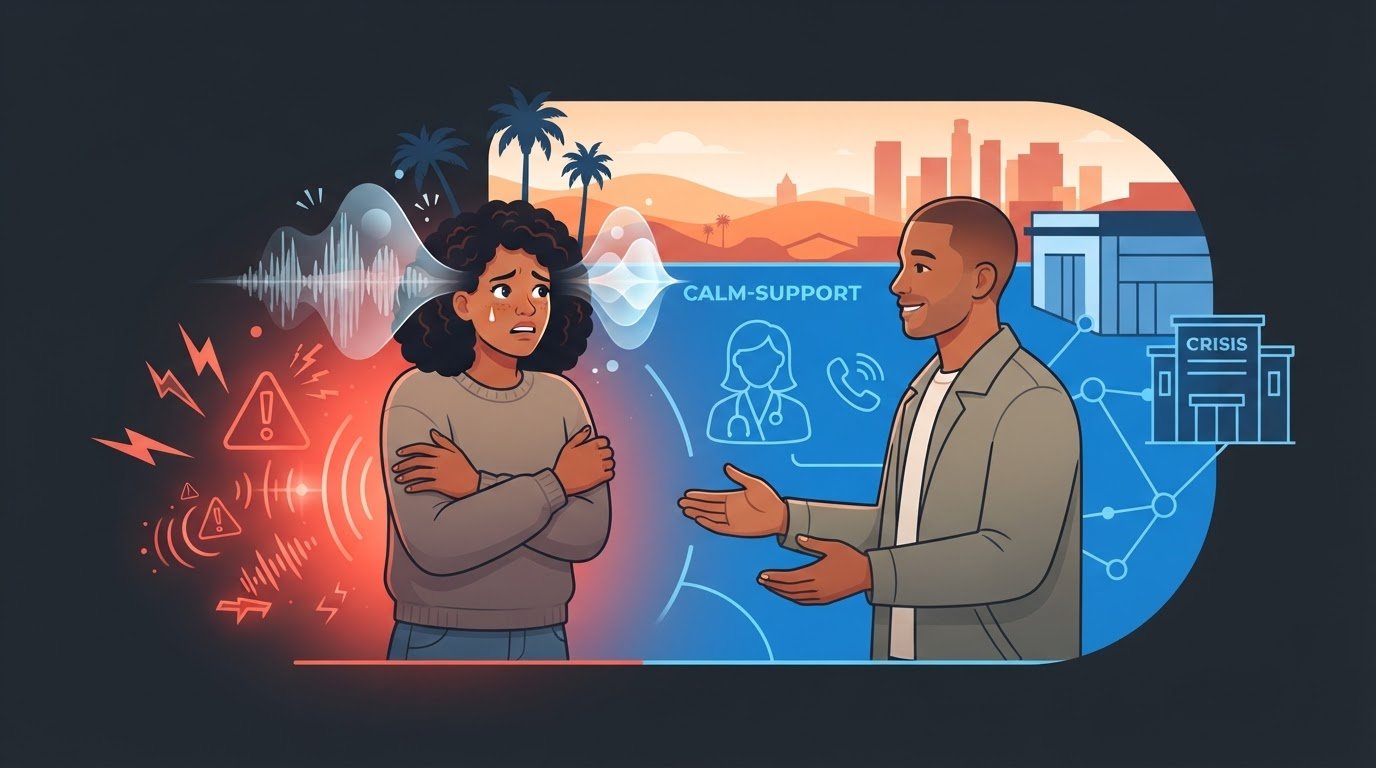
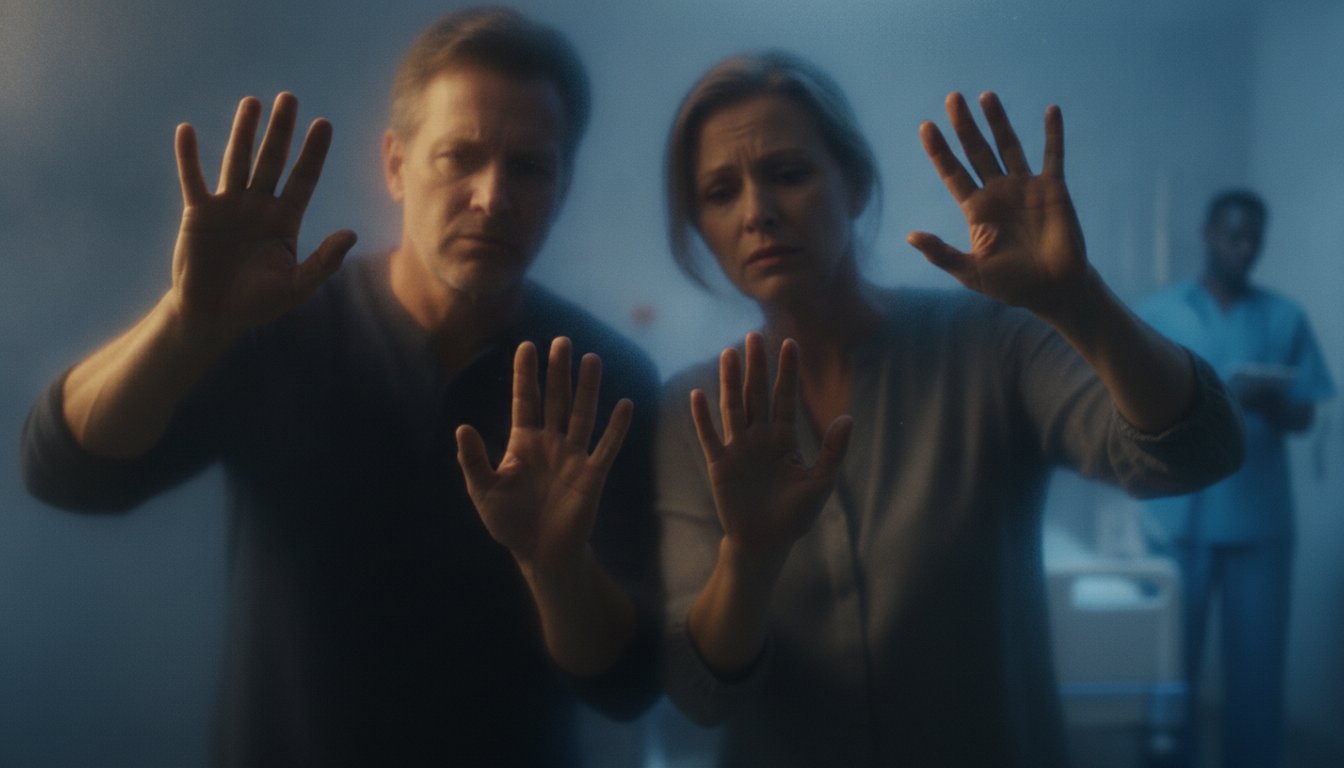
Imagine standing in a Los Angeles emergency room, watching your loved one struggle with a reality you can't see, only to be told that privacy laws prevent the doctor from even hearing your perspective. It's a moment where the legal system feels like a wall rather than a lifeline. You aren't alone in feeling helpless against the complexities of HIPAA or the rigid criteria of a 5150 hold. For many, understanding psychiatry and the law: what families need to know is the difference between a cycle of crisis and a sustainable path to stability.
We're here to provide the clinical authority and empathy required to navigate California's LPS laws, including the 2026 expansions under Senate Bill 43. This guide clarifies how you can legally share vital history with doctors and identifies recovery-oriented programs that include the family in every step. At our practice located at 11500 W. Olympic Blvd., Suite 399, Los Angeles, CA 90064, we maintain a 6% rehospitalization rate because we treat the legal landscape as a tool for advocacy. We'll show you how to move from fear to informed action, because this is a place where recovery is the expectation, not the exception!
Key Takeaways
- Understand the 2026 shifts in California's Lanterman-Petris-Short (LPS) Act and how Senate Bill 43 expands the definition of "gravely disabled" to help families secure necessary care.
- Learn the truth about HIPAA and the "18-year-old wall," including specific strategies for legally providing clinical history to doctors when your adult child is in crisis.
- Discover the essential details of psychiatry and the law: what families need to know regarding 5150 holds and the judicial pathway toward an LPS conservatorship in Los Angeles.
- Master the art of family advocacy by maintaining a "Journal of Concerns" that meets the evidence standards required by the Los Angeles Department of Mental Health.
- Explore how recovery-oriented programs like California OnTrack integrate legal expertise with clinical treatment to reduce rehospitalization rates to just 6%.
The Intersection of Psychiatry and the Law in California
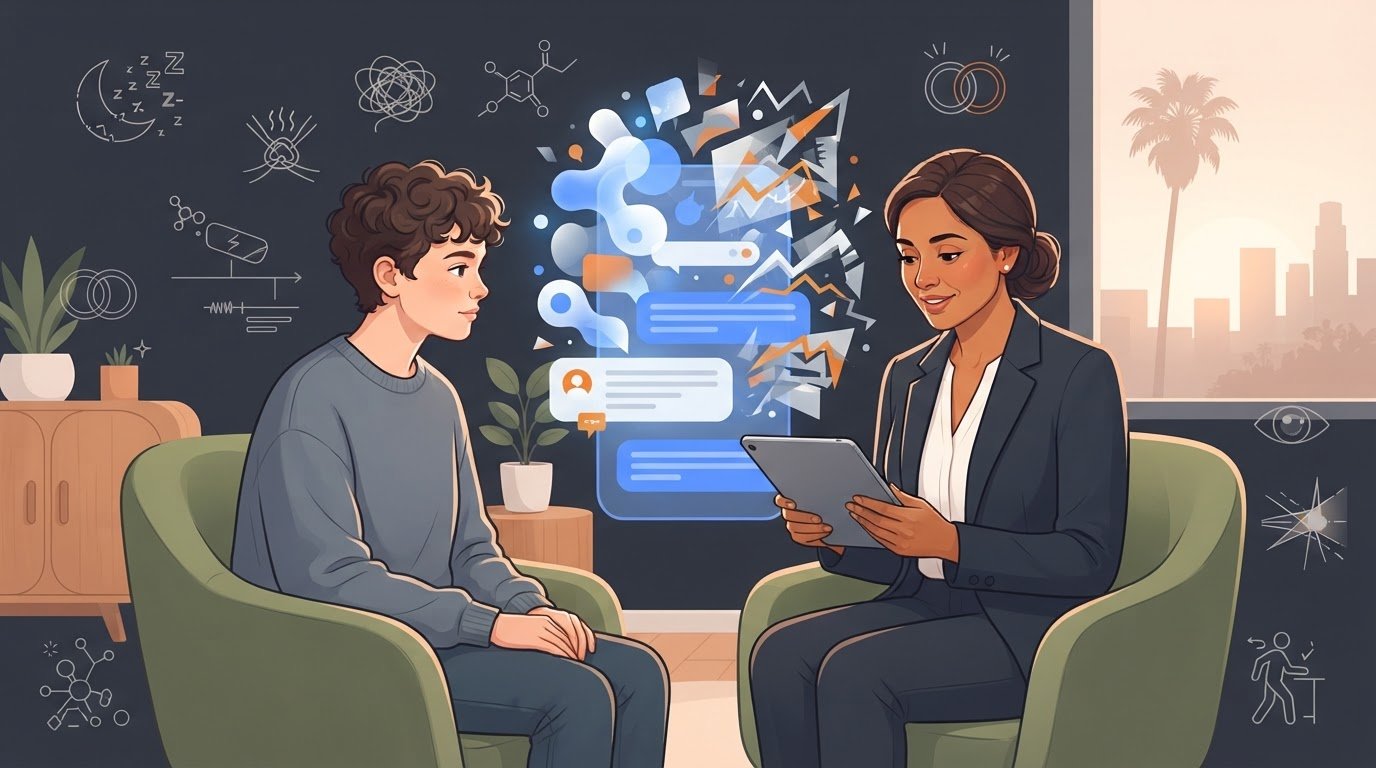
Understanding the legal architecture of mental health care in Los Angeles is often the first step toward reclaiming a sense of agency during a family crisis. When a loved one experiences a first episode of psychosis, psychiatry and the law: what families need to know becomes a critical map for a journey that feels entirely unnavigable. Historically, the system prioritized containment over rights. Today, the pendulum has swung toward autonomy. While this shift protects civil liberties, it can leave families feeling isolated and "locked out" of the clinical process just when their input is most vital.
Defining the LPS Act: California's Legal Framework
The Lanterman-Petris-Short (LPS) Act was established in 1967 to end the inappropriate and indefinite commitment of individuals with mental health disorders. It fundamentally changed how Los Angeles approaches psychiatric intervention by prioritizing patient-centered autonomy. The goal was to balance civil liberties with the need for immediate care, but this balance often creates a high bar for involuntary treatment.
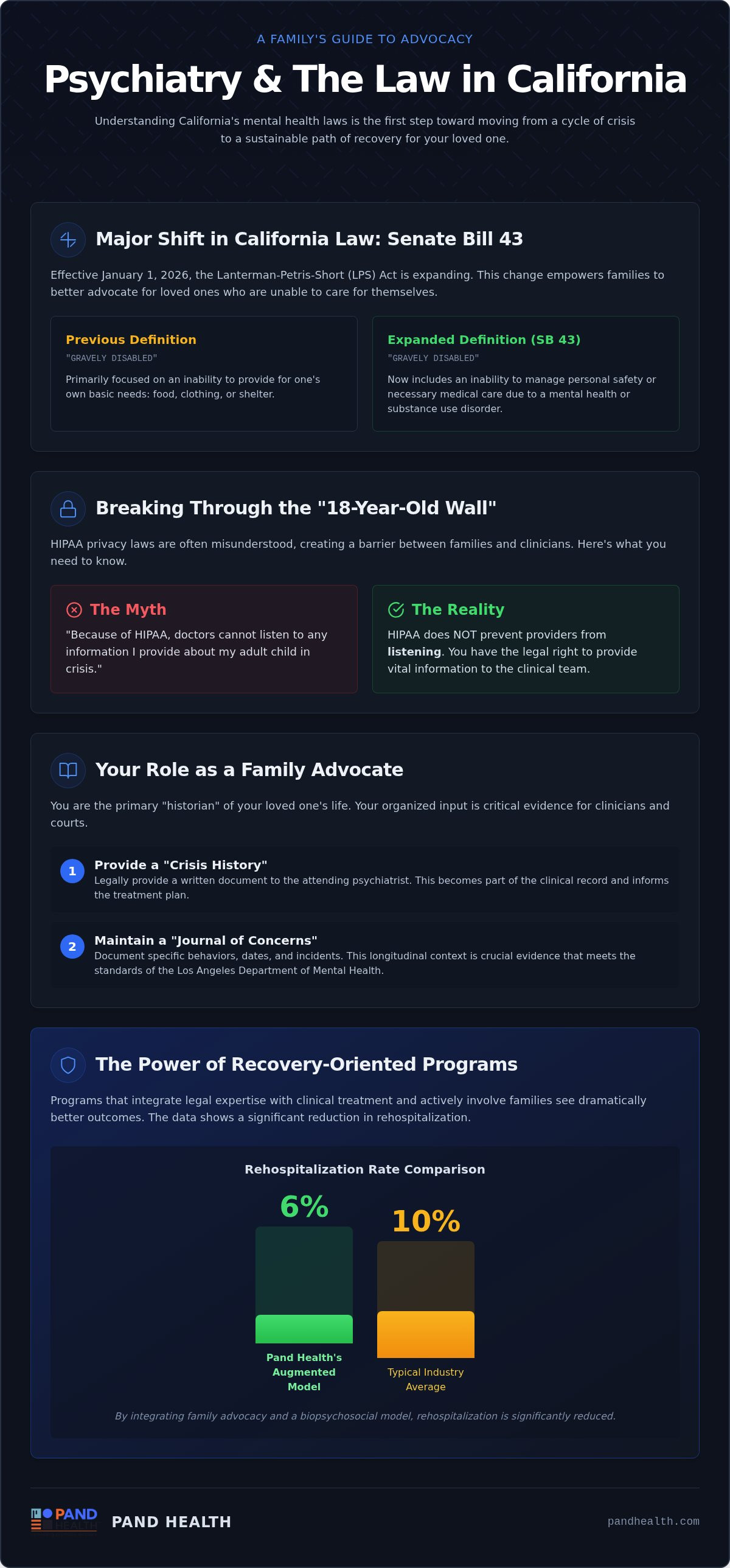
As of January 1, 2026, new legislative updates under Senate Bill 43 have expanded the criteria for involuntary holds. Los Angeles courts now interpret "gravely disabled" more broadly, accounting for an individual’s inability to manage their own medical care or personal safety due to a mental health or substance use disorder. This change reflects a growing recognition that "dangerousness" isn't always an immediate physical threat; it can also be the slow, quiet risk of self-neglect. It's a shift that acknowledges the gravity of chronic psychiatric instability.
Why Families are Essential Partners in Recovery
Clinical data consistently shows that patient outcomes improve when families are active participants in the treatment plan. You are the primary "historian" of your loved one's life. While a psychiatric evaluation provides a snapshot of a person in distress, your documented observations provide the longitudinal context needed for an accurate diagnosis. We utilize a biopsychosocial model that views the law as only one piece of a much larger recovery puzzle.
Our approach at Pand Health focuses on bridging the gap between legal stress and clinical excellence. By offering specialized family psychoeducation, we empower you to provide the information clinicians need while respecting the legal rights of the individual. Our augmented model has successfully reduced rehospitalization rates to just 6%, significantly outperforming the 10% industry average. We are committed to a standard of care where recovery is the expectation, not the exception! If you need guidance on integrating your family into the recovery process, contact our team at our office located at 11500 W. Olympic Blvd., Suite 399, Los Angeles, CA 90064.
Navigating HIPAA and the '18-Year-Old Wall'
When a young person in Los Angeles reaches legal adulthood, many parents feel a sudden, jarring disconnect from their loved one's psychiatric care. This "18-year-old wall" is often reinforced by a misunderstanding of privacy laws. Understanding psychiatry and the law: what families need to know begins with dismantling the myth that HIPAA prevents all communication. While the law protects a patient's right to privacy, it doesn't mandate that clinicians ignore the people who know the patient best.
The psychological toll on parents is significant. You move from being a primary decision-maker to feeling like an outsider in a crisis. However, the law provides specific avenues for family advocacy that many providers overlook. By focusing on "One-Way Communication," you can ensure the medical team has the full picture without requiring the patient's immediate consent to disclose records. This proactive approach transforms you from a bystander into a vital clinical resource.
The HIPAA Myth: What You CAN Do
A common barrier in emergency rooms is a clinician stating they "can't talk to you" because of HIPAA. It's vital to remember that HIPAA rules for sharing information don't prohibit a provider from listening to a family's concerns. You have the legal right to provide a written "Crisis History" or a detailed family history document to the attending psychiatrist. This document becomes part of the clinical record and can be instrumental in shaping the treatment plan.
California's Confidentiality of Medical Information Act (CMIA) also allows for "Emergency Disclosure" when a provider believes it's necessary to prevent a serious and imminent threat. In these high-stakes moments, your role as a historian is legally protected. Even if the doctor cannot speak back to you, your input remains a cornerstone of effective intervention.
Securing a Release of Information (ROI)
Long-term stability often depends on securing a Release of Information (ROI). This conversation is best handled during periods of lucidity, rather than in the heat of a crisis. We've found that our social skills training helps patients recognize the value of their support network, making them more likely to sign these essential forms. This collaborative approach is a cornerstone of our work, where recovery is the expectation, not the exception!
California utilizes specific mental health information sharing documents that go beyond standard medical releases. By educating yourself on these nuances, you transition from a helpless observer to a strategic partner. If you're struggling to bridge the gap with your loved one's treatment team, our family psychoeducation services can provide the roadmap you need to navigate these complex legal and clinical boundaries.
Involuntary Treatment: 5150 Holds and Conservatorships
When a mental health crisis escalates, families often find themselves at the mercy of the 5150 hold. In Los Angeles, this 72-hour involuntary detention allows for critical evaluation and stabilization. It's often the first step in understanding psychiatry and the law: what families need to know during an emergency. To initiate this hold, a designated professional must determine if an individual meets one of three specific criteria: they are a danger to themselves, a danger to others, or "gravely disabled."
If 72 hours aren't enough to reach stability, the facility may file a 5250 hold. This extends treatment for up to 14 days. During this period, the individual has the right to a certification review hearing. This is a legal check to ensure the hold is still necessary. For many families, this process feels like a whirlwind of legal terms and clinical assessments. Our team at 11500 W. Olympic Blvd., Suite 399, Los Angeles, CA 90064, helps families navigate these transitions by providing the psychoeducation needed to stay informed and involved.
Understanding 'Gravely Disabled' in Los Angeles
The term "gravely disabled" historically meant an individual couldn't provide for their own food, clothing, or shelter. However, the Mental Health Conservatorship Process has evolved significantly with the full implementation of Senate Bill 43 on January 1, 2026. Los Angeles courts now consider whether someone can manage their basic personal safety or essential medical care. Documentation is vital here. If you can show a "failure to thrive" through specific, dated examples of self-neglect, you provide the court with the evidence needed to secure long-term help.
LPS vs. Probate Conservatorship
It's essential to distinguish between the two primary types of conservatorships in California. An LPS conservatorship is specifically designed for those with serious mental illnesses who require involuntary treatment or medication. It's a temporary, one-year legal lifeline that requires annual judicial review and renewal. In contrast, a Probate conservatorship is typically for individuals with dementia or permanent developmental disabilities. You can learn more about LPS vs. Probate Conservatorship to see which path fits your family's needs. At Pand Health, we believe that with the right legal and clinical framework, recovery is the expectation, not the exception!
Family Advocacy: Bridging the Gap Between Law and Care
Moving from the high stress of an involuntary hold toward long term stability requires a shift in strategy. While the legal system provides the framework for safety, your advocacy provides the substance for recovery. Understanding psychiatry and the law: what families need to know involves learning how to translate your daily observations into evidence that clinicians and judges can use. In Los Angeles, this often means working closely with the Los Angeles Department of Mental Health (LACDMH) and their Psychiatric Mobile Response Teams (PMRT) to ensure that clinical decisions are based on the full picture of your loved one's life.
Advocacy also means preparing for specific judicial hurdles like the Reese Hearing. This legal proceeding determines whether an individual has the capacity to refuse psychiatric medication. Your role is to provide context that helps the court understand if a refusal is a symptom of anosognosia, a lack of insight common in psychosis, rather than a reasoned medical choice. If you're feeling overwhelmed by these legal hurdles or need help documenting a functional decline, reach out to our Los Angeles team for professional guidance.
Crisis Documentation for Families
A "Journal of Concerns" is your most powerful tool in a legal setting. It should track specific symptoms, medication compliance, and instances of functional decline with dates and times. When presenting this to a judge or a clinical team, focus on how the current behavior deviates from who your loved one was before the crisis. Judges prioritize baseline behavior because it provides a clear, objective contrast to the current psychiatric decline, making the case for intervention undeniable.
To prevent situations from escalating to the point of police involvement, we recommend the LEAP method: Listen, Empathize, Agree, and Partner. This communication strategy helps de-escalate tension and builds enough trust to encourage voluntary treatment. By documenting your use of these techniques, you show the court that you've exhausted less restrictive options, which is a key requirement for many legal interventions in California.
The Power of Family Psychoeducation
Understanding the underlying science of psychosis significantly reduces the friction between families and the legal system. When you recognize that certain behaviors are biological rather than intentional, it lowers the "High Expressed Emotion" (HEE) within the household. High levels of criticism or emotional over-involvement are statistically linked to higher relapse rates and more frequent calls for emergency services.
Our approach emphasizes that education is a form of legal prevention. By mastering the skills to manage a crisis at home, you reduce the need for court-ordered treatments. We've seen that when families are empowered with these tools, the path to stability becomes much clearer. Discover our Family Psychoeducation services to learn how we integrate these clinical insights with the local Los Angeles legal landscape. At our office at 11500 W. Olympic Blvd., Suite 399, Los Angeles, CA 90064, we believe that informed families are the strongest advocates, ensuring that recovery is the expectation, not the exception!
Beyond the Courtroom: The California OnTrack Solution
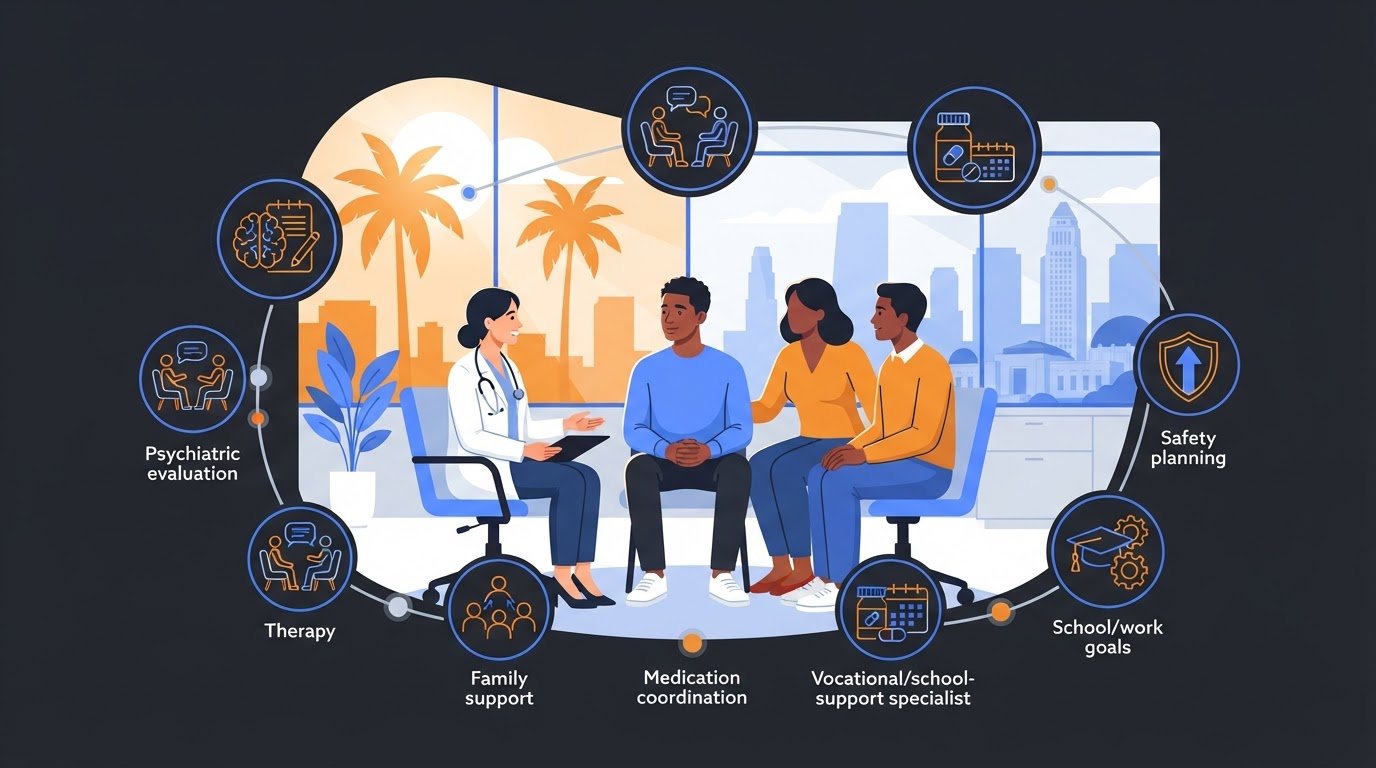
While understanding the mechanics of 5150 holds and conservatorships is vital for immediate safety, the long term goal for any Los Angeles family is to move beyond the legal system entirely. Coordinated Specialty Care (CSC) represents the gold standard in early psychosis intervention. It's a model that integrates psychiatric care, family therapy, and vocational support into a single, cohesive team. By addressing the clinical needs of the individual early, we significantly reduce the likelihood of future legal complications. Understanding psychiatry and the law: what families need to know means recognizing that the best defense against a courtroom battle is a robust, recovery oriented treatment plan.
Our augmented CSC model at Pand Health is designed to bridge the gap between stabilization and true community reintegration. We don't just aim for the absence of symptoms; we aim for the restoration of a full life. This approach has allowed us to maintain a 6% rehospitalization rate, which is nearly half the industry average of 10%. We also utilize the SEE Curriculum, which provides the legal and vocational support necessary for a young person to return to work or school. When a patient has a clear path toward their goals, the need for involuntary legal oversight often diminishes naturally.
Pand Health’s Data-Driven Approach
We believe that clinical success should be measurable. At enrollment, many of our participants show only a 6% engagement rate with traditional services. Within six months of joining our California OnTrack program, that participation rate climbs to 85%. This transformation is fueled by our use of APA-recommended cognitive remediation. These specialized exercises strengthen the executive functions required to make competent legal and medical decisions. For families who want to dive deeper into these topics, our resource, The Mind Exposed Podcast, offers expert insights into the intersection of science and family support. We provide the tools that help your loved one regain the agency the law is designed to protect.
Next Steps for Los Angeles Families
If your family is currently struggling with the complexities of the legal system or the early signs of a thought disorder, the time to act is now. Early intervention is the most effective way to avoid the trauma of police involvement or the "18-year-old wall" of privacy restrictions. You can visit our Southern California site located at 11500 W. Olympic Blvd., Suite 399, Los Angeles, CA 90064 to discuss your specific needs. Our team is ready to provide a comprehensive psychiatric evaluation and help you build a roadmap toward stability. Contact Pand Health for an Evaluation today. We are here to ensure that for your family, recovery is the expectation, not the exception!
Empowering Your Family with Advocacy and Expertise
Knowledge is the best defense against the helplessness that often accompanies a psychiatric crisis. By understanding the nuances of California's updated LPS Act and learning to document a loved one's baseline behavior, you shift from being a spectator to a strategic advocate. Mastering the basics of psychiatry and the law: what families need to know allows you to navigate HIPAA restrictions and the complexities of 5150 holds with clinical confidence. You've learned that legal barriers don't have to prevent care when you utilize one-way communication and detailed crisis histories.
At Pand Health, we provide the specialized expertise needed to bridge the gap between legal pressure and clinical recovery. As the only outpatient CSC program in Southern California offering APA-recommended cognitive remediation alongside MCT and SCIT, we deliver results that redefine expectations. Our approach has led to an industry leading 6% rehospitalization rate and an 85% success rate in employment and education participation. Take the first step toward recovery. Contact our Los Angeles specialists today. You don't have to navigate this storm alone. We are here to ensure that recovery is the expectation, not the exception!
Frequently Asked Questions
What is a 5150 hold and how long does it last in California?
A 5150 hold is an involuntary detention for psychiatric evaluation that lasts up to 72 hours. In Los Angeles, this process allows clinicians to assess whether an individual is a danger to themselves, a danger to others, or gravely disabled. During this window, the goal is stabilization and determining the next steps for care. It's a critical period where understanding psychiatry and the law: what families need to know becomes essential for advocating for long term stability.
Can I get medical information about my child if they are over 18?
You can access medical information for an adult child if they sign a Release of Information (ROI). Without an ROI, HIPAA and California’s CMIA prevent doctors from sharing details with you. However, you are always legally permitted to provide information to the treatment team. Delivering a written "Crisis History" ensures the doctors have the longitudinal context necessary for an accurate diagnosis, even if they cannot speak back to you directly.
What does 'gravely disabled' mean for a conservatorship in Los Angeles?
In Los Angeles, being "gravely disabled" means an individual is unable to provide for their basic needs for food, clothing, or shelter due to a mental health disorder. Following the implementation of Senate Bill 43 on January 1, 2026, this definition now includes an inability to manage personal safety or essential medical care. This expansion allows for intervention when someone’s self-neglect poses a serious risk, even if they aren't displaying immediate physical aggression.
How do I start an LPS conservatorship for a family member?
You cannot personally initiate an LPS conservatorship; the process must begin with a referral from a designated psychiatric facility. If a loved one is hospitalized and remains gravely disabled after multiple holds, the treating psychiatrist may refer the case to the Los Angeles County Public Guardian. The Public Guardian then investigates and petitions the court. Your role is to provide documented evidence of functional decline to the clinical team to support this referral.
Will my loved one lose their civil rights forever if they are hospitalized?
Hospitalization and conservatorship don't result in a permanent loss of civil rights. An LPS conservatorship is a temporary legal framework that expires automatically after one year unless a petition for renewal is filed. It requires regular judicial review to ensure the person still meets the legal criteria for involuntary care. The ultimate goal is always community reintegration and the restoration of autonomy once the individual achieves psychiatric stability and safety.
How can family psychoeducation help with legal issues?
Family psychoeducation helps with legal issues by teaching you how to navigate the complex intersection of psychiatry and the law: what families need to know. By learning de-escalation techniques like the LEAP method, you can often avoid the need for police involvement or involuntary holds. Additionally, our program helps you create "Journals of Concerns" that meet the evidentiary standards required by Los Angeles courts, ensuring your advocacy is both clinically and legally effective.
What is the difference between a 5150 and a 5250 hold?
The primary difference lies in the duration and the legal requirements for detention. A 5150 hold allows for an initial 72-hour evaluation period. If the individual remains a danger or gravely disabled after those three days, the facility may file a 5250 hold, which extends the involuntary stay for up to 14 additional days. Unlike the 5150, a 5250 hold triggers a certification review hearing where a hearing officer determines if there's probable cause.
Does Pand Health provide legal representation for mental health cases?
Pand Health does not provide legal representation or legal advice. We are a clinical institution specializing in early psychosis intervention and psychological rehabilitation. While we offer robust family advocacy and help you navigate the clinical requirements of the law, we recommend consulting with a qualified mental health attorney for specific legal proceedings. Our focus is providing the high standard of care where recovery is the expectation, not the exception, at our site on W. Olympic Blvd.
Disclaimer
This article is for information and educational purposes only, and can NEVER replace a proper medical evaluation. If you or a loved one may be suffering from psychosis or the prodomal symptoms of psychosis, get evaluated by a professional as soon as possible. Early diagnosis and treatment can be life-saving.