

Professional training resources for early psychosis intervention
Early psychosis care calls for more than recognizing symptoms: FEP, or first-episode psychosis, is the first time someone experiences psychotic symptoms, such as difficulty distinguishing reality from delusions or hallucinations. Professional training in early psychosis intervention helps practitioners build the skills for coordinated, individualized care that can support functional outcomes.
When assessment, treatment planning, and team coordination all matter, practical guidance can help. Professional training in early psychosis intervention can show how these parts fit together while keeping the person’s goals and experiences at the center of care.
Here, you’ll learn what FEP means and explore resources for coordinated specialty care, assessment, team roles, and early intervention. The focus is on practical approaches professionals can use to make care more connected, thoughtful, and responsive.
Key Takeaways
- Learn how coordinated specialty care brings different supports together around a person’s needs and recovery goals.
- Explore assessment and treatment resources that help professionals respond thoughtfully to psychosis experiences.
- See how prescribers, peers, and family partners contribute distinct perspectives to early intervention.
- Understand how clear team roles and purposeful meetings can support more connected care.
- Discover how Pand Health’s Professional Training Curriculum fits alongside its social skills training and psychological and social rehabilitation offerings.
Coordinated specialty care
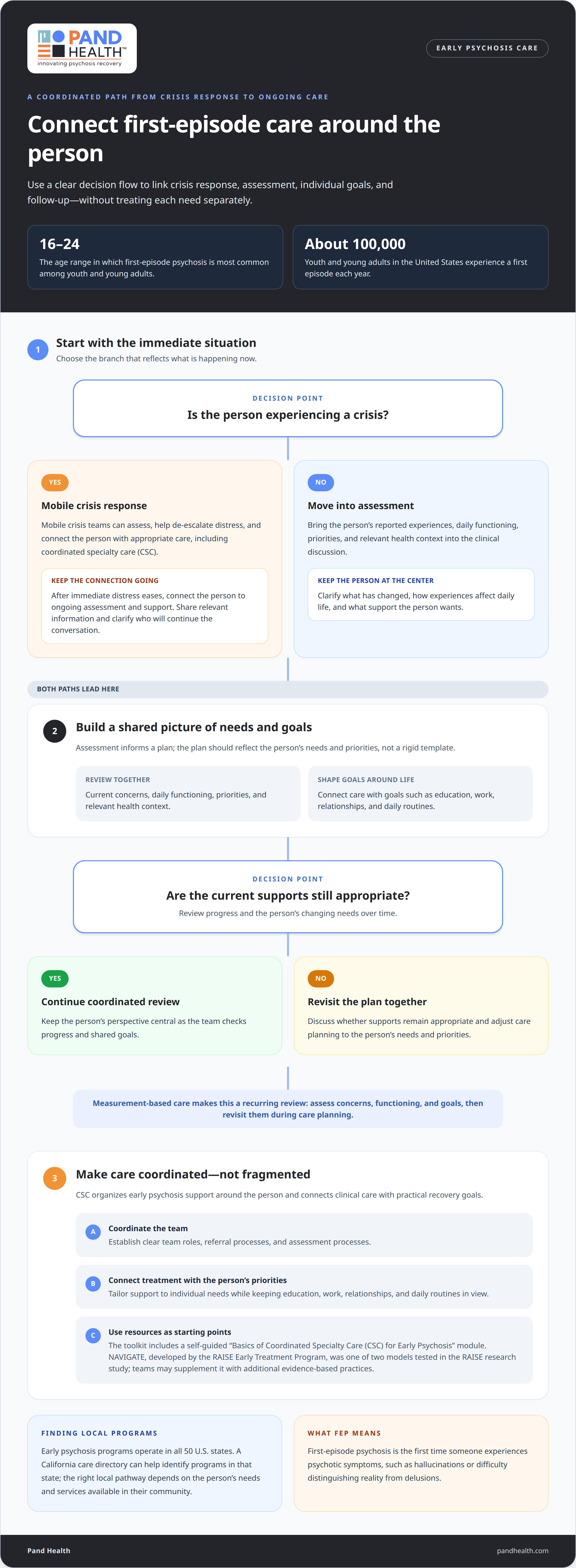
Coordinated specialty care (CSC) organizes early psychosis support around the person, rather than treating each need separately. Early detection and individualized, coordinated treatment can improve functional outcomes. The approach connects clinical care with practical recovery goals, such as maintaining education, work, relationships, and daily routines. Each plan should reflect the person’s needs and priorities, not a rigid template.
How can a behavioral health organization implement an early psychosis intervention program? Build a coordinated team, establish clear referral and assessment processes, and connect treatment with each person’s goals. Staff training should create shared practices while leaving room to tailor support to individual needs.
For a structured introduction, the toolkit’s self-guided module, “Basics of Coordinated Specialty Care (CSC) for Early Psychosis,” reviews CSC and its components. NAVIGATE is another useful model to study. Developed by the RAISE Early Treatment Program, it was one of two models tested in the RAISE research study. The toolkit notes that teams may supplement NAVIGATE with additional evidence-based practices. These resources help staff understand the model before adapting coordinated services to their setting.
A California early psychosis care directory can help people and professionals identify programs in the state and understand where coordinated support may be available. Use a directory as a starting point for connecting someone with appropriate care, rather than as a substitute for assessment. Early psychosis programs operate in all 50 U.S. states, but the right local pathway depends on a person’s needs and the services available in their community.
During a crisis, mobile crisis teams can assess people experiencing first-episode psychosis, help de-escalate distress, and connect them with appropriate care, including CSC. Follow-up remains important after immediate distress eases. The next step is a clear connection to ongoing assessment and support, not leaving the person to navigate services alone. Teams can ease this transition by sharing relevant information and clarifying who will continue the conversation.
Measurement-based care gives teams a practical way to review progress over time. Start by assessing the person’s current concerns, daily functioning, and goals. Revisit these areas during care planning, then discuss whether the supports remain appropriate. Include changes in substance use or education when they affect the person’s needs. Consistent review helps the team make decisions together while keeping the person’s perspective central.
Cognitive Behavioral Therapy for psychosis began as an individual treatment and later developed into a group-based intervention. This history helps teams recognize that the treatment can be delivered in different formats while keeping the person’s broader care plan in view. CBTp is a structured, time-limited, goal-based treatment intended to support functioning in the context of psychotic symptoms. In coordinated specialty care, this description clarifies how focused therapy can support individualized recovery goals without separating symptom-focused work from daily functioning. Teams can discuss how its goals relate to the concerns and priorities identified with the person.
Introduction to psychosis assessment and treatment
First-episode psychosis (FEP) describes the first experience of psychotic symptoms, including hallucinations or difficulty distinguishing reality from delusions. It is most common among youth and young adults ages 16-24. About 100,000 youth and young adults in the United States experience a first episode each year. These facts help teams recognize why timely assessment and age-responsive planning matter.
A comprehensive assessment brings together the person’s reported experiences, functioning, priorities, and relevant health context. A clinician can clarify what has changed, how symptoms affect daily life, and what support the person wants. Treatment planning turns those findings into shared goals. For example, a plan might address distressing experiences while supporting education, employment, or relationships. Lived experience should inform these goals and remain part of the clinical discussion.
Who is eligible for early psychosis intervention training, and what prerequisites are required? Training resources can serve behavioral health practitioners and other professionals involved in early psychosis care. A foundational self-guided module offers an entry point, while role-specific learning should reflect each person’s responsibilities and professional scope.
Outpatient treatment planning depends on a careful review of needs, safety, daily functioning, and available supports. Assessment should identify which concerns can be addressed through outpatient appointments and what follow-up will support continuity. If symptoms affect attendance, communication, or work, account for those barriers in the plan. No single symptom describes the person’s full circumstances.
Cognitive Behavioral Therapy for psychosis (CBTp) offers a structured, time-limited, goal-based approach. It aims to reduce distress linked with psychosis symptoms, support functioning, and help people understand how experiences develop and persist. The therapeutic relationship is collaborative: the person and therapist explore distressing experiences and beliefs, then consider strategies that may reduce distress and disability. CBTp began as an individual treatment and later developed group-based approaches.
For an introductory resource, the toolkit’s self-guided module, “Intro to Psychosis: Assessment, Treatment, & Feedback,” introduces early intervention and treatment concepts. The VA/DoD Clinical Practice Guideline on first-episode psychosis and schizophrenia offers a separate reference for adults. Published in 2023, it draws on research available through November 2021 and presents 34 evidence-based recommendations across three modules. These resources support learning, but the adult guideline should be read within its stated population.
Assertive Community Treatment (ACT) is another approach professionals may encounter when considering care models. Training can help teams understand how an approach fits a person’s assessed needs, treatment goals, and preferred supports. Assessment is not a one-time form: revisiting goals and functioning helps professionals refine the plan as circumstances change.
The NAVIGATE treatment model is the primary approach used by early psychosis programs in Massachusetts. It can be considered alongside assessment and shared treatment planning. Teams can connect the person’s reported experiences, functioning, priorities, and health context with goals that reflect the support they want. Keeping these elements in view makes treatment discussions more relevant to the individual and grounded in the concerns identified during assessment.
Role-specific training for prescribers, peers, and family partners
Role-specific learning helps each contributor support the same person without blurring responsibilities. For prescribers, training can focus on discussing clinical concerns, understanding reported symptoms, and explaining treatment choices clearly. A young adult should be able to describe what matters to them and ask questions. The prescriber can then connect clinical decisions with the person’s goals and daily life.
Peer providers bring lived experience to conversations about recovery, relationships, and navigating support. Training can help peers listen without judgment, respect personal boundaries, and encourage people to express their preferences. For example, someone who has experienced a psychotic episode may feel more comfortable discussing isolation with a peer. Peer support complements clinical care; it does not replace assessment or therapy.
Family partners can benefit from learning how psychosis may affect communication and routines. A practical exercise might involve responding calmly when a family member describes a distressing experience, then asking what support would feel useful. Training should also help family partners recognize their own concerns and share them constructively. The person’s preferences should guide how relatives participate in care discussions.
Individual and family partnership works best when each person’s contribution is clear. A clinician can ask the individual what they want family members to understand, while family partners can share observations about changes in sleep, social connection, or daily activities. These examples add context to planning without reducing the person to a diagnosis or disorder. Training can use role-play to practice listening, clarifying concerns, and agreeing on a next step.
The FEP resource hub offers a four-part recorded training series on crisis intervention strategies, cultural considerations, and follow-up care. The sessions can help staff and peer providers consider how communication changes during a crisis and afterward. A separate Communities of Practice program brought together twelve panelists, including people with lived experience, family members, and peer providers. Their stories and recommendations can prompt teams to consider whose perspectives are missing from routine discussions.
The Communities of Practice program that informed the mobile crisis handout had four parts. Teams can use its themes to structure discussions, including how family input and lived experience shape crisis response. Role-specific training is more useful when each participant practices a concrete task and shares what they learned with colleagues. Prescribers might practice explaining a treatment decision, peers might rehearse supportive listening, and family partners might prepare a concise observation. These exercises connect learning with coordinated, respectful support for young adults.
Transdisciplinary team roles and meetings
A transdisciplinary team brings different areas of mental health expertise into shared planning. Members can coordinate clinical perspectives with the person’s priorities instead of developing disconnected plans. A meeting might review how symptoms affect cognitive functioning, education, relationships, or employment. End the discussion with agreed next steps, clear responsibilities, and a way to revisit progress.
What evidence-based early psychosis intervention models are covered in professional training? Training resources can address coordinated specialty care, the NAVIGATE model, and Cognitive Behavioral Therapy for psychosis. The RAISE Early Treatment Program developed NAVIGATE, while CBTp provides a structured therapeutic approach. Learning about each helps team members understand how different methods can fit within coordinated support.
NAVIGATE team training is most useful when it connects the model’s principles with each role’s daily work. A prescriber can consider how treatment decisions relate to shared goals, while a therapist can connect cognitive behavioral therapy strategies with the person’s concerns. A peer provider can support engagement through lived experience, and family partners can contribute observations when the individual wants them involved. This role mapping makes collaboration more concrete.
Meetings can follow a consistent sequence without becoming a checklist detached from the person. Begin with the individual’s current priorities, then review relevant changes in functioning and barriers to care. Clarify who will take each next step, such as arranging a follow-up conversation or coordinating with a therapist. Close by confirming how the person’s preferences shaped the plan.
Customized team training addresses the specific gaps a program identifies. One team may need practice communicating across disciplines; another may need a shared approach to discussing cognitive symptoms or treatment goals. Use a case example, assign each role a perspective, and rehearse how the team would respond. A debrief can reveal unclear handoffs, overlooked viewpoints, or language that could make a person feel excluded.
The NAVIGATE model can provide a common reference point for learning, and teams may supplement it with other evidence-based practices. Training should distinguish between learning a model and applying it thoughtfully to an individual’s circumstances. For example, team members can discuss how CBTp goals relate to broader recovery aims, including social connection or daily functioning, then identify how communication across roles can support those aims.
A useful meeting record captures the person’s stated goals, the team’s agreed actions, and who will follow through. It should also preserve questions for further discussion rather than present uncertainty as a settled decision. Reviewing these points at the next meeting helps members learn from their coordination and adjust their work. This makes team learning part of care, not a separate exercise.
Core philosophies and practices in early psychosis intervention
Early intervention centers on timely, individualized support and the person’s recovery goals. The aim is to understand how symptoms affect daily life and what matters to the individual, not reduce them to a diagnosis. Early detection and proper treatment through coordinated care can improve functional outcomes. Training helps professionals put this principle into practice through shared planning, respectful communication, and attention to the person’s priorities.
Acceptance and Commitment Therapy (ACT) offers one useful lens for this work. ACT combines acceptance and mindfulness strategies with commitment and behavior-change strategies to build psychological flexibility. This means staying in contact with the present moment and changing or persisting in behavior in service of chosen values, based on what the situation allows. For example, a person might practice a valued activity while making room for difficult thoughts, rather than waiting for every symptom to disappear.
What topics and skills are covered in early psychosis intervention training? Learning resources address coordinated care, assessment, crisis response, cultural considerations, follow-up, and evidence-based approaches. Practical skills include discussing distressing experiences without judgment, collaborating on goals, and connecting care with education, work, or relationships. The FEP resource hub’s recorded training series covers crisis intervention strategies, cultural considerations, and follow-up care.
How long do early psychosis intervention training programs take, and are they online or in person? Formats vary by resource: self-guided modules and recorded trainings offer online learning, while other professional learning may use different formats. No single standard duration is established, so training time depends on the specific program and its learning materials.
Do early psychosis intervention training programs offer certificates or continuing education credits? After completing training in the learning management system, learners can download a certificate of completion and continuing education hours from the transcript tab. This gives professionals a practical way to document completed learning alongside their clinical development.
When assessment is delayed, symptoms and functional needs may go without a tailored response during that time. Early identification and coordinated treatment create an opportunity to address concerns sooner and organize support around the individual. For professionals, the practical takeaway is to make the path from concern to assessment and follow-up clear. Discuss early psychosis care and training to identify a next step.
Pand Health: Professional Training Curriculum
Pand Health’s Professional Training Curriculum supports professionals seeking focused learning in early psychosis care. It complements the practical themes covered here, including coordinated support, assessment, and recovery-oriented practice. When care involves social connection or daily functioning, social skills training and psychological and social rehabilitation can address related needs. Evaluation for thought disorders and autism can help clarify an individual’s experiences.
Consider the curriculum when you want to deepen your understanding of early psychosis intervention alongside care that responds to individual needs. To discuss professional training, contact Pand Health.
Carry learning into thoughtful care
Professional training in early psychosis intervention can be a starting point for strengthening care. Put learning into practice by making space for each person’s priorities, keeping communication clear, and helping the team respond as needs evolve. This work takes deliberate reflection and consistent attention to the person behind the diagnosis.
Pand Health’s services can complement this focus through social skills training, psychological and social rehabilitation, and evaluation for thought disorders and autism. These offerings address different needs, from building social connection to supporting a clearer understanding of an individual’s experiences. The right next step depends on what kind of learning or support would be most useful now.
If you’re considering how professional learning can inform compassionate, coordinated care, contact Pand Health to learn more. Continued learning can help professionals create care that recognizes individual strengths and supports meaningful progress.
Frequently Asked Questions
What is FEP?
FEP means first-episode psychosis, the first time someone experiences psychotic symptoms. These experiences can include hallucinations or difficulty distinguishing reality from delusions. The term describes the episode, not the person’s goals, strengths, or full care needs. For example, when planning support, a clinician may explore how the person’s experiences affect school, work, relationships, and everyday routines.
What professional training is available in early psychosis intervention in the United States?
Available learning resources include self-guided modules on coordinated specialty care and psychosis assessment, treatment, and feedback. The FEP resource hub also provides recorded training on crisis response, cultural considerations, and follow-up. Clinicians can study NAVIGATE as a coordinated specialty care model. After completing training in the learning management system, learners can download completion certificates and continuing education hours from the transcript tab.
Which organizations offer early psychosis intervention training for clinicians?
Pand Health offers a Professional Training Curriculum for healthcare professionals. The FEP resource hub provides recorded training, while self-guided toolkit modules cover coordinated specialty care and psychosis assessment and treatment. The RAISE Early Treatment Program developed NAVIGATE, a model clinicians can study when learning about coordinated care. The VA/DoD Clinical Practice Guideline is a reference for adult first-episode psychosis and schizophrenia, not a training course.
How can clinicians find early psychosis intervention training near them?
Clinicians in California can use an early psychosis care directory to locate programs and identify local connections. To find training, narrow the search by topic, such as assessment, coordinated care, or crisis follow-up, then identify whether resources are self-guided or recorded. In Los Angeles, Pand Health’s Professional Training Curriculum is a local option for healthcare professionals. Match the learning format and subject to your role and training goals.
Disclaimer
This article is for information and educational purposes only, and can NEVER replace a proper medical evaluation. If you or a loved one may be suffering from psychosis or the prodomal symptoms of psychosis, get evaluated by a professional as soon as possible. Early diagnosis and treatment can be life-saving.