

Disorganized Speech: What It Means and What May Cause It
Disorganized speech doesn’t automatically mean schizophrenia. It’s a symptom, not a diagnosis, and may reflect difficulty organizing and expressing thoughts. Understanding how to deal with disorganized speech starts with noticing the pattern and considering possible causes, rather than judging the words alone.
It can be unsettling when someone jumps between unrelated topics, loses their train of thought, or speaks in a way that’s hard to follow. Stress and anxiety can affect speech, while persistent disorganization can also occur with thought disorders and other mental health conditions. One observation alone can’t explain the cause.
This article explains what disorganized speech means, how it relates to formal thought disorder, and why it may occur alongside changes in brain function, stress, anxiety, or schizophrenia. You’ll also learn how a careful evaluation can clarify what’s happening and how supportive communication and appropriate treatment can help address the underlying needs.
Key Takeaways
- Disorganized speech describes communication that is difficult to follow; it is a symptom, not a diagnosis.
- Notice how speech changes and whether it affects daily communication, but don’t assume one example reveals the cause.
- Stress and anxiety may disrupt speech, while persistent changes can also relate to psychosis or other mental health conditions.
- Formal thought disorder refers to difficulty organizing thoughts, which can become apparent in how a person speaks.
- Calm, patient conversation and a professional evaluation can help clarify what support may be useful.
What is disorganized speech?
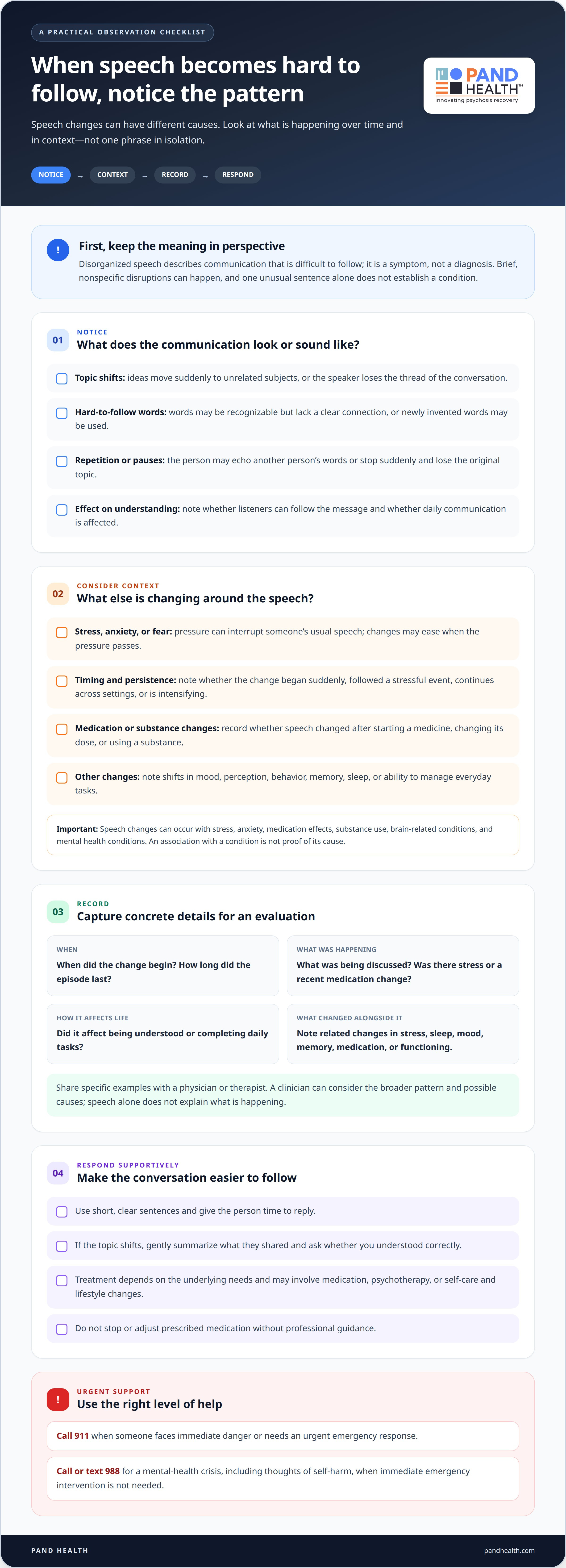
Disorganized speech is communication that becomes hard to follow because ideas don’t connect clearly. It is a symptom, not a diagnosis. A person may lose the thread of a conversation, shift topics abruptly, or struggle to make their meaning understood. Brief, nonspecific disruptions can happen, so one unusual sentence doesn’t establish a condition.
Examples show how different the pattern can look. Someone describing a family dinner might suddenly discuss a bus route, then return to the meal without explaining the connection. Another person might combine unrelated words into “word salad,” making a sentence hard to understand. The person may still be trying to communicate, even when listeners can’t follow the message.
Other patterns include repeating another person’s words, known as echolalia, or using neologisms, newly invented words. Thought blocking describes a sudden pause when someone loses the original topic. For example, a speaker might stop mid-sentence, look confused, and be unable to recall what they meant to say. These examples describe communication patterns, not their cause.
To get evaluated in the United States, arrange an appointment with a physician or therapist. Describe specific examples, when they began, and how they affect daily communication. Mention relevant changes in stress, sleep, medication, or functioning so the clinician can assess possible causes.
Treatment may address the underlying condition and can involve medication, psychotherapy, or self-care and lifestyle changes. Progress may be assessed through clearer communication or improved daily functioning; no single approach applies to every cause.
Call 911 when someone faces immediate danger or needs an urgent emergency response. Call or text 988 for a mental-health crisis, including thoughts of self-harm, when immediate emergency intervention isn’t needed.
Family members can reduce pressure by using short, clear sentences and allowing time for replies. If a speaker shifts from a game to an unrelated subject, gently summarize what they shared and ask whether you understood correctly.
Track when episodes happen, what the person was discussing, how long the change lasted, and whether it affected daily tasks. Share these examples, recent changes, and any related symptoms with the clinician. Concrete details can help clarify the pattern.
The DSM-5 notes that brief disorganized speech can be common and nonspecific; a brief instance alone does not establish a condition. The significance of a communication change depends on the broader pattern and its effect on being understood, rather than on one phrase viewed in isolation.
Disorganized speech can involve rapidly moving between unrelated topics, incoherent word salad, echoing another person’s words, or speaking as if addressing someone who is not present. These forms may sound different: a listener may recognize individual words but not a clear connection between them, or hear a repeated phrase without a clear response to the conversation. In other cases, the speaker may seem to address someone who isn’t there. These examples describe what communication can look or sound like; they don’t, by themselves, identify why it is happening.
Possible brain, stress, and anxiety-related causes
Disorganized speech can have several possible causes. Stress, anxiety, changes in mental health, brain-related conditions, medication effects, and substance use may all affect speech patterns. Timing matters: a sudden change after a stressful event may raise different concerns than a pattern that continues across settings.
Extreme stress, anxiety, or fear can interrupt a person’s usual way of speaking. During a tense meeting, for example, someone may talk rapidly, lose their point, or struggle to arrange ideas. These changes may ease when the pressure passes. If they persist, intensify, or interfere with daily communication, a professional evaluation can help clarify contributing factors.
Disorganized speech also occurs with some mental health conditions. The National Institute of Mental Health notes that it can be associated with psychotic, mood, and anxiety disorders, and is notably linked with schizophrenia. That association doesn’t make speech changes proof of schizophrenia. A clinician considers the broader pattern, including changes in mood, perception, behavior, and daily functioning.
Brain-related changes can also affect how someone organizes and expresses ideas. Cognitive decline associated with Alzheimer’s disease or dementia may alter communication, though the pattern and needs differ from person to person. A clinician considers when the change began, whether it is progressing, and how it affects everyday tasks. These details help distinguish possible causes rather than treating speech alone.
Some medications and drugs can affect speech patterns. If a change begins after starting a medicine, changing its dose, or using a substance, tell the prescribing clinician or another qualified health professional. Share the timing and any other changes you’ve noticed. Don’t stop or adjust prescribed medication without professional guidance.
For lower-cost mental health support in the United States, ask about community mental health services, sliding-scale fees, and coverage through insurance or public programs. Available services and eligibility depend on location and individual circumstances. An evaluation for thought disorders can help assess whether persistent speech changes need specialized attention, and you can ask about an evaluation.
For a clearer picture, note whether speech changes appear during anxiety, follow a medication change, or occur alongside shifts in mood or memory. A clinician can weigh these patterns together; no single detail explains every case.
Hallucinations, psychosis, and some medications might affect speech patterns. A speech change alone can’t establish which, if any, of these factors is involved. Describe what changed and when, including whether it appeared around a medication change or alongside shifts in mood, perception, memory, or behavior. These details help a clinician consider speech in the broader pattern rather than in isolation.
When discussing the change, share specific examples of how communication has been affected and whether it continues across settings. Mention whether the pattern has persisted, intensified, or interfered with daily communication. A qualified health professional can consider these observations alongside other changes in daily functioning and assess possible contributors. If the cause remains unclear, ask whether a specialized evaluation is appropriate. The aim is to understand the pattern and identify support that may fit the person’s circumstances, not to draw a conclusion from speech alone.
Schizophrenia and disorganized speech
Disorganized speech is often associated with schizophrenia, but it doesn’t establish a diagnosis by itself. A person may have difficulty connecting ideas, following a conversation, or expressing information clearly. The pattern matters alongside other changes, including how the person engages socially and manages daily life. A clinician considers the whole picture rather than interpreting one confusing conversation as proof of schizophrenia.
In schizophrenia, speech changes can affect relationships and everyday tasks. Someone might struggle to explain a plan, respond in a way listeners can follow, or keep track of a conversation. The difficulty can involve processing information as well as expressing it. When communication becomes hard to follow, ordinary activities such as coordinating an appointment or discussing household needs may become more challenging, which is why personalized assistance from providers such as Mighty Mentors WA can be valuable for supporting daily routines and community access.
The older term “disorganized schizophrenia” describes a presentation involving disorganized speech and daily behaviors. Current assessment still requires attention to the person’s broader symptoms and functioning. Persistent speech disorganization without another medical cause may be a symptom of schizophrenia, but other explanations need consideration. Changes in medication, substance use, or physical health can also matter when a clinician evaluates what is happening.
Bipolar disorder is a mood disorder, and disorganized speech can occur with mood disorders. Unusual speech alone doesn’t distinguish bipolar disorder from schizophrenia or another condition. Clinicians consider the accompanying mood pattern, changes in behavior, timing, and effects on daily functioning. For example, they may ask whether speech changes occur alongside a noticeable shift in mood or appear independently.
That distinction matters because treatment focuses on the underlying condition, not simply on making speech sound more organized. A clinician may consider how symptoms developed, whether they persist, and whether social engagement or daily routines have changed. Family observations can help describe patterns across settings, such as differences between a calm conversation at home and communication during a difficult period.
For families, the most useful response is to describe specific changes without assigning a diagnosis. Note what became difficult, when the change appeared, and how it affected communication or daily activities. Avoid arguing over confusing statements; instead, use clear language and give the person time to respond. A professional assessment can clarify whether schizophrenia, a mood disorder, or another cause best explains the pattern.
Disorganized speech can be distressing for the person and those around them, especially when conversations become difficult to share. Patient, respectful communication preserves connection while an evaluation considers the full set of symptoms. The central point is simple: schizophrenia is one possible explanation, not a conclusion drawn from speech alone.
Definition of disorganized speech and formal thought disorder
Disorganized speech is a noticeable difficulty arranging ideas into a clear, connected message. It describes how someone communicates, not a diagnosis on its own. Formal thought disorder refers to disruption in the organization of thought that may become apparent through speech. For example, a listener may find it difficult to understand how one sentence leads to the next.
The word “formal” refers to the structure of thought, rather than whether an idea is true or unusual. Compare a clearly stated but unconventional opinion with a sentence that shifts abruptly between unrelated ideas. The first may be easy to follow; the second may be hard to interpret because its connections are unclear. Clinicians consider these patterns in context.
A conversation can show different disruptions. Someone may begin answering a question, move to an unrelated subject, and not explain the transition. Another person may stop speaking and lose the point they were making. These examples describe observable communication, but they don’t reveal by themselves why the person is having difficulty.
It helps to distinguish occasional lapses from a pattern that affects communication. A speaker might lose their train of thought when tired, then explain the idea clearly later. By contrast, repeated difficulty connecting ideas across conversations may make it harder to share needs, make plans, or follow discussion. Frequency, context, and impact all provide useful information for assessment.
Clinicians listen for how ideas connect, whether the person can return to a topic, and how understandable the message remains. They may consider changes over time, examples from daily life, and whether speech difficulty appears alongside other changes. A description such as “she stopped halfway through explaining a plan, then couldn’t return to it” is more useful than a label alone.
Formal thought disorder is not the same as having an unusual belief or choosing an unconventional topic. The key concern is the organization of communication. For instance, a person can discuss an unfamiliar subject in a logical sequence, while a familiar story may become difficult to follow if its ideas shift without clear links.
Understanding this distinction can make conversations less judgmental. Focus on what was difficult to follow, rather than assuming the person is being careless or deliberately confusing. If the pattern persists or interferes with daily communication, a professional evaluation for thought disorders can help clarify what the speech changes may mean.
How can you support someone experiencing disorganized speech during a conversation?
Start by reducing pressure. In a quiet setting, face the person and share one clear idea at a time. If background television competes with conversation, turn it off before continuing. A calmer environment can make it easier to focus without asking someone to speak perfectly. Part of how to deal with disorganized speech is making the conversation feel manageable.
Give the speaker time to finish. Avoid interrupting, correcting every phrase, or completing their sentences. If they pause, wait and let them decide whether to continue. A rushed response can add pressure and make it harder to organize what they want to say.
Use a brief reflection to check your understanding. For example, say, “I heard that you met someone after the game. Is that right?” This summarizes what they shared without criticizing the speaker. If your summary misses the point, invite them to clarify rather than insisting on your interpretation.
When the conversation shifts, gently offer a choice of focus. You might say, “Would you like to finish telling me about the appointment, or talk about the ride home?” Two simple options can make the next step clearer. Questions with several parts can be difficult to hold in mind and answer.
Respect the person’s experience, even when their words are hard to follow. You can acknowledge the feeling without agreeing with a confusing or distressing statement: “That sounds upsetting. I’m listening.” Keep your voice even, and don’t argue over each detail. If the person seems overwhelmed, suggest a pause or a quieter place.
Notice what helps during different conversations. One person may communicate more easily with short questions; another may benefit from writing down a choice or using familiar routines. Ask what feels useful, then allow the person to respond in their own way. Don’t treat eye contact or quick replies as proof of understanding.
For families, learning how to deal with disorganized speech can include finding shared ways to listen and respond. Family therapy or psychoeducation can help relatives discuss communication difficulties and the strain they may cause. Social skills training can also provide structured practice with communication strategies, when appropriate to the person’s needs; for instance, resources from Social Skills Australia highlight practical techniques for starting and navigating conversations effectively.
After a difficult exchange, describe the moment neutrally: “We lost track of the plan when several topics came up.” This keeps the focus on what happened, not blame. For help finding support related to communication and thought concerns, contact Pand Health.
Pand Health
Pand Health can help clarify persistent communication changes through evaluation for thought disorders and autism. When psychosis is involved, intensive treatment and psychological and social rehabilitation can address broader needs. Social skills training may support communication practice, while family psychoeducation helps relatives better understand symptoms and respond supportively. These services may be relevant when speech changes continue, affect daily interactions, or occur alongside other concerns about mental health. The right next step depends on the person’s needs and the changes they’re experiencing. For support in understanding those concerns and exploring care, contact Pand Health.
Take the next step toward clearer support
Understanding how to deal with disorganized speech can begin with one practical step: describe the changes you’ve noticed and the support that would make conversations easier. That information can help shape a thoughtful discussion about evaluation, communication goals, and day-to-day needs.
Pand Health offers evaluation for thought disorders and autism, social skills training, and psychological and social rehabilitation in Los Angeles. These services can help individuals and families explore appropriate support when communication concerns affect everyday life.
You don’t need to have every answer before seeking guidance. Bring the questions that matter most to you, whether they concern understanding a change, supporting someone close, or finding a path forward. Contact Pand Health to discuss your concerns, and take the next step with care and clarity.
Frequently Asked Questions
What’s formal thought disorder?
Formal thought disorder describes difficulty organizing and connecting thoughts, which can affect how a person communicates. For instance, someone explaining a weekly schedule may leave out links between events, making the sequence difficult to understand. Clinicians focus on observable communication patterns and their effect on daily life, rather than treating the term as a judgment about intelligence, effort, or the value of someone’s ideas.
What is disorganized speech and what are its symptoms?
Disorganized speech is communication that’s hard to follow because ideas aren’t expressed in a clear, connected way. Symptoms may include unclear transitions, losing the thread of an explanation, or giving an answer that doesn’t seem connected to the question. A person might struggle to explain instructions they understood earlier. The pattern and its effect on everyday communication matter more than one awkward exchange.
What causes disorganized speech, including mental health conditions and substance use?
Possible causes include psychotic, mood, and anxiety disorders; the National Institute of Mental Health notes that disorganized speech is especially associated with schizophrenia. Stress, medication effects, and substance use can also be relevant to an evaluation. Tell a clinician what substances or medicines were involved and when speech changes began. Timing, other symptoms, and health history help guide assessment; speech alone doesn’t identify a cause.
Disclaimer
This article is for information and educational purposes only, and can NEVER replace a proper medical evaluation. If you or a loved one may be suffering from psychosis or the prodomal symptoms of psychosis, get evaluated by a professional as soon as possible. Early diagnosis and treatment can be life-saving.