
Early Intervention Psychosis Care in Los Angeles
Early support can begin before a family has all the answers. EPI-LA is Los Angeles County’s early psychosis intervention program, and an early intervention psychosis program in Los Angeles can help connect people experiencing psychosis symptoms with coordinated care and support. EPI-LA is funded through the Los Angeles County Department of Mental Health’s Prevention and Early Intervention Plan.
It’s understandable to feel uncertain when changes in someone’s thoughts, emotions, or daily life are hard to explain. A professional assessment can help clarify what may be happening and what care could be appropriate. Family support can also make the next steps more manageable.
This article explains what EPI-LA is, who it serves, and how early detection and coordinated care can address psychosis symptoms. You’ll also learn how family psychoeducation, therapy, and rehabilitation can support recovery, and when specialized care may help with evaluation or intensive treatment.
Key Takeaways
- Understand how Coordinated Specialty Care brings clinical treatment and practical support together for people experiencing a first episode of psychosis.
- Learn how family support and evidence-based approaches can help address distress and support daily functioning.
- Recognize why timely professional assessment matters and what clinicians consider when evaluating changes that may signal psychosis.
- Explore the early psychosis programs available in Los Angeles County and how their services may differ.
- See how Pand Health’s California OnTrack Work-Study Program, social skills training, and psychological and social rehabilitation may support progress toward work, study, and community participation.
Coordinated Specialty Care for first-episode psychosis
Coordinated Specialty Care (CSC) brings several kinds of support together for people experiencing first-episode psychosis. In Los Angeles County, EPI-LA is part of a broader early psychosis landscape that includes assessment, treatment, and services focused on clinical risk.
Assessment and Linkage
The First Episode Psychosis Assessment and Linkage Program assesses a first episode and connects people with appropriate care. An assessment helps clarify someone’s experiences, needs, and possible next steps. Linkage is important because it can turn an evaluation into a path toward ongoing support.
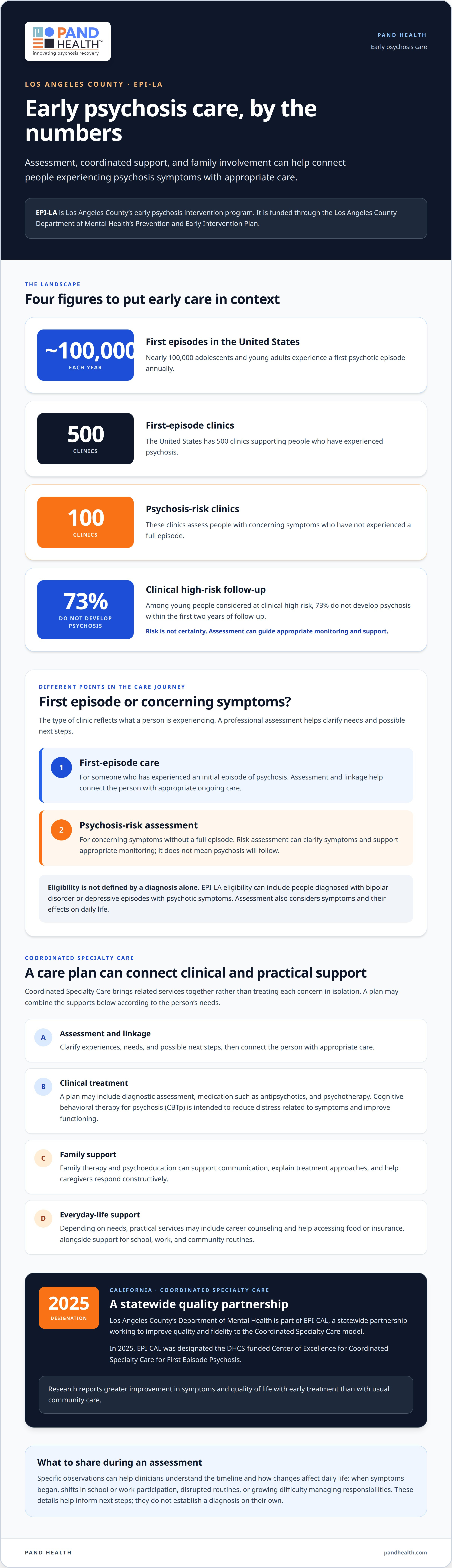
Nearly 100,000 adolescents and young adults in the United States experience a first psychotic episode each year. For a family, a practical point to consider is whether an assessment addresses current symptoms and identifies the support needed after the initial evaluation. Coordinated specialty care is intended to bring related services together rather than treat each concern in isolation.
Program Eligibility
Eligibility for the First Episode Psychosis Program centers on a first psychotic episode and the person’s clinical needs. EPI-LA eligibility can include people diagnosed with bipolar disorder or depressive episodes with psychotic symptoms. A diagnosis alone does not tell the whole story, so an assessment also considers symptoms and their effects on daily life.
“First episode” means the initial experience of psychosis, not necessarily a confirmed long-term disorder. This distinction matters for young people and adults whose symptoms may occur alongside another diagnosis. Assessment and referral help determine whether first-episode services or another level of support is appropriate.
First-Episode and Risk Clinics
First-episode clinics support people who have experienced psychosis, while psychosis-risk clinics assess people with concerning symptoms who have not experienced a full episode. The United States has 500 first-episode clinics and 100 psychosis-risk clinics. These services address different points in the course of symptoms, so the distinction can guide the kind of assessment considered.
Risk does not mean psychosis will follow. Among young people considered at clinical high risk, 73% do not develop psychosis within the first two years of follow-up. A risk assessment can help clarify symptoms and support appropriate monitoring without treating a possible future episode as certain.
Los Angeles County’s Department of Mental Health is part of EPI-CAL, a statewide partnership that works to improve quality and fidelity to the CSC model. In 2025, EPI-CAL was designated the DHCS-funded Center of Excellence for Coordinated Specialty Care for First Episode Psychosis. Research reports greater improvement in symptoms and quality of life with early treatment than with usual community care.
Evidence-based treatment and family support
Families can expect treatment to address psychotic symptoms alongside health, relationships, and everyday functioning. Caregivers may participate through family therapy and psychoeducation, learning about treatment and ways to support recovery at home.
A coordinated plan may combine diagnostic assessment and medication, commonly antipsychotics, with psychotherapy and practical services. Depending on the person’s needs, support may also include career counseling and help accessing food or insurance. For example, a care team could address distressing experiences while helping someone reconnect with school, work, or community routines.
Cognitive behavioral therapy for psychosis, often called CBTp, is an evidence-based approach intended to reduce distress related to psychotic symptoms and improve functioning. It can help someone explore how thoughts, feelings, and experiences affect daily life. Treatment is not a single technique: clinicians consider the person’s concerns and how symptoms affect activities such as sleep, relationships, or work.
Lived experience adds important context to a treatment plan. Someone might describe hearing voices as frightening, distracting, or difficult to discuss; a family member might notice missed classes or withdrawal from friends. These perspectives help the care team understand how symptoms affect everyday life, rather than relying only on a diagnosis or one appointment.
Family history and changes in functioning are useful details to share during an assessment. A relative can describe observed patterns, such as declining school participation, disrupted routines, or growing difficulty managing responsibilities. These details do not establish a diagnosis on their own. They help clinicians understand the timeline, consider relevant context, and discuss suitable next steps with the person and family.
Family therapy can support communication and help relatives respond constructively to symptoms. Family psychoeducation explains psychosis, treatment approaches, and ways caregivers can offer support. For example, a family can discuss how to respond when a loved one feels overwhelmed, while respecting that person’s perspective and keeping recovery goals central. Research indicates that family therapy can help improve treatment outcomes for a loved one with mental illness.
Referrals can begin with a family member, a community contact, or a clinician who has noticed changes in someone’s wellbeing. A useful next step is to share specific observations, such as when symptoms began and how daily activities have changed. An early psychosis team can use that information to guide assessment and linkage. For support involving family therapy or psychoeducation, contact the care team.
Early detection and intervention for psychosis
Early detection focuses on changes that may signal psychosis before they disrupt more parts of life. Psychosis often begins in a person’s early 20s, but age alone cannot determine whether someone is developing a mental illness. A professional evaluation considers the person’s experiences, their timing, and changes in functioning. The practical takeaway is to discuss concerning changes early, rather than waiting for a crisis to clarify what support may help.
California estimates that 107,000 residents experience a first psychosis episode each year. Estimates of annual incidence range from 15 to 100 people per 100,000, reflecting variation across populations and settings. These figures describe population-level patterns, not an individual’s likelihood of developing psychosis. A collaborative evaluation focuses instead on concrete signs, such as unusual perceptions, increasing distress, or difficulty maintaining school, work, or relationships.
For people with possible early symptoms, clinicians may use the Structured Interview for Psychosis-risk Syndromes, known as SIPS. Administration takes about 30 minutes to two hours, and the person conducting it should have clinical training. The interview helps assess psychosis-risk symptoms; it is not a prediction that a person will develop a disorder. A careful evaluation also considers the person’s history and current functioning.
Early intervention can matter before symptoms become longstanding. The Los Angeles County Department of Mental Health says that intervention during the first phases of psychotic symptoms can reduce the likelihood of progression into a chronic psychotic disorder. Changes such as declining attendance or growing difficulty with everyday tasks are worth discussing in an assessment. One change alone does not establish psychosis, but a clear timeline can help clinicians understand what has shifted.
California’s Assembly Bill 1315 established the Early Psychosis Intervention Plus Program and its advisory committee. In 2022, the Department of Health Care Services supported the expansion of EPI-CAL’s Learning Health Care Network and training and technical assistance for counties receiving early psychosis funding.
Program quality also involves assessing whether care follows its intended model. EPI-CAL developed a modified FEPS-FS fidelity evaluation for programs serving youth at clinical high risk. This type of review examines how services are delivered, not whether an individual has a diagnosis. For families, a useful next step is an evaluation that distinguishes current symptoms from possible risk and considers their impact on daily life.
What early psychosis intervention programs are available in Los Angeles County?
EPI-LA is the named early psychosis intervention program in Los Angeles County. It is funded through the Los Angeles County Department of Mental Health Prevention and Early Intervention Plan. The county department also participates in EPI-CAL, a statewide partnership focused on Coordinated Specialty Care for first-episode psychosis. These names distinguish the county program from the statewide network supporting early psychosis care.
For families, a useful starting point is identifying the kind of support needed. A first-episode service focuses on assessment and care after psychosis symptoms begin. A risk-focused service evaluates concerning experiences before a full episode. These pathways address different needs, so describing what prompted concern can help clarify which type of assessment is relevant.
The First Episode Psychosis Assessment and Linkage Program is another named pathway to understand when exploring early care. It focuses on assessment and connection to services. “Linkage” matters: an initial evaluation is most useful when it establishes a next step, rather than leaving the person and family unsure how care will continue. Ask how the assessment connects to ongoing support.
EPI-CAL’s Learning Health Care Network connects early psychosis programs in California to support shared learning and care quality. Los Angeles County’s participation places EPI-LA within this broader collaborative effort. For families comparing program types, the practical question is whether a service addresses the person’s current situation: a recent first episode, emerging risk concerns, or continued support after evaluation.
Program information can clarify who a service is designed to support. EPI-LA eligibility can include people diagnosed with bipolar disorder or depressive episodes with psychotic symptoms, so its scope is not limited to one diagnosis. In an initial conversation, explain the symptoms, any diagnosis already given, and changes to daily routines. These details can help determine whether the program’s focus aligns with the person’s needs.
Use these distinctions to make the first conversation more specific:
- Program: Ask whether the service is EPI-LA, an assessment and linkage pathway, or another early psychosis service.
- Focus: Clarify whether support is for a first episode or symptoms that raise risk concerns.
- Next step: Find out how an assessment connects to continuing care and family support.
These questions don’t replace a clinical assessment. They help families understand each program’s role and explain what has changed. In Los Angeles County, EPI-LA is the county-specific program to know, while EPI-CAL provides the wider statewide context for coordinated early psychosis care.
What services do Los Angeles early psychosis programs provide?
Services can cover assessment, treatment, and practical support, rather than focusing only on symptoms. In Los Angeles, coordinated care may combine diagnostic evaluation and medication with psychotherapy, family support, and social services. The mix depends on the person’s needs, including how psychosis affects relationships, school, work, and daily routines. Understanding these components can help families discuss what support should address.
An initial evaluation helps clarify what someone is experiencing and what care may be appropriate. Clinicians consider reported symptoms, their effect on functioning, and relevant history. For example, difficulty attending classes alongside distressing perceptions gives a fuller picture than either detail alone. Evaluation can also help distinguish first-episode care from support focused on emerging risk, guiding the next step.
Medication may be part of treatment, with antipsychotics commonly used in psychosis care. Psychotherapy can address distress, coping, and everyday functioning. Cognitive behavioral therapy for psychosis is one evidence-based approach intended to reduce symptom-related distress and improve functioning. These components address different needs: medication targets clinical symptoms, while therapy helps someone work through their impact on daily life.
Practical services can connect clinical care with goals beyond appointments. Support may include career counseling or help accessing food and insurance. For instance, someone struggling to return to work may need to discuss vocational goals alongside mental health treatment. Practical needs can affect whether a care plan feels workable, so coordinated programs consider them as part of the broader picture.
Family involvement is another service to ask about. Family psychoeducation can help relatives understand psychosis and treatment, while family therapy can support communication and shared problem-solving. A caregiver might learn how to respond when a loved one feels distressed, then discuss family concerns in therapy. The person receiving care remains central to decisions, with relatives contributing observations and support.
Some programs also connect people with community resources. This may mean identifying social services relevant to someone’s situation, such as food or insurance assistance, rather than treating those needs as separate from mental health. Ask how the care team coordinates these supports with clinical treatment and whether family participation can be included.
When comparing services, focus on how an evaluation leads to a plan and how that plan addresses more than symptoms. Consider whether support includes clinical care, therapy, family involvement, and practical needs such as returning to school or work. A clear explanation of each service helps the person and family understand what care involves and how it relates to their goals.
Pand Health: California OnTrack Work-Study Program
Pand Health’s California OnTrack Work-Study Program can support people working toward education or employment goals alongside mental health care. Social skills training and psychological and social rehabilitation can help develop interpersonal and everyday living skills. For people seeking clarity about symptoms, evaluation for thought disorders and autism can inform appropriate care.
This support may be worth exploring when a person is ready to build practical skills and pursue work or study goals as part of their care. The right focus depends on the person’s needs and priorities. Contact Pand Health to discuss the California OnTrack Work-Study Program and related support.
Choose a next step that fits the person’s goals
The next step doesn’t need to answer every question at once. Start with a clear discussion of what has changed, what feels most difficult now, and what the person hopes to regain in daily life. For one person, that may mean returning to a familiar routine; for another, it may mean clarifying symptoms and priorities with a professional.
Choosing an early intervention psychosis program in Los Angeles also means finding care that respects the person’s perspective and involves family support where appropriate. A thoughtful conversation can help identify which concerns need attention first and whether the care being considered fits the person’s current needs.
For individuals and families ready to discuss a next step, contact Pand Health to discuss care. Bringing a few observations about recent changes and personal goals can help make that conversation focused and useful. Progress can begin with one clear, supported step toward greater stability and renewed participation in everyday life.
Frequently Asked Questions
What is EPI-LA?
EPI-LA is Los Angeles County’s early psychosis intervention program, funded through the County Department of Mental Health Prevention and Early Intervention Plan. It is part of California’s broader early psychosis care network, EPI-CAL, which supports quality and fidelity to Coordinated Specialty Care. The distinction is useful for families: EPI-LA identifies the county program, while EPI-CAL describes a statewide partnership supporting early psychosis services.
Does Los Angeles County offer Coordinated Specialty Care for first-episode psychosis?
Yes. Los Angeles County participates in EPI-CAL, a statewide partnership focused on Coordinated Specialty Care for first-episode psychosis. CSC coordinates clinical and practical support around a person’s needs, rather than treating each concern as unrelated. If you’re considering an early intervention psychosis program in Los Angeles, clarify whether the service focuses on a first episode, risk assessment, or another care need.
Who is eligible for early psychosis intervention programs in Los Angeles?
Eligibility depends on the program and the person’s clinical assessment. EPI-LA eligibility can include people diagnosed with bipolar disorder or depressive episodes with psychotic symptoms, as well as people experiencing a first psychotic episode. Separately, Pand Health’s California OnTrack programs serve teens and adults ages 13-35 with early-episode or high-risk psychosis. An evaluation helps identify which pathway fits the person’s symptoms and needs.
How can a Los Angeles early psychosis program help with referral or enrollment?
A referral or enrollment process typically begins by sharing the symptoms, changes in daily functioning, and any existing diagnosis so the program can assess the person’s needs and connect them with care. Pand Health provides same or next day psychosis evaluation services, which address assessment rather than guaranteeing program enrollment. For inquiries, call 888-710-PAND to discuss available evaluation and care options.
Where are early psychosis clinics located in Los Angeles County, and which areas do they serve?
EPI-LA is Los Angeles County’s early psychosis program. One named local clinic is the San Fernando Valley Community Mental Health Clinic at 14535 Sherman Cir, Van Nuys, California. That address identifies a clinic location, but it does not establish the clinic’s service area or represent every early psychosis program. The relevant pathway depends on the person’s needs and the program involved.
How quickly can someone start treatment at a Los Angeles early psychosis program?
Treatment timing follows assessment and depends on the person’s symptoms, clinical needs, and appropriate care plan. Pand Health offers same or next day psychosis evaluation services, but an evaluation helps determine care and does not promise treatment will begin that day. Pand Health’s guiding phrase is “Recovery is the expectation, not the exception,” with care directed toward the individual’s needs.
Disclaimer
This article is for information and educational purposes only, and can NEVER replace a proper medical evaluation. If you or a loved one may be suffering from psychosis or the prodomal symptoms of psychosis, get evaluated by a professional as soon as possible. Early diagnosis and treatment can be life-saving.