

Parental Support for Child Psychosis in Los Angeles
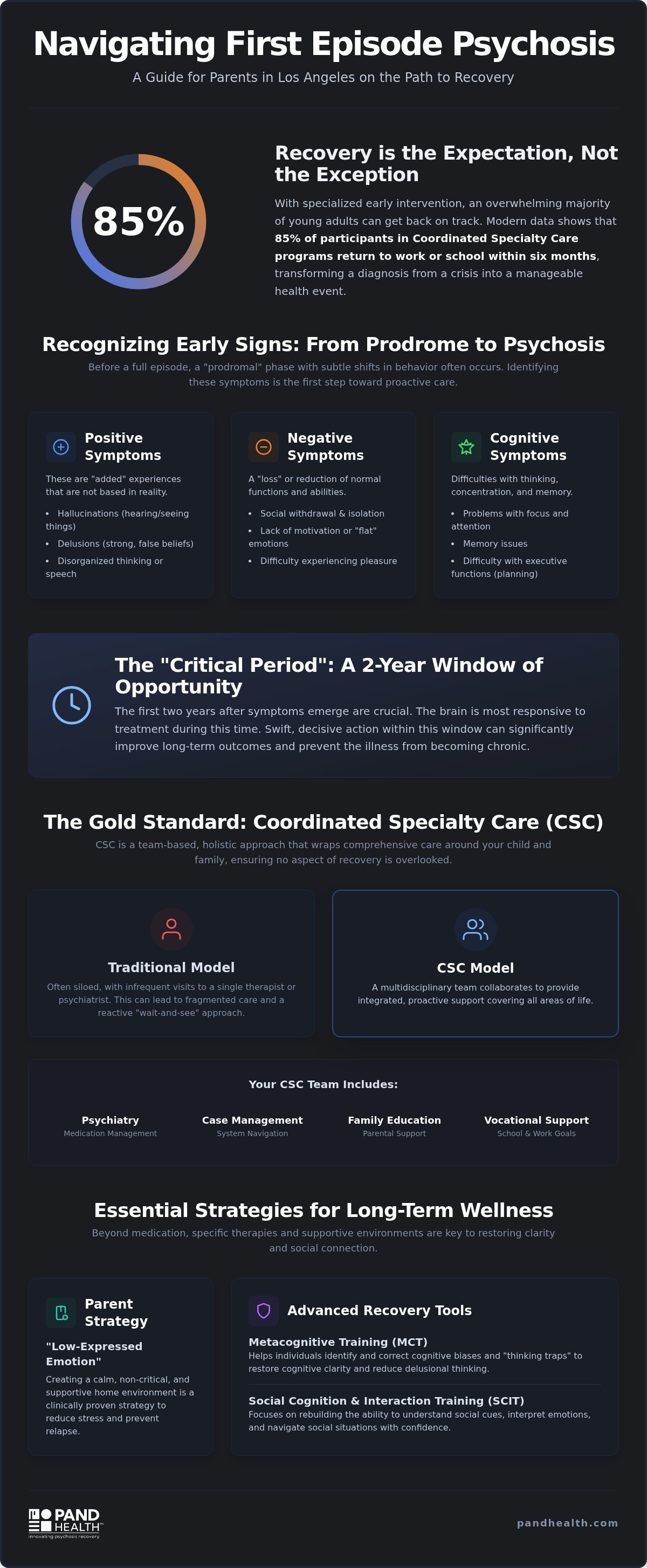
What if a psychosis diagnosis wasn't a dead end, but the start of a journey where 85% of participants return to work or school within six months? You're likely feeling the heavy weight of caregiver burnout while trying to decipher clinical jargon and navigate a fragmented local healthcare system. It's natural to fear for your child's long-term independence when the present feels so unstable. Finding the right support for parents of child with psychosis LA is the most critical step you can take to replace that fear with a concrete plan for recovery.
We're here to clarify the path forward by highlighting specialized resources and evidence-based therapies that prioritize your child's return to normalcy. This article explores how the Coordinated Specialty Care model works in Los Angeles, details the impact of the 2026 CARE Act expansions, and identifies local programs designed to act as a steady hand through this storm. You'll gain a clear understanding of the latest clinical tools and find a sense of hope grounded in real, local data.
Key Takeaways
- Recognize the subtle "Prodromal" symptoms of First Episode Psychosis to transition from a state of crisis to a proactive, treatable medical framework.
- Explore why Coordinated Specialty Care (CSC) is the clinical gold standard and how a multidisciplinary team provides a stabilizing lifeline for families.
- Implement specific communication techniques, such as creating a "Low-Expressed Emotion" environment, to provide the most effective support for parents of child with psychosis LA.
- Discover how advanced interventions like Metacognitive Training (MCT) and SCIT help restore social nuances and cognitive clarity for long-term wellness.
- Learn to navigate the Los Angeles mental health system by identifying providers with high success metrics, including an 85% return to education or employment.
Understanding First Episode Psychosis (FEP) in Young Adults
Hearing the word psychosis often triggers a vision of a lifelong disability. However, modern clinical data suggests a different reality. Psychosis is a treatable medical event, not a permanent identity. While the term carries heavy social stigma, it's better understood as a manageable disruption in brain signaling that responds well to targeted care. For families seeking support for parents of child with psychosis LA, it's vital to recognize that your child is still there, beneath the symptoms. You aren't alone in the Los Angeles mental health system. Many families are currently navigating these same waters, and finding a community of specialized experts can provide the stability you need. If you feel overwhelmed by the initial diagnosis, reaching out for a professional consultation can help ground your family in a clear recovery plan.
Before a full episode occurs, there's often a "prodromal" phase. In Los Angeles teens, these subtle shifts are frequently dismissed as typical adolescent moodiness or academic burnout. You might notice your child becoming increasingly suspicious of friends or withdrawing from social activities they once loved. Identifying these nuances early allows for a much smoother path to restoration.
Common Signs and Symptoms to Monitor
Symptoms are generally categorized into three areas. Recognizing which ones your child is experiencing helps clinicians tailor the intervention.
- Positive Symptoms: These are "added" experiences, such as hallucinations (hearing or seeing things others don't), delusions (firmly held false beliefs), and disorganized thinking.
- Negative Symptoms: These involve a "loss" of normal function. Social withdrawal and a lack of motivation are common. Parents often mistake this for laziness, but it's actually a core symptom of the brain struggling to process reward and engagement.
- Cognitive Symptoms: Problems with focus, memory, and executive function. In a school setting, this often manifests as a sudden, unexplained drop in grades or an inability to follow complex instructions.
The 'Critical Period' of Intervention
The first two years after symptoms emerge are known as the "critical period." Scientific consensus highlights that Early intervention in psychosis significantly dictates long-term recovery success. During this window, the brain is more responsive to treatment, and early action can prevent the structural changes often associated with chronic illness. In Los Angeles, moving away from a "wait and see" approach is essential. Traditional models often wait for a crisis to occur before providing intensive care; modern early intervention programs prioritize immediate, comprehensive support to keep the child's life on track. First Episode Psychosis (FEP) is a time-sensitive clinical window where specialized intervention can fundamentally shift a child's developmental trajectory.
Navigating Coordinated Specialty Care (CSC) in Los Angeles
Finding the right support for parents of child with psychosis LA requires moving beyond traditional, siloed therapy toward a specialized framework. The National Institute of Mental Health identifies Coordinated Specialty Care (CSC) as the gold standard for early intervention. Unlike standard outpatient visits that might only occur once a week, CSC uses a team-based approach. A multidisciplinary group of psychiatrists, case managers, and vocational specialists collaborate daily to wrap care around your child. This collective expertise ensures that no aspect of recovery, from medication to social reintegration, is left to chance.
Families in Southern California typically choose between public programs through the Los Angeles County Department of Mental Health (LACDMH) and private, augmented models. While county programs like EPI-LA provide essential services, they often face high caseloads and rigid enrollment windows. Private institutions like Pand Health offer a more intensive, "augmented" version of this care. Located conveniently near Olympic Blvd, these services are accessible for families across West Los Angeles and the San Fernando Valley who require a higher level of dedicated attention.
The Components of a High-Quality CSC Model
A high-quality program integrates several clinical pillars to ensure stability. Cognitive Behavioral Therapy for Psychosis (CBT-P) helps individuals manage distressing experiences, while medication management is handled with a philosophy of finding the lowest effective dose to minimize side effects. Family psychoeducation is equally vital. Your involvement is statistically the strongest predictor of your child's success; learning how to navigate the nuances of the diagnosis at home reduces the risk of relapse. Supported Education and Employment (SEE) works alongside clinical care to keep your child "on track" with their academic or career goals.
Pand Health’s Augmented CSC Model
Standard care is often limited by strict timelines or a focus only on symptom reduction. The California OnTrack program at Pand Health augments the traditional model by offering 24 to 32 hours of intensive outpatient care per client. This includes APA-recommended cognitive remediation and social cognition training (SCIT), which aren't typically available in standard outpatient settings. We also incorporate fitness coaching to support metabolic health and wellness. Our data shows an 85% employment or education participation rate after six months, significantly outperforming traditional intervention models. We offer indefinite program enrollment, which provides a permanent safety net for families rather than a temporary solution. If you're ready to explore how a tailored team can support your family's specific needs, reaching out to a specialist is the next logical step toward long-term stability.
Essential Strategies for Parents Supporting a Child with Psychosis
While clinical teams manage the medical aspects of recovery, the home environment remains the most influential factor in your child's long-term stability. Living with a young adult experiencing a break from reality is emotionally taxing. It requires a shift from traditional parenting to a more specialized, supportive role. Finding consistent support for parents of child with psychosis LA involves learning how to maintain a calm, predictable atmosphere. This approach doesn't just make daily life easier; it actively protects your child's brain from the stress that often leads to rehospitalization. By adopting evidence-based communication and environmental strategies, you become a co-facilitator of their healing process.
Managing a crisis in a city as large as Los Angeles can feel overwhelming. It's important to distinguish between a clinical escalation and an immediate safety risk. If your child is at risk of harming themselves or others, utilizing the 988 crisis line or requesting a Los Angeles County Department of Mental Health mobile crisis team is necessary. However, for non-emergency symptom flares, your first point of contact should be your outpatient team. They can adjust treatment plans without the trauma of an unnecessary hospital stay. Balancing this vigilance with your own wellness is the only way to avoid the caregiver burnout that sidelines so many families.
Communication Dos and Don'ts
Talking about delusions requires a delicate balance. You don't want to validate a false reality, but dismissing it often leads to defensive arguments and isolation. We recommend the LEAP method: Listen, Empathize, Agree, and Partner. Start by listening to their experience without judgment. Empathize with the feeling behind the belief, even if you don't share the belief itself. Find common ground to agree on, such as a mutual desire for them to feel safe or less stressed. Finally, partner with them on a goal, like getting better sleep or attending a session. A Low-Expressed Emotion (Low-EE) environment is a key factor in preventing relapse by minimizing high-stress interactions that can trigger symptom flares.
Local Support Resources for LA Parents
You don't have to navigate this complex system in isolation. Peer-led organizations like NAMI Westside LA offer support groups specifically for families, providing a space where your experiences are understood without explanation. For those who prefer digital resources, the Mind Exposed Podcast offers deep dives into the science of recovery and personal stories from other Southern California families. It serves as a vital lifeline when you're seeking specialized family therapy for psychosis Los Angeles that understands the nuances of this diagnosis. These resources remind you that while the journey is difficult, a community of experts and peers is ready to guide you toward a successful outcome.
Advanced Recovery Tools: MCT, SCIT, and SEE Curriculum
Traditional recovery models often stop at symptom management. For many families, the real goal isn't just the absence of hallucinations; it's the presence of a meaningful life. This is where advanced clinical tools bridge the gap between clinical stability and functional success. When looking for support for parents of child with psychosis LA, it's essential to find a program that addresses the cognitive and social "rust" that accumulates during a psychotic break. Comprehensive support for parents of child with psychosis LA must include a path back to the classroom or the workplace.
We believe that recovery is a proactive process of rebuilding the skills that psychosis often erodes. By integrating specialized cognitive training with vocational support, we help young adults move from a state of crisis to a state of contribution. These tools don't just manage the condition; they actively rewire the brain's approach to social and professional environments.
How Metacognitive Training Changes the Brain
Metacognitive Training (MCT) is a specialized intervention that helps the brain "think about thinking." It targets common cognitive biases, such as the tendency to jump to conclusions or over-attribute negative intentions to others. These biases are often the fuel for paranoia. Unlike traditional talk therapy, which might explore the content of a delusion, MCT provides practical exercises to help the individual recognize when their brain is taking a mental shortcut. Pand Health is currently the exclusive provider in Southern California offering certified MCT instructors in an outpatient setting. This high-standard intervention is a cornerstone of our commitment to neuroplasticity and long-term wellness.
Supported Education and Employment (SEE)
Recovery is incomplete if a young adult remains isolated at home. Social Cognition and Interaction Training (SCIT) provides specialized social skills training for adults with schizophrenia LA, helping them relearn the nuances of body language, sarcasm, and emotional cues. This social rehabilitation is paired with the Supported Education and Employment (SEE) curriculum. Our team acts as a dedicated advocate for your child at institutions like UCLA, USC, or local community colleges to ensure they have the necessary academic accommodations.
The results of this augmented approach are transformative. While the industry average for work and school participation in this demographic is often low, our California OnTrack program sees an 85% participation rate after just six months of treatment. This is a significant leap compared to the 6% rehospitalization rate we maintain, which is nearly half the 10% industry average. We don't just aim for stability; we aim for a full return to the life your child was meant to lead. If you're ready to see how these advanced tools can change your child's trajectory, contact our Los Angeles team to discuss our specialized curriculum.
Choosing the Right Early Psychosis Specialist in Los Angeles
Selecting a clinical provider is a high-stakes decision for any family. You need more than a general therapist; you need a team that understands the specific neurobiology of early psychosis and the urgency of the critical period. When vetting local resources, ask about their specific success metrics. Do they track how many of their clients return to school or work? What is their specific rehospitalization rate? These data points offer a clear window into the quality of care your child will receive. Finding the right support for parents of child with psychosis LA means identifying a partner who treats recovery as the expected outcome, not a rare exception.
Accessibility is a practical but vital consideration in Southern California. Our clinic on Olympic Blvd is strategically located to serve families throughout West Los Angeles and the San Fernando Valley. Intensive care requires frequent visits, and a manageable commute reduces the burden on both the child and the caregiver. During your initial psychiatric evaluation for psychosis Los Angeles, we'll discuss these logistical details alongside the clinical plan. We'll also address insurance and financial considerations for our intensive outpatient programs to ensure your family feels stable and supported from day one.
The Pand Health Difference: Where Recovery is the Expectation
Our approach is defined by results that exceed national benchmarks. We maintain a 6% rehospitalization rate, which is significantly lower than the 10% industry average. This stability is achieved through our augmented CSC model and our commitment to community reintegration. We utilize a "Clubhouse Model" in West LA, providing a social space where young adults can practice the skills they learn in SCIT and MCT. This isn't just about clinical visits; it's about building a life. Contact our team on Olympic Blvd to start the evaluation process and see how our specialized focus can benefit your child.
Next Steps for Your Family
The path forward begins with clarity. Scheduling a comprehensive thought disorder assessment LA allows us to pinpoint the specific cognitive and social needs of your child. This evaluation serves as the roadmap for their personalized California OnTrack program. We also encourage you to join one of our family psychoeducation groups. Meeting other parents who are navigating similar challenges provides a unique form of support for parents of child with psychosis LA that clinical sessions alone cannot replicate. Learn more about our Social Skills Training in Los Angeles to understand how we facilitate these vital social connections. Taking this first step moves your family from a state of uncertainty into a structured, hopeful future.
Restoring Your Child's Future in Los Angeles
The journey from a psychosis diagnosis to long-term stability is a path we navigate together. By prioritizing the critical period of early intervention and utilizing advanced clinical tools like Metacognitive Training, we move beyond simple symptom management. Our data shows that 85% of our clients are successfully engaged in work or school within six months of starting treatment. This outcome is possible because we're the only outpatient program in Southern California offering certified MCT, SCIT, and APA-recommended cognitive remediation within an augmented care model. Finding the right support for parents of child with psychosis LA means choosing a partner that acts as a steady hand during the storm.
Located on Olympic Blvd in West Los Angeles, our team is ready to help your family find a new sense of normalcy and hope. We've seen firsthand how specialized care transforms lives and restores the developmental trajectory of young adults. You don't have to carry this weight alone; a future defined by purpose and community connection is within reach. Contact Pand Health today to schedule a psychiatric evaluation and start your child's recovery journey.
Frequently Asked Questions
Is psychosis the same thing as schizophrenia?
No, psychosis is a clinical symptom rather than a specific diagnosis. It refers to a break from reality that can be caused by various factors, including severe depression, bipolar disorder, or substance use. Schizophrenia is a chronic mental health condition where psychosis is a core feature. Identifying the specific cause during a psychiatric evaluation is the first step toward building an effective, personalized treatment plan.
Can my child ever go back to college or hold a job after a psychotic episode?
Yes, functional recovery is the primary expectation of modern early intervention programs. Our California OnTrack program prioritizes social and vocational goals, resulting in an 85% participation rate in work or school within six months. We provide dedicated support to help students navigate academic accommodations at local Los Angeles colleges, ensuring they don't have to sacrifice their long-term career ambitions because of a diagnosis.
How long does a typical early psychosis program like California OnTrack last?
Most Coordinated Specialty Care programs are designed to last between two and three years, though we offer indefinite enrollment to provide a permanent safety net for families. This duration covers the "critical period" where the brain is most responsive to intervention. The timeline allows individuals to master cognitive and social skills, ensuring they're fully stabilized before transitioning to a lower level of outpatient care.
What is the difference between an inpatient hospital stay and an intensive outpatient program?
Inpatient care is a short-term, 24-hour intervention used primarily for immediate safety and crisis stabilization. An intensive outpatient program (IOP) allows your child to live at home while receiving 24 to 32 hours of clinical care each week. This model is often more effective for long-term recovery because it focuses on community reintegration and real-world skill-building rather than just temporary symptom suppression in a hospital setting.
Are there specific support groups for parents of children with psychosis in Los Angeles?
Yes, Los Angeles has a robust network of resources, including NAMI Westside LA and our own internal family psychoeducation groups. These sessions provide vital support for parents of child with psychosis LA, allowing you to connect with other families who truly understand your experience. You'll learn evidence-based strategies for communication and crisis management in a validating environment that prioritizes your own wellness alongside your child's recovery.
What should I do if my child refuses to believe they are experiencing symptoms?
This lack of insight is a clinical condition known as anosognosia and is a common part of the illness. We suggest avoiding direct arguments about the reality of their experiences, as this often leads to isolation and defensiveness. Instead, use the LEAP method to empathize with their feelings and partner on neutral goals, such as improving their sleep or reducing anxiety. This approach builds the trust necessary to eventually engage them in professional treatment.
Does insurance usually cover Coordinated Specialty Care (CSC) programs?
Many private insurance plans and Medi-Cal provide coverage for various components of the CSC model. Because these programs are evidence-based and reduce long-term costs by preventing rehospitalization, they're increasingly recognized by major payers. Our administrative team on Olympic Blvd can help you verify your specific benefits and navigate the financial considerations of our intensive outpatient services to ensure your child receives the highest standard of care.
What is the success rate for young adults treated during their first episode?
Success rates are exceptionally high when specialized intervention begins during the first two years of symptoms. At Pand Health, our augmented recovery tools lead to a 6% rehospitalization rate, which is nearly half the 10% industry average. When families have access to consistent support for parents of child with psychosis LA, the vast majority of young adults achieve long-term clinical stability and successfully return to their social and professional lives.
Disclaimer
This article is for information and educational purposes only, and can NEVER replace a proper medical evaluation. If you or a loved one may be suffering from psychosis or the prodomal symptoms of psychosis, get evaluated by a professional as soon as possible. Early diagnosis and treatment can be life-saving.