

Outpatient Care After a 5150 Hold in Los Angeles: A Guide to Sustained Recovery
The 72-hour hold is ending, but what happens next to help prevent another crisis? A 5150 hold can create immediate safety and stabilization; it isn’t a long-term treatment plan. For families seeking outpatient care after 5150 hold Los Angeles, that gap between discharge and ongoing support can feel frightening, especially when the plan is unclear or specialized psychosis care is hard to find.
Your concern is understandable. The first weeks after discharge call for coordinated follow-up, clear communication, and support that addresses more than symptoms alone. Evidence-based Coordinated Specialty Care (CSC) is recommended for first-episode psychosis and can support progress toward school, work, and daily life.
This guide explains what a 5150 hold means, what to clarify before discharge, and how to build a practical roadmap for the first 30 days. You’ll learn how outpatient treatment, family psychoeducation, and rehabilitation can work together, and what to consider when looking for specialized care in Los Angeles. With a thoughtful plan and the right support, recovery can include renewed stability, meaningful goals, and greater peace of mind for the whole family.
Key Takeaways
- Understand what a 5150 hold means in California and which criteria may lead to an involuntary psychiatric evaluation.
- Learn why the transition after discharge needs more than a crisis plan, and what to ask when arranging follow-up care.
- See how Coordinated Specialty Care brings together treatment and family support for people experiencing first-episode psychosis.
- Use practical steps to evaluate outpatient care after 5150 hold Los Angeles, including how to look for experience with psychosis and thought disorders.
- Explore how California OnTrack supports progress toward school or work, with Pand Health reporting 85% employment or education engagement after six months.
Understanding the 5150 Psychiatry Process in Los Angeles
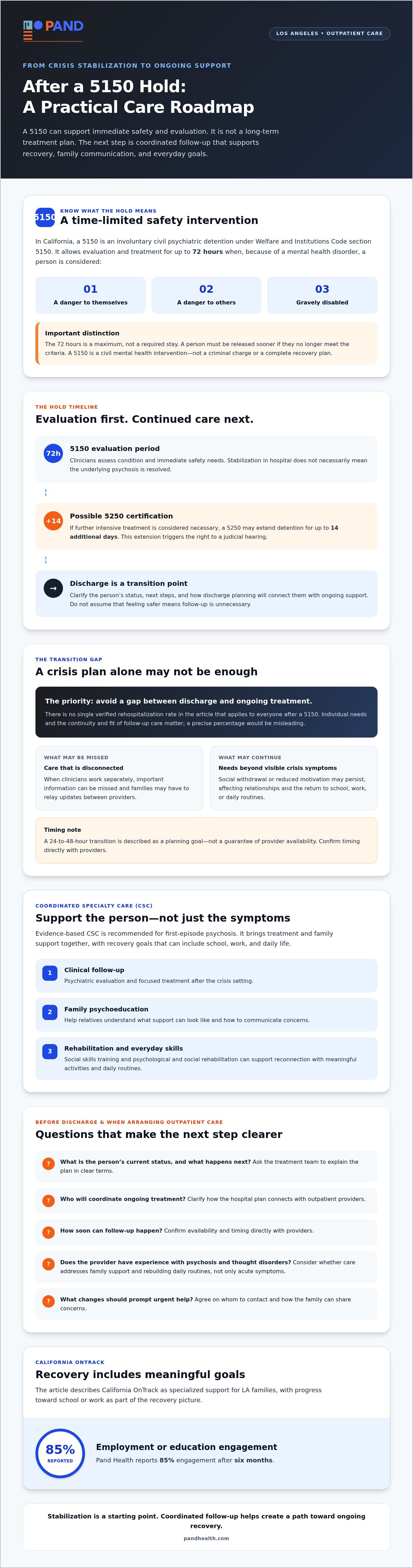
A 5150 hold is an involuntary civil psychiatric detention under California Welfare and Institutions Code section 5150, part of the Lanterman-Petris-Short (LPS) Act. It allows a person to be held for evaluation and treatment for up to 72 hours when, because of a mental health disorder, they are considered a danger to themselves, a danger to others, or gravely disabled. The hold is a safety intervention, not a criminal charge or a complete recovery plan.
For some young adults experiencing a first psychotic episode, a crisis may be the first time families encounter psychiatric services or hear the term “5150 psychiatry.” A hospital can assess immediate risks and support stabilization. Longer-term recovery, including ongoing treatment and steps toward school, work, and daily routines, requires follow-up beyond the crisis setting. That’s where a plan for outpatient care after 5150 hold Los Angeles becomes essential.
The 72-Hour Timeline: What Actually Happens?
During the hold, clinicians evaluate the person’s condition and immediate safety needs. The 72 hours is a maximum, not a required stay: the person must be released sooner if they no longer meet the criteria. If further intensive treatment is considered necessary, a 5250 certification may extend detention for up to 14 additional days. This extension triggers the right to a judicial hearing. Ask the treatment team to explain the person’s status, the next steps, and how discharge planning will connect them with continued care.
Stabilization and recovery are different goals. A person may become safer or more settled in a hospital without the underlying psychosis being resolved. Discharge is therefore a transition point, not proof that ongoing support is unnecessary.
Common Misconceptions About Involuntary Holds
Myth: A 5150 automatically creates a permanent record or takes away all rights. A 5150 is a civil mental health intervention, not a criminal conviction, and it doesn’t automatically mean a person loses all rights. The effects of a hold can depend on the specific circumstances, so ask qualified professionals about individual legal questions rather than assuming one outcome applies to everyone.
Reality: The purpose is immediate safety and evaluation. But once the hold ends, waiting to see what happens can leave a person and family without timely support. Agree on follow-up, clarify who will coordinate ongoing treatment, and note changes that should prompt urgent help. A clear next step can make the transition from hospital stabilization to sustained recovery feel less uncertain.
The 'Rehospitalization Cliff' and the Need for Intensive Outpatient Care
Discharge from a psychiatric hold can bring relief, but it also begins a vulnerable transition. Families often want to know the chance of rehospitalization in the first 90 days. There isn’t a single verified rate here that applies to every person after a 5150, so a precise percentage would be misleading. Risk depends on individual needs and the continuity and fit of follow-up care. The practical priority is to avoid a gap between discharge and ongoing treatment.
Weekly therapy may be valuable, but by itself it may not address the range of needs following a psychotic episode. A person might need psychiatric evaluation, focused treatment, family support, and help rebuilding daily routines. Ask the discharge team what follow-up is planned, who will coordinate care, and how soon an outpatient provider can see the person. The outline’s suggested 24-to-48-hour transition is a planning goal, not a guarantee of availability; confirm timing directly with providers.
Why Standard Outpatient Care Often Falls Short
When clinicians work separately, important information can be missed. Families may find themselves relaying updates between providers while trying to recognize changes at home. Psychosis can also involve negative symptoms, such as social withdrawal or reduced motivation. These may persist even when the most visible crisis has eased, making it harder to return to school, work, or relationships. Family psychoeducation and therapy can help relatives understand what support looks like and how to communicate concerns.
The Goal of Intensive Treatment: Beyond Symptom Suppression
Recovery is about more than reducing acute symptoms. It also means helping a person reconnect with meaningful activities and build confidence in everyday settings. Social skills training and psychological and social rehabilitation can address isolation and support progress toward personal goals. The National Institute of Mental Health’s Coordinated Specialty Care research describes a coordinated approach for early psychosis that connects treatment with family involvement and work or school goals.
Pand Health reports a 6% rehospitalization rate among enrolled participants, compared with 50% before enrollment. These are client-reported figures, not a guarantee of an individual outcome or a direct comparison with a 90-day population rate. They do underscore why coordinated, specialized follow-up deserves consideration. For families exploring outpatient care after 5150 hold Los Angeles, Pand Health’s psychosis care information can be a starting point for asking about evaluation and treatment options.
Coordinated Specialty Care (CSC): The Gold Standard for Post-5150 Recovery
A 5150 hold addresses an immediate crisis. For first-episode psychosis, the next step is care that connects clinical treatment with the person’s goals and family context. Coordinated Specialty Care (CSC) does this through a team-based approach that can include medication management, therapy, family support, and help with education or employment. The National Institute of Mental Health’s RAISE research found CSC more effective than typical care for improving symptoms, quality of life, and engagement in work or school.
That coordinated approach matters because recovery is not only about reducing acute symptoms. It also means working toward connection, independence, and a return to meaningful routines. Families seeking outpatient care after 5150 hold Los Angeles can review services through the Los Angeles County Department of Mental Health and ask providers how they coordinate treatment and family involvement.
Specialized Therapies and Cognitive Skills
CSC may involve different interventions depending on a person’s needs. Metacognitive Training (MCT) helps people notice and examine thinking patterns that can contribute to distress or suspicious interpretations. Social Cognition and Interaction Training (SCIT) focuses on understanding social cues, while cognitive behavioral therapy for psychosis (CBT-P) can help a person explore the links between thoughts, feelings, and experiences. These are distinct approaches, so families should ask which are available and appropriate rather than assume every program provides them.
Pand Health reports that its team includes certified MCT instructors and offers APA-recommended cognitive remediation. Cognitive remediation uses structured exercises to work on cognitive skills such as attention, memory, and planning. It isn’t a quick fix or a substitute for clinical care; it can be one part of a broader recovery plan. Ask how progress is assessed and how skills practiced in treatment connect to daily life.
California OnTrack and Individualized Recovery
Pand Health offers California OnTrack programs for teens and adults, as well as a Work-Study Program. These offerings support a focus on functioning and participation alongside treatment. The available information identifies them as specialized programs for psychosis, but doesn’t confirm that they follow the NAVIGATE framework specifically. Families can ask providers which CSC components are included and how the treatment plan is coordinated.
There’s no single therapy combination that fits everyone. A useful discussion with a provider covers medication, therapy, family psychoeducation, cognitive needs, and realistic school or work goals. Recovery is the expectation, with the plan shaped around the individual rather than a one-size-fits-all path.
5 Steps to Navigating Outpatient Care in Los Angeles
After a psychiatric hold, clear next steps can help turn discharge into a supported transition. Use these five steps to compare options for outpatient care after 5150 hold Los Angeles and build a plan around the person’s clinical needs, family, and goals.
- Arrange a psychiatric evaluation. Seek a comprehensive assessment promptly, and bring discharge paperwork and medication information if available. Pand Health offers same- or next-day psychosis evaluation services; confirm appointment timing directly with the provider.
- Ask about experience with psychosis. Find out whether the team evaluates and treats first-episode psychosis and thought disorders. Ask how clinicians coordinate care and how they’ll respond if symptoms or daily functioning change.
- Include family support. Family psychoeducation can help relatives understand psychosis, communicate more constructively, and support recovery while respecting the person’s independence. Families can ask what support is available and how to participate.
- Make school and work part of the plan. Look for treatment that addresses functional goals, not only symptoms. Ask whether the program supports education or employment goals, and whether it offers social skills training or psychological and social rehabilitation.
- Plan for setbacks and ongoing recovery. Discuss early warning signs, who to contact, and what steps to take if concerns arise. A relapse prevention plan should be individualized and include relevant clinical and rehabilitation supports.
Assessing Program Intensity
Ask how many hours of care are provided each week and what those hours include. Pand Health’s program information describes 24–32 hours of care weekly; confirm the current schedule and which services are part of the plan. Also ask whether a dedicated case manager supports school or workplace advocacy, and whether the program uses a Clubhouse Model for community reintegration. These are useful questions, not features to assume every provider offers.
Family Psychoeducation: From Caregiver to Recovery Partner
Families don’t have to manage the transition alone. Psychoeducation can help relatives recognize when a loved one may need more support, practice calm and clear communication, and create a home environment that supports recovery without placing the entire responsibility on family members. Ask how family participation is included and what guidance is available between appointments.
For a discussion of evaluation and psychosis treatment options, contact Pand Health about outpatient care. A practical first conversation can clarify whether the program’s intensity, family involvement, and functional goals fit the person’s needs.
California OnTrack: A Specialized Lifeline for LA Families
After a crisis, families need more than a name on a referral list. They need to understand what ongoing support can address, how it connects with everyday goals, and how to begin. Pand Health specializes in first-episode psychosis and offers California OnTrack programs for teens and adults, along with a Work-Study Program. Its approach is designed to connect psychosis treatment with meaningful steps toward education, employment, and community life.
Pand Health reports that 85% of participants are engaged in employment or education after six months. This is a program-reported outcome, not a guarantee for every person. Ask how the program measures engagement, what supports are included, and how goals are individualized. For families considering outpatient care after 5150 hold Los Angeles, those details can help clarify whether a program fits their loved one’s needs.
Pand Health is located at 11500 W. Olympic Blvd., Suite 399, Los Angeles, CA 90064. The team describes its care as an augmented Coordinated Specialty Care model for psychosis, with certified Metacognitive Training (MCT) instructors and APA-recommended cognitive remediation. “Recovery is the expectation” is a hopeful starting point, while each person’s treatment plan should reflect their own clinical needs and goals.
Work and Study as Part of Recovery
Returning to college or work can involve challenges beyond symptoms, such as rebuilding routines, confidence, and social connections. California OnTrack’s Work-Study Program is an option families can ask about when education or employment is a priority. Discuss how the program supports a participant’s specific goals, what services are included, and whether resume development or workplace advocacy is available. These details should be confirmed directly rather than assumed. Families seeking additional background can read the LA Work-Study Guide for Mental Health Recovery.
Getting Started with an Evaluation
Pand Health offers same- or next-day psychosis evaluation services. Contact the team to confirm current appointment availability and discuss whether an evaluation is appropriate. Preparing a brief account of recent concerns, prior care, and the person’s education or work goals may help guide the conversation. An evaluation can clarify possible next steps, but treatment recommendations should be based on the individual’s assessment.
For families looking for a specialized next step after a 5150 hold, contact Pand Health to discuss a psychiatric evaluation and California OnTrack options.
Build a Steadier Path Forward After Discharge
A 5150 hold can address an immediate safety crisis, but sustained recovery depends on what follows. A clear outpatient plan should connect specialized psychosis care with family support and goals for returning to school, work, and daily life. For families considering outpatient care after 5150 hold Los Angeles, the key is to seek coordinated follow-up rather than wait for another crisis to determine the next step.
Pand Health reports a 6% rehospitalization rate among enrolled participants and 85% employment or education engagement after six months. These are program-reported outcomes, not promises for any individual. Its approach includes certified MCT instructors and California OnTrack programs focused on recovery and functional goals.
If you’re exploring next steps for a loved one, ask about the evaluation process, current appointment availability, and which treatment options may fit their needs. Contact Pand Health to ask about scheduling a same- or next-day psychosis evaluation.
With thoughtful follow-up and the right support, life after a crisis can move toward stability, connection, and renewed possibility.
Frequently Asked Questions
What is the difference between a 5150 and a 5250 hold in California?
A 5150 allows involuntary psychiatric detention for up to 72 hours when a person is assessed as a danger to themselves, a danger to others, or gravely disabled due to a mental health disorder. If further intensive treatment is considered necessary, a 5250 certification may extend detention for up to 14 additional days and triggers the right to a judicial hearing. A 5150 is a maximum period, not an automatic 72-hour stay.
Can I choose my outpatient provider after being released from a 5150 hold?
In general, families can explore outpatient providers after discharge, but the available options may depend on insurance, clinical needs, and referral arrangements. Ask the hospital team for the discharge plan and any recommended follow-up, then confirm whether a chosen provider accepts the person’s coverage and treats their specific needs. For psychosis, ask about experience with first-episode psychosis, coordinated care, family support, and goals such as returning to school or work.
How soon should we start outpatient treatment after hospital discharge?
Arrange follow-up as soon as possible rather than waiting to see whether difficulties return. Before discharge, ask who will provide follow-up care, how to make the appointment, and what to do if symptoms change. Families seeking outpatient care after 5150 hold Los Angeles can ask providers about current availability. Pand Health offers same- or next-day psychosis evaluation services; confirm timing and whether an evaluation is appropriate directly with the team.
What is Coordinated Specialty Care (CSC) and is it available in Los Angeles?
Coordinated Specialty Care is a team-based approach for early psychosis that connects clinical treatment with family support and goals for education, employment, or daily life. The National Institute of Mental Health identifies CSC as an evidence-based approach for first-episode psychosis. In Los Angeles, Pand Health offers an augmented CSC model through California OnTrack programs. Ask providers which services are included and how treatment is coordinated around the individual’s needs.
Will my insurance cover intensive outpatient care for psychosis?
Coverage depends on the person’s plan, eligibility, provider, and the specific service. For Medi-Cal, Los Angeles County’s Mental Health Plan is the entry point for specialty mental health services for more severe conditions such as psychosis. Contact the plan or the Los Angeles County Department of Mental Health to ask about eligibility, referrals, and covered care. Before starting with any provider, verify benefits and any authorization requirements directly with the insurer.
What if the patient refuses to attend outpatient care after a 5150?
Start by listening calmly and asking what feels difficult, such as concerns about treatment, transportation, or returning to a clinic. Offer choices where possible and explain the purpose of an evaluation without turning the conversation into a confrontation. Family psychoeducation or family therapy may help relatives communicate and support engagement. If safety becomes an immediate concern, contact emergency services or the person’s clinical team for guidance rather than trying to manage the crisis alone.
How does social skills training help with psychosis recovery?
Social skills training provides structured opportunities to practice communication and everyday interactions, such as starting a conversation or responding to social cues. For someone who has withdrawn during or after a psychotic episode, these skills may support gradual reconnection with friends, school, work, or community activities. It complements, rather than replaces, clinical treatment. Ask the provider how training is incorporated into the person’s goals and how progress is reviewed.
What are the first signs that a relapse might be occurring?
Possible warning signs vary from person to person, so changes from the individual’s usual pattern matter most. A family might notice increasing withdrawal, reduced engagement in daily routines, or changes in the experiences and concerns discussed with the treatment team. These changes don’t confirm a relapse, but they’re worth documenting and sharing promptly with the provider. Ask the care team to create a personalized plan that names warning signs and next steps.
Disclaimer
This article is for information and educational purposes only, and can NEVER replace a proper medical evaluation. If you or a loved one may be suffering from psychosis or the prodomal symptoms of psychosis, get evaluated by a professional as soon as possible. Early diagnosis and treatment can be life-saving.