
Differential Diagnosis: Is it Autism or Early Psychosis in Teens?
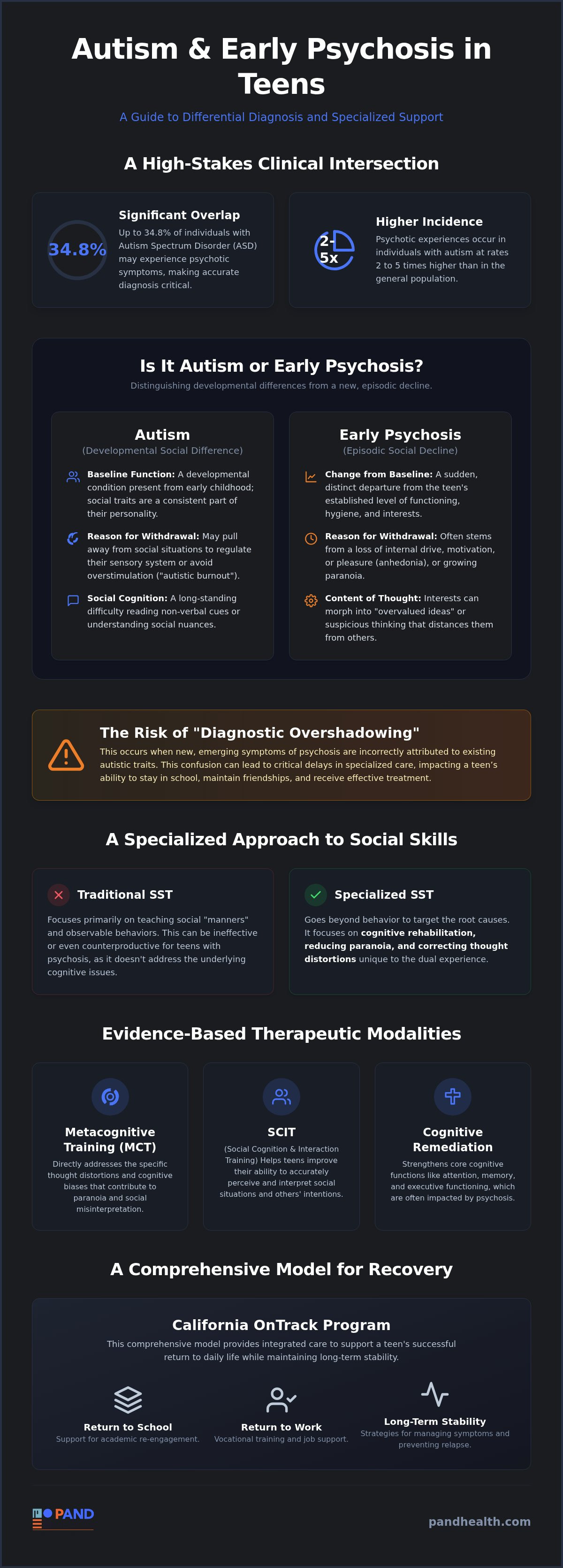
What if the social withdrawal you see in your teenager isn't just "autistic burnout," but the quiet onset of a different clinical challenge? When a teen with Autism Spectrum Disorder begins to pull away from the world, it's natural to feel a sense of profound concern. You might worry that a misdiagnosis could lead to the wrong medication or a therapy that fails to address their specific needs. Research suggests that up to 34.8% of individuals with autism may experience psychotic symptoms, making the need for specialized social skills training for teens with psychosis and autism more critical than ever. We understand the weight of this uncertainty and the isolation your family may feel.
In this guide, we provide clear clinical criteria to help you distinguish between the "social difference" of autism and the "social decline" often seen in early psychosis. You'll learn how evidence-based social skills training can support recovery while honoring neurodiversity. We also highlight specialized resources in Los Angeles, including the California OnTrack program, to help your teen find a path back to a stable, connected life.
Key Takeaways
- Distinguish between "developmental" social differences inherent in autism and the sudden "episodic" social decline that often signals early psychosis.
- Discover how specialized social skills training for teens with psychosis and autism focuses on cognitive rehabilitation and reducing paranoia rather than simply teaching social "manners."
- Learn why evidence-based modalities like Metacognitive Training (MCT) are essential for addressing the specific thought distortions that occur at the intersection of ASD and psychosis.
- Explore the California OnTrack program as a comprehensive model for recovery, supporting your teen's successful return to school or work while maintaining long-term stability.
Understanding the Intersection of Autism and Early Psychosis in Teens
The diagnostic landscape for adolescents is rarely a simple, single-path journey. For many families, the teenage years bring a confusing overlap of behaviors that sit at the intersection of Autism Spectrum Disorder (ASD) and First-Episode Psychosis (FEP). This "Diagnostic Intersection" is a high-stakes clinical area where developmental differences meet emerging psychiatric challenges. Understanding this overlap is the first step toward effective recovery. While these conditions are distinct, they often share a social language that makes them difficult to untangle without expert evaluation.
Research indicates a significant clinical bridge between these two experiences. A 2020 meta-analysis revealed that psychotic experiences occur in individuals with autism at rates two to five times higher than the general population. Because there are many Conditions comorbid to autism, clinicians must look beyond surface behaviors to understand the underlying "why" of a teen’s social struggle. This is where the concept of social cognition becomes vital. It isn't just about whether a teen can make eye contact; it's about how their brain processes, interprets, and responds to the social world around them.
The Shared Symptoms: Why They Look Alike
At first glance, the social profiles of ASD and early psychosis can appear nearly identical. Both may involve a profound difficulty reading non-verbal cues, such as a raised eyebrow or a subtle shift in tone. A teenager might begin to prefer solitary activities, retreating into a private world that feels safer than the unpredictable nature of peer groups. You might also notice unusual or highly specific interests. While these are often a hallmark of autism, in the context of emerging psychosis, they can sometimes morph into "overvalued ideas" or suspicious thinking that distances the teen even further from their community.
The Critical Need for Early Intervention
Timing is everything in adolescent mental health. We often see the "Prodromal Phase" of psychosis-the period of subtle decline before a full episode-mistaken for simple "autistic burnout." This confusion can lead to delays in specialized care, impacting a teen’s ability to stay in school or maintain friendships. Implementing Social Skills Training in Los Angeles provides a lifeline during this window. Unlike traditional therapies that focus solely on social "manners," specialized social skills training for teens with psychosis and autism addresses the cognitive distortions and sensory processing issues unique to this dual experience. Early, precise intervention doesn't just manage symptoms; it preserves the teen's future and restores a sense of normalcy to the entire family.
Differential Diagnosis: Is it Autism or Early Signs of Psychosis?
Diagnosing a teenager already on the autism spectrum requires a high level of clinical precision. One of the greatest risks in adolescent mental health is "diagnostic overshadowing," where new, emerging symptoms of psychosis are incorrectly attributed to existing autistic traits. Specialized pediatric neurology practices, such as Blue Cactus Neurology, highlight how critical an accurate diagnosis is for managing the complex needs of children with neurological conditions. The primary goal of a differential diagnosis isn't just to label a behavior, but to identify the "why" behind sudden social changes. While autism is a developmental condition present from early childhood, psychosis is typically episodic. It represents a distinct departure from a teen's established baseline of functioning.
Distinguishing between "negative symptoms" of psychosis and standard autistic traits is a complex task. Negative symptoms, such as alogia (poverty of speech) or a profound sense of apathy, can look remarkably like the social withdrawal seen in autistic burnout. However, where an autistic teen might retreat to regulate their sensory system, a teen experiencing early psychosis often loses the internal drive to engage with the world entirely. If you're concerned about these shifts, reaching out for a comprehensive psychiatric evaluation can provide the clarity your family needs to move forward.
Key Differentiators for Parents to Observe
Parents are often the first to notice the subtle "red flags" that indicate a shift in mental health. When monitoring your teen, look for these specific changes:
- Change in Baseline: Has there been a sudden, unexplained drop in personal hygiene or a withdrawal from hobbies they once loved?
- Content of Thought: Is their anxiety focused on social "rules" (common in ASD) or has it shifted toward distressing paranoia, such as believing they're being watched?
- Sensory Experience: Autistic sensory processing usually involves over-sensitivity to real sounds or lights. Psychotic hallucinations involve perceiving things that aren't there at all.
The Role of Specialized Evaluations
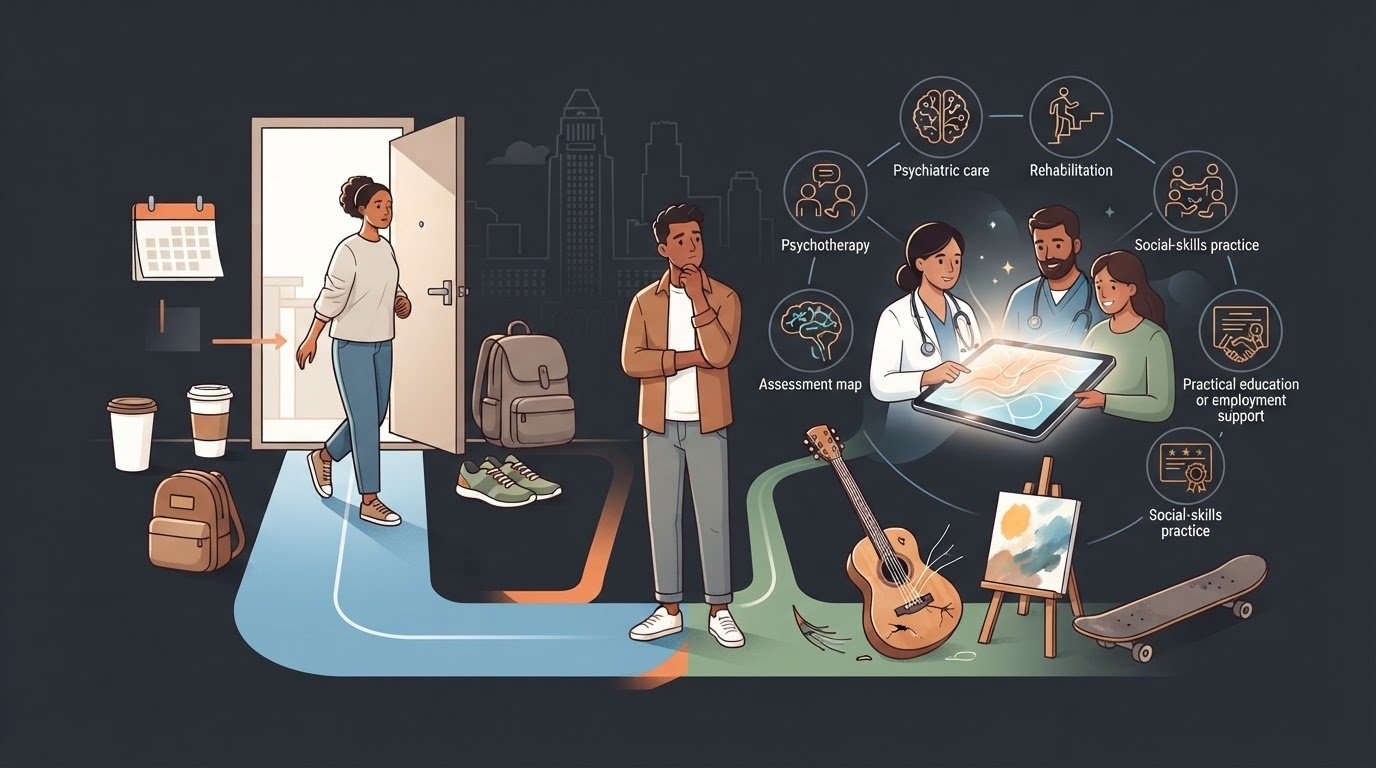
Standard school-based assessments are designed for educational placement, not for untangling the complexities of a dual diagnosis. At Pand Health, our evaluation for thought disorders and autism happens simultaneously to ensure no symptom is overlooked. We utilize structured monthly interviews within our California OnTrack program to track these nuances over time. This rigorous approach allows us to tailor social skills training for teens with psychosis and autism to the specific cognitive needs of the individual. By identifying the root cause of social decline, we can implement the right rehabilitation strategy before the teen's educational or social foundation is further compromised.
The Role of Social Skills Training (SST) for Complex Teens
For a teenager navigating the dual challenges of autism and emerging psychosis, social interactions can feel like a minefield of misunderstood intentions and sensory overload. Traditional social skills training is often criticized by the neurodiversity community as "masking training," or an attempt to force autistic individuals to mimic neurotypical behaviors. At Pand Health, we reframe this intervention as social skills training for teens with psychosis and autism that functions as true social rehabilitation. Our goal isn't to change who the teen is, but to restore the cognitive and social abilities that psychosis often disrupts. We prioritize the teen's authentic self while giving them the tools to navigate a world that can feel increasingly alienating.
Effective rehabilitation requires a "steady hand in the storm." We move beyond the surface level of behavior to address the underlying cognitive processes. By integrating family psychoeducation, we ensure that the teen's environment is as supportive as their clinical care. Just as early childhood centers like Jumpstart Learning Academy create supportive environments for initial school readiness, this holistic approach bridges the gap between clinical progress and daily life, fostering a sense of safety that is essential for long-term recovery.
Moving Beyond "Basic Manners"
Social rehabilitation focuses heavily on social cognition, which is the brain's ability to process and interpret the intentions of others. In early psychosis, a specific cognitive bias known as "Jumping to Conclusions" (JTC) often takes hold. A teen might see two peers whispering and immediately conclude they're plotting against them. Specialized social skills training for teens with psychosis and autism teaches them to slow down their thinking and look for alternative explanations. Through our clubhouse model, we provide a safe space for community reintegration where teens can practice these skills in real-time, reducing the paranoia that leads to isolation.
Addressing the "Double Empathy Problem" in Therapy
We recognize that communication is a two-way street, a concept known as the "Double Empathy Problem." Our therapists don't act as rigid social coaches; they serve as compassionate allies. We validate the teen's unique perspective while providing practical strategies to navigate neurotypical social structures without sacrificing their identity. Family therapy plays a vital role in this process by helping parents understand their child's internal experience. This reduces friction at home and creates a shared language for recovery. When the family moves together, the path toward stability becomes much clearer for the teen.
Evidence-Based Modalities: SCIT, MCT, and Cognitive Remediation
Pand Health stands alone in Southern California as the only outpatient Coordinated Specialty Care (CSC) program offering a trifecta of APA-recommended interventions: cognitive remediation, Metacognitive Training (MCT), and Social Cognition and Interaction Training (SCIT). These are not generic therapies. They are precision tools designed to repair the social and cognitive infrastructure that both autism and psychosis can strain. When we provide social skills training for teens with psychosis and autism, we use these modalities to build a bridge between their internal experience and the external world.
This high standard of care ensures that every intervention is grounded in the latest clinical science. We don't just hope for improvement; we utilize structured, evidence-based methods to achieve it. By addressing the "engine" of social interaction through brain training and the "navigation" through metacognitive strategy, we give teens a comprehensive roadmap for recovery.
Metacognitive Training (MCT) for Psychosis
Metacognitive Training focuses on the "how" of thinking rather than just the "what." It helps teens identify and correct the cognitive biases that fuel paranoia and suspicious thinking. Our therapists are certified MCT instructors who guide teens to "think about their thinking," allowing them to catch delusional patterns before they take root. Unlike standard CBT, which often challenges the content of a belief, MCT targets the underlying process. This approach is particularly effective for teens with autism who may already be prone to rigid thinking patterns.
SCIT: Training for Social Interaction
Social Cognition and Interaction Training (SCIT) is an essential component of social skills training for teens with psychosis and autism. It helps teens identify emotions in others and avoid "attributional bias," which is the tendency to assume others have negative or hostile intentions. We conduct SCIT in small-group formats to provide a safe, supportive space for practice. To see if these specialized groups are the right fit for your family, you can start with a comprehensive Evaluation for Thought Disorders and Autism to determine clinical eligibility.
In addition to these group therapies, we utilize computerized cognitive remediation. This "brain training" targets the executive functions, such as memory and attention, that are necessary for a successful social life. When a teen's brain is better equipped to process information, they feel more confident in school and social settings. If you are ready to explore these advanced modalities, we invite you to schedule a specialized evaluation with our clinical team today.
Comprehensive Recovery at Pand Health: Beyond the Diagnosis
At Pand Health, we believe that a diagnosis is only the starting point, not the destination. Our clinical philosophy is simple: Recovery is Expected. This mindset drives every aspect of the California OnTrack program, which serves as the gold standard for early psychosis intervention in Southern California. While other programs might focus solely on symptom management, we prioritize the restoration of a teen's life. This approach is rooted in Coordinated Specialty Care (CSC), a model that integrates psychiatric care, family support, and specialized social skills training for teens with psychosis and autism to ensure a seamless transition back to health.
The results of this intensive, holistic model are clear. Program graduates achieve an 85% participation rate in employment or education after just six months of treatment. Additionally, our rehospitalization rate stands at only 6%, which is significantly lower than the industry average of 10%. These aren't just numbers; they represent teenagers who are returning to their classrooms, reconnecting with their peers, and reclaiming their futures with confidence.
The OnTrack Work-Study Program
Recovery doesn't happen in a vacuum. It happens in the real world. Our Supported Education and Employment (SEE) curriculum is designed to help teens practice their social and cognitive skills where they matter most. Whether a teen is returning to a Los Angeles high school or starting a first job, we provide the advocacy they need to succeed. This includes working with school administrators to secure necessary accommodations or coaching a teen on how to navigate complex workplace social dynamics. We also integrate physical fitness and health coaching, recognizing that a healthy body supports a resilient mind. In this setting, social skills training for teens with psychosis and autism becomes a practical tool for independence rather than an abstract clinical exercise.
Next Steps for Los Angeles Families
If you've noticed a social decline in your teenager or feel that their current support system isn't addressing the full complexity of their needs, it's time for a specialized perspective. A standard evaluation often misses the subtle intersection of neurodiversity and thought disorders. We invite you to schedule a consultation at our Los Angeles site on Olympic Blvd. Our team is here to act as your dedicated guide, offering a lifeline of expertise when you need it most.
For families who want to learn more about these complex topics from the comfort of home, "The Mind Exposed Podcast" offers deep dives into the science of psychosis and the lived experience of recovery. You don't have to navigate this storm alone. Reach out today to start the journey back to stability and help your teen find their way forward.
Restoring Connection and Stability for Your Teen
Navigating the complexities of a dual diagnosis requires more than just patience; it demands a precise clinical approach. By distinguishing between the developmental nature of autism and the episodic shifts of early psychosis, you can ensure your teen receives the right support at the right time. Specialized social skills training for teens with psychosis and autism isn't about masking differences. It's about rebuilding the cognitive foundations that allow for genuine connection and independence.
As the only Southern California provider of APA-recommended cognitive remediation, Pand Health offers a level of care that is both innovative and deeply human. Our team of certified MCT instructors is dedicated to helping your child thrive. With 85% of our graduates successfully returning to school or work within six months, we know that transformation is possible. You don't have to face this uncertainty alone. Take the first step toward clarity and peace of mind by choosing to Schedule a Comprehensive Evaluation for Your Teen in Los Angeles today. Your family's path to recovery starts with a single, expert conversation.
Frequently Asked Questions
Is social withdrawal in teens always a sign of autism?
No, social withdrawal is a symptom shared by several conditions, including depression, anxiety, and early psychosis. While an autistic teen might pull away to manage sensory overload, a sudden or episodic decline in social interest often indicates a different clinical shift. It's vital to distinguish between a lifelong preference for solitude and a new, distressing retreat from the world that interferes with daily functioning.
Can a teen have both autism and psychosis at the same time?
Yes, it's possible for a teenager to experience both autism and psychosis simultaneously, a situation often referred to as a dual diagnosis. Clinical research shows that individuals on the autism spectrum face a higher risk of psychotic experiences than the general population. This intersection requires specialized social skills training for teens with psychosis and autism to address both developmental differences and emerging psychiatric symptoms in a coordinated way.
How does social skills training for psychosis differ from autism social groups?
Psychosis-focused training targets cognitive biases and thought distortions rather than just conversational rules. While traditional autism groups might focus on eye contact or turn-taking, our specialized social skills training for teens with psychosis and autism uses evidence-based modalities like SCIT and MCT. These tools help teens accurately interpret the intentions of others and manage paranoid thoughts, functioning as a form of social rehabilitation to restore cognitive clarity.
What are the first "red flags" of psychosis I should look for in my autistic teen?
The most significant red flag is a distinct departure from your teen's established "autistic baseline." Look for a sudden drop in personal hygiene, the emergence of distressing paranoia, or a loss of interest in their long-held special interests. While autistic anxiety often centers on social "rules," psychotic symptoms involve perceiving things that aren't there or believing in specific, impossible threats that cause a sharp decline in their ability to function.
Is the social skills training at Pand Health neurodiversity-affirming?
Yes, our clinical team acts as a compassionate ally, prioritizing the teen's authentic identity over social "masking." We don't view autistic communication as a deficit to be fixed. Instead, we focus on repairing the cognitive disruptions caused by psychosis so the teen can navigate the world on their own terms. Our goal is to empower the individual with tools for recovery while fully respecting their unique neurodivergent perspective.
How long does the California OnTrack program for teens usually last?
The California OnTrack program is typically a two-year intensive intervention designed to provide a stable foundation for long-term recovery. This duration allows our team to support the teen through critical transitions, such as returning to high school or starting a first job. Over these 24 months, we provide a steady hand through psychiatric care, family therapy, and vocational support to ensure the teen's success is sustainable and well-integrated.
Do I need a referral to get a psychiatric evaluation for my teen at Pand Health?
No, you don't need a formal physician's referral to begin the evaluation process at our Los Angeles clinic. Parents can contact us directly to schedule a specialized consultation for thought disorders and autism. This direct access is crucial for families who notice a rapid social decline and need an expert second opinion without the delay of long waiting lists or complex insurance hurdles during a time of crisis.
Disclaimer
This article is for information and educational purposes only, and can NEVER replace a proper medical evaluation. If you or a loved one may be suffering from psychosis or the prodomal symptoms of psychosis, get evaluated by a professional as soon as possible. Early diagnosis and treatment can be life-saving.