


Therapy for Paranoia and Suspicion in Los Angeles: Finding the Right Support
What if the most helpful response to persistent suspicion isn’t to argue against it, but to understand what may be driving it? Distressing thoughts can feel convincing and isolating, affecting relationships, work, school, and everyday decisions. If you’re searching for “therapy for paranoia and suspicion Los Angeles,” it can be hard to know whether psychotherapy, a psychiatric evaluation, or coordinated care is the right first step.
It makes sense to want support that takes someone’s experience seriously without dismissing it or escalating tension. A professional assessment can explore what the person is experiencing, how it affects daily life, and what kind of care may fit. Therapy can address distress and build coping strategies, while a psychiatric evaluation may clarify whether additional treatment is appropriate. These forms of support can work together.
This article explains when persistent suspicion may merit professional assessment, what approaches such as CBT for psychosis and metacognitive training may involve, and how family support can be included without being a prerequisite. You’ll also learn what to expect from an initial evaluation and how to compare outpatient options in Los Angeles, including California OnTrack for eligible teens and adults.
Key Takeaways
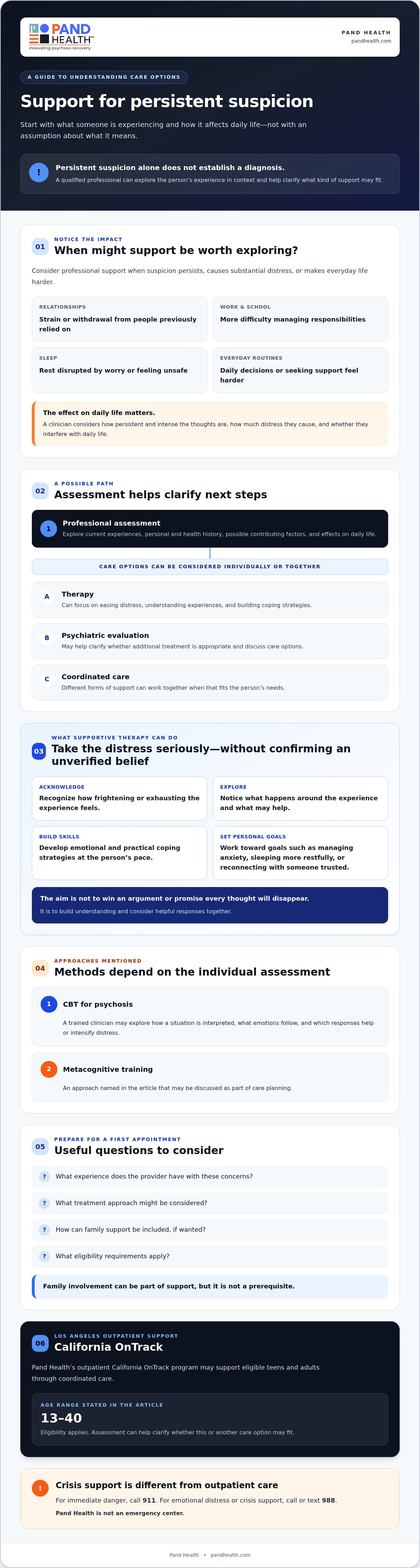
- Persistent suspicion can affect relationships, work, school, and sleep. Its presence alone doesn’t establish a diagnosis.
- Therapy can focus on easing distress and building coping strategies without dismissing or reinforcing unverified beliefs.
- An initial assessment can help clarify whether individual therapy, psychiatric evaluation, family support, or coordinated care may fit.
- Questions about a provider’s experience, treatment approach, family involvement, and eligibility can help you prepare for a first appointment for therapy for paranoia and suspicion Los Angeles.
- Pand Health’s outpatient California OnTrack program may support eligible teens and adults ages 13-40 through coordinated care.
When paranoia and persistent suspicion may call for therapy in Los Angeles
Suspicious thoughts can range from brief uncertainty to persistent fears that make it difficult to feel safe or trust others. Paranoia is a broad term for thoughts or feelings of distrust or threat; it doesn’t, by itself, identify a specific condition. For a general introduction, see this overview of understanding paranoia. A clinician considers the person’s experience in context rather than drawing conclusions from one symptom.
A distressing experience deserves attention, but only a careful clinical assessment can determine whether it reflects a diagnosable condition.
The effect on daily life may be more useful to consider than the label. Worry about others’ intentions can strain relationships, lead someone to withdraw from friends, or make school and work harder to manage. It may also disrupt sleep or make seeking support feel unsafe. These effects can add stress for the person and those close to them, even before the cause is clear.
What can persistent suspicious thoughts feel like?
Someone might find it increasingly hard to trust people they previously relied on, or feel watched in situations where others don’t share that concern. These examples don’t confirm that a perceived threat is real, and they don’t automatically indicate psychosis. During an assessment, a professional may ask how persistent and intense the thoughts are, how much distress they cause, and whether they interfere with daily life.
Experiences can have different contributing factors, so online symptom lists can’t provide a reliable diagnosis. Changes in mood, health, sleep, or other circumstances may be relevant. An individualized evaluation helps place concerns in context and identify possible next steps.
When should someone seek a professional evaluation?
Consider professional support when suspicion persists, causes substantial distress, or disrupts relationships, school, work, sleep, or everyday routines. You don’t need to know the right diagnosis before asking for help. A psychiatric evaluation can explore current experiences, personal and health history, and possible contributing factors. Its purpose is to understand the situation and discuss care options, not to dismiss the person’s concerns.
If you’re researching therapy for paranoia and suspicion Los Angeles, start with a qualified professional who can assess the person’s needs. For immediate danger, call 911. If you or someone else is in emotional distress or needs crisis support, call or text 988. Pand Health provides outpatient care and is not an emergency center.
How therapy for paranoia can address distress without dismissing the person
Therapy can take a person’s fear seriously without treating an unverified explanation as fact. A clinician can acknowledge how frightening or exhausting an experience feels, then work with the person to understand what happens around it and what might help them cope day to day. As Understanding Paranoia and Suspicion explains, these experiences can be complex. Care should be shaped around the individual rather than a one-size-fits-all assumption.
Good therapy validates the distress a person feels while staying curious about, rather than confirming, the explanation they fear.
Early work may focus on goals the person chooses, such as managing anxiety during a difficult interaction, getting more restful sleep, or reconnecting with someone they trust. A therapist may help identify emotional and practical coping strategies while respecting the person’s pace and preferences. The aim isn’t to win an argument or promise that every thought will disappear. It’s to build understanding and consider helpful responses together.
What CBT for psychosis may focus on
In CBT for psychosis, a trained clinician may explore how a situation is interpreted, what emotions follow, and which responses help or intensify distress. For example, therapy might look at what the person noticed in a stressful moment and consider different ways to manage the resulting fear, without insisting on a particular conclusion. Goals and techniques depend on assessment, individual priorities, and readiness.
How metacognitive training may support reflection
Metacognitive training (MCT) supports awareness of thinking patterns and reflection on how conclusions are reached. It can complement other individualized care; it isn’t a diagnostic test or a guaranteed solution. A clinician can help determine whether it fits alongside approaches such as CBT for psychosis or supportive psychotherapy, which may provide space to discuss emotions, stressors, and coping over time.
These approaches aren’t interchangeable, and not everyone needs the same combination. If you’re exploring therapy for paranoia and suspicion Los Angeles, ask prospective providers how they adapt therapy to the person’s concerns and whether they have experience supporting psychosis-related distress. For information about arranging an outpatient psychiatric evaluation with Pand Health, review its psychiatric evaluation contact information.
Comparing therapy, psychiatric evaluation, and coordinated care for paranoia
These forms of support serve different purposes, and a person may benefit from more than one. An assessment helps clarify what’s happening and what type of care may be appropriate. Therapy can address distress and coping, while psychiatric care can evaluate symptoms and consider treatment recommendations. Respectful care neither dismisses someone’s fear nor confirms an explanation without careful assessment.
| Type of support | What it may involve | How it can help |
|---|---|---|
| Psychiatric evaluation | Discussion of symptoms, when they began, daily functioning, personal and health history, and possible contributing factors. | Helps clarify needs and inform recommendations. One symptom alone doesn’t determine a diagnosis or care plan. |
| Individual therapy | Collaborative work on emotional distress, coping, and personally relevant goals. | Can help a person explore experiences and consider practical responses at a manageable pace. |
| Family support | Family therapy or psychoeducation, when appropriate and welcomed. | Can help relatives communicate supportively and understand ways to respond without arguing about or reinforcing fears. |
| Coordinated specialty care | A team-based outpatient approach that may bring together psychotherapy, family support, cognitive and social rehabilitation, and education or employment support. | May be considered for eligible people experiencing early psychosis, based on assessment and program fit. |
What a psychiatric evaluation can clarify
An evaluation explores more than suspicious thoughts alone. A clinician may ask when they began, how often they occur, how intense they feel, how they affect relationships or daily responsibilities, and what relevant personal or health history may help explain them. This broader picture can inform recommendations. Pand Health offers psychiatric evaluations; confirm current appointment availability and eligibility directly with the provider.
Therapy and psychiatric care aren’t competing choices. Depending on the assessment, they may be combined or coordinated. It’s reasonable to ask how a clinician will approach the person’s concerns. The aim is to understand the experience carefully, not to shame the person, argue them out of it, or treat a feared explanation as established fact.
When coordinated specialty care may be relevant
For eligible teens and adults ages 13-40 experiencing first-episode psychosis, schizophrenia-spectrum disorders, or clinically high risk for psychosis, California OnTrack is an outpatient coordinated specialty care option. Its supports may include psychotherapy, family support, cognitive remediation, social rehabilitation, and supported education or employment. Social skills training may be included as part of rehabilitation when appropriate. Eligibility and fit are determined through assessment, not assumed from a single symptom.
If you’re comparing therapy for paranoia and suspicion Los Angeles, ask providers how they assess needs, coordinate care, and include family support when the person wants it.
How to choose a paranoia therapist and prepare for a first appointment in Los Angeles
Finding a good fit starts with practical questions. Write down the main concerns and how they affect daily life. Then ask providers about their experience with psychosis-related concerns, their treatment approach, and how they involve family or coordinate with psychiatric care when appropriate. Before scheduling, confirm age eligibility, current availability, insurance details, and where services take place.
Questions to ask a therapist or program
A brief conversation with a provider can help you decide whether their approach feels respectful and relevant. Consider asking:
- How do you work with suspicious thoughts without confronting the person or automatically agreeing with a feared explanation?
- What experience do you have supporting people with psychosis-related concerns, and what therapy approaches might you consider?
- Could a psychiatric evaluation, family support, or coordinated care be appropriate?
- How can relatives participate, if the person wants their involvement?
- What are the age and program eligibility requirements, current availability, insurance details, and service location?
Clear answers help set expectations. It’s also reasonable to ask how the provider handles questions or concerns that come up between appointments.
To prepare, bring a short timeline of when the concerns began and how they’ve changed, a current medication list, and a few questions you want answered. If a family member has observations that may help, discuss sharing them with the person first and respect their consent. The person’s own account should remain central to the conversation.
How family members can support the first conversation
Calm, nonjudgmental listening can make it easier to consider support. A relative might say, “I can see this is frightening. Would you like help finding someone to talk with?” This acknowledges distress without endorsing an unverified explanation. Offer practical help, such as finding provider information or arranging transportation, while allowing the person to make choices where possible. Avoid blame, threats, or pressure. If conversations repeatedly become difficult, ask a professional about family psychoeducation or family therapy as possible supports.
Family members can learn ways to communicate supportively without taking responsibility for diagnosing or resolving the situation. Pand Health offers family support as part of its outpatient services. To ask about evaluation or care options, contact Pand Health about outpatient support.
Pand Health outpatient support for paranoia and early psychosis in Los Angeles
For people seeking therapy for paranoia and suspicion Los Angeles, a psychiatric evaluation may be a useful starting point for understanding their experiences and discussing suitable care. Pand Health provides outpatient psychiatric evaluations and psychosis care in Los Angeles. An evaluation can help determine whether California OnTrack may fit, but eligibility and current appointment availability should be confirmed directly with the team.
What California OnTrack combines
California OnTrack is an outpatient coordinated specialty care program based on the NIMH NAVIGATE framework. For eligible teens and adults ages 13-40, care may bring together psychotherapy, family support, cognitive remediation, social rehabilitation, and support related to education or employment. Depending on an individual’s assessed needs, therapy may include CBT for psychosis. Metacognitive training may also be available with therapists Pand Health describes as certified MCT instructors. Family interventions are possible supports, not a prerequisite for receiving care.
This coordinated approach can address several areas of a person’s life while keeping services individualized. The specific mix of support depends on assessment and program fit. California OnTrack is outpatient care, not residential treatment or emergency crisis care.
Pand Health reports outcomes for a cohort of 41 patients from 2022-2024. In that cohort, employment or education participation was reported as 6% at enrollment, 40% after 3 months, and 85% after 6 months. The reported rehospitalization rate was over 50% before enrollment and 6% after enrollment; the reported average inpatient stay length was 40 days before enrollment and 7 days after. These cohort figures describe the reported group and don’t predict an individual’s results. Ask the team about the measures, follow-up periods, and current program details.
A practical next step for individuals and families
Start by describing what has changed, what feels most concerning, and how the experiences affect daily life. Ask whether a psychiatric evaluation is appropriate, what eligibility requirements apply, and whether California OnTrack or another outpatient option may fit. Families can ask how they might participate supportively, while respecting the person’s preferences and consent.
For a direct next step, contact Pand Health about an evaluation and ask about eligibility and current availability.
Take the next step toward appropriate support
Persistent suspicion can be distressing, but a symptom alone doesn’t determine a diagnosis or the right care. A professional evaluation can help clarify what’s happening. Therapy, psychiatric care, and family support may be considered together when appropriate. The right approach is individualized, respectful, and focused on the person’s needs.
For eligible teens and adults ages 13-40, California OnTrack offers outpatient coordinated specialty care. Pand Health reports outcomes for a cohort of 41 patients from 2022-2024; those group results don’t predict any one person’s experience or outcome.
If you’re considering therapy for paranoia and suspicion Los Angeles, a conversation with a care team can help you ask about evaluation, eligibility, and current availability. Contact Pand Health to discuss evaluation and outpatient care. Taking one informed step can make the path forward feel more manageable.
Frequently Asked Questions
Can therapy help with paranoia and suspicion?
Therapy may help someone understand distress linked to suspicious thoughts, develop coping strategies, and work toward personal goals. The right approach depends on an individual assessment, symptoms, preferences, and circumstances. Therapy doesn’t have to confirm a feared belief or dismiss the person’s experience. If concerns persist or affect relationships, sleep, work, or other daily activities, a professional evaluation can help clarify possible next steps.
What type of therapy is used for paranoid thoughts?
Clinicians may consider CBT for psychosis, metacognitive training, individual psychotherapy, or coordinated specialty care, depending on the person’s needs. The choice depends on symptoms, preferences, history, and assessment, rather than one thought or concern alone. A clinician can explain options and discuss whether psychiatric care or family support may also be useful. Treatment should be individualized; no single approach is right for everyone.
When should someone seek help for paranoia in Los Angeles?
Seek an evaluation when suspicion persists, causes distress, or interferes with relationships or everyday activities. People searching for “therapy for paranoia and suspicion Los Angeles” can look for a qualified provider who can assess concerns and discuss suitable care. If there’s immediate danger, call 911. In the United States, call or text 988 for crisis support. Pand Health provides outpatient care and isn’t a 24/7 emergency center.
Can family members attend therapy for paranoia?
Family members may be involved when the individual agrees and the clinician considers it appropriate. Family therapy or psychoeducation can help relatives communicate supportively and understand care options. Participation should respect the person’s privacy and autonomy. Rather than arguing about suspicious thoughts, relatives can acknowledge distress and ask the treatment provider how family involvement works. A clinician can help determine whether family participation may be useful and how to approach it.
What happens during a psychiatric evaluation for suspicious thoughts?
A clinician may ask about the experiences, when they began, how they affect daily functioning, and relevant personal or health history. This broader conversation helps inform recommendations; a diagnosis can’t be determined from one symptom alone. The person can bring questions and, if they choose, observations from someone they trust. A brief timeline or notes about changes in sleep, relationships, or daily routines may help guide the discussion.
Does Pand Health provide inpatient or emergency treatment for paranoia?
No. Pand Health provides outpatient services and doesn’t offer residential inpatient treatment, hospitalization, or a 24/7 emergency crisis center. Its team can discuss psychiatric evaluation and whether outpatient services may be appropriate after assessing the person’s needs and eligibility. For immediate danger, call 911. In the United States, people experiencing a mental health crisis can call or text 988 for support. Confirm current service availability directly with the provider.
Disclaimer
This article is for information and educational purposes only, and can NEVER replace a proper medical evaluation. If you or a loved one may be suffering from psychosis or the prodomal symptoms of psychosis, get evaluated by a professional as soon as possible. Early diagnosis and treatment can be life-saving.