
Psychological Rehabilitation in Los Angeles: A Guide to Cognitive Remediation Therapy
The fear that a psychotic episode marks a permanent decline in intelligence or potential is one of the heaviest burdens a family can carry. You might notice your loved one struggling to follow a conversation, losing focus on simple tasks, or withdrawing from the social circles they once enjoyed. It's natural to feel that traditional talk therapy isn't enough to rebuild the cognitive muscle required for daily life. Finding the right psychological rehabilitation Los Angeles offers is about more than just symptom management; it's about reclaiming the future that felt lost.
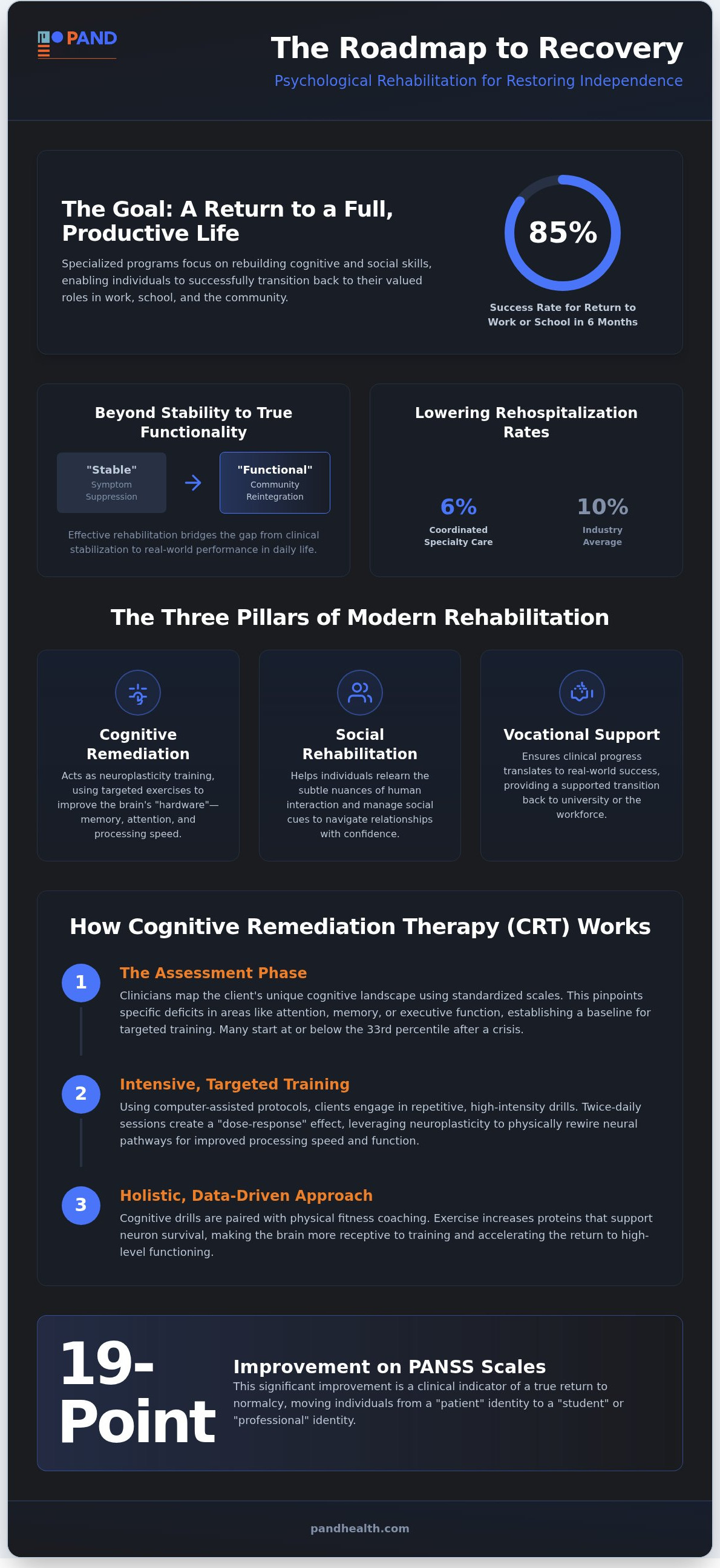
Recovery isn't just a hope, it's the expectation when you utilize an augmented model of care that prioritizes brain health alongside emotional support. This guide will show you how data-driven cognitive remediation and social rehabilitation can restore independence and functional performance. We'll explore how specialized programs achieve an 85% success rate for participants returning to work or school within six months. You'll discover how targeted training can turn the tide on cognitive decline and foster a successful return to a productive, independent life.
Key Takeaways
- Learn why effective psychological rehabilitation Los Angeles families trust focuses on restoring functional independence rather than just suppressing symptoms.
- Discover how Cognitive Remediation Therapy uses targeted, computer-assisted exercises to regrow cognitive muscles like memory and focus.
- Understand how specialized tools like Metacognitive Training help individuals manage social cues and navigate interpersonal relationships with confidence.
- Explore the critical connection between supported employment and long-term wellness, including how to transition back to college or the workforce.
- See how specialized outpatient programs provide a clear roadmap for recovery, moving from crisis stabilization to full community reintegration.
Understanding Psychological Rehabilitation for Psychosis in Los Angeles
Hospitalization often serves as a necessary pause to ensure safety, but it isn't the final destination. There's a profound difference between being "stable" and being "functional." For those navigating the complexities of a thought disorder, psychological rehabilitation Los Angeles offers a specialized path that goes beyond the four walls of a clinic. It's a process designed to restore the cognitive and social abilities that a psychotic episode can temporarily disrupt. By focusing on the critical window following First Episode Psychosis (FEP), clinicians can help young adults bridge the gap between clinical stabilization and full community reintegration.
The shift toward Coordinated Specialty Care (CSC) in Southern California reflects a deeper understanding of neurobiology. Families are no longer satisfied with simply "quieting" symptoms; they're looking for ways to ensure their loved ones can return to their lives. This team-based approach integrates psychiatry, therapy, and family education into a single, cohesive strategy. It's about building a lifeline that supports the individual's transition back to the roles they value most. Programs that follow this model have shown a 6% rehospitalization rate, significantly lower than the 10% industry average.
The Core Pillars of Modern Rehabilitation
Effective recovery rests on three structural supports. First, Cognitive Remediation Therapy acts as a form of neuroplasticity training. It targets the brain's "hardware" to improve memory, attention, and processing speed. Second, social rehabilitation helps individuals relearn the subtle nuances of human interaction that often become blurred during a psychotic break. Finally, vocational support ensures that the progress made in a clinical setting translates into real-world success, such as returning to a university campus or starting a new career.
Why 'Talk Therapy' Isn't Enough for Thought Disorders
Traditional psychotherapy is a valuable tool for processing emotion, but it often fails to address the executive function deficits inherent in thought disorders. Medication alone can't teach a brain how to organize a complex schedule or filter out distracting stimuli. This is where evidence-based frameworks like NIMH NAVIGATE become essential. These models move the individual away from a "patient" identity, where they're defined by their diagnosis, and toward a "student" or "professional" identity. In the context of psychological rehabilitation Los Angeles, this shift is what allows for a 19-point improvement on PANSS scales, signaling a true return to normalcy. If you're ready to explore these specialized frameworks, reaching out for a professional evaluation is often the first step toward clarity.
How Cognitive Remediation Therapy Works: A Step-by-Step Guide
Cognitive Remediation Therapy (CRT) represents the precision-medicine side of psychological rehabilitation Los Angeles. Unlike generic support groups, CRT uses computer-assisted protocols designed to leverage neuroplasticity. This isn't about playing games; it's about targeted drills that regrow the cognitive "muscles" damaged by a psychotic episode. Research suggests that the brain remains capable of reorganization and growth long after an initial break. By engaging in repetitive, high-intensity exercises, individuals can physically rewire neural pathways to improve processing speed and executive function.
Clinical outcomes show that intensity matters. While many outpatient programs offer weekly visits, our data favors a more rigorous approach. Twice-daily sessions create the "dose-response" effect necessary for significant brain change. We also pair these cognitive drills with physical fitness coaching. Physical activity increases the production of proteins that support neuron survival, making the brain more receptive to the training. This holistic, data-driven approach is what transforms a "patient" back into a high-functioning individual.
The Assessment Phase: Mapping Cognitive Strengths
Before training begins, we must map a client's unique cognitive landscape. We use standardized scales to pinpoint exactly where deficits lie, whether in attention, memory, or complex executive function. It's common for clients to start at or below the 33rd percentile in specific areas after a crisis. To track progress, we utilize a specific metric: the Cognitive Performance Composite Score. This score serves as a vital benchmark for recovery, aggregating various data points into a single metric of functional brain health.
The Training Protocol: From Drills to Daily Life
The journey from the clinic to the community follows a structured, three-step path:
- Step 1: Intensive computer-assisted exercises target the foundation of cognition, specifically processing speed and early visual memory.
- Step 2: Bridging groups act as the glue between digital training and real-world application. Here, the skills learned on a screen are applied to tasks like managing a budget or planning a commute.
- Step 3: Monthly reassessments track percentile gains. We target the 50th percentile as the goal for functional independence.
If you're wondering where to start, a comprehensive assessment can provide the clarity and roadmap your family needs to move forward with confidence.
MCT vs. SCIT: Specialized Tools for Social Rehabilitation
While cognitive remediation focuses on the brain's internal processing, social rehabilitation addresses how an individual interprets the world around them. After a psychotic episode, the "social software" of the brain often requires a recalibration. This is a critical stage of psychological rehabilitation Los Angeles families must prioritize to prevent the long-term isolation that often follows hospitalization. Generic social skills groups frequently fail because they don't address the underlying cognitive biases that drive paranoia or social withdrawal. Instead, specialized protocols like Metacognitive Training (MCT) and Social Cognition and Interaction Training (SCIT) provide the clinical precision necessary for true reconnection.
These tools are particularly effective for individuals navigating thought disorders or autism, helping them decode the complex social landscape of a city like Los Angeles. By using evidence-based frameworks, we see a documented 19-point improvement on PANSS scales, which measures the reduction of symptoms like delusional thinking and social avoidance. This progress isn't accidental; it's the result of rigorous, protocol-driven intervention delivered by certified experts who understand the nuances of social cognition.
Metacognitive Training (MCT) Explained
Metacognitive Training, or MCT, is the APA-recommended standard for schizophrenia-spectrum disorders. It centers on the concept of "thinking about thinking." During a psychotic break, the brain often develops "traps" or cognitive biases, such as jumping to conclusions or over-confidence in errors. MCT helps individuals identify these patterns in a supportive group setting. By de-stigmatizing these symptoms through education, clients learn to second-guess their own paranoia and replace it with objective reasoning. It's a transformative process that shifts the individual from a state of defensive withdrawal to one of curious engagement with their environment.
SCIT: Building Social Competence
Social Cognition and Interaction Training (SCIT) takes the recovery process a step further by focusing on the mechanics of human interaction. It moves beyond basic manners to help clients identify subtle emotions in others and manage complex social cues. In a safe clinic setting, participants practice conflict resolution and social problem-solving. This training is essential for those who want to move past the "patient" label and return to the classroom or the office. For a deeper look at how these methods foster community reintegration, you can explore our guide on Advanced Social Skills Training in Los Angeles.
Success in these programs depends heavily on protocol fidelity. This is why we emphasize the importance of working with certified MCT instructors who can tailor the curriculum to the individual's specific needs. When delivered with clinical authority and empathy, these social tools become the bridge that leads back to a life of independence and meaningful connection. Effective psychological rehabilitation Los Angeles ensures that every individual has the social competence required to thrive in their community once again.
The Roadmap to Re-Entry: Supported Education and Employment (SEE)
The ultimate measure of success for psychological rehabilitation Los Angeles is the individual's ability to live a life of their own choosing. For many young adults, this means returning to a college campus or a competitive workplace. Employment and education are more than just milestones; they're clinical outcomes that correlate directly with lower relapse rates and improved self-esteem. When an individual has a clear purpose and a community that expects their presence, the risk of a secondary crisis drops significantly. Recovery is the expectation, and that recovery is solidified through meaningful daily activity.
Our Supported Education and Employment (SEE) curriculum is designed to bridge the gap between clinical stabilization and professional reality. One of the most common anxieties for young adults is explaining a "gap" on their resume caused by a psychotic episode. We work with clients to frame these periods honestly yet professionally, focusing on the intensive personal development and skills training they've undertaken. This advocacy ensures that a temporary health crisis doesn't become a permanent barrier to their career aspirations.
Vocational Coaching in the LA Job Market
Navigating the competitive Los Angeles job market requires more than just a polished resume. Our vocational coaches provide case-managed support tailored to local employers and educational institutions. This includes advocating for specific school accommodations under the Americans with Disabilities Act (ADA) for students attending universities like UCLA, USC, or the various CSU campuses. By focusing on "soft skills" like professional communication and time management, we ensure that the transition back to the classroom or the office is sustainable and successful.
Case Study: The Impact of Functional Rehab
The results of this intensive, vocational-focused approach speak for themselves. While many traditional programs see only a 6% engagement rate in work or school at the start of treatment, our participants achieve 85% participation after just six months of rehabilitation. This shift is accompanied by a dramatic reduction in the need for acute care; intensive outpatient rehabilitation has helped reduce average inpatient stays from 40 days down to just 7 days. This functional restoration is best illustrated by the 19-point improvement on the PANSS scale, which serves as a definitive marker of clinical and social success.
If you're ready to see how the California OnTrack Work-Study Program can help your loved one reclaim their future, our team is here to guide you through the next steps.
Starting Your Recovery at Pand Health’s Los Angeles Clinic
Pand Health's Los Angeles clinic on Olympic Blvd serves as a specialized hub for those seeking the highest standard of psychological rehabilitation Los Angeles provides. Our California OnTrack program isn't just a standard treatment plan; it's an augmented Coordinated Specialty Care (CSC) model designed specifically to address the needs of teens and young adults. We understand that the first step into a clinic can be the most difficult. That's why our intake process is designed to offer clarity, safety, and a sense of immediate direction for families in crisis.
Your journey begins with a thorough psychiatric evaluation and a detailed cognitive assessment. We don't just look at symptoms; we map out your baseline cognitive performance to understand how the brain is currently processing information. This data-driven approach allows us to tailor the Cognitive Remediation and Metacognitive Training (MCT) specifically to your unique profile. By identifying these benchmarks early, we can track the 19-point improvement on PANSS scales that our participants typically achieve through dedicated effort.
Family involvement is a cornerstone of the rehabilitation process. We offer family psychoeducation and multi-family group therapy to ensure that the recovery environment extends beyond our clinic walls. This collaborative approach helps parents and siblings understand the science of the recovery process, which reduces household stress and fosters a supportive home life. When the family unit is informed and empowered, the individual's path to independence becomes much clearer.
A Recovery-Oriented Environment
At Pand Health, "recovery is the expectation." This philosophy defines our culture and every intervention we offer. Our Olympic Blvd site integrates physical fitness, computer-assisted brain training, and clinical therapy under one roof. For teens and young adults, this holistic environment feels less like a traditional doctor's office and more like a high-performance training center. We focus on the whole person, ensuring that physical health supports the neuroplasticity required for lasting cognitive growth and psychological stability.
Take the First Step Toward Reconnection
The path back to independence starts with a single conversation. We invite families to schedule a consultation to discuss their specific needs and learn how our California OnTrack program can provide a lifeline. For those who want to learn more about the science of thought disorders before their visit, the Mind Exposed Podcast offers valuable educational support and insights from our clinical experts. Reclaiming a future after a psychotic episode is possible, and we're here to guide you every step of the way with expertise and empathy.
Contact Pand Health today to schedule a comprehensive evaluation and begin the process of functional restoration and community reconnection.
Reclaiming a Future Defined by Independence
True recovery from a psychotic episode requires more than just symptom suppression. It demands a rigorous, data-driven approach that addresses the underlying cognitive and social challenges. By integrating computer-assisted brain training with vocational support, the process of psychological rehabilitation Los Angeles families seek becomes a pathway to genuine functional restoration. We've seen how neuroplasticity and specialized social tools like Metacognitive Training can bridge the gap between clinical stabilization and a productive life.
Pand Health provides the only Southern California outpatient program delivering APA-recommended cognitive remediation within a Coordinated Specialty Care framework. Our team of certified MCT instructors and neuro-cognitive specialists is dedicated to the philosophy that recovery is the expectation. With 85% of our clients successfully returning to work or education within six months, we offer a proven roadmap for young adults to reclaim their potential. You don't have to navigate this storm alone; a steady hand and a specialized plan are within reach.
Schedule a Consultation for the California OnTrack Program to begin the journey toward reconnection and lasting wellness. Your loved one's potential remains intact, and together, we can build the skills necessary to see it flourish once again.
Frequently Asked Questions
What is the difference between psychological rehabilitation and traditional therapy?
Psychological rehabilitation centers on functional restoration and skill-building, while traditional therapy usually focuses on emotional processing. Rehabilitation is a structured process designed to help individuals regain the cognitive and social abilities needed for daily life. It's less about discussing feelings and more about training the brain to manage complex tasks. This distinction is vital for those seeking effective psychological rehabilitation Los Angeles offers, as it directly targets the specific barriers to independence.
How long does a typical cognitive remediation program last in Los Angeles?
The length of a program depends on the individual's baseline and goals, but many intensive protocols last between three to six months. We prioritize a high-intensity schedule because neuroplasticity responds best to frequent, consistent training. Monthly reassessments allow us to track progress and adjust the curriculum as needed. This methodical pace ensures that the brain has the time it needs to consolidate new skills and build lasting cognitive strength.
Can cognitive remediation therapy help with memory loss after psychosis?
Targeted cognitive remediation is one of the most effective ways to address memory deficits after a psychotic episode. It uses specialized, computer-assisted exercises to stimulate neural pathways responsible for short-term and working memory. By repeatedly engaging these areas, the brain can physically restructure itself to improve retention and recall. This training helps clear the cognitive fog that often makes returning to school or work feel like an impossible challenge.
Is the California OnTrack program covered by insurance?
Insurance coverage for the California OnTrack program varies depending on your specific policy and provider. Many major carriers recognize the clinical necessity of the Coordinated Specialty Care model for treating psychosis. We recommend contacting your insurance representative to verify your 2026 benefits and understand any potential out-of-pocket costs. Our team can also provide documentation to help you navigate the authorization process and ensure your loved one receives the care they need.
What age groups are eligible for psychological rehabilitation at Pand Health?
Our specialized programs are designed for adolescents and young adults, typically between the ages of 13 and 35. This focus allows us to provide developmentally appropriate support during the years when first-episode psychosis most commonly occurs. By intervening early with high-standard psychological rehabilitation Los Angeles services, we can help young people stay on their educational or career tracks. This age-specific approach fosters a community of peers who are navigating similar life transitions.
How does family involvement impact the success of rehabilitation for thought disorders?
Family participation is a critical factor in the success of any rehabilitation program for thought disorders. When families engage in psychoeducation, they learn the skills needed to create a low-stress, supportive environment at home. This involvement helps reduce the risk of relapse and ensures that the individual feels understood and validated. A unified family approach provides a steady hand during the recovery process, making long-term independence a more achievable goal for everyone involved.
What is the success rate for returning to work after a psychotic episode?
Returning to a professional or academic environment is a central focus of functional rehabilitation. When vocational support is integrated into clinical treatment, individuals are far more likely to sustain long-term employment. Our curriculum focuses on resume building, workplace advocacy, and managing social cues in professional settings. This comprehensive support helps bridge the gap between recovery and re-entry, ensuring that individuals don't just find a job but have the skills to thrive in it.
Do I need a referral to start psychological rehabilitation in Los Angeles?
A formal referral from a doctor is not a requirement to begin your journey with us. Families can contact our Los Angeles clinic directly to schedule a comprehensive psychiatric evaluation and cognitive assessment. This initial meeting helps us understand the unique challenges your loved one is facing and determine if our program is the right fit. We're here to act as a dedicated guide, providing a clear path forward when other avenues have failed.
Disclaimer
This article is for information and educational purposes only, and can NEVER replace a proper medical evaluation. If you or a loved one may be suffering from psychosis or the prodomal symptoms of psychosis, get evaluated by a professional as soon as possible. Early diagnosis and treatment can be life-saving.