


Autism Evaluation for Adults in Los Angeles: What to Expect
What if the social effort, sensory strain, or need for routine you’ve experienced for years has a name worth exploring? If you’re searching “autism evaluation for adults Los Angeles,” you may be looking for more than a yes-or-no answer. You may want to understand how your experiences fit together, especially if you’ve learned to mask them or wonder whether something else could explain your current challenges.
Those questions deserve a careful, respectful look. An adult autism evaluation connects present-day concerns with developmental and personal history to explore whether patterns are consistent with autism and whether other clinical questions are relevant. Preparing a few examples from different stages of life can make it easier to describe experiences that may not be obvious in a brief conversation.
This guide explains what an evaluation may involve, what history and questions to bring, and how to think about overlapping concerns. It also introduces Pand Health, a Los Angeles provider offering evaluations for autism and thought disorders as distinct clinical services. The aim is to help you approach the process with greater clarity and consider what support may be useful next.
Key Takeaways
- An adult autism evaluation can put long-standing experiences in context, even if autism wasn’t considered earlier in life.
- The process may include discussing concerns, reviewing personal history, considering available information, and explaining findings. Components depend on the person and clinical questions.
- Recognizing familiar traits alone can’t confirm or rule out autism. Clinical context helps explore overlapping experiences and other possible explanations.
- Bring examples, relevant records, and questions if useful. Your preparation doesn’t need to be polished or exhaustive.
- If you’re seeking an autism evaluation for adults Los Angeles, Pand Health offers evaluations for autism and thought disorders at 11500 W. Olympic Blvd., Suite 399, Los Angeles, CA 90064.
What Can an Autism Evaluation for Adults in Los Angeles Clarify?
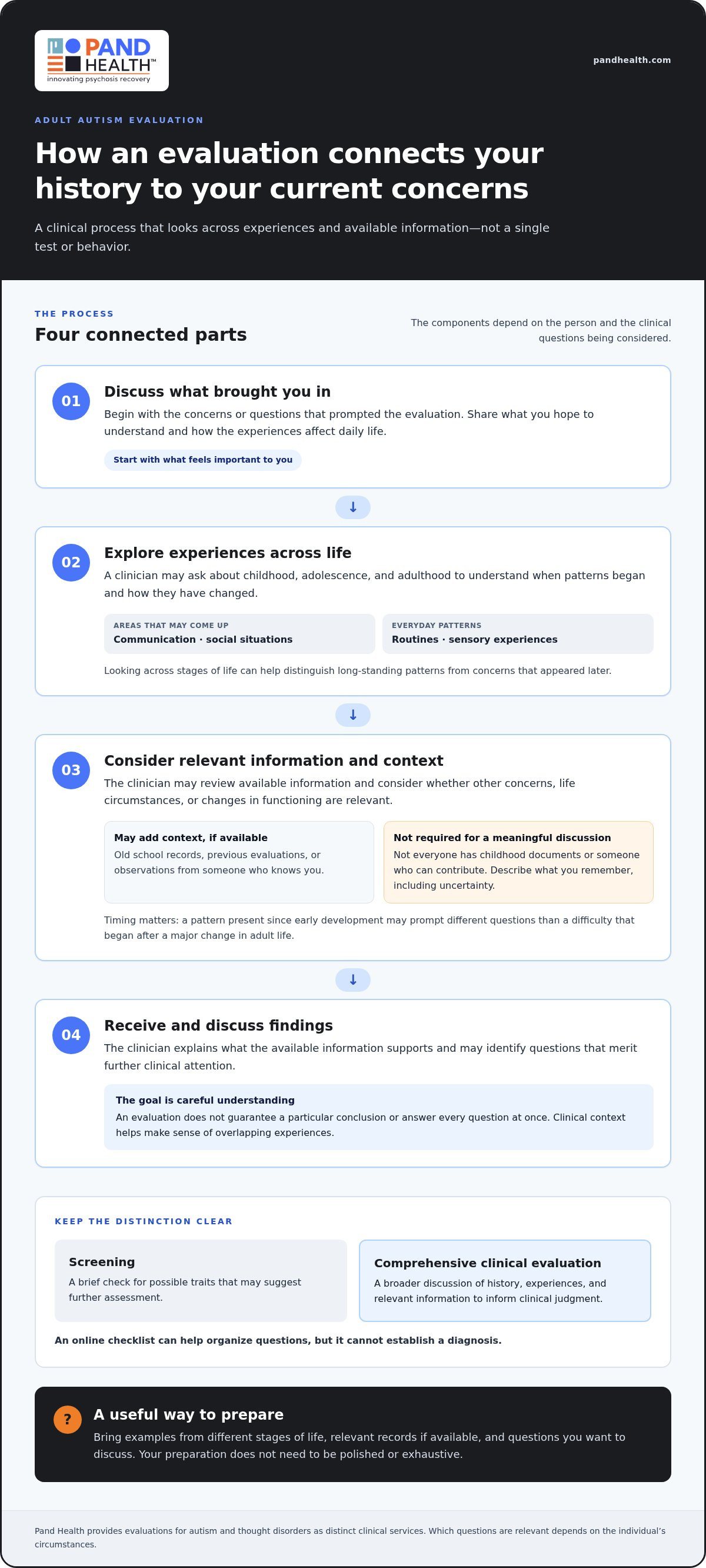
An autism evaluation is a clinical process for exploring whether autism may help explain someone’s experiences across life, including developmental history and current concerns. It considers patterns in context rather than treating one behavior as decisive. A screening is a brief check for possible traits that may suggest further assessment. A comprehensive clinical evaluation considers a broader discussion of history, experiences, and relevant information to inform clinical judgment.
That distinction matters. An online checklist can help you organize questions, but it can’t establish a diagnosis. Neither can a single social interaction or one sensory preference. An Autism spectrum disorder overview can provide background, but personal experiences need to be understood as a whole.
Why adults seek an autism evaluation later in life
Some adults revisit questions they’ve carried for years. Social situations may feel effortful, communication may be hard to interpret, certain sounds or textures may feel overwhelming, or routines may feel especially important. These experiences are worth discussing, but none alone proves autism. Someone may seek greater self-understanding, not a demand to change their identity. Work pressures, relationship challenges, or a major life transition can also prompt reflection on patterns that were easier to manage before.
Not having been assessed earlier doesn’t make the question less valid. Your awareness of your experiences can change, and the reasons they affect daily life may become clearer over time. Seeking an evaluation now can be a thoughtful way to explore them.
What an evaluation can and cannot tell you
An evaluation may help clarify whether autism fits your developmental and present-day experiences, and provide a more informed understanding of the concerns that led you to seek answers. It can also help identify questions that merit further clinical attention. Autism traits can overlap with experiences associated with other conditions or life circumstances, so a clinician considers context rather than relying on a simple either-or comparison.
The process doesn’t guarantee a particular conclusion, and an evaluation may not answer every question at once. Its value is in examining experiences carefully and discussing what the available information supports. For someone considering an autism evaluation for adults Los Angeles, the goal is not to force a label, but to make sense of a complex personal history with clinical care.
What Happens During an Adult Autism Evaluation?
An adult autism evaluation typically involves conversation and review, rather than a single test that delivers an answer on its own. The clinician may begin by discussing what prompted the evaluation, then explore relevant developmental and current experiences, consider available information, and share findings. The components depend on the person and the clinical questions being considered.
An evaluation looks beyond a single questionnaire or appointment because lifelong patterns and present-day concerns need to be understood together. Questionnaires or structured activities may contribute information, but they don’t replace clinical judgment. You can ask what information will be considered and how the findings will be explained.
How developmental history and current experiences inform assessment
A clinician may ask about childhood, adolescence, and adulthood to understand when certain experiences began and how they’ve changed. Questions might explore communication, social situations, routines, sensory experiences, or the ways you’ve learned to manage everyday demands. Looking across different stages can help distinguish long-standing patterns from concerns that appeared later.
Old school records, previous evaluations, or observations from someone who knows you may add context when available and appropriate. But not everyone has access to childhood documents or a family member who can contribute. Their absence does not automatically prevent a meaningful discussion. Describe what you remember in your own words, including where details are uncertain.
How an evaluation may consider overlapping concerns
Some experiences can have more than one possible explanation. A clinician may consider autism alongside other mental health concerns, life circumstances, or changes in functioning, rather than assuming one possibility rules out another. The timing and context of an experience matter: a pattern present since early development may prompt different questions than a difficulty that began after a major change in adult life.
This is not a checklist for self-diagnosis. It’s a reason to describe what you’ve noticed, when it began, and how it affects you, while leaving interpretation to a careful clinical process. Pand Health provides evaluations for autism and thought disorders as distinct services. Those questions are related only when an individual’s circumstances make them relevant, not interchangeable by default.
If you’re exploring an autism evaluation for adults Los Angeles, understanding how the process may draw on multiple kinds of information can make the first conversation feel more manageable. Pand Health’s evaluation services in Los Angeles offer a place to discuss your questions.
Autism Traits, Other Explanations, and the Value of Clinical Context
Recognizing familiar traits can be a useful reason to ask questions, but it can’t confirm or rule out autism by itself. Similar experiences may arise in different contexts, and people can have more than one concern at once. A clinician considers how patterns developed, how they affect daily life, and what else may help explain them. The goal is careful understanding, not a quick either-or answer.
Why a person’s timeline matters
Long-standing experiences and newer changes can call for different questions. For example, someone may recall social or sensory differences from early life, while another concern may feel more recent or connected to a change in health or circumstances. Timing is one part of the clinical picture, not a stand-alone test. Specific examples across settings, such as work, home, or relationships, can be more useful than relying only on labels.
| Area to describe | Current concern | Questions a clinician may explore |
|---|---|---|
| Developmental timeline | Experiences remembered from childhood or adolescence | When did the pattern begin, and how did it show up across settings? |
| Present-day experiences | Social, communication, sensory, or routine-related challenges | What happens now, and how does it affect daily activities? |
| Changes over time | A concern that feels new or has become more noticeable | When did it change, and what else was happening at the time? |
When autism and other clinical questions need careful consideration
An evaluation may consider autism alongside other clinical concerns when a person’s history makes that relevant. Autism and thought disorders are distinct clinical questions, not interchangeable labels, and one doesn’t automatically exclude the other. A clinician can consider whether experiences reflect a long-standing developmental pattern, a later change, or more than one factor. This is clinical reasoning, not a self-diagnosis checklist.
The Diagnostic and Statistical Manual of Mental Disorders, Fifth Edition, Text Revision (DSM-5-TR) provides a framework clinicians use when assessing autism, but reading criteria or identifying a few traits isn’t enough to determine a diagnosis. The meaning of any experience depends on its broader context. An autism evaluation for adults Los Angeles can bring those questions into a thoughtful clinical discussion without assuming the outcome in advance.
How to Prepare for an Adult Autism Evaluation in Los Angeles
Preparing can make it easier to bring important experiences into the conversation, but you don’t need a complete life history or perfectly worded notes. It’s understandable to feel uncertain or exposed when discussing personal experiences. Take the process one question at a time and share what feels relevant.
A simple checklist to organize your experiences
Consider jotting down brief examples rather than trying to explain everything at once. Notes can help you remember patterns, questions, and the areas where you hope to gain clarity.
- Life stages: Note experiences from childhood, adolescence, and adulthood that seem relevant to your questions.
- Different settings: Recall examples from school, work, relationships, home life, or daily routines.
- Specific situations: Describe what happened, what felt difficult or manageable, and whether the experience has changed over time.
- Questions and goals: Write down what you hope to understand, along with anything you’re unsure how to describe.
- Optional context: Bring relevant records or a trusted person’s perspective if they’re accessible and you’re comfortable including them.
Your notes don’t need to be polished or exhaustive. If you can’t remember something clearly, it’s fine to say so. The purpose is to support discussion, not to prove a conclusion.
Questions to bring to the conversation
It may help to ask how findings will be explained, what uncertainties remain, and what next steps could be discussed. You can also share communication preferences or accessibility needs, such as wanting questions repeated, time to think before responding, or written information to review later.
Looking into an autism evaluation for adults Los Angeles can bring up mixed feelings. You may feel hopeful, apprehensive, or unsure what an assessment might mean for your sense of identity. Those reactions are understandable. Raise them as part of the conversation; you don’t need to have every answer prepared beforehand.
If you’d like to discuss an evaluation with Pand Health, use the Los Angeles evaluation contact page. Social skills training is a separate service that some people may wish to explore, depending on their interests and needs.
Adult Autism Evaluation in Los Angeles: Pand Health and Next Steps
After considering what you want to understand, a practical next step is finding a local service that can address your evaluation questions. Pand Health offers evaluations for autism and thought disorders in Los Angeles. These evaluations address distinct clinical questions. An autism evaluation explores whether autism may help explain a person’s experiences, while an evaluation for thought disorders considers a different set of concerns. They aren’t interchangeable, though a clinician may consider more than one question when relevant to a person’s history.
How Pand Health fits into the local evaluation search
Pand Health is located at 11500 W. Olympic Blvd., Suite 399, Los Angeles, CA 90064. For adults seeking greater clarity about long-standing experiences or current concerns, the Los Angeles location provides access to evaluation services. The information you’ve organized, such as questions you hope to explore or examples from different stages of life, can help you explain what brought you to seek an evaluation.
An evaluation is a process for exploring clinical questions, not a predetermined result. Sharing your main concerns and what you hope to understand can help frame the conversation. You don’t need to arrive with a conclusion or use clinical terminology. A clear description of what you’ve noticed and what you’d like help making sense of is a useful place to begin.
Take a supported next step
Before reaching out, you might write down a few points to guide the conversation:
- The experiences or questions that led you to consider an evaluation.
- Whether you’re hoping to understand developmental patterns, current concerns, or both.
- Any communication preferences or accessibility needs you’d like the team to know about.
There’s no requirement to have every detail ready. Your concerns can be uncertain or still taking shape. Starting with what feels most important to you is enough to begin discussing next steps for an autism evaluation for adults Los Angeles.
Pand Health also offers social skills training, a separate service that may interest adults considering support with social interaction. It’s distinct from an autism evaluation and may be relevant to different goals.
If you’re ready to discuss an adult autism evaluation, contact Pand Health about evaluation next steps. You can share your main questions and goals and begin the conversation at a pace that feels manageable.
Take the Next Step Toward Clarity
An adult autism evaluation can connect present-day questions with a person’s broader history. It isn’t determined by one trait or checklist, and the process may also consider other clinical questions in context. Preparing a few examples and questions can help you feel more ready, but you don’t need a complete record of your life to begin a conversation.
If you’re considering an autism evaluation for adults Los Angeles, Pand Health provides evaluations for autism and thought disorders as distinct clinical services at its Los Angeles location, 11500 W. Olympic Blvd., Suite 399, Los Angeles, CA 90064.
Share what prompted your questions and what you hope to understand. Contact Pand Health to discuss an adult autism evaluation and explore a thoughtful next step. Seeking clarity is worthwhile, and you can approach the process at your own pace.
Frequently Asked Questions
Can adults get an autism evaluation in Los Angeles?
Yes. Adults looking for an autism evaluation in Los Angeles can explore clinical assessment services, including those offered by Pand Health. Its location is at 11500 W. An evaluation can put current questions in context with a person’s broader experiences. You can begin by noting what prompted your questions and what you hope to understand.
How do I know if I should seek an autism evaluation as an adult?
You might consider an evaluation if you have ongoing questions about social communication, sensory experiences, routines, or patterns that reach back to earlier life. These experiences alone don’t establish autism, but they can be worth discussing if they affect daily life or relationships. Work changes or other life transitions may also prompt reflection. You don’t need to be certain autism is the explanation before seeking clarity.
Can an autism evaluation also consider thought-disorder concerns?
Yes, when relevant to your history, an evaluation process may consider more than one clinical question. Autism and thought disorders are distinct concerns, not interchangeable explanations, and one doesn’t automatically rule out the other. Pand Health offers evaluations for autism and thought disorders in Los Angeles. Sharing when a concern began and how it has changed can provide context for discussing which questions matter to you.
What should I bring to an adult autism evaluation?
Consider bringing brief notes with examples from different stages of life, such as school, work, relationships, or daily routines. You may also bring relevant records, questions you want answered, and notes about communication or accessibility preferences. If available and appropriate, a trusted person’s perspective may provide additional context. You don’t need a complete history or polished notes; preparation is simply there to support the conversation.
Can an online autism test diagnose an adult?
No. An online test may help you organize questions or notice experiences you’d like to discuss, but it can’t establish an autism diagnosis. A clinical evaluation considers the person’s experiences and context rather than relying on a checklist score or a single trait. If an online test raises questions, you can bring your results or notes to a clinical conversation and discuss what they may or may not indicate.
Disclaimer
This article is for information and educational purposes only, and can NEVER replace a proper medical evaluation. If you or a loved one may be suffering from psychosis or the prodomal symptoms of psychosis, get evaluated by a professional as soon as possible. Early diagnosis and treatment can be life-saving.