


Afraid of Being Diagnosed with Schizophrenia? Understanding the Fear
Does being afraid of a schizophrenia diagnosis mean you have schizophrenia? No. The fear of being diagnosed with schizophrenia can feel overwhelming, especially when you’re trying to make sense of intrusive worries or changes in how you experience the world. Fear alone can’t establish a diagnosis, and asking for help doesn’t automatically lead to one.
It’s understandable to worry that an evaluation could confirm your worst fear. A careful assessment is meant to clarify what’s happening, not jump to conclusions. A qualified professional may ask about your experiences over time, how they affect daily life, and other factors that could help explain them.
This article explains why the fear can become so powerful, what it does and doesn’t mean, and how to distinguish distressing thoughts from experiences that affect perception or functioning. You’ll also learn what a psychiatric evaluation may involve and how it can help you or someone you care about find a calm, practical next step.
Key Takeaways
- The fear of being diagnosed with schizophrenia is not, by itself, evidence of schizophrenia.
- OCD-related worries are one possible explanation for recurring fears, but self-checking symptoms can’t determine a diagnosis.
- A psychiatric evaluation may explore your concerns, their timeline, daily functioning, health history, and relevant context.
- Pause repeated symptom searches and write down what you’ve noticed and how it affects your life.
- In Los Angeles, Pand Health offers psychiatric evaluations and thought-disorder assessments to help clarify concerns.
Afraid of Being Diagnosed with Schizophrenia? Start with What the Fear Means
Uncertainty about a diagnosis can feel frightening, especially when you don’t have clear answers about what you’re experiencing. The fear of being diagnosed with schizophrenia may lead you to scrutinize thoughts, feelings, or ordinary lapses in concentration for signs of illness. That worry deserves compassion, but it isn’t a diagnosis.
Fear of a diagnosis is an emotional response to the possibility of having a condition; a clinical diagnosis is a professional judgment based on a broader assessment. A qualified clinician considers symptoms, personal and health history, changes over time, and effects on everyday functioning. An online description or a single conversation can’t substitute for that fuller picture.
Why the possibility of a diagnosis can feel so overwhelming
Uncertainty can make the mind search for certainty. Stigma, frightening portrayals of schizophrenia, and worries about relationships or the future may make the possibility feel especially threatening. General background reading, such as this overview of Schizophrenia, can offer context, but it can’t tell you what your own experiences mean.
Repeatedly checking your thoughts or searching for symptoms may bring brief relief, followed by a new doubt and another round of checking. This cycle can keep the fear in focus without providing a dependable answer. Reassurance and symptom checklists may not resolve the uncertainty because they aren’t a way to establish or rule out a diagnosis.
What fear alone can and cannot tell you
One emotion or worry cannot establish a psychiatric diagnosis. Feeling distressed, noticing your own thoughts, or questioning what’s happening also doesn’t prove or disprove schizophrenia. These experiences are only pieces of a larger clinical picture.
A clinician considers patterns over time and whether experiences are affecting relationships, school, work, sleep, or daily routines. They may also explore other explanations and relevant health or life circumstances. The purpose is to understand the whole situation rather than match one fear to a label. If the worry persists or interferes with daily life, discussing it with a qualified mental-health professional can be a measured step toward clarity, not a commitment to a particular conclusion.
Schizophrenia Fears, OCD, and Psychosis: How to Avoid Self-Diagnosis
The same fear can arise in different situations. Someone may worry intensely about having schizophrenia and repeatedly search for signs. Another person may notice changes in perception or daily functioning and feel unsure how to explain them. Both situations deserve thoughtful attention, but neither a single fear nor an online comparison can identify the cause.
When fear may be part of an OCD or health-anxiety pattern
Unwanted doubts about having a serious condition can sometimes occur in OCD or health-anxiety patterns. A person might repeatedly review memories, check their thoughts, seek reassurance, or avoid situations that trigger the fear. These are possibilities, not conclusions about any individual reader. The pattern, distress, and effect on life matter more than matching one thought to a symptom description.
Checking may briefly reduce anxiety, then leave the person seeking more certainty. That cycle alone does not confirm OCD, just as fear of being diagnosed with schizophrenia does not confirm schizophrenia. Information from the National Institute of Mental Health can help explain schizophrenia generally, but it isn’t a personal diagnostic tool.
Why psychosis cannot be ruled in or out by an online comparison
Experiences involving perception, beliefs, or communication need to be understood in context. A clinician may consider how they have changed over time, health history, stressors, and effects on relationships, school, work, and sleep. No single symptom, level of insight, or amount of fear can serve as a reliable test on its own.
The examples below are general education, not a diagnostic checklist. Similar experiences can have different explanations. A professional assessment helps make sense of the full picture.
| Experience | Possible context | Why assessment may help |
|---|---|---|
| Repeatedly checking whether a thought or memory is “normal” | Could occur with anxiety, OCD-related doubt, or other concerns | A clinician can explore the pattern, distress, and impact instead of judging one thought. |
| Changes in how someone interprets or perceives experiences | May have several possible causes, including psychosis-related concerns | History and surrounding circumstances help clarify what the experience means. |
| Worry that disrupts sleep, relationships, school, or work | May signal a need for support, whatever the underlying cause | An evaluation can consider functioning and identify appropriate next steps. |
If concerns persist or interfere with daily life, consider discussing them with a qualified mental-health professional rather than repeatedly testing yourself against online descriptions. A psychiatric evaluation offers space to describe what’s happening and explore it carefully. Learn about psychiatric evaluations as one option for seeking clarity.
What Happens During an Evaluation for Fear of Schizophrenia?
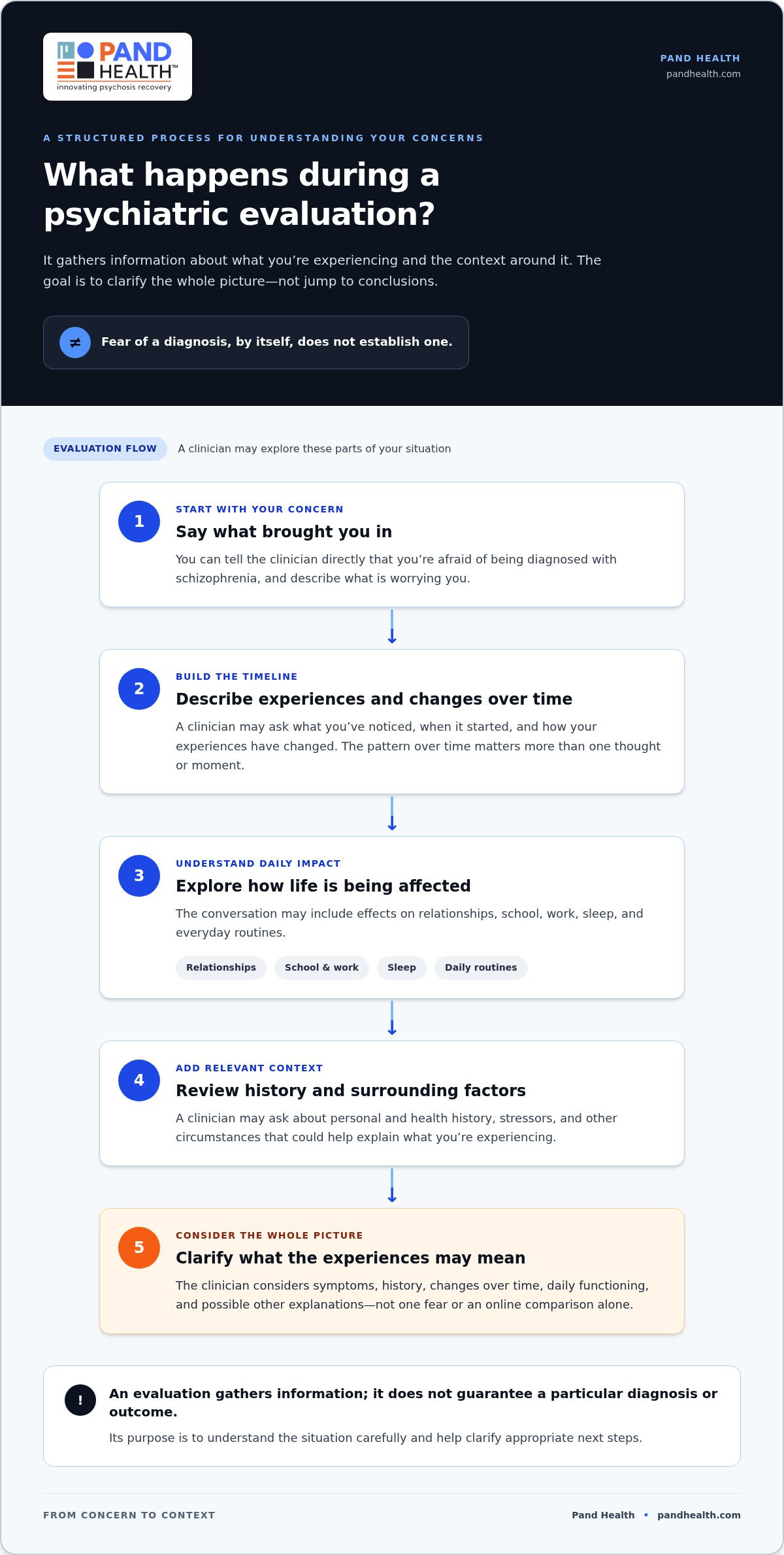
An evaluation is a structured way to understand what you’re experiencing. It gathers information; it doesn’t guarantee a particular diagnosis or outcome. If the fear of being diagnosed with schizophrenia is what brings you in, you can say so directly. A clinician can explore that concern alongside your experiences, history, and current needs, rather than drawing a conclusion from the fear itself or an online checklist.
The conversation may cover what prompted the concern, when it began, and whether anything has changed over time. A clinician may ask how you’re sleeping, managing everyday responsibilities, and relating to others. They may also ask about health history, medications or substances, stressors, and existing supports. These details help put symptoms in context and consider other explanations. The National Institute of Mental Health provides general information about schizophrenia, but only an individualized clinical assessment can help interpret a person’s specific circumstances.
Information that can help a clinician understand the concern
You don’t need to prepare a perfect account or arrive with a diagnosis in mind. If it helps, jot down when the worry started, what tends to intensify it, and how it affects routines such as sleep, school, work, or relationships. Bring questions, too. You may choose to involve someone you trust, particularly if they can share observations or help you feel more at ease.
How an evaluation can clarify concerns without rushing to a label
A respectful assessment considers more than symptoms. It can include your personal strengths, what’s going well, and the support you already have. Sometimes the discussion points to follow-up questions or further evaluation. That isn’t a failure to reach a conclusion; careful assessment may take more than one conversation.
A diagnosis, if one is made, is a clinical description intended to guide understanding and care. It doesn’t define a person’s character or determine every part of their future. The clinician should explain their findings and discuss possible next steps, leaving room for questions and clarification.
A typical process may include:
- 1. Share your concerns. Describe what prompted you to seek an evaluation, including fears and experiences that feel difficult to explain.
- 2. Explore the broader picture. Discuss the timeline, daily functioning, health history, and relevant life context.
- 3. Review what the information suggests. The clinician considers patterns and possible explanations rather than relying on a single symptom.
- 4. Discuss next steps. Ask about the findings, any remaining uncertainties, and whether follow-up or additional support may be useful.
Managing Recurring Fear of a Schizophrenia Diagnosis
Recurring fear can make it tempting to search symptoms, replay conversations, or repeatedly test whether an experience feels “real.” These checks may bring short-lived relief, but they can also keep attention fixed on the worry. A practical first step is to pause searching and focus on what you’re experiencing and how it affects your life, without trying to reach a diagnosis on your own.
- Write down the main concern and when it tends to arise.
- Note concrete changes in sleep, relationships, school, work, or daily routines.
- Record questions you want to ask, rather than repeatedly comparing yourself with online symptom lists.
How to talk about the fear with a clinician or trusted person
You can begin simply: “I am afraid of being diagnosed and want help understanding why.” Then describe what you’ve noticed, when it began, and what has changed. You don’t need to use clinical terms or decide what the experience means before asking for support.
If it would help, consider telling someone you trust and asking them to join a conversation or help you organize questions. Involving family is a choice, not a requirement. The person seeking help should have a say in what they share and with whom, except when immediate safety needs require urgent action.
When to seek prompt or emergency support
If distress is increasing, experiences are changing, or daily life is becoming harder to manage, seek prompt guidance from a qualified mental-health professional. You don’t have to wait until you’re certain what is happening. A psychiatric evaluation can help clarify concerns and consider appropriate next steps.
Urgent situations are different from routine evaluation. If someone may be in immediate danger or unable to stay safe, contact local emergency services. In the United States, call 911 for immediate danger. For a mental-health crisis in the United States, call or text 988 to reach the Suicide & Crisis Lifeline. If you’re supporting someone, stay calm, listen without arguing about their experiences, and help connect them with appropriate crisis support.
Seeking help for fear of being diagnosed with schizophrenia does not predetermine what an assessment will find. If you’re in Los Angeles and want to discuss your concerns through a psychiatric evaluation, Pand Health provides evaluations and thought-disorder assessments.
Finding Thought-Disorder Evaluation and Early-Psychosis Support in Los Angeles
Persistent fear can be a reason to seek clarity, even when you don’t know what the fear means. The fear of being diagnosed with schizophrenia does not itself indicate schizophrenia or psychosis. A psychiatric evaluation can help put concerns in context and explore what support, if any, may be appropriate.
In Los Angeles, Pand Health provides psychiatric evaluations and assessments for thought disorders, as well as same or next day psychosis evaluation services. An assessment considers a person’s experiences, history, daily functioning, and needs rather than treating a feared diagnosis as a conclusion. It can help clarify concerns and guide a discussion of possible next steps, without promising a particular finding.
How specialized early-psychosis care differs from a diagnosis
An assessment and a treatment plan serve different purposes. Assessment helps a clinician understand what may be happening; care planning responds to the individual’s needs. California OnTrack is a specialized early-psychosis program for teens and adults experiencing early signs of psychosis or identified as clinically high-risk. It uses an augmented Coordinated Specialty Care model that brings clinical and psychosocial supports together. Eligibility and the right level of support are determined individually.
A loved one can also benefit from guidance. Family psychoeducation can help families better understand psychosis-related concerns, communicate supportively, and consider how to respond while respecting the individual’s needs and preferences.
A gentle next step for individuals and families in Los Angeles
You don’t need to arrive with a label or a complete explanation. It may help to share what has been worrying you, when it began, and whether it has affected sleep, relationships, school, work, or daily routines. If you’re supporting a family member, you can ask how to be helpful while allowing them to take part in decisions about their care.
Seeking an evaluation is a way to start a conversation, not a commitment to a diagnosis or a specific treatment. Pand Health’s recovery-oriented approach considers the person, not only the concern that brought them in. A calm first step can be simply sharing what you’ve noticed and asking what an assessment may involve.
Contact Pand Health about a psychiatric evaluation to discuss your concerns and possible next steps.
Take a Steady Step Toward Clarity
The fear of being diagnosed with schizophrenia can feel intense, but fear alone cannot establish a diagnosis. Repeated symptom searches and self-checking may keep uncertainty alive, while a qualified clinician can explore your concerns in the context of your experiences, history, and daily functioning.
You don’t need to arrive with the right label or a perfectly organized explanation. Writing down what worries you and how it affects your life can help you begin a conversation. An evaluation is a way to seek understanding, not a guarantee of any particular conclusion.
In Los Angeles, Pand Health provides psychiatric evaluations and thought-disorder assessments. For teens and adults experiencing early psychosis or identified as clinically high-risk, California OnTrack offers recovery-oriented early-psychosis care. These supports are guided by individual needs, not by fear alone.
If you’re ready to discuss your concerns, contact Pand Health to discuss an evaluation. Asking for support is a thoughtful step toward greater clarity, and you don’t have to figure everything out before taking it.
Frequently Asked Questions
Does being afraid of schizophrenia mean I have schizophrenia?
No. The fear of being diagnosed with schizophrenia cannot establish a diagnosis. A qualified clinician considers experiences over time, personal and health history, daily functioning, and broader context. Persistent worry can have different explanations, including anxiety or OCD-related patterns, but an online article can’t determine which applies to you. If the fear is affecting daily life, a professional can help explore it without relying on one thought or symptom.
Can OCD make someone fear developing schizophrenia?
Yes. Fear of developing schizophrenia can occur in OCD, sometimes alongside repeated doubt, checking, reassurance seeking, or avoidance. Those patterns may be distressing, but they don’t mean that everyone with this fear has OCD, and they aren’t enough to diagnose it. A qualified clinician can explore how the thoughts and behaviors fit together, how they affect daily life, and what support may be appropriate for the individual.
What is the difference between fearing schizophrenia and experiencing psychosis?
Fear is an emotional response, and it may involve recurring worries about what could happen. Psychosis refers to experiences that need careful clinical assessment in context. Fear alone doesn’t establish that someone is experiencing psychosis, and an online comparison can’t determine the cause of an experience. A clinician considers symptoms, history, daily functioning, and other possible explanations. Seek professional guidance if concerns persist or disrupt everyday life.
Should I get evaluated if I am afraid of being diagnosed with schizophrenia?
Consider speaking with a qualified mental-health professional if the fear is persistent, difficult to manage, or affecting sleep, relationships, school, or work. An evaluation gives you an opportunity to explain what’s worrying you and discuss relevant context. It can’t predict a diagnosis from an article or a single symptom. You can bring questions, describe changes you’ve noticed, and ask whether further assessment or support may be helpful.
What should I tell a clinician if I am afraid to discuss schizophrenia?
You can start with: “I am afraid of being diagnosed and want help understanding what is happening.” Then share when the worry began, what experiences concern you, and how daily life has been affected. You don’t need to decide on a diagnosis before seeking help or organize every detail perfectly. If it feels supportive, you can ask someone you trust to join the conversation or help you remember questions.
What should I do if I feel unsafe or someone may be in immediate danger?
If someone may be in immediate danger, call 911 in the United States or go to an emergency department. For a mental-health crisis in the United States, call or text 988 for crisis support; check the 988 Lifeline for current guidance. These are urgent options, not routine evaluation.
Disclaimer
This article is for information and educational purposes only, and can NEVER replace a proper medical evaluation. If you or a loved one may be suffering from psychosis or the prodomal symptoms of psychosis, get evaluated by a professional as soon as possible. Early diagnosis and treatment can be life-saving.