
LPS Conservatorship in California: A Family Guide
By Pand Health

An LPS conservatorship in California is a court-ordered legal arrangement that authorizes a designated conservator to oversee psychiatric treatment and placement for an adult who is gravely disabled by serious mental illness. Under California Senate Bill 43 (SB 43), “grave disability” now also includes the inability to provide for personal safety or necessary medical care, and extends to severe substance use disorder when it co-occurs with a serious mental disorder. If your family member is in crisis right now, these are the steps that matter most:
- Call 911 or a mobile crisis team if there is immediate danger
- Request an LPS-authorized evaluator at the hospital or emergency department
- Contact the treating psychiatrist or hospital social worker to document current symptoms
- Preserve all recent hospital records, medication histories, and written observations of behavior
Pro Tip: Clinicians and county investigators need specific, recent facts linking symptoms to an inability to meet basic needs. Written notes from family members, dated and detailed, carry real weight in a conservatorship petition.
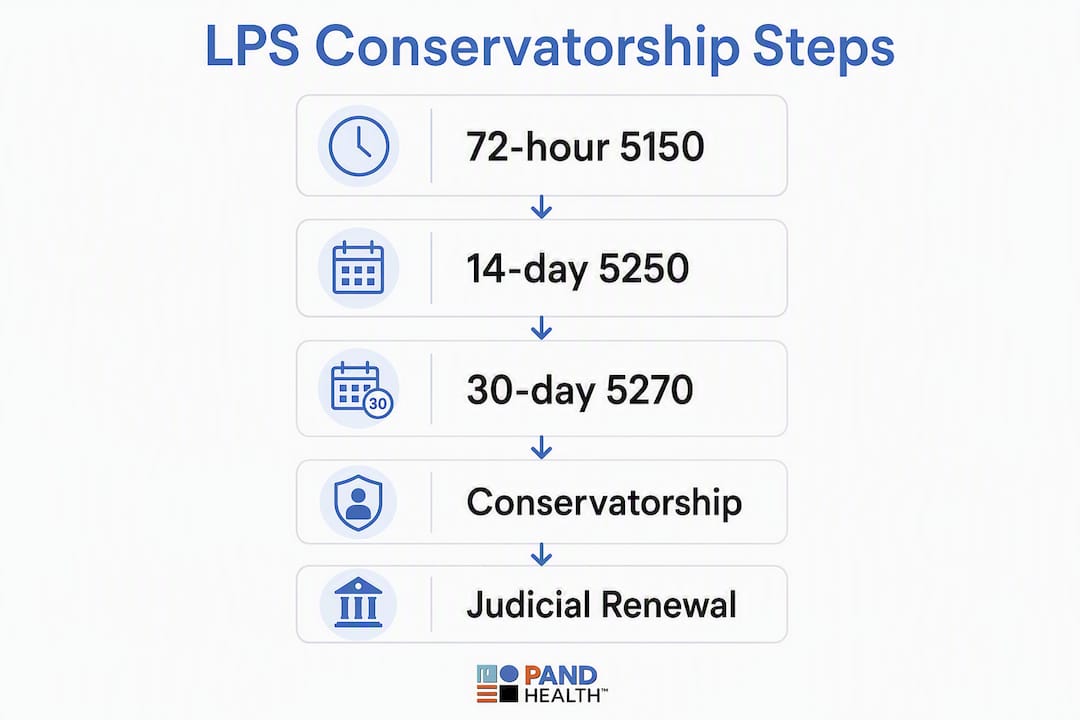
The involuntary-hold pathway typically begins with a 72-hour 5150 hold. Clinicians may then file for a 14-day 5250 hold, followed by a 30-day 5270 hold, reaching up to 47 days total before either discharge or a conservatorship petition is filed. A temporary conservatorship (T-Con) can hold placement for up to 30 additional days while the county prepares its report and the court schedules a general conservatorship hearing.

Once granted, an LPS conservatorship automatically expires after one year and must be renewed through judicial review. The conservatee retains the right to legal counsel and an evidentiary hearing at every renewal. A conservator may authorize psychotropic medication over the conservatee’s objection, but cannot physically force administration. In practice, that legal authority supports consistent treatment plans and reduces revolving hospitalizations.
One common misconception: LPS conservatorship covers treatment and placement decisions only. Financial management typically requires a separate probate conservatorship. Conservatorship is also a tool of last resort. The Public Conservator must consider less restrictive alternatives before recommending it, and courts are required to prioritize the least restrictive option that meets the person’s needs.
Table of Contents
- Key Takeaways
- Pandhealth supports families navigating early psychosis in Los Angeles
- Authoritative California sources for families and clinicians
- FAQ
Key Takeaways
An LPS conservatorship in California is a time-limited, court-supervised legal tool for adults gravely disabled by serious mental illness, and SB 43 has meaningfully expanded who may qualify.
| Point | Details |
|---|---|
| SB 43 expanded eligibility | Grave disability now includes inability to provide for personal safety and covers severe SUD co-occurring with serious mental illness. |
| Hold timeline before petition | 5150 (72 hrs) → 5250 (14 days) → 5270 (30 days) = up to 47 days before conservatorship or discharge. |
| One-year limit with renewal | Conservatorship expires automatically after one year; renewal requires a judicial hearing and the conservatee has the right to counsel. |
| LPS scope is narrow | LPS covers treatment and placement only; a separate probate conservatorship is needed for financial decisions. |
| Pandhealth’s role | Pandhealth’s California OnTrack program supports families during and after conservatorship with coordinated specialty care for ages 13–35. |
Pandhealth supports families navigating early psychosis in Los Angeles
When a hospital hold ends, the hardest question is often: what comes next? Pandhealth’s early psychosis treatment program in Los Angeles is built precisely for that transition. Using an augmented version of the California OnTrack Coordinated Specialty Care (CSC) model, Pandhealth serves teens and young adults ages 13–35 with conditions including schizophrenia, schizoaffective disorder, bipolar disorder with psychotic features, and cannabis-induced psychosis.

During a hospital hold or conservatorship period, Pandhealth’s clinical team can coordinate directly with inpatient staff, provide documentation to support county investigators, and begin family psychoeducation before discharge. The program includes psychiatry, medication management, individual and group therapy, cognitive remediation, and supported education and employment. For teens ages 13–17, care is available at no cost through the California Early Psychosis Initiative. Adults 18–35 can access services through insurance or need-based scholarships. Early intervention through the CSC model reduces repeat hospitalizations and supports a meaningful transition off conservatorship when the time comes. Contact Pandhealth to schedule an intake consultation and bring any available hospital records to your first appointment.
Authoritative California sources for families and clinicians
The sources below are the primary references families, attorneys, and clinicians should consult when preparing for a conservatorship petition, hearing, or renewal.
- LPS Act & SB 43, LA County DMH: The county’s official summary of SB 43 changes, including updated grave disability definitions and implementation timelines. Note that some procedural rules have county-specific effective dates in 2026; verify your county’s rollout.
- Disability Rights California, LPS Act Guide: Plain-language explanation of the 5150/5250/5270 hold sequence, patient rights at each stage, and representation rights.
- NAMI Westside Los Angeles, LPS Conservatorship Guide: Family-facing overview of the Lanterman-Petris-Short Act and the conservatorship process under California Welfare and Institutions Code §5200.
- San Francisco Superior Court, Mental Health Conservatorship: Explains the T-Con process, the county investigator’s report, and the general conservatorship hearing sequence.
- Disability Rights California, LPS Conservatorship Chapter 2: Details what investigators must examine, including less restrictive alternatives, before recommending conservatorship.
Hold timeline and court milestones at a glance:
| Stage | Duration | Key rights |
|---|---|---|
| 5150 hold | 72 hours | Right to be informed of reason for hold |
| 5250 hold | 14 days | Right to a Riese hearing; right to counsel |
| 5270 hold | 30 days | Continued right to counsel and hearing |
| Temporary conservatorship (T-Con) | Up to 30 days | County prepares investigative report |
| General conservatorship hearing | Court-scheduled | Right to evidentiary hearing and legal representation |
| Annual renewal | One year | Right to counsel; conservatorship expires without renewal |
For coordinated specialty care options in Los Angeles, contact your county’s Public Guardian office or ask a hospital social worker for a referral to a California OnTrack program. Families preparing for a hearing should request the Public Defender’s office early and bring all clinical documentation they have gathered.
This article provides general information about California mental health law and is not legal or medical advice. Confirm current rules and procedures with a licensed attorney, your county’s Public Guardian office, or a qualified mental health clinician.
FAQ
What is an LPS conservatorship in California?
An LPS conservatorship is a court-ordered arrangement giving a conservator authority over psychiatric treatment and placement for an adult gravely disabled by serious mental illness. It is governed by the Lanterman-Petris-Short Act under California Welfare and Institutions Code §5200.
How long does the 5150-to-conservatorship process take?
The involuntary hold sequence can last up to 47 days total (72-hour 5150, 14-day 5250, 30-day 5270) before a conservatorship petition is filed or the person is discharged.
Does an LPS conservatorship give family members financial control?
No. LPS conservatorship covers treatment and placement decisions only. A separate probate conservatorship is required to manage financial affairs or assets.
How long does an LPS conservatorship last?
It expires automatically after one year. Renewal requires a judicial hearing, and the conservatee has the right to legal counsel at every renewal proceeding.
Where can families in Los Angeles get early psychosis care after a hospital hold?
Pandhealth offers California OnTrack-based treatment for ages 13–35 in Los Angeles, including care coordination with inpatient teams and family psychoeducation to support transition after a hold or conservatorship.