
California OnTrack was founded on computational psychiatry, from the bottom up
We treat schizophrenia as a breakdown in the brain's internal inference machinery, where symptoms are rational solutions to a pathologically perceived world. Every module in our program targets a specific computational parameter.
In a healthy brain, cognition operates as a Bayesian inference engine that uses predictive coding to continuously balance top-down expectations with bottom-up sensory "prediction errors," relying on a finely tuned chemical system to assign precise importance (salience) only to meaningful surprises. When this system breaks down, often due to dopamine dysregulation in the development of schizophrenia, it results in aberrant salience, a state where the brain assigns intense, artificial meaning to irrelevant details or random background noise. Flooded with these false prediction errors, the Bayesian brain desperately attempts to restore logical order by constructing bizarre new prior beliefs (delusions) to logically "explain" the false significance it is perceiving. Ultimately, as the brain struggles to suppress this overwhelming sensory chaos, its top-down internal predictions become so abnormally strong that they overpower actual sensory evidence, causing the individual to perceive things that are not there (hallucinations) and fundamentally severing their connection to shared reality.
The computational triad of normal brain function: theory, mechanism, and filter
To fully understand computational psychiatry in schizophrenia, it helps to examine how the overarching mathematical principles, neural implementation, and neuromodulatory filters work together in a unified hierarchy.
Bayesian reasoning (the theory)
Overarching framework: explains what the brain is doing. Perception is not a direct recording of reality, but a statistical inference combining prior expectations with incoming sensory evidence to calculate what is most likely happening.
Predictive coding (the mechanism)
Neural implementation: explains how the brain executes Bayesian inference. Higher cortical regions send top-down predictions while lower regions send bottom-up prediction errors when mismatches occur.
Normal salience (the filter)
Neuromodulatory control: explains how relevance is assigned. Dopamine acts as a biological highlighter, tagging meaningful surprises for attention while filtering out meaningless background noise.
1The theory: Bayesian reasoning in the brain
At the core of computational psychiatry is the Bayesian brain hypothesis. It posits that the brain operates like a statistician, using Bayes' theorem to make sense of a noisy, ambiguous world. Perception and belief formation are not passive; they are active processes of probabilistic inference.
The brain mathematically combines two sources of information:
- The prior: our expectations, memories, and previous models of how the world works.
- The likelihood: the raw, incoming sensory evidence or new data.
The resulting perception or belief, the posterior, is an optimal, precision-weighted combination of the prior and the likelihood. In schizophrenia this balancing act fails. Depending on the symptom, the brain may either rigidly cling to priors (delusions) or be overwhelmed by noisy likelihoods (hallucinations), revealing a fundamental flaw in Bayesian belief updating.
P(B)
1The foundation: hierarchical predictive coding
The "Bayesian brain" hypothesis suggests we don't just see the world; we infer it. High-level cortical regions generate top-down priors (predictions), while lower regions receive bottom-up sensory likelihoods. The difference between them is the prediction error. In a healthy brain, these errors update our model of the world.
2The filter: normal vs. aberrant salience
In a healthy brain, dopamine acts as a biological highlighter, marking certain stimuli as "salient" (important) and filtering out the rest. This normal salience ensures that prediction errors are only generated for meaningful events that require our attention or a change in behavior, a sudden loud noise, or a reward cue.
The aberrant salience hypothesis (Kapur, 2003) posits that in psychosis a dysregulated, hyperactive dopamine system assigns significance to neutral, irrelevant stimuli. The filter breaks down. Random background noise is tagged with high precision, flooding the cortex with false prediction errors. The mind then attempts to make sense of these artificially profound experiences by constructing elaborate, rigid priors, resulting in delusions.
The breakdown of the filter
Precision weighting
Precision is the volume knob on information. In schizophrenia that knob is broken: sensory noise is over-weighted, and high-level beliefs become compensatorily rigid.
The imbalance between noisy sensory data and rigid priors creates the cognitive gridlock seen in psychosis.
The Symptom Spectrum
Visualizing how different computational failures manifest as clinical symptoms. From hallucinations (false priors) to anhedonia (blunted reward signals).
- Hallucinations (false priors)
- Delusions (rigid beliefs)
- Avolition (low RPE signal)
- Social deficit (2nd-order error)
- JTC bias (high volatility)
Key takeaway: Negative symptoms (blunted RPE) and positive symptoms (aberrant salience) stem from distinct algorithmic breakdowns.
The Development of Schizophrenia: A System Overwhelmed
The breakdown creates a cascading failure within the inferential machine:
Aberrant Salience
The cascade begins with a dysregulated dopamine system firing spontaneously, misinterpreting the "noise" of the environment or internal thoughts. The brain begins assigning intense importance and weight to completely irrelevant details (e.g., a stranger scratching their nose), flooding it with massive, highly weighted prediction errors that scream, "This is important! Pay attention!"
Delusions
Because the brain is a Bayesian inference machine, it cannot tolerate a constant stream of massive, unexplained prediction errors. To explain away the aberrant salience, the brain's higher regions adopt bizarre, rigid new prior beliefs (e.g., "I am being followed by agents"). Delusions are the brain's rational attempt to explain an irrational neurobiological state.
Hallucinations
As the brain tries to stabilize this chaotic sensory environment, the balance of predictive coding shifts. To suppress the constant flood of false prediction errors, it relies far too heavily on its own top-down predictions, overriding actual sensory input. When strong internal predictions overpower weak sensory evidence, it creates a hallucination.
The algorithmic toolkit: computational psychaitry-targeted theraeutics
Psychotherapy for psychosis is not just supportive dialogue; it is structural engineering for the mind. Each modality inside California OnTrack targets a specific parameter in the inferential machinery.
MCT
Recalibrates prior precision. Teaches the brain to sow seeds of doubt and reduce overconfidence in false conclusions.
CBTp
Uses guided discovery to generate high-precision safety prediction errors that update delusional priors.
SCIT
Targets second-order inference, differentiating facts from guesses in complex social environments.
mBA
Repairs reward prediction errors, forcing positive updates through graded behavioral activation.
PAT
Upregulates the positive valence system via mental imagery to combat anhedonia.
SST
Builds high-precision action policies through rehearsal, minimizing social surprise.
VR agency
Restores sensory attenuation by re-coupling motor predictions with proprioceptive feedback.
DBT skills
Downregulates interoceptive noise through mindfulness, calming emotional prediction errors.
The future: precision phenotyping
Researchers now use the Hierarchical Gaussian Filter (HGF) to map "belief instability." That data lets us predict which people will respond to therapies like MCT before the first session begins.
Computational models are turning psychiatry from a descriptive science into a predictive engineering discipline.
Why this matters for care
California OnTrack sequences medication, cognitive remediation, and social-cognitive training against these computational targets rather than against symptom labels alone.
Core references
- Sterzer et al. (2018), The predictive coding account of psychosis.
- Hauke et al. (2022), Belief instability in psychotic disorders.
- Fletcher & Frith (2009), Perceiving is believing.
- Adams et al. (2013), The computational anatomy of psychosis.
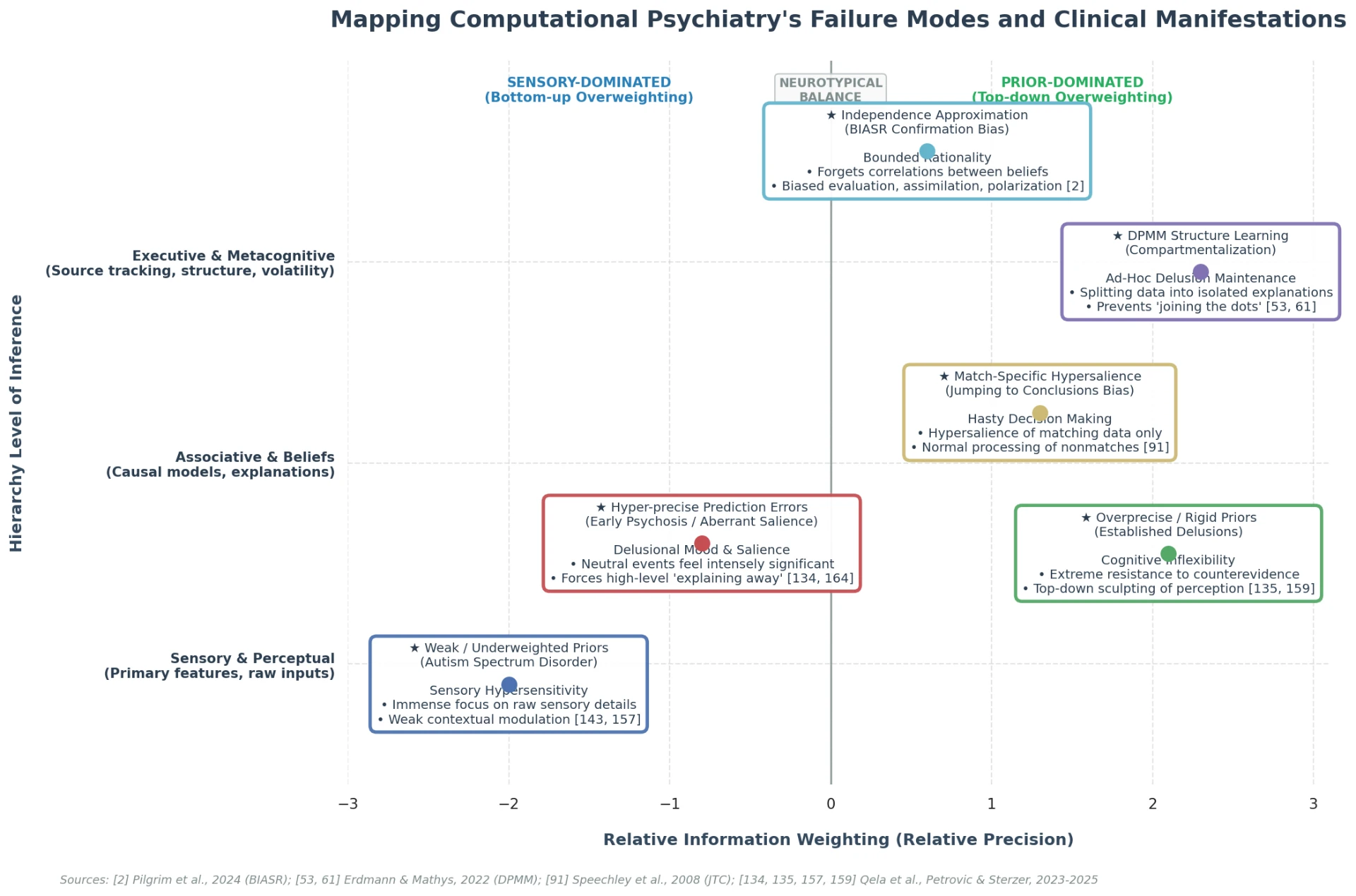
Mapping computational psychiatry's failure modes and clinical manifestations
This framework maps how disturbances in relative precision and hierarchical inference produce distinct clinical phenotypes, from sensory hypersensitivity to rigid delusions.
Keep reading
All research & library pages →- Research & libraryComputational psychiatry tutorialsStep-by-step tutorials on the models behind psychosis research.For clinicians
- Research & libraryComputational models of delusionsPrediction error, aberrant salience, and belief updating.For clinicians
- Research & libraryAnhedonia & apathy: a computational viewEffort cost, reward learning, and the negative symptoms of psychosis.For clinicians
- Understanding psychosisGenesis of psychosisThe cognitive architecture behind delusion formation, with an interactive beads task.For everyone
- Clinician toolsJumping to conclusions (beads task)The classic reasoning-bias task, playable.For everyone