
Phases of psychosis
What if the social withdrawal you're seeing in your teenager isn't just a difficult phase of growing up, but the silent onset of a treatable medical condition? For many families in Southern California, the line between typical adolescent moodiness and the emergence of the Psychosis Prodrome, hallucinations, delusions, negative symptoms, cognitive deficits and social cognition impairment often feels painfully blurred. You aren't alone in feeling confused or fearful about what comes next. It's natural to worry that a diagnosis might mean a permanent loss of the friendships, school success, and milestones your child deserves.
We understand that you're looking for more than just clinical definitions; you're looking for a definitive way back to normalcy. This guide offers a clear, compassionate roadmap for identifying early warning signs and selecting high-standard, data-driven intervention programs that prioritize real-world recovery. We'll examine how specialized, augmented care can bridge the gap between crisis and stability, focusing on proven methods that help individuals regain their social confidence and prevent the progression of a full-blown psychotic episode.
Key Takeaways
- Learn to identify the Psychosis Prodrome, hallucinations, delusions, negative symptoms, cognitive deficits and social cognition impairment during the critical window when intervention is most effective.
- Understand why addressing social cognition impairment is essential for helping your loved one read social cues and rebuild meaningful friendships.
- Discover the difference between standard outpatient therapy and "Augmented" Coordinated Specialty Care, which offers the intensive support needed for true recovery.
- Find out how to evaluate Los Angeles programs based on their use of the NAVIGATE framework and specialized certifications like SCIT and MCT.
- Explore how data-driven intervention in Southern California leads to an 85% success rate for patients returning to school or the workforce.
Recognizing the Psychosis Prodrome: Beyond Hallucinations and Delusions
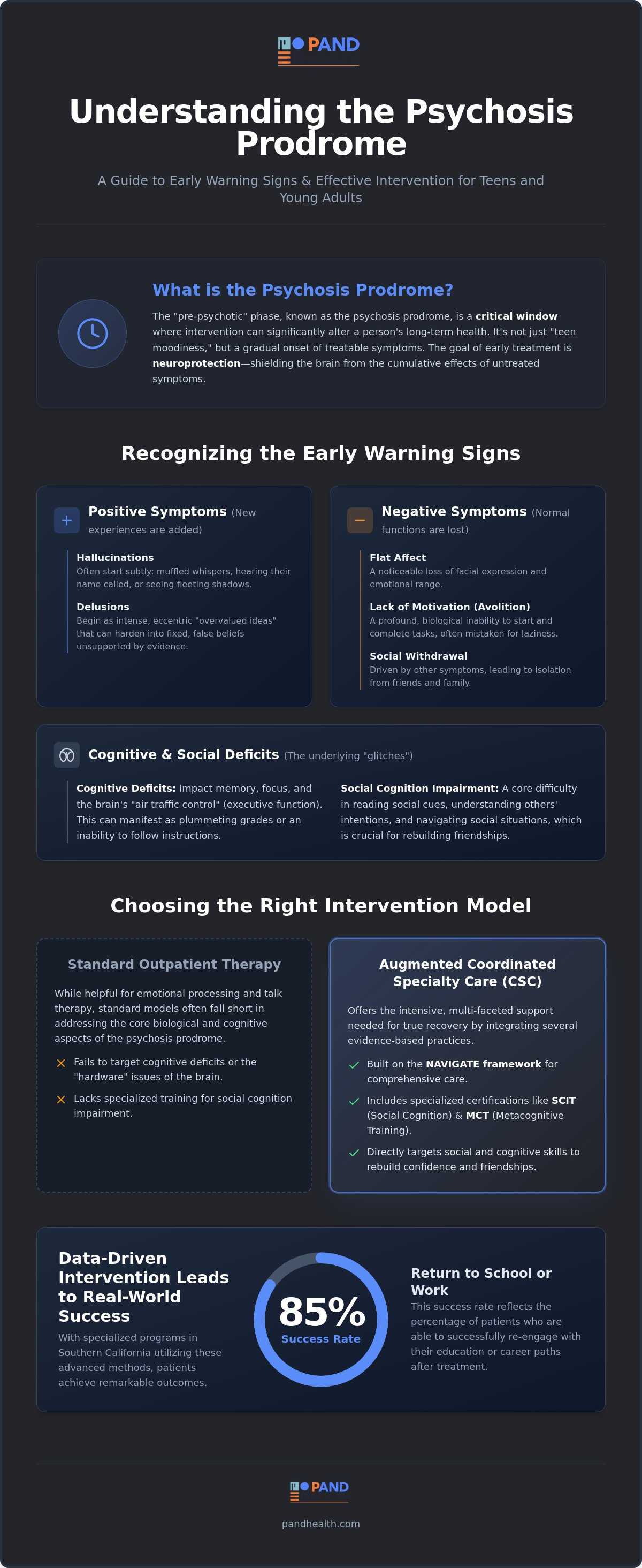
The period leading up to a first psychotic episode is known as the psychosis prodrome. This "pre-psychotic" phase represents a critical window where specialized intervention can significantly alter a person's long-term trajectory. While many people associate mental health crises with sudden, dramatic breaks from reality, the truth is usually more gradual. Identifying the Psychosis Prodrome, hallucinations, delusions, negative symptoms, cognitive deficits and social cognition impairment early allows for a proactive rather than reactive approach. To understand the gravity of these changes, it helps to first establish a clinical baseline of what psychosis is, a condition where the brain struggles to process information and distinguish what is real from what is not.
Distinguishing between typical teen behavior and clinical warning signs like persistent suspiciousness or intense new ideas is a common point of confusion for families. It's normal for adolescents to seek more privacy or change their social circles. However, clinical warning signs involve a distinct, often distressing departure from their baseline personality. You might notice an unusual level of paranoia, where they feel peers are plotting against them without any evidence. They may become consumed by intense new ideas or eccentric philosophical concepts that disconnect them from their daily responsibilities. This clinically high-risk state is a vital period for neuroprotection, where the goal is to shield the brain from the cumulative effects of untreated symptoms.
Positive Symptoms: When Reality Begins to Blur
In clinical terms, positive symptoms refer to experiences added to a person's reality. Hallucinations exist on a spectrum; they often start as muffled whispers, the sound of their name being called in an empty room, or fleeting shadows in their peripheral vision. For a teenager, this can be terrifying and isolating. Delusions are fixed, false beliefs that remain even when presented with contradictory evidence. In the early stages, these often manifest as "overvalued ideas." These are beliefs that are intense and eccentric but not yet fully detached from logic. As the condition progresses, these ideas can harden into full-blown delusions that disrupt daily logic and safety.
The Silent Warning Signs: Negative Symptoms
While hallucinations capture the most attention, negative symptoms are often the most disabling in the long term. These represent the loss of normal psychological functions, such as a "flat affect" where a loved one’s face loses its expressive range. You might notice a profound lack of motivation that looks like extreme laziness but is actually a biological inability to initiate tasks. These symptoms are the primary drivers of the social withdrawal seen in the prodrome phase. Because they are less "loud" than hallucinations, they are frequently overlooked, yet they are more damaging to a person's ability to maintain friendships, stay in school, or hold a job.
The Role of Cognitive Deficits and Social Cognition Impairment
While hallucinations and delusions are the most visible markers of psychosis, they are often just the tip of the iceberg. The underlying biological changes during the Psychosis Prodrome, hallucinations, delusions, negative symptoms, cognitive deficits and social cognition impairment often manifest first as subtle "glitches" in how the brain processes information. These glitches are cognitive deficits. They impact memory, the ability to focus, and executive function. When a student who previously excelled suddenly sees their grades plummet, or an employee begins failing to follow simple instructions, it's rarely a matter of effort. It's a matter of biological capacity. Standard talk therapy, while helpful for emotional processing, often fails to address these fundamental "hardware" issues. Understanding the Early Signs of Psychosis means recognizing that these cognitive shifts are as central to the disorder as any sensory hallucination.
Executive Function and the Work-Study Challenge
Executive function acts as the brain's "air traffic control" system. It manages time, organizes tasks, and helps us switch between ideas. During the early phases of psychosis, this system begins to falter. A teen might find it impossible to finish a history paper, not because they don't understand the material, but because they can't organize the steps to complete it. This is where computer-assisted brain training becomes essential. These modern recovery tools help "rewire" neural pathways to improve attention and processing speed. For those struggling to stay in the classroom, seeking supported education for college students in LA is a vital step in bridging the gap between clinical stabilization and academic success.
Social Cognition: The Foundation of Friendships
Social cognition is the ability to understand what others are thinking and feeling, often referred to as "Theory of Mind." It's the foundation of every friendship. When this is impaired, the world becomes a confusing and threatening place. A neutral facial expression on a stranger might be misinterpreted as a look of intense hostility, fueling the paranoia often seen in the prodrome. This isn't just "social anxiety"; it's a breakdown in how the brain decodes social signals. Specialized training, such as Social Cognition and Interaction Training (SCIT), helps individuals "re-learn" these cues. By practicing these skills in a safe, guided environment, individuals can begin to rebuild the social confidence necessary for a full return to their community. If you're noticing these subtle shifts, exploring a specialized evaluation can provide the clarity your family needs to move forward with confidence.
Comparing Clinical Models: Why Social Cognition Training is Essential
Standard outpatient therapy typically involves one hour of talk therapy per week. While this provides emotional support, it rarely addresses the complex biological shifts seen during the Psychosis Prodrome, hallucinations, delusions, negative symptoms, cognitive deficits and social cognition impairment. For a person in the early stages of a thought disorder, a more robust framework is required. Coordinated Specialty Care (CSC) is that framework. Specifically, the NAVIGATE model is recognized as the gold standard for treating First Episode Psychosis (FEP). It integrates psychiatric care, family education, and vocational support into a single, unified team. However, even standard CSC can sometimes overlook the specific mechanics of Social Cognition Impairment in Psychosis. This is why "augmented" models that include targeted interventions like SCIT and MCT are increasingly vital for long-term social reintegration.
MCT vs. CBT: A New Approach to Thought Disorders
Traditional Cognitive Behavioral Therapy (CBT) often focuses on the "what" of a thought, examining the content of a delusion to see if it's true. Metacognitive Training (MCT) takes a different path by targeting the "how" of thinking. It addresses the underlying cognitive biases that allow delusional patterns to take root. MCT is specifically designed to reduce the "jump to conclusions" bias, helping individuals slow down their reasoning process before accepting a fearful thought as a fact. Because MCT is a specialized clinical tool, it requires certified instructors to ensure the training is delivered with high fidelity. This nuanced approach helps move past the mere suppression of symptoms toward a fundamental restoration of logical processing.
The Power of SCIT for Teens and Young Adults
Social Cognition and Interaction Training (SCIT) provides a structured, group-based environment where young adults can practice navigating social cues without the fear of real-world rejection. In these sessions, participants learn to distinguish between different emotions and avoid the "personalizing bias," where they might assume a stranger’s bad mood is somehow their fault. The transition from learning these cues in a clinic to applying them at school or work is the ultimate goal. By integrating these sessions into a broader program of social skills training, patients can move from isolation back into active, meaningful participation in their communities. This isn't just about managing a condition; it's about reclaiming a life that feels connected and purposeful.
Buying Guide: Evaluating a Social Skills Group for Teens in Los Angeles
Selecting a recovery program in Southern California is a high-stakes decision that requires more than a simple search for "therapy near me." For families facing the Psychosis Prodrome, hallucinations, delusions, negative symptoms, cognitive deficits and social cognition impairment, the quality of the intervention determines the speed and stability of the return to normalcy. You should look for "Augmented" Coordinated Specialty Care (CSC). While standard CSC provides a solid foundation, an augmented model offers significantly more than the bare minimum of 10 to 15 hours of care. This intensive approach is necessary to provide the "wraparound" support that prevents a single episode from becoming a lifelong struggle.
Clinical certifications are another non-negotiable factor. It isn't enough for a therapist to be "experienced with teens." You must verify that the clinical team is specifically trained and certified in evidence-based protocols like Social Cognition and Interaction Training (SCIT), Metacognitive Training (MCT), and Cognitive-Behavioral Therapy for Psychosis (CBT-P). These specialized tools are designed to treat the biological processing issues that standard talk therapy misses. Accessibility also plays a major role in success. Because high-fidelity care often requires multiple visits per week, choosing a program with a central location, such as on Olympic Blvd, ensures that the intensive schedule remains sustainable for your family.
Finding specialized help is often the most difficult step in any care journey; whether you are researching adolescent mental health in California or looking to find out more about senior support in Australia, using a verified directory can save families valuable time and stress.
Five Questions to Ask an LA Psychosis Provider
- 1. Do you use the NIMH NAVIGATE framework? This is the gold standard for early intervention; any program not using it may be providing outdated care.
- 2. What is your program's average rehospitalization rate? High-standard programs should demonstrate rates significantly lower than the 50% industry average; look for outcomes closer to 6%.
- 3. Do you offer daily cognitive remediation and fitness coaching? Recovery requires treating both the brain and the body to restore executive function.
- 4. How is the family involved in the psychoeducation process? You need a partner who views the family as a vital part of the treatment team.
- 5. Is there a dedicated Work-Study program for vocational goals? The ultimate goal is a return to life, which means having a clear path back to school or work; for those interested in creative vocational paths, you can check out Advanced PMU to learn about professional training in the beauty industry.
The Red Flags of Substandard Care
Be wary of programs that rely solely on medication without a robust psychosocial curriculum. While medication can manage some symptoms, it cannot "teach" social skills or fix cognitive slips. Avoid general "mental health" groups that treat thought disorders the same way they treat mild anxiety or depression. These one-size-fits-all approaches often ignore the unique needs of the psychosis prodrome and fail to provide the specialized social cognition training necessary for real-world reintegration. If you are ready to move beyond basic care, you can explore our specialized teen recovery program to see how data-driven intervention changes lives.
The California OnTrack Advantage at Pand Health: Proven Outcomes
Pand Health stands as the premier provider of California OnTrack in Southern California, offering a specialized lifeline for families navigating the most challenging phases of early mental health crises. While many programs focus solely on stabilizing a crisis, our model is built on the expectation of full recovery. Addressing the Psychosis Prodrome, hallucinations, delusions, negative symptoms, cognitive deficits and social cognition impairment requires an augmented approach that goes beyond traditional symptom management. This commitment is reflected in our data: 85% of our participants are active in school or the workforce within six months of enrollment. This success is a direct result of our Specialized Employment and Education (SEE) curriculum, which treats functional recovery as a primary goal rather than an afterthought.
Our results provide a sense of relief for families who fear the revolving door of acute care. The rehospitalization rate for those in our program is just 6%, a stark contrast to the 50% industry average often seen prior to enrollment. At our Olympic Blvd site, we combine high-intensity clinical expertise with technology-enhanced recovery tools. This ensures that every individual has the best possible chance at a successful future. By maintaining a high standard of intervention that is both rigorous and deeply human, we help our clients move from a state of crisis to a state of thriving independence.
Integrated Care: From Brain Training to Job Coaching
Our approach creates a synergy between daily computer-assisted remediation and professional fitness coaching. This combination targets the biological roots of cognitive slips while improving overall physical resilience. For teenagers, this integrated care is a bridge back to their peers. The California OnTrack Work-Study Program specifically helps students navigate their return to LAUSD classrooms or local Los Angeles colleges. By reinforcing these academic goals with ongoing social skills training, we ensure that the transition isn't just temporary. It's a permanent step toward long-term independence and meaningful employment. For those preparing to enter the professional world and interested in corporate culture, you can check out Logotrade to see how businesses use branded gifts to foster connections.
A Lifeline for Los Angeles Families
We believe that a diagnosis should not define a person's potential. Pand Health remains a steady hand for Los Angeles families, providing the niche knowledge and specialized support needed when other avenues have failed. Our recovery-oriented promise is simple: we provide the tools, and you rediscover the future. We invite you to schedule a comprehensive psychiatric evaluation at our Los Angeles office to begin this journey toward diagnostic clarity and restoration. Our team is ready to help you navigate the path back to school, work, and the social connections that matter most.
Contact Pand Health to learn about the California OnTrack Program for Teens
Reclaiming a Future of Connection and Success
Navigating the complexities of the Psychosis Prodrome, hallucinations, delusions, negative symptoms, cognitive deficits and social cognition impairment is a journey no family should walk alone. We've explored how identifying subtle warning signs and prioritizing specialized social cognition training can fundamentally change a young person's trajectory. Recovery isn't just about the absence of symptoms; it's about the restoration of a life filled with friendships, education, and career milestones. With a 6% rehospitalization rate and an 85% employment or education participation rate after six months, our data demonstrates that a return to normalcy is a realistic and expected outcome.
As the only outpatient Coordinated Specialty Care provider in Southern California offering both SCIT and MCT, we provide the steady hand and niche expertise your family needs during this critical time. You don't have to settle for standard care when a premium, data-driven lifeline is available. Taking the first step toward diagnostic clarity is the most important move you can make for your loved one's long-term wellness. We're here to guide you through every phase of this transition with clinical precision and deep compassion.
Schedule a Comprehensive Evaluation for Your Teen in Los Angeles
Frequently Asked Questions
What is the difference between social anxiety and the psychosis prodrome in teens?
Social anxiety typically involves a fear of judgment or embarrassment in social settings, while the psychosis prodrome involves a fundamental shift in how a teen perceives reality. During the Psychosis Prodrome, hallucinations, delusions, negative symptoms, cognitive deficits and social cognition impairment often begin as subtle suspiciousness or unusual ideas that go beyond simple shyness. While an anxious teen worries about what others think, a teen in the prodrome may believe others are actively plotting against them or hear muffled voices that aren't there.
How long does the California OnTrack program typically last?
The California OnTrack program is designed as a two-year intensive intervention to ensure long-term stability and success. This duration allows our clinical team to move beyond initial symptom stabilization and focus on the deep work of psychological and social rehabilitation. By committing to this timeframe, families provide their loved ones with the consistent support needed to master new social skills and successfully navigate the transition back to independent living or higher education.
Can my child still go to school while in an intensive outpatient psychosis program?
Yes, maintaining enrollment in school is a primary goal of our recovery model. Our California OnTrack Work-Study Program is specifically designed to help teens return to LAUSD or local colleges while receiving care. We believe that staying connected to academic and social milestones is vital for a full recovery. In fact, 85% of our participants are actively engaged in school or employment within six months of starting the program.
What are the first signs of cognitive deficits I should look for?
The earliest signs of cognitive deficits often manifest as a sudden drop in academic performance or an inability to follow multi-step instructions. You might notice your child struggling with "executive function," such as forgetting assignments, losing track of time, or having trouble organizing their daily schedule. These aren't signs of laziness; they are biological processing issues that require specialized cognitive remediation to address effectively before they lead to further school or workplace challenges.
Does insurance cover specialized social skills training for psychosis in California?
Many California insurance plans cover the various components of Coordinated Specialty Care, including intensive outpatient services and psychiatric evaluations. Because the California OnTrack program is a comprehensive clinical model, it often falls under mental health parity laws that require coverage for serious conditions. We recommend contacting your insurance provider to discuss your specific benefits for psychological rehabilitation and family psychoeducation to understand your coverage options in detail.
What happens if the prodrome isn't treated early?
Leaving the prodrome untreated increases the risk of a full-blown psychotic episode, which can lead to significant neurocognitive decline. Early intervention is considered neuroprotective because it shields the brain from the cumulative damage caused by untreated symptoms. Without professional support, individuals may experience worsening social isolation and a higher likelihood of long-term disability. Treating the Psychosis Prodrome, hallucinations, delusions, negative symptoms, cognitive deficits and social cognition impairment early is the most effective way to preserve a young person's future potential.
How does Pand Health's rehospitalization rate compare to the industry average?
Pand Health maintains a rehospitalization rate of just 6%, which is significantly lower than the pre-enrollment industry average of 50%. This success is a direct result of our "augmented" care model, which provides more intensive support than standard outpatient programs. By focusing on data-driven outcomes and high-fidelity clinical protocols, we ensure that our clients stay out of the hospital and remain active in their communities, schools, and workplaces.
Is family therapy required as part of the early intervention process?
Family therapy and psychoeducation are essential components of the Coordinated Specialty Care model and are highly encouraged for the best outcomes. We view the family as a vital part of the treatment team, providing the necessary home support for a loved one's recovery. These sessions help parents and siblings understand the clinical nature of the condition, reduce household stress, and learn effective communication strategies that foster a sense of safety and stability for everyone involved.