

What Are Grandiose Delusions? Symptoms and Treatment
By Pand Health

What Are Grandiose Delusions? Symptoms and Treatment
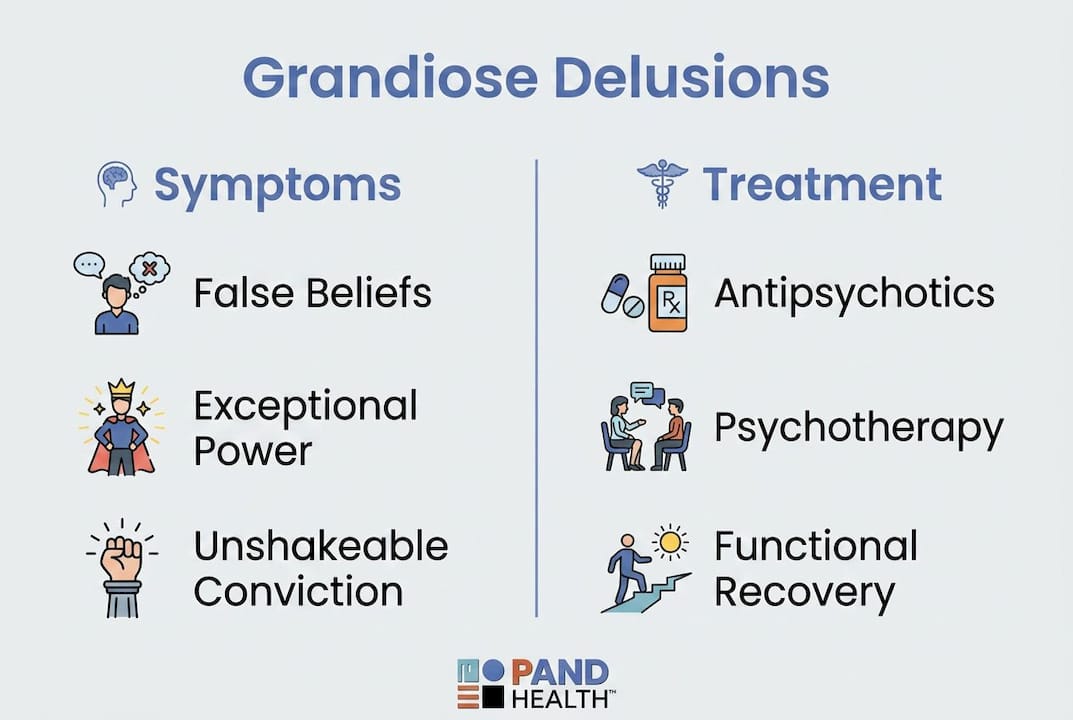
Grandiose delusions are defined as fixed, false beliefs that a person holds extraordinary power, identity, or importance that reality does not support. Clinically classified as a subtype of delusional disorder in the DSM-5, these beliefs persist despite clear contradictory evidence and cause significant disruption to daily functioning. They appear most often in bipolar disorder, schizophrenia spectrum conditions, and schizoaffective disorder. Understanding what grandiose delusions are, what causes them, and how they are treated gives families and patients a foundation for seeking effective care and realistic recovery.
What are grandiose delusions? Symptoms and diagnostic criteria
Grandiose delusions are a specific type of delusional disorder in which a person maintains a persistent, unshakeable belief that they possess exceptional abilities, wealth, fame, or a special relationship with a powerful figure such as a deity or celebrity. The belief is not consistent with the person’s actual circumstances, and no amount of logical argument changes it. Clinicians also use the terms “delusions of grandeur” and “grandiose ideation” to describe the same phenomenon, depending on severity and context.
The diagnostic threshold requires one or more delusions persisting for at least one month, with schizophrenia and substance-induced psychosis ruled out as causes. This duration requirement separates a true delusional disorder from brief psychotic episodes that resolve quickly. Functioning outside the delusional focus is often preserved, meaning a person may hold a job and maintain relationships while still believing, for example, that they are secretly a chosen prophet.
Common examples of grandiose delusions include believing one has discovered a cure for cancer that the medical establishment is suppressing, believing one is the direct descendant of a historical ruler, or believing one possesses a divine mission unknown to others. These beliefs are described as “non-bizarre” because they involve situations that could theoretically be true, unlike beliefs about alien implants. That distinction matters clinically because it separates grandiose delusional disorder from the more disorganized symptom profile seen in schizophrenia.
The table below compares grandiose delusions to other common delusional subtypes to clarify how each presents differently.
| Subtype | Core belief | Typical associated condition |
|---|---|---|
| Grandiose | Exceptional power, identity, or importance | Bipolar disorder, schizoaffective disorder |
| Persecutory | Being targeted, followed, or harmed | Schizophrenia, delusional disorder |
| Erotomanic | A person of higher status is in love with them | Delusional disorder, schizophrenia |
| Somatic | A physical disease or defect is present | Delusional disorder, OCD spectrum |
| Jealous | A partner is unfaithful without evidence | Delusional disorder, substance use |
What causes grandiose delusions?
Grandiose delusions appear most frequently in bipolar disorder, schizophrenia spectrum conditions, and schizoaffective disorder, but they also emerge secondary to neurological diseases including Huntington’s disease and Parkinson’s disease. The underlying mechanism differs by condition. In bipolar disorder, grandiose ideation typically arises during manic episodes driven by dysregulated dopamine and norepinephrine activity. In schizophrenia, the same dopaminergic excess operates alongside broader disorganization of thought and perception.
Several psychiatric and medical conditions are associated with grandiose thinking:
- Bipolar I disorder: Manic episodes frequently produce grandiose delusions, sometimes severe enough to require hospitalization.
- Schizoaffective disorder: Combines mood episode features with persistent psychotic symptoms, making grandiosity a recurring presentation.
- Schizophrenia: Grandiose delusions appear as one of several positive symptoms alongside hallucinations and disorganized speech.
- Secondary mania: Neurological events such as traumatic brain injury, stroke, or frontal lobe tumors can trigger manic-like states with grandiose features.
- Substance use: Stimulants including cocaine and methamphetamine produce grandiose states that can persist beyond acute intoxication.
- Delusional disorder, grandiose type: A standalone diagnosis when grandiose beliefs persist without the broader symptom profile of schizophrenia.
Psychological and social factors also contribute. Individuals who experience chronic low self-esteem or social marginalization may develop grandiose beliefs as a psychological defense. In California’s urban centers, where social comparison is intense and economic inequality is visible, clinicians report that environmental stressors can amplify vulnerability in those already at biological risk. The interaction between neurobiology and environment shapes both the content and the persistence of grandiose ideation.
How are grandiose delusions treated effectively in 2026?
Treatment for grandiose delusions combines pharmacological management with structured psychotherapy. Neither approach alone produces the best outcomes. The goal is not necessarily to eliminate the belief entirely, but to reduce its grip on the person’s daily functioning and quality of life.

Pharmacological treatment
Atypical antipsychotics are the first-line medication choice. Risperidone at 1–4 mg/day and olanzapine at 5–10 mg/day are the most commonly prescribed, with a standard 4–6 week trial period to assess response. These medications reduce dopaminergic overactivity, which is the primary neurochemical driver of delusional thinking. If a patient does not respond after 6–8 weeks, switching antipsychotics is the standard clinical practice rather than simply increasing the dose.
Maintenance therapy continues for 1–2 years after remission to reduce relapse risk. Many patients discontinue medication once they feel better, which is one of the most common causes of relapse. For patients who struggle with oral medication adherence, long-acting injectable antipsychotics provide a reliable alternative that removes the daily decision to take a pill.
Psychotherapeutic approaches
- Establish therapeutic alliance first. Building trust before addressing the delusion is the single most important step. Patients with grandiose beliefs often feel misunderstood or dismissed, so a clinician who listens without judgment creates the safety needed for progress.
- Apply Cognitive Behavioral Therapy (CBT) to reduce functional impact. CBT targets the delusion’s influence on daily life rather than attempting to argue the belief away. A therapist might work with a patient on managing the distress caused by others “not recognizing” their supposed status, rather than debating whether the status is real.
- Focus sessions on neutral life stressors. Discussing sleep, relationships, and work performance builds rapport and often reveals the emotional needs the delusion is serving.
- Incorporate family psychoeducation. Families learn how to communicate without reinforcing or directly challenging the belief, which reduces conflict and supports treatment adherence.
- Monitor for mood episodes. In bipolar disorder, grandiose delusions signal a manic episode. Mood stabilizers such as lithium or valproate are added alongside antipsychotics in these cases.
Pro Tip: If you are supporting a loved one in therapy, ask the treatment team about what to expect in sessions before the first appointment. Understanding the process reduces anxiety for both the patient and the family.
What challenges exist in managing grandiose delusions?
Poor insight is the defining challenge in treating grandiose delusions. A person who genuinely believes they are a figure of extraordinary importance sees no reason to accept a psychiatric diagnosis or take medication. Patients with grandiose delusions often have limited insight, which makes the therapeutic alliance more predictive of positive outcomes than medication adherence alone.
Families and clinicians face several specific obstacles:
- Direct confrontation backfires. Challenging the delusion directly triggers defensive hostility and damages the therapeutic relationship. The recommended approach is to acknowledge the person’s feelings without validating the false belief.
- Expressed emotion worsens symptoms. High expressed emotion in the home, including criticism, hostility, or emotional overinvolvement, accelerates symptom relapse. Family education programs teach communication strategies that lower this emotional temperature.
- Treatment resistance requires escalation. When oral antipsychotics fail after adequate trials, long-acting injectables become the practical solution. They also remove the burden of daily adherence decisions from a patient who may not believe they are unwell.
- Legal and safety concerns arise. Grandiose beliefs sometimes lead to financial decisions, confrontations with authority, or risky behavior driven by a sense of invulnerability. Families in California can contact county mental health services or a mobile crisis team when safety becomes a concern.
- Relapse is common without support. Structured relapse prevention planning helps families identify early warning signs before a full episode develops.
Pro Tip: When talking with a loved one experiencing grandiose ideation, replace “That’s not true” with “I can see this feels very real and important to you.” This keeps the conversation open without reinforcing the belief.
Treatment success is measured by functional improvement, not belief elimination. A patient who returns to school, maintains relationships, and manages daily responsibilities represents a clinical success even if the underlying belief has not fully resolved. Functional recovery is the expectation, not the exception.
Pandhealth: specialized care for delusional and psychotic disorders in Los Angeles
Persistent grandiose delusions require expert clinical evaluation, not watchful waiting.

Pandhealth, based in Los Angeles, provides specialized care for teens and young adults ages 13–35 experiencing thought disorders including schizoaffective disorder and bipolar disorder with psychotic features. Using the evidence-based California OnTrack coordinated specialty care model, Pandhealth combines psychiatry, medication management, CBT, cognitive remediation, and family psychoeducation into one coordinated treatment plan. Both in-person and telehealth options are available for California residents. If you or someone you care about is experiencing persistent grandiose beliefs, a clinical evaluation is the right first step toward recovery.
Key takeaways
Grandiose delusions are treatable with atypical antipsychotics and CBT, and functional recovery is achievable even when the belief itself does not fully resolve.
| Point | Details |
|---|---|
| Clinical definition | Grandiose delusions are fixed false beliefs of exceptional power or identity, persisting for at least one month. |
| Common causes | Bipolar disorder, schizophrenia, schizoaffective disorder, and neurological conditions are the most frequent sources. |
| First-line medications | Risperidone (1–4 mg/day) and olanzapine (5–10 mg/day) with a 4–6 week trial are the standard starting point. |
| CBT goal | Therapy reduces the delusion’s impact on daily life, not the belief itself, which builds trust and improves outcomes. |
| Family role | Lowering expressed emotion and avoiding direct confrontation significantly reduces relapse risk. |
FAQ
What is the difference between grandiose delusions and grandiose thinking?
Grandiose thinking refers to inflated self-perception that can occur in normal mood states or mild hypomania, while grandiose delusions are fixed, unshakeable false beliefs that persist regardless of contradictory evidence and meet formal diagnostic criteria.
Can grandiose delusions go away without medication?
Grandiose delusions rarely resolve without treatment. Atypical antipsychotics such as risperidone and olanzapine are the evidence-based standard, and maintenance therapy for 1–2 years after remission significantly reduces the chance of relapse.
How do I talk to a family member who has grandiose delusions?
Avoid directly challenging the belief, as this triggers hostility and closes communication. Acknowledge their feelings without confirming the false belief, and focus conversations on practical concerns like sleep, safety, and daily routines.
Are grandiose delusions a sign of schizophrenia?
Grandiose delusions appear in schizophrenia but are not exclusive to it. They are also a core feature of bipolar disorder manic episodes, schizoaffective disorder, and standalone delusional disorder, each requiring a distinct treatment approach.
How long does treatment for grandiose delusions take?
Most patients require a 4–6 week medication trial to assess initial response, followed by 1–2 years of maintenance therapy. Psychotherapy runs concurrently and continues as long as functional improvement is the treatment goal.