Social Skills Training in Los Angeles: 2026 Guide
By Pand Health

Social Skills Training in Los Angeles: 2026 Guide
TL;DR:
- Social skills training helps individuals build essential social abilities through active practice and feedback. It addresses mental health challenges like social anxiety and schizophrenia by combining behavioral rehearsal, modeling, and executive function training. In Los Angeles, access is available through clinics, community centers, private therapists, and integrated treatment programs.
Social skills training (SST) is a structured behavioral intervention that helps people develop essential interpersonal abilities through active practice, feedback, and real-world application. For individuals in Los Angeles managing mental health challenges such as social anxiety, schizophrenia, or schizoaffective disorder, SST offers a direct path to greater confidence and connection. The core modalities include didactic instruction, modeling, role-playing, and behavioral rehearsal. These are not passive learning techniques. They are active, skill-building methods that produce measurable change in how people communicate, read social cues, and engage with others.
What methods are used in social skills training in Los Angeles?
SST programs use a specific set of techniques that work together to build lasting interpersonal skills. Understanding what happens in a session helps you know what to expect and how to get the most from the process.
The core methods include:
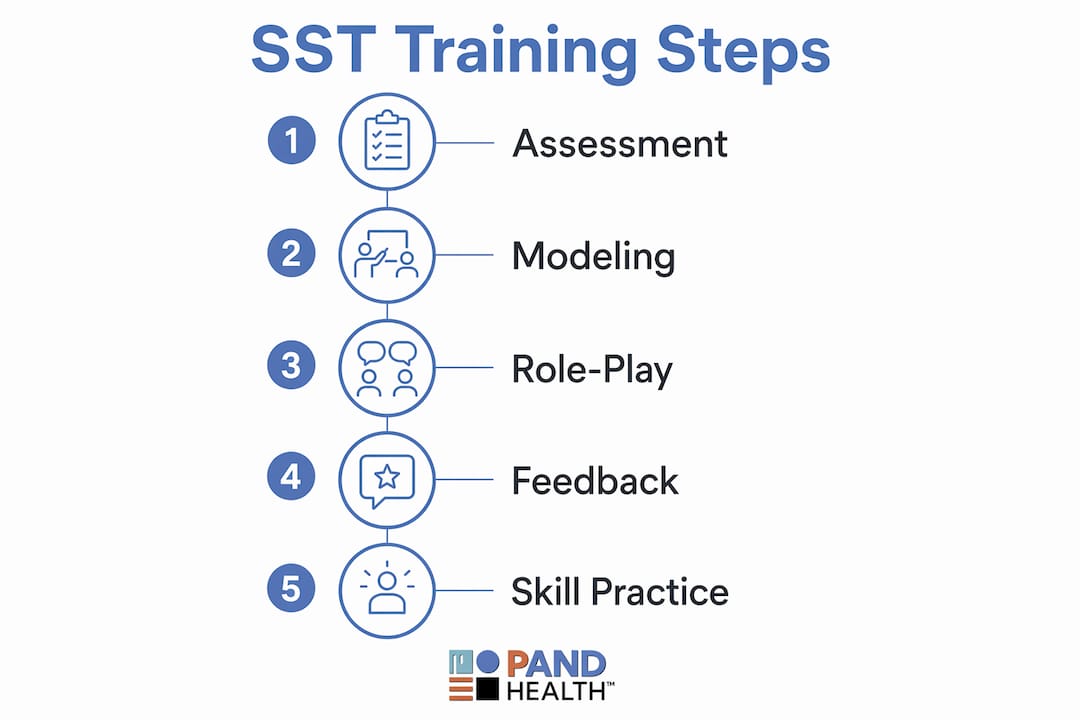
- Didactic instruction: A therapist explains a specific social skill, such as maintaining eye contact or starting a conversation, using clear, concrete language.
- Modeling: The therapist or a group member demonstrates the skill so participants can observe it in action before attempting it themselves.
- Behavioral rehearsal: Participants practice the skill through structured role-play scenarios that mirror real-life situations.
- Corrective feedback: After each rehearsal, the therapist provides specific, constructive feedback to reinforce what worked and adjust what did not.
- Homework assignments: Participants practice skills between sessions in real-world settings, which accelerates learning and builds confidence outside the clinical environment.
Active modeling and feedback loops are more effective than passive social skills learning. This means simply reading about how to start a conversation produces far less change than practicing it with a trained therapist who gives you immediate, specific feedback.
Group formats add a layer of peer interaction that mirrors real social situations. Individual sessions allow for a more personalized focus on specific deficits or anxieties. Both formats are clinically valid, and the right choice depends on your goals and comfort level.

Pro Tip: Ask your therapist to record role-play exercises when possible. Watching yourself on video is one of the fastest ways to notice nonverbal habits you were not aware of, such as avoiding eye contact or speaking too quietly.
How does SST address mental health disorders like social anxiety and schizophrenia?
Social skills deficits in people with serious mental illness are not simply a matter of shyness or inexperience. They often stem from impairments in social cognition, emotional regulation, and executive function. These are neurological processes that affect how the brain reads social cues and plans responses in real time.
| Mental health condition | Core social challenge | SST approach |
|---|---|---|
| Social anxiety disorder | Fear of negative evaluation, avoidance | Exposure-based rehearsal, cognitive restructuring |
| Schizophrenia | Social perception deficits, flat affect | CBSST, executive function training |
| Schizoaffective disorder | Mood instability, social withdrawal | Blended CBSST and emotional regulation skills |
| Bipolar disorder with psychosis | Impulsivity, interpersonal conflict | Communication skills, conflict resolution practice |
Cognitive Behavioral Social Skills Training (CBSST) is the most evidence-backed protocol for complex mental health conditions. It integrates Cognitive Behavioral Therapy with SST to address both the thought patterns and the behavioral deficits that interfere with social functioning. CBSST protocols may require up to 36 sessions for sustainable change, which reflects how deeply rooted these challenges can be.
Executive function is often the hidden bottleneck. Planning, working memory, and cognitive flexibility are all required to apply social skills in real time. A person may know intellectually how to respond in a conversation but struggle to access that knowledge quickly enough when the moment arrives. Executive function training alongside CBSST improves outcomes in severe mental illness by directly targeting this gap.
SST also complements other treatments. When combined with CBT and exposure therapy, it increases communication comfort and reduces social anxiety symptoms more effectively than either approach alone. For patients on medication, SST addresses the functional deficits that medication alone does not resolve.
A critical nuance: effective SST does not impose neurotypical social standards on every participant. Neurodiversity-affirming programs focus on helping individuals communicate more effectively on their own terms, not on forcing conformity to a single social script.
Pro Tip: If you are managing a thought disorder, ask your treatment team whether your program includes executive function training alongside social skills work. The combination produces better real-world results than SST alone.
Where can you access social skills workshops and coaching in Los Angeles?
Los Angeles has a range of options for interpersonal skills coaching and communication skills classes, from university-affiliated clinics to community mental health centers and specialized treatment programs. Knowing what to look for helps you choose a program that will actually work.
-
University-affiliated clinics: The UCLA PEERS clinic offers evidence-based social skills programs specifically designed for adolescents and young adults. These programs use structured, manualized protocols with trained clinicians.
-
Specialized mental health treatment centers: Programs like those at Pandhealth integrate SST directly into coordinated specialty care for patients with psychotic spectrum disorders. This means social skills work is not an add-on. It is built into the treatment plan alongside psychiatry, cognitive remediation, and family support.
-
Community mental health centers: Los Angeles County’s Department of Mental Health funds community-based programs that include group social skills workshops for adults. These are often low-cost or sliding-scale.
-
Private therapists and coaches: Individual interpersonal skills coaching is available through licensed therapists specializing in CBT or social anxiety. Private sessions offer flexibility and personalized attention.
-
Online and hybrid programs: Several Los Angeles-based providers now offer hybrid formats, combining in-person group sessions with online practice modules. This is particularly useful for individuals whose social anxiety makes in-person attendance difficult at first.
When evaluating any program, check for three things: evidence-based methods (such as CBSST or behavioral rehearsal), qualified clinicians (licensed therapists or psychologists with SST training), and adequate session frequency. Group and individual SST protocols both show clinical efficacy, but programs with fewer than six sessions rarely produce lasting change.
For individuals with a diagnosed thought disorder, SST works best when it is embedded in a broader treatment plan. Pandhealth’s coordinated specialty care model integrates SST with psychiatry, medication management, and family psychoeducation, which is the standard of care for first-episode psychosis and related conditions.
Teens and young adults benefit from age-specific programs. The social demands of high school, college, and early employment are distinct, and programs designed for those contexts produce more relevant skill transfer. For more on CBT-based approaches for teens in California, evidence-based therapy models show strong outcomes for this age group.
What outcomes can you expect from adult social skills education?
Progress in SST is real, measurable, and often faster than people expect. A 2026 randomized controlled trial with 103 veterans showed that SST significantly increased comfort and positive anticipation during social interactions after just two months of intensive training. That is a meaningful result in a relatively short timeframe.
Common improvements participants report include:
- Increased communication confidence: Participants initiate conversations more readily and sustain them longer without significant anxiety.
- Better nonverbal communication: Eye contact, body posture, and facial expression become more natural and congruent with verbal messages.
- Reduced avoidance: People begin attending social events they previously avoided, which creates a positive feedback loop of real-world practice.
- Improved social perception: Participants become more accurate at reading others’ emotional states and intentions, which reduces misunderstandings.
- Greater self-esteem: As skills improve, self-perception shifts. Patients begin to see themselves as capable of meaningful social connection.
SST leads to significant improvements in personal and social functioning among individuals with paranoid schizophrenia, including verbal and nonverbal social behaviors. This is not a minor quality-of-life improvement. For people with serious mental illness, better social functioning is directly linked to reduced hospitalization and stronger community integration.
Progress is tracked through multiple methods. Role-play assessments and ecological momentary assessment tools measure both the quality and frequency of real-world social interactions over time. Self-report measures capture changes in confidence and comfort. Clinician-rated scales track observable behavioral changes across sessions.
Expect progress to require consistent effort. Most evidence-based programs run for 12–36 sessions, and skills consolidate through real-world practice between appointments. Setting specific, measurable goals at the start of treatment, such as initiating one new conversation per day, gives both you and your therapist a clear benchmark for success.
Pro Tip: Keep a brief social interaction log between sessions. Note what went well, what felt difficult, and what you would do differently. Sharing this with your therapist makes feedback sessions far more targeted and productive.
Key Takeaways
Social skills training is a structured, evidence-based intervention that produces measurable improvements in communication, confidence, and social functioning, particularly when integrated with cognitive-behavioral and executive function approaches.
| Point | Details |
|---|---|
| SST is structured and active | Programs use modeling, role-play, and corrective feedback, not passive instruction. |
| CBSST targets complex conditions | Up to 36 sessions of Cognitive Behavioral Social Skills Training produce sustainable change in psychotic disorders. |
| Executive function matters | Adding executive function training to SST improves real-world skill application in severe mental illness. |
| Progress is measurable | Role-play assessments and ecological momentary assessment tools track improvements in social comfort and interaction quality. |
| Integration amplifies results | SST embedded in a full treatment plan, including psychiatry and cognitive remediation, produces better outcomes than standalone workshops. |
Pandhealth’s social skills programs for Los Angeles residents
Pandhealth provides specialized mental health treatment for teens and young adults ages 13–35 in Los Angeles, with social skills training built directly into its coordinated specialty care model. This is not a standalone workshop. It is part of a multidisciplinary treatment pathway that includes psychiatry, cognitive remediation, family psychoeducation, and support for school and employment.
For individuals managing conditions such as schizoaffective disorder, early psychosis, or social anxiety, Pandhealth’s programs address both the neurological and behavioral dimensions of social functioning. The team uses evidence-based protocols, including CBSST, to set personalized goals and track real progress. Functional recovery is the expectation, not the exception. Contact Pandhealth to learn whether their programs are the right fit for your situation.
FAQ
What is social skills training used for?
SST is used to improve interpersonal communication, confidence, and social functioning in people with social anxiety, schizophrenia, schizoaffective disorder, and other mental health conditions. It uses behavioral rehearsal, modeling, and corrective feedback to build lasting skills.
How long does social skills training take to work?
A 2026 randomized controlled trial found significant improvements in social comfort after two months of intensive training. More complex conditions, such as schizophrenia, may require 12–36 sessions for sustainable change.
Is group or individual social skills training more effective?
Both formats are clinically effective. Group sessions provide peer interaction that mirrors real social situations, while individual sessions allow for personalized focus on specific deficits. The right format depends on your diagnosis, goals, and comfort level.
Do I need social skills training if I have social anxiety?
SST combined with CBT and exposure therapy reduces social anxiety symptoms more effectively than medication or therapy alone. If social situations consistently cause avoidance or distress, a structured SST program is a clinically supported option.
How is progress measured in social skills training?
Clinicians use role-play assessments, self-report measures, and ecological momentary assessment tools to track changes in social comfort, interaction frequency, and behavioral skills over the course of treatment.