Cognitive Remediation Therapy for Schizophrenia: 2026 Guide
By Pand Health

Cognitive remediation therapy for schizophrenia is an evidence-based behavioral treatment designed to improve the cognitive deficits that medication alone cannot fully address. 2026 clinical guidelines confirm CRT as a structured intervention targeting attention, working memory, processing speed, and executive function. These are the mental skills that shape whether someone can hold a job, maintain friendships, or manage daily tasks independently. CRT complements psychiatric medication and psychosocial supports, and research shows its benefits last months after treatment ends. Functional recovery should be the expectation, not the exception.
What is cognitive remediation therapy for schizophrenia?
Cognitive remediation therapy, also called CRT, is a behavioral intervention that trains specific thinking skills through repeated practice, strategy coaching, and therapist guidance. The formal clinical term is “cognitive remediation,” and it sits within the broader category of psychiatric rehabilitation. CRT does not treat hallucinations or delusions directly. Instead, it targets the cognitive deficits that interfere with daily functioning, which are present in most people with schizophrenia regardless of symptom severity.
The therapy works across several core domains. Attention training helps patients stay focused during conversations or tasks. Working memory exercises build the ability to hold and use information in real time. Processing speed drills improve how quickly the brain responds. Executive function tasks develop planning, problem-solving, and mental flexibility. Integrated Neurocognitive Therapy (INT) is one structured protocol that addresses all these domains within a group format, and it has shown strong results in clinical trials.

Cognitive improvements from CRT are durable, producing small to moderate gains in real-world functioning that persist well after the treatment course ends. That durability matters because it means the skills patients build transfer to life outside the clinic. CRT is not a short-term fix. It is a foundation for sustained functional improvement.
Which cognitive functions does CRT improve?
CRT targets the specific thinking skills that schizophrenia most commonly disrupts. The table below maps each cognitive domain to the functional outcomes patients and families typically notice in daily life.
| Cognitive domain | Real-world functional outcome |
|---|---|
| Attention and concentration | Staying on task at work or school |
| Working memory | Following multi-step instructions |
| Processing speed | Responding in conversations without long delays |
| Executive function | Planning meals, appointments, and finances |
| Social cognition | Reading facial expressions and managing conflict |
Social cognition is a particularly important target. Research on CIRCuiTS found measurable post-treatment gains in initiating conversations, maintaining discussions, and managing everyday communication tasks. These are the skills that determine whether someone can build and keep relationships, not just score well on a test.
CRT also produces indirect benefits on motivation and insight. Patients who experience cognitive gains often feel more capable and more willing to engage with other parts of their treatment plan. Meta-analyses confirm that CRT does not significantly reduce positive or negative symptoms, but the functional improvements it generates are real and meaningful. Better thinking leads to better living, even when symptoms remain present.
How to start cognitive remediation therapy: assessment and readiness
Starting CRT begins with a baseline cognitive assessment. Clinicians use tools like the Digit Symbol Substitution Test to measure processing speed and identify which cognitive domains need the most attention. Baseline processing speed is the strongest predictor of functional improvement from CRT, based on a 2026 multicenter study of 174 patients. Knowing where a patient starts allows the therapist to set realistic goals and choose the right program intensity.
Clinical stability is a prerequisite. Patients in acute psychotic crisis are not ideal candidates for outpatient CRT, though short-course CRT in inpatient settings has shown feasibility and superior engagement when integrated with a coordinated care team. For most patients in California, CRT begins after stabilization, either in an outpatient clinic, a community mental health center, or through a coordinated specialty care program like the California OnTrack model.
Setting personal functional goals is the next step. Goals should be specific: returning to college, getting a part-time job, or managing a weekly schedule independently. These goals guide which cognitive domains the therapist prioritizes. CRT delivered without clear functional targets tends to improve test scores without changing daily life.
CRT is delivered in several formats, each with distinct advantages.
- In-person, therapist-led sessions: Highest level of strategy coaching and personalization; best for patients who need strong therapeutic alliance to stay engaged.
- Computer-based programs: Structured drill exercises with adaptive difficulty; accessible and consistent, but require therapist oversight to generalize skills.
- Virtual reality (VR) platforms: Immersive environments that simulate real-world scenarios; a 2024 Danish RCT found VR-based CRT improved functional cognitive capacity with large effect sizes and was well tolerated.
- Hybrid or telehealth formats: Combine remote computer exercises with scheduled therapist check-ins; practical for patients in areas with limited in-person access.
Pro Tip: Ask your treatment team to administer the Digit Symbol Substitution Test before starting CRT. The score helps your clinician predict how much functional gain to expect and which program format fits your profile best.
Step-by-step process for engaging in CRT and maximizing benefits
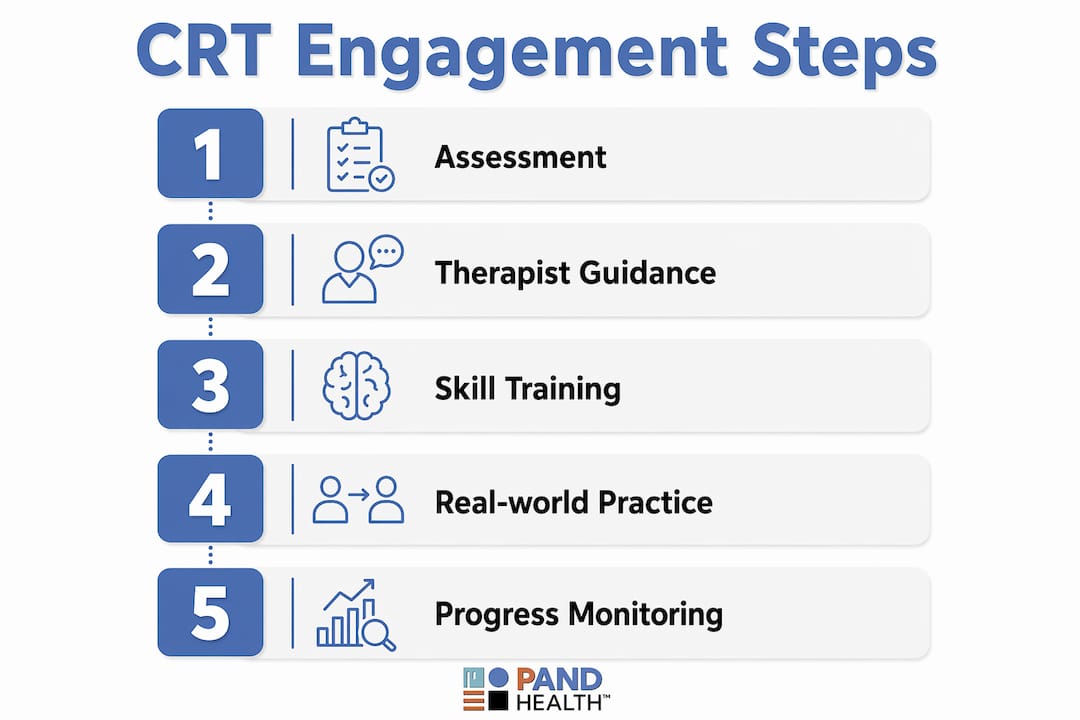
CRT follows a structured progression. Each step builds on the last, and skipping steps reduces how much the training transfers to real life.
- Complete a cognitive baseline assessment. Your clinician maps your current strengths and deficits across attention, memory, processing speed, and executive function. This profile shapes your entire program.
- Set two to three specific functional goals. Goals like “hold a part-time job” or “manage my own medication schedule” give every drill a real-world purpose.
- Begin drill-based exercises with therapist coaching. Sessions typically involve computerized or paper-based tasks that gradually increase in difficulty. The therapist observes, coaches strategy use, and adjusts difficulty to keep you in the productive learning zone.
- Practice errorless learning techniques. Errorless learning means tasks are structured so patients succeed from the start, building confidence and reinforcing correct patterns. Techniques like chunking (breaking information into small pieces) and rehearsal (repeating information aloud) are taught explicitly.
- Integrate CRT with psychosocial rehabilitation. CRT effectiveness is maximized when combined with vocational rehabilitation, social skills training, and supported employment. Cognitive gains without real-world practice do not stick.
- Use VR or engaging modalities to sustain motivation. VR environments simulate job interviews, grocery shopping, or public transit. These scenarios make practice feel relevant and keep engagement high over a full treatment course.
- Schedule regular therapist reviews. Every four to six weeks, your therapist reassesses your cognitive profile and adjusts the program. Progress that plateaus often means the difficulty level or the domain focus needs to change.
Human therapist guidance is the primary success factor in CRT. The therapist models how to apply cognitive strategies in real situations, reinforces learning through positive feedback, and helps patients recognize when they are using new skills outside of sessions.
Pro Tip: Keep a brief daily log of moments when you used a CRT strategy outside of sessions. Showing this log to your therapist at each visit helps them coach generalization more precisely and keeps you aware of real progress.
Common challenges in CRT and how to address them
CRT is effective, but it is not always easy to sustain. Motivation fluctuates, especially during periods of increased symptoms or life stress. The most common challenges patients and families face are predictable, and most have clear solutions.
- Engagement drops after the first few weeks. Novelty fades and drills can feel repetitive. Switching to a VR format or introducing new task types restores engagement without losing therapeutic continuity.
- Difficulty generalizing skills to daily life. Patients improve on drills but do not notice changes at home or work. This signals that therapist-led strategy coaching needs more emphasis. The therapist should explicitly practice applying skills in simulated real-world scenarios.
- Misconception that CRT is just computer games. Families sometimes underestimate the therapy’s depth. Research is clear that human guidance, strategy coaching, and errorless learning are the active ingredients. The computer is a tool, not the treatment.
- Difficulty adjusting task difficulty. Tasks that are too easy produce boredom; tasks that are too hard produce frustration and avoidance. A skilled therapist calibrates difficulty continuously based on performance data and patient feedback.
- Combining CRT with other treatments sustainably. Patients in coordinated specialty care programs attend multiple appointments each week. CRT sessions should be scheduled to avoid cognitive fatigue, ideally earlier in the day when mental energy is highest.
“Cognition in schizophrenia is plastic and responsive to targeted intervention. The brain can change with the right support, and that change translates into real improvements in how people live, work, and connect with others.”
Tailoring CRT to individual cognitive profiles is the most reliable way to maintain progress. Patients whose primary deficit is social cognition benefit most from protocols that emphasize emotion recognition and perspective-taking, not just processing speed drills.
What outcomes should you expect from CRT?
CRT produces cognitive and functional gains that are moderate in size but meaningful in daily life. Patients typically notice improvements in attention and working memory within the first six to eight weeks of consistent practice. Functional gains, such as returning to work or managing a schedule independently, often emerge over three to six months as cognitive skills generalize to real-world tasks.
| Outcome category | What patients typically notice |
|---|---|
| Cognitive performance | Faster thinking, better concentration, improved memory recall |
| Social functioning | More confident conversations, better conflict resolution |
| Vocational outcomes | Ability to hold part-time work or return to education |
| Daily living skills | Managing finances, medications, and appointments |
| Motivation and insight | Greater willingness to engage with treatment overall |
Studies find moderate effects on cognition and sustained improvements in work and social independence months after treatment ends. That durability is one of CRT’s strongest arguments over purely symptom-focused interventions. Symptom reduction remains the goal of medication; functional improvement is the primary goal of CRT. Both are necessary for a full recovery.
Therapists track progress using standardized assessments at regular intervals. Patients and families can also observe progress through changes in daily behavior: fewer missed appointments, more consistent self-care, and increased participation in social activities. These real-world markers are as meaningful as any test score.
Key Takeaways
Cognitive remediation therapy for schizophrenia produces durable improvements in attention, memory, executive function, and social cognition that translate directly into better daily functioning, work, and relationships.
| Point | Details |
|---|---|
| CRT targets cognitive deficits, not symptoms | It improves thinking skills that medication cannot fully address, enabling better daily functioning. |
| Baseline assessment shapes the program | The Digit Symbol Substitution Test predicts functional gains and guides which domains to prioritize. |
| Therapist coaching is the active ingredient | Human guidance, errorless learning, and strategy coaching transfer skills to real life. |
| Combine CRT with psychosocial rehabilitation | Vocational and social supports maximize how much cognitive gains change everyday outcomes. |
| Benefits last beyond the treatment course | Studies confirm sustained improvements in work and social independence months after CRT ends. |
Cognitive remediation at Pandhealth in Los Angeles
Pandhealth is a specialized mental health treatment center in Los Angeles serving teens and young adults ages 13–35 with schizophrenia, schizoaffective disorder, and related thought disorders. Cognitive remediation is integrated into every treatment pathway alongside psychiatry, medication management, individual therapy, family psychoeducation, and vocational support.

Pandhealth uses an augmented version of the California OnTrack coordinated specialty care model, which means cognitive remediation does not happen in isolation. It is coordinated with the full clinical team so that gains in the therapy room translate directly into progress at school, work, and home. Families are active partners in the process. If you are looking for schizophrenia treatment in Los Angeles that includes cognitive remediation as part of a structured, multidisciplinary program, Pandhealth offers a free consultation to help you understand your options and build a personalized care plan. For families navigating early psychosis treatment for the first time, that first conversation can clarify exactly where to start.
FAQ
What is cognitive remediation therapy for schizophrenia?
Cognitive remediation therapy for schizophrenia is a behavioral treatment that uses structured exercises and therapist coaching to improve attention, memory, processing speed, and executive function. It is evidence-based and designed to improve daily functioning rather than reduce psychotic symptoms directly.
How long does CRT take to show results?
Cognitive improvements typically appear within six to eight weeks of consistent practice. Functional gains, such as returning to work or managing daily tasks, often take three to six months to become noticeable in everyday life.
Does CRT reduce hallucinations or delusions?
CRT does not significantly reduce positive or negative symptoms of schizophrenia. Meta-analyses confirm its primary benefit is functional improvement, including better work performance, social skills, and daily living skills.
Can CRT be done online or at home?
Computer-based and telehealth CRT formats are available and effective, but therapist oversight remains necessary. Research shows that human guidance and strategy coaching are the key factors that transfer cognitive gains to real-world functioning.
Is CRT available for teens with schizophrenia in California?
Cognitive remediation is appropriate for adolescents and young adults and is offered within coordinated specialty care programs across California. Pandhealth provides cognitive remediation for teens ages 13 and older as part of its multidisciplinary schizophrenia treatment program in Los Angeles.